


Workshop: Paraphrasing and 
Avoiding Plagiarism 
Elena González Rivera, Ed.D. 
September 20, 2013 
BIOL 3095
Objectives 
• Define the terms 
– Paraphrasing 
– Direct Quoting 
– Summarizing 
• Discuss effective ways to summarize 
• Identify appropriate transitional words 
• Practice effective ways of paraphrasing 
• Define plagiarism and identify it 
• Discuss how to find your own voice and 
avoid plagiarism
Exercise # 1 
• In your own words and without consulting 
a dictionary, write your definition of 
– Paraphrasing 
– Summarizing 
– Direct quoting
I. Definitions 
Paraphrasing involves: 
• expressing the text in your own words. 
• producing a slightly shorter version of the 
original text. 
• crediting the author for their intellectual 
production. 
Source: 
http://owl.english.purdue.edu/owl/resource/563/1/ 
OWL University of Perdue Writing Lab
I. Definitions 
Summarizing involves: 
• placing only the author’s main idea(s) into your 
own words. 
• recognizing the author’s contribution by citing 
him/her. 
• making a significantly shorter version of the 
text. 
Source: 
http://owl.english.purdue.edu/owl/resource/563/1/ 
OWL University of Perdue Writing Lab
I. Definitions 
Direct quotations must: 
• be a carbon copy of the original text. 
• refer to a limited segment of the 
source. 
• give credit to the author. 
Source: 
http://owl.english.purdue.edu/owl/resource/563/1/ 
OWL University of Perdue Writing Lab
Exercise #2 
• Summarizing 
• Read handout #1 on Summarizing 
Facts about summarizing
II. Transitional Words 
Making logical transitions between ideas 
• Alternative—some examples of alternative transitional words are: either, or, 
nor, on the other hand, however, neither, and otherwise. They are used when you 
can alternate between two concepts or expressions. 
• Causal— include thus, then, unless, subsequently, therefore, because, 
consequently, as a result, if, in order to/that, for, and so. They can be used when 
referring to consequences or effects. 
• Illustrative—phrases such as for example, for instance, to illustrate, and as an 
example permit us to clarify an idea by connecting it to an example. 
• Repetitive, reiterative— expressions such as include in other words, in short, 
that is, stated simply, and to put it another way help add clarity through 
meaningful repetition 
• Spatial, physical—prepositions like the words under, beside, on top of, next to, 
behind, point to a physical/spatial relationship between things mentioned in 
two separate statements 
• There are also transitional words to denote time (“first”), purpose (“to this end”), 
summary (“without doubt”), and addition (“equally important”)
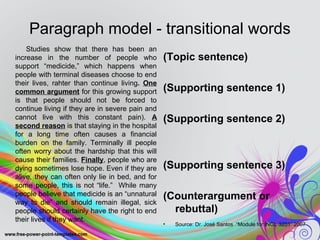
Paragraph model - transitional words 
Studies show that there has been an 
increase in the number of people who 
support “medicide,” which happens when 
people with terminal diseases choose to end 
their lives, rahter than continue living. One 
common argument for this growing support 
is that people should not be forced to 
continue living if they are in severe pain and 
cannot live with this constant pain). A 
second reason is that staying in the hospital 
for a long time often causes a financial 
burden on the family. Terminally ill people 
often worry about the hardship that this will 
cause their families. Finally, people who are 
dying sometimes lose hope. Even if they are 
alive, they can often only lie in bed, and for 
some people, this is not “life.” While many 
people believe that medicide is an “unnatural 
way to die” and should remain illegal, sick 
people should certainly have the right to end 
their lives if they want. 
(Topic sentence) 
(Supporting sentence 1) 
(Supporting sentence 2) 
(Supporting sentence 3) 
(Counterargument or 
rebuttal) 
• Source: Dr. José Santos “Module for INGL 3201” 2007
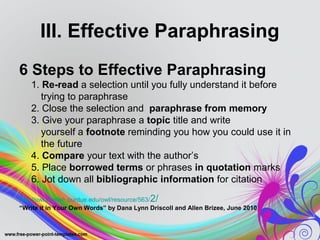
III. Effective Paraphrasing 
6 Steps to Effective Paraphrasing 
1. Re-read a selection until you fully understand it before 
trying to paraphrase 
2. Close the selection and paraphrase from memory 
3. Give your paraphrase a topic title and write 
yourself a footnote reminding you how you could use it in 
the future 
4. Compare your text with the author’s 
5. Place borrowed terms or phrases in quotation marks 
6. Jot down all bibliographic information for citation 
http://owl.english.purdue.edu/owl/resource/563/2/ 
“Write it in Your Own Words” by Dana Lynn Driscoll and Allen Brizee, June 2010
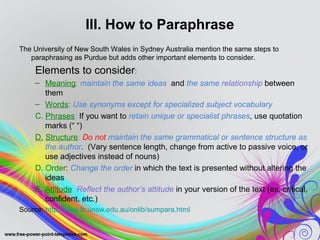
III. How to Paraphrase 
The University of New South Wales in Sydney Australia mention the same steps to 
paraphrasing as Purdue but adds other important elements to consider. 
Elements to consider: 
– Meaning: maintain the same ideas and the same relationship between 
them 
– Words: Use synonyms except for specialized subject vocabulary 
C. Phrases: If you want to retain unique or specialist phrases, use quotation 
marks (“ “) 
D. Structure: Do not maintain the same grammatical or sentence structure as 
the author. (Vary sentence length, change from active to passive voice, or 
use adjectives instead of nouns) 
D. Order: Change the order in which the text is presented without altering the 
ideas 
E. Attitude: Reflect the author’s attitude in your version of the text (ex. critical, 
confident, etc.) 
Source: http://www.lc.unsw.edu.au/onlib/sumpara.html
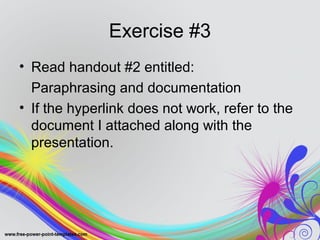
Exercise #3 
• Read handout #2 entitled: 
Paraphrasing and documentation 
• If the hyperlink does not work, refer to the 
document I attached along with the 
presentation.
Exercise #4 
• Now that you have read an example of a 
paraphrase, complete the following 
exercise by evaluating the quality of 3 
paraphrased versions of a test. Handout 
#3 contains the exercise. 
Compare paraphrases
Exercise #5 
• Now you will practice paraphrasing 5 
passages by completing handout #4 
Paraphrasing exercises
IV. AVOID PLAGIARISM: 
USE YOUR OWN WORDS
Define Plagiarism 
• Plagiarism is 
– taking another person’s ideas and pretending 
they are yours 
– a type of intellectual theft 
– the result of ignorance or deliberate intention 
• Plagiarism has serious consequences
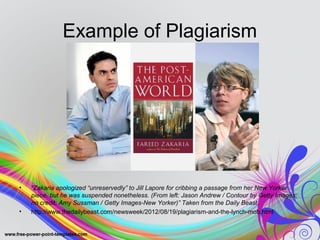
Example of Plagiarism 
• “Zakaria apologized “unreservedly” to Jill Lapore for cribbing a passage from her New Yorker 
piece, but he was suspended nonetheless. (From left: Jason Andrew / Contour by Getty Images; 
no credit; Amy Sussman / Getty Images-New Yorker)” Taken from the Daily Beast. 
• http://www.thedailybeast.com/newsweek/2012/08/19/plagiarism-and-the-lynch-mob.html
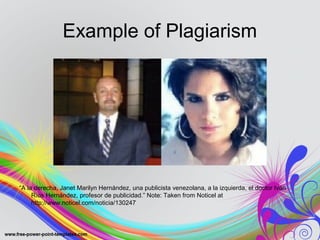
Example of Plagiarism 
“A la derecha, Janet Marilyn Hernández, una publicista venezolana, a la izquierda, el doctor Iván 
Ríos Hernández, profesor de publicidad.” Note: Taken from Noticel at 
http://www.noticel.com/noticia/130247
Clarification of Term 
• Take the plagiarism quiz 
http://www.lc.unsw.edu.au/plagiarism/plag 
quiz.html
How Does Plagiarism Happen? 
“Intellectual insecurity related to using your own 
words 
The Problem: It’s a Paradox 
• Contradictions about academic writing: 
You are expected to: 1. refer to experts, and 
2. produce 'original' work 
How can you do both? 
• Solution: 
– Develop arguments or views based on research. 
– Come to your own conclusions based on your research. 
• http://www.lc.unsw.edu.au/plagiarism/how_1.html
How Does Plagiarism Happen? 
The Solution 
• Find your voice and incorporate it into your own writing. 
• In assignments synthesize answers from the opinions of others. 
• Be like a DJ - draw information from many sources and show it in a 
new light –YOUR LIGHT, YOUR PERSPECTIVE 
• Finding your own voice = producing something of your own from the 
ideas/research of others 
• http://www.lc.unsw.edu.au/plagiarism/how_1.html
Four Steps to Finding Your Own Voice 
• Overt 
• Original Research 
• Organization 
• Integration
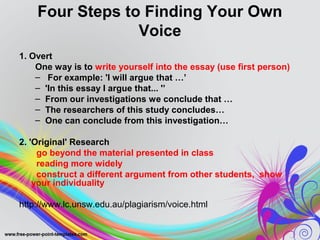
Four Steps to Finding Your Own 
Voice 
1. Overt 
One way is to write yourself into the essay (use first person) 
– For example: 'I will argue that …’ 
– 'In this essay I argue that... '’ 
– From our investigations we conclude that … 
– The researchers of this study concludes… 
– One can conclude from this investigation… 
2. 'Original' Research 
go beyond the material presented in class 
reading more widely 
construct a different argument from other students, show 
your individuality 
http://www.lc.unsw.edu.au/plagiarism/voice.html
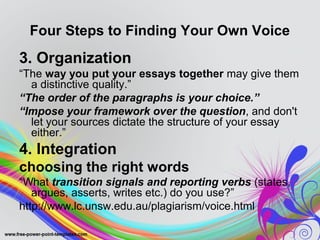
Four Steps to Finding Your Own Voice 
3. Organization 
“The way you put your essays together may give them 
a distinctive quality.” 
“The order of the paragraphs is your choice.” 
“Impose your framework over the question, and don't 
let your sources dictate the structure of your essay 
either.” 
4. Integration 
choosing the right words 
“What transition signals and reporting verbs (states, 
argues, asserts, writes etc.) do you use?” 
http://www.lc.unsw.edu.au/plagiarism/voice.html
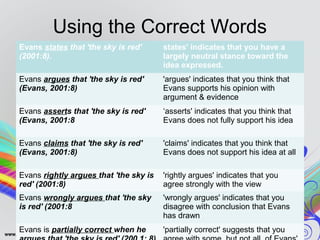
Using the Correct Words 
Evans states that 'the sky is red' 
(2001:8). 
states' indicates that you have a 
largely neutral stance toward the 
idea expressed. 
Evans argues that 'the sky is red' 
(Evans, 2001:8) 
'argues' indicates that you think that 
Evans supports his opinion with 
argument & evidence 
Evans asserts that 'the sky is red' 
(Evans, 2001:8 
‘asserts' indicates that you think that 
Evans does not fully support his idea 
Evans claims that 'the sky is red' 
(Evans, 2001:8) 
'claims' indicates that you think that 
Evans does not support his idea at all 
Evans rightly argues that 'the sky is 
red' (2001:8) 
'rightly argues' indicates that you 
agree strongly with the view 
Evans wrongly argues that 'the sky 
is red' (2001:8 
'wrongly argues' indicates that you 
disagree with conclusion that Evans 
has drawn 
Evans is partially correct when he 
argues that 'the sky is red' (200 1: 8) 
'partially correct' suggests that you 
agree with some, but not all, of Evans'
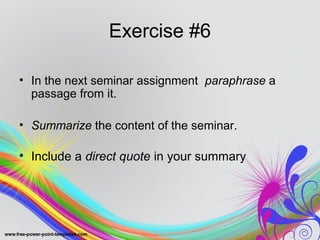
Exercise #6 
• In the next seminar assignment paraphrase a 
passage from it. 
• Summarize the content of the seminar. 
• Include a direct quote in your summary
Paraphrasing and avoiding plagiarism workshop  sept 2014

Paraphrasing and avoiding plagiarism workshop sept 2014

  • 1.
    Workshop: Paraphrasing and Avoiding Plagiarism Elena González Rivera, Ed.D. September 20, 2013 BIOL 3095
  • 2.
    Objectives • Definethe terms – Paraphrasing – Direct Quoting – Summarizing • Discuss effective ways to summarize • Identify appropriate transitional words • Practice effective ways of paraphrasing • Define plagiarism and identify it • Discuss how to find your own voice and avoid plagiarism
  • 3.
    Exercise # 1 • In your own words and without consulting a dictionary, write your definition of – Paraphrasing – Summarizing – Direct quoting
  • 4.
    I. Definitions Paraphrasinginvolves: • expressing the text in your own words. • producing a slightly shorter version of the original text. • crediting the author for their intellectual production. Source: http://owl.english.purdue.edu/owl/resource/563/1/ OWL University of Perdue Writing Lab
  • 5.
    I. Definitions Summarizinginvolves: • placing only the author’s main idea(s) into your own words. • recognizing the author’s contribution by citing him/her. • making a significantly shorter version of the text. Source: http://owl.english.purdue.edu/owl/resource/563/1/ OWL University of Perdue Writing Lab
  • 6.
    I. Definitions Directquotations must: • be a carbon copy of the original text. • refer to a limited segment of the source. • give credit to the author. Source: http://owl.english.purdue.edu/owl/resource/563/1/ OWL University of Perdue Writing Lab
  • 7.
    Exercise #2 •Summarizing • Read handout #1 on Summarizing Facts about summarizing
  • 8.
    II. Transitional Words Making logical transitions between ideas • Alternative—some examples of alternative transitional words are: either, or, nor, on the other hand, however, neither, and otherwise. They are used when you can alternate between two concepts or expressions. • Causal— include thus, then, unless, subsequently, therefore, because, consequently, as a result, if, in order to/that, for, and so. They can be used when referring to consequences or effects. • Illustrative—phrases such as for example, for instance, to illustrate, and as an example permit us to clarify an idea by connecting it to an example. • Repetitive, reiterative— expressions such as include in other words, in short, that is, stated simply, and to put it another way help add clarity through meaningful repetition • Spatial, physical—prepositions like the words under, beside, on top of, next to, behind, point to a physical/spatial relationship between things mentioned in two separate statements • There are also transitional words to denote time (“first”), purpose (“to this end”), summary (“without doubt”), and addition (“equally important”)
  • 9.
    Paragraph model -transitional words Studies show that there has been an increase in the number of people who support “medicide,” which happens when people with terminal diseases choose to end their lives, rahter than continue living. One common argument for this growing support is that people should not be forced to continue living if they are in severe pain and cannot live with this constant pain). A second reason is that staying in the hospital for a long time often causes a financial burden on the family. Terminally ill people often worry about the hardship that this will cause their families. Finally, people who are dying sometimes lose hope. Even if they are alive, they can often only lie in bed, and for some people, this is not “life.” While many people believe that medicide is an “unnatural way to die” and should remain illegal, sick people should certainly have the right to end their lives if they want. (Topic sentence) (Supporting sentence 1) (Supporting sentence 2) (Supporting sentence 3) (Counterargument or rebuttal) • Source: Dr. José Santos “Module for INGL 3201” 2007
  • 10.
    III. Effective Paraphrasing 6 Steps to Effective Paraphrasing 1. Re-read a selection until you fully understand it before trying to paraphrase 2. Close the selection and paraphrase from memory 3. Give your paraphrase a topic title and write yourself a footnote reminding you how you could use it in the future 4. Compare your text with the author’s 5. Place borrowed terms or phrases in quotation marks 6. Jot down all bibliographic information for citation http://owl.english.purdue.edu/owl/resource/563/2/ “Write it in Your Own Words” by Dana Lynn Driscoll and Allen Brizee, June 2010
  • 11.
    III. How toParaphrase The University of New South Wales in Sydney Australia mention the same steps to paraphrasing as Purdue but adds other important elements to consider. Elements to consider: – Meaning: maintain the same ideas and the same relationship between them – Words: Use synonyms except for specialized subject vocabulary C. Phrases: If you want to retain unique or specialist phrases, use quotation marks (“ “) D. Structure: Do not maintain the same grammatical or sentence structure as the author. (Vary sentence length, change from active to passive voice, or use adjectives instead of nouns) D. Order: Change the order in which the text is presented without altering the ideas E. Attitude: Reflect the author’s attitude in your version of the text (ex. critical, confident, etc.) Source: http://www.lc.unsw.edu.au/onlib/sumpara.html
  • 12.
    Exercise #3 •Read handout #2 entitled: Paraphrasing and documentation • If the hyperlink does not work, refer to the document I attached along with the presentation.
  • 13.
    Exercise #4 •Now that you have read an example of a paraphrase, complete the following exercise by evaluating the quality of 3 paraphrased versions of a test. Handout #3 contains the exercise. Compare paraphrases
  • 14.
    Exercise #5 •Now you will practice paraphrasing 5 passages by completing handout #4 Paraphrasing exercises
  • 15.
    IV. AVOID PLAGIARISM: USE YOUR OWN WORDS
  • 16.
    Define Plagiarism •Plagiarism is – taking another person’s ideas and pretending they are yours – a type of intellectual theft – the result of ignorance or deliberate intention • Plagiarism has serious consequences
  • 17.
    Example of Plagiarism • “Zakaria apologized “unreservedly” to Jill Lapore for cribbing a passage from her New Yorker piece, but he was suspended nonetheless. (From left: Jason Andrew / Contour by Getty Images; no credit; Amy Sussman / Getty Images-New Yorker)” Taken from the Daily Beast. • http://www.thedailybeast.com/newsweek/2012/08/19/plagiarism-and-the-lynch-mob.html
  • 18.
    Example of Plagiarism “A la derecha, Janet Marilyn Hernández, una publicista venezolana, a la izquierda, el doctor Iván Ríos Hernández, profesor de publicidad.” Note: Taken from Noticel at http://www.noticel.com/noticia/130247
  • 19.
    Clarification of Term • Take the plagiarism quiz http://www.lc.unsw.edu.au/plagiarism/plag quiz.html
  • 20.
    How Does PlagiarismHappen? “Intellectual insecurity related to using your own words The Problem: It’s a Paradox • Contradictions about academic writing: You are expected to: 1. refer to experts, and 2. produce 'original' work How can you do both? • Solution: – Develop arguments or views based on research. – Come to your own conclusions based on your research. • http://www.lc.unsw.edu.au/plagiarism/how_1.html
  • 21.
    How Does PlagiarismHappen? The Solution • Find your voice and incorporate it into your own writing. • In assignments synthesize answers from the opinions of others. • Be like a DJ - draw information from many sources and show it in a new light –YOUR LIGHT, YOUR PERSPECTIVE • Finding your own voice = producing something of your own from the ideas/research of others • http://www.lc.unsw.edu.au/plagiarism/how_1.html
  • 22.
    Four Steps toFinding Your Own Voice • Overt • Original Research • Organization • Integration
  • 23.
    Four Steps toFinding Your Own Voice 1. Overt One way is to write yourself into the essay (use first person) – For example: 'I will argue that …’ – 'In this essay I argue that... '’ – From our investigations we conclude that … – The researchers of this study concludes… – One can conclude from this investigation… 2. 'Original' Research go beyond the material presented in class reading more widely construct a different argument from other students, show your individuality http://www.lc.unsw.edu.au/plagiarism/voice.html
  • 24.
    Four Steps toFinding Your Own Voice 3. Organization “The way you put your essays together may give them a distinctive quality.” “The order of the paragraphs is your choice.” “Impose your framework over the question, and don't let your sources dictate the structure of your essay either.” 4. Integration choosing the right words “What transition signals and reporting verbs (states, argues, asserts, writes etc.) do you use?” http://www.lc.unsw.edu.au/plagiarism/voice.html
  • 25.
    Using the CorrectWords Evans states that 'the sky is red' (2001:8). states' indicates that you have a largely neutral stance toward the idea expressed. Evans argues that 'the sky is red' (Evans, 2001:8) 'argues' indicates that you think that Evans supports his opinion with argument & evidence Evans asserts that 'the sky is red' (Evans, 2001:8 ‘asserts' indicates that you think that Evans does not fully support his idea Evans claims that 'the sky is red' (Evans, 2001:8) 'claims' indicates that you think that Evans does not support his idea at all Evans rightly argues that 'the sky is red' (2001:8) 'rightly argues' indicates that you agree strongly with the view Evans wrongly argues that 'the sky is red' (2001:8 'wrongly argues' indicates that you disagree with conclusion that Evans has drawn Evans is partially correct when he argues that 'the sky is red' (200 1: 8) 'partially correct' suggests that you agree with some, but not all, of Evans'
  • 26.
    Exercise #6 •In the next seminar assignment paraphrase a passage from it. • Summarize the content of the seminar. • Include a direct quote in your summary