Harvard Referencing
                               System
                                    Mr Patrice Seuwou
                                  School of Technology


Copyright © Patrice Seuwou 2013
Session objectives


Copyright © Patrice Seuwou 2013
What is plagiarism?
       • Use of any source of information
         (including electronic) without proper
         acknowledgement.
       • Quoting, summarising or paraphrasing,
         copying and pasting without citing source.
       • Citing sources you didn’t use.
       • Unauthorised collaboration.


Copyright © Patrice Seuwou 2013
Why do students plagiarise?
       •      Poor study skills
       •      Inability to find information
       •      Poor citation skills
       •      Lack of understanding of what constitutes
              plagiarism


Copyright © Patrice Seuwou 2013
Writing a dissertation, thesis,
                               article, essay
       To support your arguments and provide ideas:

       • Read widely and analyse the work of
         others.
       • Use as many sources as you can (books,
         journals, newspapers, reports, web etc.)
       • Read at an appropriate academic level.
       • Use good quality sources.

Copyright © Patrice Seuwou 2013
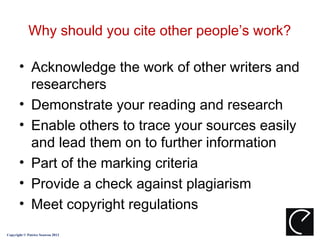
Why should you cite other people’s work?

       • Acknowledge the work of other writers and
         researchers
       • Demonstrate your reading and research
       • Enable others to trace your sources easily
         and lead them on to further information
       • Part of the marking criteria
       • Provide a check against plagiarism
       • Meet copyright regulations
Copyright © Patrice Seuwou 2013
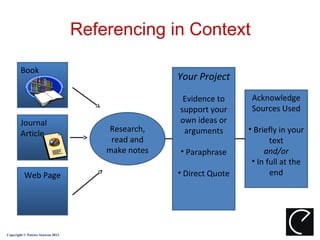
Referencing in Context

        Book
                                                   Your Project

                                                    Evidence to      Acknowledge
                                                   support your      Sources Used
        Journal                                    own ideas or
                                      Research,     arguments       • Briefly in your
        Article
                                       read and                            text
                                      make notes   • Paraphrase          and/or
                                                                     • In full at the
          Web Page                                 • Direct Quote          end


Copyright © Patrice Seuwou 2013
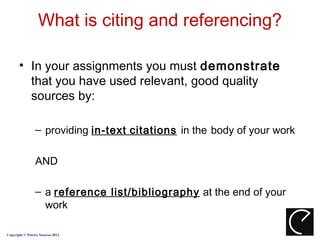
What is citing and referencing?

       • In your assignments you must demonstrate
         that you have used relevant, good quality
         sources by:

                – providing in-text citations in the body of your work

                AND

                – a reference list/bibliography at the end of your
                  work

Copyright © Patrice Seuwou 2013
What’s an in-text citation?

              In-text citations appear in the body of the text of
              your assignment and should be included
              whenever you quote, summarise or otherwise
              refer to someone else’s ideas.


Copyright © Patrice Seuwou 2013
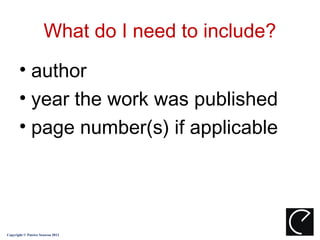
What do I need to include?
       • author
       • year the work was published
       • page number(s) if applicable


Copyright © Patrice Seuwou 2013
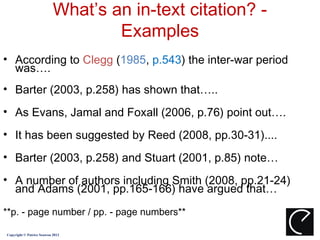
What’s an in-text citation? -
                                   Examples
• According to Clegg (1985, p.543) the inter-war period
  was….
• Barter (2003, p.258) has shown that…..
• As Evans, Jamal and Foxall (2006, p.76) point out….
• It has been suggested by Reed (2008, pp.30-31)....
• Barter (2003, p.258) and Stuart (2001, p.85) note…
• A number of authors including Smith (2008, pp.21-24)
  and Adams (2001, pp.165-166) have argued that…
**p. - page number / pp. - page numbers**

Copyright © Patrice Seuwou 2013
What’s a reference list?
    • A list of all the sources you have cited in the text of your
      assignment

    • Presented at the end of your work in alphabetical
      order by author/ editor

    • Do not list books, journals, newspapers, then websites etc.


    Note: a bibliography lists all of the sources you have read to help write
    your assignment, not just those cited in the text.

    Bibliography and/ or reference list? Ask your tutor!


Copyright © Patrice Seuwou 2013
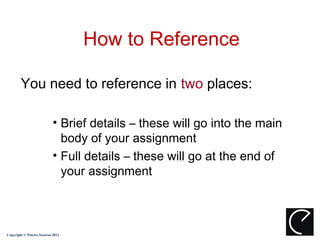
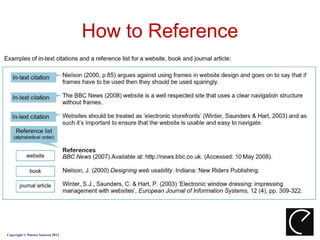
How to Reference

        You need to reference in two places:

                           • Brief details – these will go into the main
                             body of your assignment
                           • Full details – these will go at the end of
                             your assignment


Copyright © Patrice Seuwou 2013
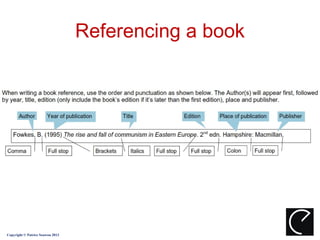
Referencing a book


Copyright © Patrice Seuwou 2013
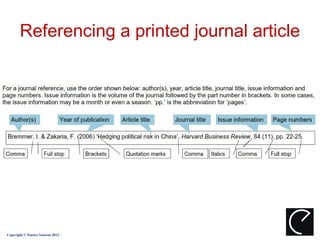
Referencing a printed journal article


Copyright © Patrice Seuwou 2013
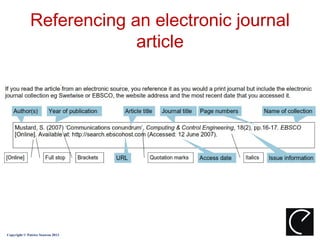
Referencing an electronic journal
                          article


Copyright © Patrice Seuwou 2013
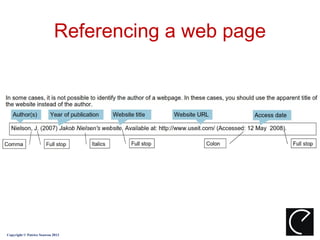
Referencing a web page


Copyright © Patrice Seuwou 2013
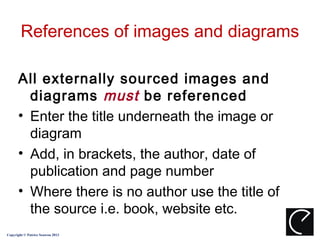
References of images and diagrams

      All externally sourced images and
        diagrams must be referenced
      • Enter the title underneath the image or
        diagram
      • Add, in brackets, the author, date of
        publication and page number
      • Where there is no author use the title of
        the source i.e. book, website etc.
Copyright © Patrice Seuwou 2013
References of images and diagrams

     Example 1 (Book/Publication):


                    Figure 1: Risk assessment guidelines for lifting and lowering
                        (Essentials of Health and Safety at Work 2008, 48)

Copyright © Patrice Seuwou 2013
References of images and diagrams
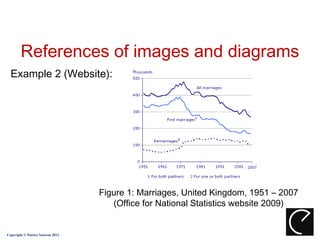
  Example 2 (Website):


                                  Figure 1: Marriages, United Kingdom, 1951 – 2007
                                     (Office for National Statistics website 2009)


Copyright © Patrice Seuwou 2013
How to Reference


Copyright © Patrice Seuwou 2013
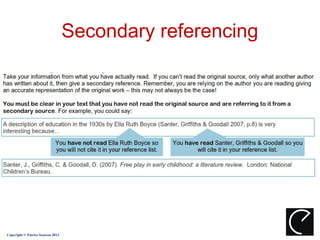
Secondary referencing


Copyright © Patrice Seuwou 2013
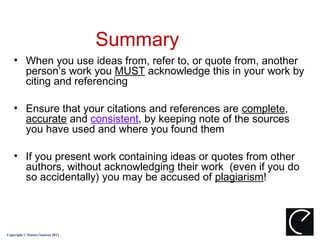
Summary
    • When you use ideas from, refer to, or quote from, another
      person’s work you MUST acknowledge this in your work by
      citing and referencing

    • Ensure that your citations and references are complete,
      accurate and consistent, by keeping note of the sources
      you have used and where you found them

    • If you present work containing ideas or quotes from other
      authors, without acknowledging their work (even if you do
      so accidentally) you may be accused of plagiarism!


Copyright © Patrice Seuwou 2013

Harvard referencing system

  • 1.
    Harvard Referencing System Mr Patrice Seuwou School of Technology Copyright © Patrice Seuwou 2013
  • 2.
  • 3.
    What is plagiarism? • Use of any source of information (including electronic) without proper acknowledgement. • Quoting, summarising or paraphrasing, copying and pasting without citing source. • Citing sources you didn’t use. • Unauthorised collaboration. Copyright © Patrice Seuwou 2013
  • 4.
    Why do studentsplagiarise? • Poor study skills • Inability to find information • Poor citation skills • Lack of understanding of what constitutes plagiarism Copyright © Patrice Seuwou 2013
  • 5.
    Writing a dissertation,thesis, article, essay To support your arguments and provide ideas: • Read widely and analyse the work of others. • Use as many sources as you can (books, journals, newspapers, reports, web etc.) • Read at an appropriate academic level. • Use good quality sources. Copyright © Patrice Seuwou 2013
  • 6.
    Why should youcite other people’s work? • Acknowledge the work of other writers and researchers • Demonstrate your reading and research • Enable others to trace your sources easily and lead them on to further information • Part of the marking criteria • Provide a check against plagiarism • Meet copyright regulations Copyright © Patrice Seuwou 2013
  • 7.
    Referencing in Context Book Your Project Evidence to Acknowledge support your Sources Used Journal own ideas or Research, arguments • Briefly in your Article read and text make notes • Paraphrase and/or • In full at the Web Page • Direct Quote end Copyright © Patrice Seuwou 2013
  • 8.
    What is citingand referencing? • In your assignments you must demonstrate that you have used relevant, good quality sources by: – providing in-text citations in the body of your work AND – a reference list/bibliography at the end of your work Copyright © Patrice Seuwou 2013
  • 9.
    What’s an in-textcitation? In-text citations appear in the body of the text of your assignment and should be included whenever you quote, summarise or otherwise refer to someone else’s ideas. Copyright © Patrice Seuwou 2013
  • 10.
    What do Ineed to include? • author • year the work was published • page number(s) if applicable Copyright © Patrice Seuwou 2013
  • 11.
    What’s an in-textcitation? - Examples • According to Clegg (1985, p.543) the inter-war period was…. • Barter (2003, p.258) has shown that….. • As Evans, Jamal and Foxall (2006, p.76) point out…. • It has been suggested by Reed (2008, pp.30-31).... • Barter (2003, p.258) and Stuart (2001, p.85) note… • A number of authors including Smith (2008, pp.21-24) and Adams (2001, pp.165-166) have argued that… **p. - page number / pp. - page numbers** Copyright © Patrice Seuwou 2013
  • 12.
    What’s a referencelist? • A list of all the sources you have cited in the text of your assignment • Presented at the end of your work in alphabetical order by author/ editor • Do not list books, journals, newspapers, then websites etc. Note: a bibliography lists all of the sources you have read to help write your assignment, not just those cited in the text. Bibliography and/ or reference list? Ask your tutor! Copyright © Patrice Seuwou 2013
  • 13.
    How to Reference You need to reference in two places: • Brief details – these will go into the main body of your assignment • Full details – these will go at the end of your assignment Copyright © Patrice Seuwou 2013
  • 14.
    Referencing a book Copyright© Patrice Seuwou 2013
  • 15.
    Referencing a printedjournal article Copyright © Patrice Seuwou 2013
  • 16.
    Referencing an electronicjournal article Copyright © Patrice Seuwou 2013
  • 17.
    Referencing a webpage Copyright © Patrice Seuwou 2013
  • 18.
    References of imagesand diagrams All externally sourced images and diagrams must be referenced • Enter the title underneath the image or diagram • Add, in brackets, the author, date of publication and page number • Where there is no author use the title of the source i.e. book, website etc. Copyright © Patrice Seuwou 2013
  • 19.
    References of imagesand diagrams Example 1 (Book/Publication): Figure 1: Risk assessment guidelines for lifting and lowering (Essentials of Health and Safety at Work 2008, 48) Copyright © Patrice Seuwou 2013
  • 20.
    References of imagesand diagrams Example 2 (Website): Figure 1: Marriages, United Kingdom, 1951 – 2007 (Office for National Statistics website 2009) Copyright © Patrice Seuwou 2013
  • 21.
    How to Reference Copyright© Patrice Seuwou 2013
  • 22.
  • 23.
    Summary • When you use ideas from, refer to, or quote from, another person’s work you MUST acknowledge this in your work by citing and referencing • Ensure that your citations and references are complete, accurate and consistent, by keeping note of the sources you have used and where you found them • If you present work containing ideas or quotes from other authors, without acknowledging their work (even if you do so accidentally) you may be accused of plagiarism! Copyright © Patrice Seuwou 2013

Editor's Notes

  • #7 This is what your lecturers want. And this is why you need references – to demonstrate that you have done this. A plagiarised report where the material seems to be coming only from you does not fulfil the criteria needed to pass your courses. So plagarism even deliberate or unintentional will only hold you back.