Tuesday, March 13, 2012

           English 9
        Research Unit
  Navejar, Dammanna, Huth
Sponge Activity

Make a list of items we learned
 yesterday.

 **Review your notes for a quiz. **
Learning Objectives-Common Core
• W.9-10.7. Conduct short as well as more sustained research projects to
  answer a question (including a self-generated question) or solve a
  problem; narrow or broaden the inquiry when appropriate; synthesize
  multiple sources on the subject, demonstrating understanding of the
  subject under investigation.
• W.9-10.8. Gather relevant information from multiple authoritative print
  and digital sources, using advanced searches effectively; assess the
  usefulness of each source in answering the research question; integrate
  information into the text selectively to maintain the flow of ideas, avoiding
  plagiarism and following a standard format for citation.
• W.9-10.9. Draw evidence from literary or informational texts to support
  analysis, reflection, and research.
    – Apply grades 9–10 Reading standards to literary nonfiction (e.g., “Delineate
      and evaluate the argument and specific claims in a text, assessing whether the
      reasoning is valid and the evidence is relevant and sufficient; identify false
      statements and fallacious reasoning”).
Research Writing
• You will write a research paper on the dangers
  of co-sleeping
• We have pulled the research for you
• You will review the research and learn the
  following (see next slide)
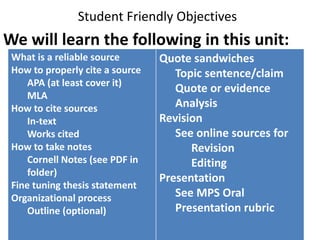
Student Friendly Objectives
We will learn the following in this unit:
 What is a reliable source       Quote sandwiches
 How to properly cite a source      Topic sentence/claim
     APA (at least cover it)
                                    Quote or evidence
     MLA
 How to cite sources                Analysis
     In-text                     Revision
     Works cited                    See online sources for
 How to take notes                     Revision
     Cornell Notes (see PDF in         Editing
     folder)
                                 Presentation
 Fine tuning thesis statement
 Organizational process             See MPS Oral
     Outline (optional)             Presentation rubric
Research Writing
A research report presents information from many different sources and
   indicates where the information comes from. Here are step-by-step
   directions to help you create a research report

1. Prewriting
Select a topic that fits the assignment, research the topic,
  and organize the information you gather. We are here**
  Monday, March 12th
2. Writing
Introduce the topic clearly, provide information in a logical order, cite sources,
    and reflect on what the information means.
3. Revising
Improve your work by making sure you have included the most important
    information in the best order.
4. Editing
Check your facts for accuracy, check your writing for correctness, and make sure
    you have used the correct formats for citations and bibliographies.
Terms or Devices you should know
                         Write down the following list in your notes.
        Leave a space in-between each term so you can fill in your notes on the term.
                  You will check mark the words you learn along the way.
•   Summarize
•   Paraphrase
•   Quoting
•   In-text citation
•   Work cited page
•   Plagiarism
•   Fact vs. opinion
•   Evidence
•   Credibility of sources
•   Essay structure
      – Introduction
      – Body
      – Conclusion
•   Thesis statement
•   Revision
•   Editing
•   Transition
Read the following text,
  Co-sleeping and sudden infant death syndrome
• Postulated- to claim or assume the existence or truth of,
  especially as a basis for reasoning or arguing.
• Mechanism- the agency or means by which an effect is
  produced or a purpose is accomplished.
• Hypoxia- inadequate oxygenation of the blood.
• Obstruction- something that obstructs, blocks, or closes
  up with an obstacle or obstacles; obstacle or hindrance
• Thermal- Also, thermic. of, pertaining to, or caused by
  heat or temperature:
• Prone- having the front or ventral part downward; lying
  face downward.
• Supine- lying on the back, face or front upward.
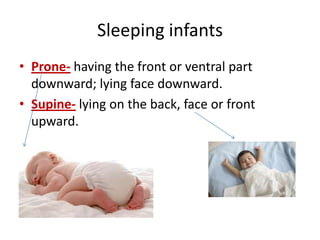
Sleeping infants
• Prone- having the front or ventral part
  downward; lying face downward.
• Supine- lying on the back, face or front
  upward.
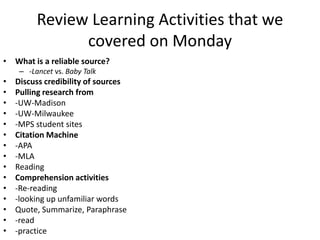
Review Learning Activities that we
                covered on Monday
• What is a reliable source?
     – -Lancet vs. Baby Talk
•   Discuss credibility of sources
•   Pulling research from
•   -UW-Madison
•   -UW-Milwaukee
•   -MPS student sites
•   Citation Machine
•   -APA
•   -MLA
•   Reading
•   Comprehension activities
•   -Re-reading
•   -looking up unfamiliar words
•   Quote, Summarize, Paraphrase
•   -read
•   -practice
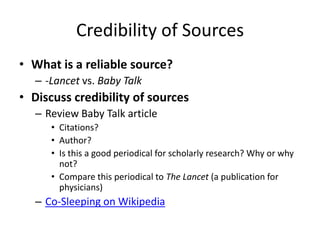
Credibility of Sources
• What is a reliable source?
   – -Lancet vs. Baby Talk
• Discuss credibility of sources
   – Review Baby Talk article
      • Citations?
      • Author?
      • Is this a good periodical for scholarly research? Why or why
        not?
      • Compare this periodical to The Lancet (a publication for
        physicians)
   – Co-Sleeping on Wikipedia
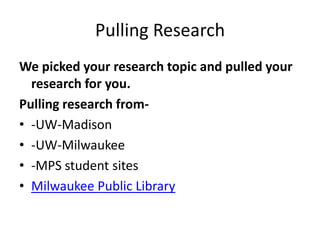
Pulling Research
We picked your research topic and pulled your
  research for you.
Pulling research from-
• -UW-Madison
• -UW-Milwaukee
• -MPS student sites
• Milwaukee Public Library
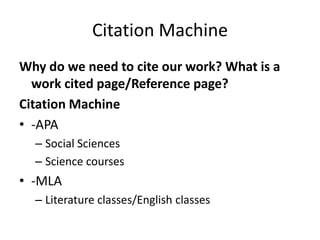
Citation Machine
Why do we need to cite our work? What is a
  work cited page/Reference page?
Citation Machine
• -APA
  – Social Sciences
  – Science courses
• -MLA
  – Literature classes/English classes
Plagiarism
• What is plagiarism?
Co-Sleeping and sudden infant death
              syndrome
• Pass out Lancet article
• Review vocabulary from the 1st paragraph
• Review first paragraph
  – Check for understanding
• Pass out second handout
  – Notice how the first sentence in the box is the first
    sentence in the second paragraph
  – Practice quoting, paraphrasing and summarizing
Co-Sleeping and sudden infant death
              syndrome
• Research Unit, Quoting, paraphrasing, and
  summarizing
• Second page of handout will cover the second
  and third paragraph
  – REVIEW- unfamiliar words
  – Practice quoting, paraphrasing and summarizing
Quoting, Paraphrasing, and
      Summarizing
        WHAT IS THE DIFFERENCE
      BETWEEN THE THREE WAYS OF
         INCORPORATING OTHER
     WRITERS' WORK INTO YOUR OWN
               WRITING?
What is plagiarism?

Is copying just a sentence or two without crediting a
source plagiarism?

Is it OK to paraphrase what another has written without
correctly citing the author?

Is it OK to use information or ideas without crediting the
source if the exact words are not used?

Can you use parts of a friend's paper as your own if he
or she says it's OK?
Why do we use quotes, paraphrases, and summaries?

• To provide support for claims or add credibility to your writing

• To refer to work that leads up to the work you are now doing

• To give examples of several points of view on a subject

• To highlight a particularly striking phrase, sentence, or passage by
  quoting the original

• To expand the breadth or depth of your writing
QUOTING
• Quotations must…

  – Be identical to the original

  – Use a narrow segment of the source

  – Match the source document word for word

  – Be attributed to the original author
PARAPHRASING
• Involves putting a passage from source
  material into your own words

• Paraphrased material must also be attributed
  to the source

• A paraphrase is usually shorter than the
  original passage
SUMMARIZING
• Involves putting the main idea(s) into your
  own words, including only the main points

• Summaries must also be attributed to the
  source

• Summaries are significantly shorter than the
  original and give a broad overview of the
  source material
Six Steps to Effective Paraphrasing
1. Reread the original passage until you understand its
   full meaning. You can’t paraphrase what you don’t
   understand.

2. Set the original aside, and write your paraphrase on
   a note card.

3. Jot down a few words below your paraphrase to
   remind you later how you envision using this
   material. At the top of the note card, write a key
   word or phrase to indicate the subject of your
   paraphrase.
Six Steps to Effective Paraphrasing
4. Check your version with the original to make sure
   that your version accurately expresses all the
   essential information in a new form.

5. Use quotation marks to identify any unique term or
   phraseology you have borrowed exactly from the
   source.

6. Record the source (including the page) on your
   note card so that you can credit it easily if you
   decide to incorporate the material into your paper.
Original Passage:
  Students frequently overuse direct quotation in taking notes, and as a result they
     overuse quotations in the final [research] paper. Probably only about 10% of
     your final manuscript should appear as directly quoted matter. Therefore, you
     should strive to limit the amount of exact transcribing of source material while
     taking notes.
  Lester, James D. Writing Research Papers. 2nd ed. (1976): 4647.
       A Legitimate Paraphrase:                     An Acceptable Summary:
In research papers students often          Students should take just a few notes in
    quote excessively, failing to keep     direct quotation from sources to help
    quoted material down to a
    desirable level. Since the problem     minimize the amount of quoted material in
    usually originates during note         a research paper (Lester 4647).
    taking, it is essential to minimize
    the material recorded verbatim
    (Lester 4647).
                                  A Plagiarized Version:
  Students often use too many direct quotations when they take notes, resulting in
     too many of them in the final research paper. In fact, probably only about 10% of
     the final copy should consist of directly quoted material. So it is important to
     limit the amount of source material copied while taking notes.

Wednesday, march 14, 2012

  • 1.
    Tuesday, March 13,2012 English 9 Research Unit Navejar, Dammanna, Huth
  • 2.
    Sponge Activity Make alist of items we learned yesterday. **Review your notes for a quiz. **
  • 3.
    Learning Objectives-Common Core •W.9-10.7. Conduct short as well as more sustained research projects to answer a question (including a self-generated question) or solve a problem; narrow or broaden the inquiry when appropriate; synthesize multiple sources on the subject, demonstrating understanding of the subject under investigation. • W.9-10.8. Gather relevant information from multiple authoritative print and digital sources, using advanced searches effectively; assess the usefulness of each source in answering the research question; integrate information into the text selectively to maintain the flow of ideas, avoiding plagiarism and following a standard format for citation. • W.9-10.9. Draw evidence from literary or informational texts to support analysis, reflection, and research. – Apply grades 9–10 Reading standards to literary nonfiction (e.g., “Delineate and evaluate the argument and specific claims in a text, assessing whether the reasoning is valid and the evidence is relevant and sufficient; identify false statements and fallacious reasoning”).
  • 4.
    Research Writing • Youwill write a research paper on the dangers of co-sleeping • We have pulled the research for you • You will review the research and learn the following (see next slide)
  • 5.
    Student Friendly Objectives Wewill learn the following in this unit: What is a reliable source Quote sandwiches How to properly cite a source Topic sentence/claim APA (at least cover it) Quote or evidence MLA How to cite sources Analysis In-text Revision Works cited See online sources for How to take notes Revision Cornell Notes (see PDF in Editing folder) Presentation Fine tuning thesis statement Organizational process See MPS Oral Outline (optional) Presentation rubric
  • 6.
    Research Writing A researchreport presents information from many different sources and indicates where the information comes from. Here are step-by-step directions to help you create a research report 1. Prewriting Select a topic that fits the assignment, research the topic, and organize the information you gather. We are here** Monday, March 12th 2. Writing Introduce the topic clearly, provide information in a logical order, cite sources, and reflect on what the information means. 3. Revising Improve your work by making sure you have included the most important information in the best order. 4. Editing Check your facts for accuracy, check your writing for correctness, and make sure you have used the correct formats for citations and bibliographies.
  • 7.
    Terms or Devicesyou should know Write down the following list in your notes. Leave a space in-between each term so you can fill in your notes on the term. You will check mark the words you learn along the way. • Summarize • Paraphrase • Quoting • In-text citation • Work cited page • Plagiarism • Fact vs. opinion • Evidence • Credibility of sources • Essay structure – Introduction – Body – Conclusion • Thesis statement • Revision • Editing • Transition
  • 8.
    Read the followingtext, Co-sleeping and sudden infant death syndrome • Postulated- to claim or assume the existence or truth of, especially as a basis for reasoning or arguing. • Mechanism- the agency or means by which an effect is produced or a purpose is accomplished. • Hypoxia- inadequate oxygenation of the blood. • Obstruction- something that obstructs, blocks, or closes up with an obstacle or obstacles; obstacle or hindrance • Thermal- Also, thermic. of, pertaining to, or caused by heat or temperature: • Prone- having the front or ventral part downward; lying face downward. • Supine- lying on the back, face or front upward.
  • 9.
    Sleeping infants • Prone-having the front or ventral part downward; lying face downward. • Supine- lying on the back, face or front upward.
  • 10.
    Review Learning Activitiesthat we covered on Monday • What is a reliable source? – -Lancet vs. Baby Talk • Discuss credibility of sources • Pulling research from • -UW-Madison • -UW-Milwaukee • -MPS student sites • Citation Machine • -APA • -MLA • Reading • Comprehension activities • -Re-reading • -looking up unfamiliar words • Quote, Summarize, Paraphrase • -read • -practice
  • 11.
    Credibility of Sources •What is a reliable source? – -Lancet vs. Baby Talk • Discuss credibility of sources – Review Baby Talk article • Citations? • Author? • Is this a good periodical for scholarly research? Why or why not? • Compare this periodical to The Lancet (a publication for physicians) – Co-Sleeping on Wikipedia
  • 12.
    Pulling Research We pickedyour research topic and pulled your research for you. Pulling research from- • -UW-Madison • -UW-Milwaukee • -MPS student sites • Milwaukee Public Library
  • 13.
    Citation Machine Why dowe need to cite our work? What is a work cited page/Reference page? Citation Machine • -APA – Social Sciences – Science courses • -MLA – Literature classes/English classes
  • 14.
  • 15.
    Co-Sleeping and suddeninfant death syndrome • Pass out Lancet article • Review vocabulary from the 1st paragraph • Review first paragraph – Check for understanding • Pass out second handout – Notice how the first sentence in the box is the first sentence in the second paragraph – Practice quoting, paraphrasing and summarizing
  • 16.
    Co-Sleeping and suddeninfant death syndrome • Research Unit, Quoting, paraphrasing, and summarizing • Second page of handout will cover the second and third paragraph – REVIEW- unfamiliar words – Practice quoting, paraphrasing and summarizing
  • 17.
    Quoting, Paraphrasing, and Summarizing WHAT IS THE DIFFERENCE BETWEEN THE THREE WAYS OF INCORPORATING OTHER WRITERS' WORK INTO YOUR OWN WRITING?
  • 18.
    What is plagiarism? Iscopying just a sentence or two without crediting a source plagiarism? Is it OK to paraphrase what another has written without correctly citing the author? Is it OK to use information or ideas without crediting the source if the exact words are not used? Can you use parts of a friend's paper as your own if he or she says it's OK?
  • 19.
    Why do weuse quotes, paraphrases, and summaries? • To provide support for claims or add credibility to your writing • To refer to work that leads up to the work you are now doing • To give examples of several points of view on a subject • To highlight a particularly striking phrase, sentence, or passage by quoting the original • To expand the breadth or depth of your writing
  • 20.
    QUOTING • Quotations must… – Be identical to the original – Use a narrow segment of the source – Match the source document word for word – Be attributed to the original author
  • 21.
    PARAPHRASING • Involves puttinga passage from source material into your own words • Paraphrased material must also be attributed to the source • A paraphrase is usually shorter than the original passage
  • 22.
    SUMMARIZING • Involves puttingthe main idea(s) into your own words, including only the main points • Summaries must also be attributed to the source • Summaries are significantly shorter than the original and give a broad overview of the source material
  • 23.
    Six Steps toEffective Paraphrasing 1. Reread the original passage until you understand its full meaning. You can’t paraphrase what you don’t understand. 2. Set the original aside, and write your paraphrase on a note card. 3. Jot down a few words below your paraphrase to remind you later how you envision using this material. At the top of the note card, write a key word or phrase to indicate the subject of your paraphrase.
  • 24.
    Six Steps toEffective Paraphrasing 4. Check your version with the original to make sure that your version accurately expresses all the essential information in a new form. 5. Use quotation marks to identify any unique term or phraseology you have borrowed exactly from the source. 6. Record the source (including the page) on your note card so that you can credit it easily if you decide to incorporate the material into your paper.
  • 25.
    Original Passage: Students frequently overuse direct quotation in taking notes, and as a result they overuse quotations in the final [research] paper. Probably only about 10% of your final manuscript should appear as directly quoted matter. Therefore, you should strive to limit the amount of exact transcribing of source material while taking notes. Lester, James D. Writing Research Papers. 2nd ed. (1976): 4647. A Legitimate Paraphrase: An Acceptable Summary: In research papers students often Students should take just a few notes in quote excessively, failing to keep direct quotation from sources to help quoted material down to a desirable level. Since the problem minimize the amount of quoted material in usually originates during note a research paper (Lester 4647). taking, it is essential to minimize the material recorded verbatim (Lester 4647). A Plagiarized Version: Students often use too many direct quotations when they take notes, resulting in too many of them in the final research paper. In fact, probably only about 10% of the final copy should consist of directly quoted material. So it is important to limit the amount of source material copied while taking notes.