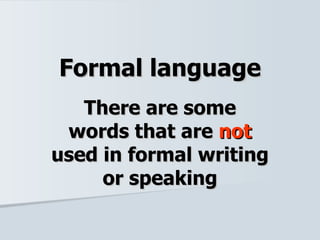
Formal language There are some words that are  not  used in formal writing or speaking
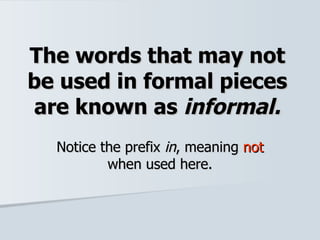
The words that may not be used in formal pieces are known as  informal. Notice the prefix  in , meaning  not  when used here.
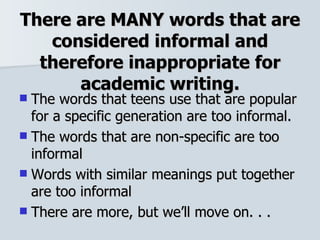
There are MANY words that are considered informal and therefore inappropriate for academic writing. The words that teens use that are popular for a specific generation are too informal. The words that are non-specific are too informal  Words with similar meanings put together are too informal There are more, but we’ll move on. . .
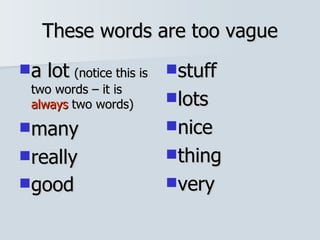
These words are too vague a lot   (notice this is two words – it is  always  two words) many really good   stuff  lots  nice  thing  very
Teen-speak is another informal, therefore, inappropriate way of expressing meaning.  It is slang.  Regardless of the receiver's ability to understand, slang is not appropriate in academic work.
For example peeps, dawgs, homies – use  friends rents -use  parents kicks, rides - use  shoes   hella -use  really sick, wicked, tope -use the most specific  word to relay your intended meaning  of “cool”
DO NOT USE THESE WORDS IN YOUR ESSAYS!  I, me, my, mine Our, ours We, us You, your, yours
“ But why?” you ask, “they are fine words and I’ve been using them since I could write.” Oh, let me tell you a true story about why those pronouns don’t work in formal writing. . .
You may not use contractions either, NOT AT ALL!  WHATEVER   WILL YOU DO?
You’ll learn to proofread You will learn to proofread You really will. The penalties are too severe for you to ignore this rule!  Each use  of the informal words in this slide show will reduce your score by 3%.
Sentence Starters  Pre AP students will NEVER use: Well, So, First, Second, Third, Also, And also (this is redundant) Lastly, Finally, In conclusion
About “In conclusion. . .” This is ridiculous in writing because the reader can  see  the white space at the end.  For a writer to report this to his reader, with  any phrase  of this type, is an insult to the reader’s intelligence.  These phrases should be saved for speech making.  The audience may want to know when the speaker is finally going to stop talking!
Not one English teacher in this building allows use of “in conclusion” in formal essays. ‘ nuff said about that!
Phrases Pre AP students will NEVER use: The author uses ____________ to draw the reader in. The author uses ______________to catch the reader’s attention. The author uses __________ to show…. The author ____________ to prove a point.
Any phrase that refers to the paper itself or the reader is one Pre AP students will NEVER use: As was previously mentioned. . . . As you can see, by my astute analysis. . .
Author or Piece Commentary Phrases Pre AP students will NEVER use: The author is a good writer. This is a well-written piece.
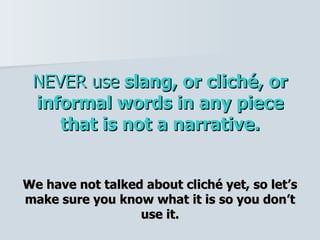
NEVER use  slang, or cliché, or informal words in any piece that is not a narrative. We have not talked about cliché yet, so let’s make sure you know what it is so you don’t use it.
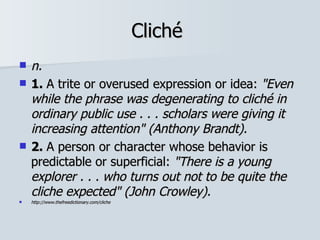
Cliché  n.   1.  A trite or overused expression or idea:  "Even while the phrase was degenerating to cliché in ordinary public use . . . scholars were giving it increasing attention"   (Anthony Brandt). 2.  A person or character whose behavior is predictable or superficial:  "There is a young explorer . . . who turns out not to be quite the cliche expected"   (John Crowley). http://www.thefreedictionary.com/cliche
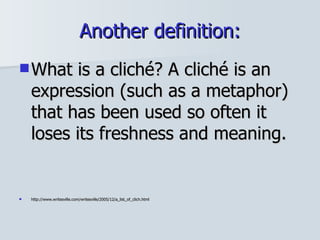
Another definition: What is a cliché? A cliché is an expression (such as a metaphor) that has been used so often it loses its freshness and meaning.  http://www.writesville.com/writesville/2005/12/a_list_of_clich.html
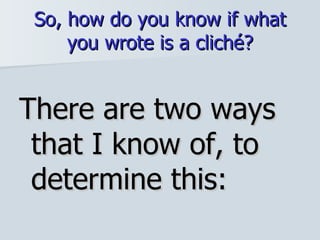
So, how do you know if what you wrote is a cliché? There are two ways that I know of, to determine this:
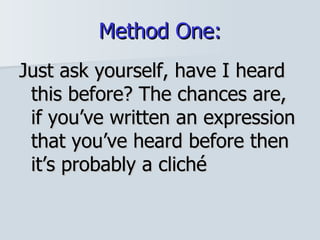
Method One: Just ask yourself, have I heard this before? The chances are, if you’ve written an expression that you’ve heard before then it’s probably a cliché
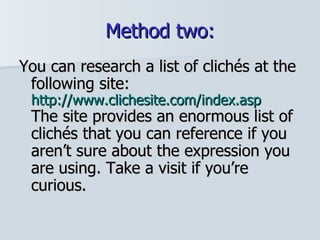
Method two: You can research a list of clichés at the following site:  http://www.clichesite.com/index.asp The site provides an enormous list of clichés that you can reference if you aren’t sure about the expression you are using. Take a visit if you’re curious.
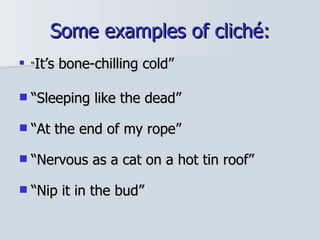
Some examples of cliché: “ It’s bone-chilling cold” “ Sleeping like the dead” “ At the end of my rope” “ Nervous as a cat on a hot tin roof” “ Nip it in the bud”
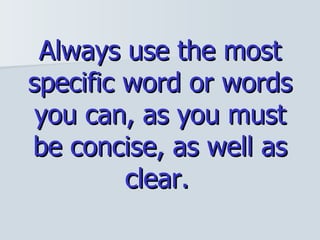
Always use the most specific word or words you can, as you must be concise, as well as clear.
Do not use a thesaurus to drop words into your writing.  Often, the connotation is incorrect, resulting in your seeming ignorant of the language and less scholarly.
The expectations are high because you are capable of great things! I believe it.  Do you?

The Never List

  • 1.
    Formal language Thereare some words that are not used in formal writing or speaking
  • 2.
    The words thatmay not be used in formal pieces are known as informal. Notice the prefix in , meaning not when used here.
  • 3.
    There are MANYwords that are considered informal and therefore inappropriate for academic writing. The words that teens use that are popular for a specific generation are too informal. The words that are non-specific are too informal Words with similar meanings put together are too informal There are more, but we’ll move on. . .
  • 4.
    These words aretoo vague a lot (notice this is two words – it is always two words) many really good stuff lots nice thing very
  • 5.
    Teen-speak is anotherinformal, therefore, inappropriate way of expressing meaning. It is slang. Regardless of the receiver's ability to understand, slang is not appropriate in academic work.
  • 6.
    For example peeps,dawgs, homies – use friends rents -use parents kicks, rides - use shoes hella -use really sick, wicked, tope -use the most specific word to relay your intended meaning of “cool”
  • 7.
    DO NOT USETHESE WORDS IN YOUR ESSAYS! I, me, my, mine Our, ours We, us You, your, yours
  • 8.
    “ But why?”you ask, “they are fine words and I’ve been using them since I could write.” Oh, let me tell you a true story about why those pronouns don’t work in formal writing. . .
  • 9.
    You may notuse contractions either, NOT AT ALL! WHATEVER WILL YOU DO?
  • 10.
    You’ll learn toproofread You will learn to proofread You really will. The penalties are too severe for you to ignore this rule! Each use of the informal words in this slide show will reduce your score by 3%.
  • 11.
    Sentence Starters Pre AP students will NEVER use: Well, So, First, Second, Third, Also, And also (this is redundant) Lastly, Finally, In conclusion
  • 12.
    About “In conclusion.. .” This is ridiculous in writing because the reader can see the white space at the end. For a writer to report this to his reader, with any phrase of this type, is an insult to the reader’s intelligence. These phrases should be saved for speech making. The audience may want to know when the speaker is finally going to stop talking!
  • 13.
    Not one Englishteacher in this building allows use of “in conclusion” in formal essays. ‘ nuff said about that!
  • 14.
    Phrases Pre APstudents will NEVER use: The author uses ____________ to draw the reader in. The author uses ______________to catch the reader’s attention. The author uses __________ to show…. The author ____________ to prove a point.
  • 15.
    Any phrase thatrefers to the paper itself or the reader is one Pre AP students will NEVER use: As was previously mentioned. . . . As you can see, by my astute analysis. . .
  • 16.
    Author or PieceCommentary Phrases Pre AP students will NEVER use: The author is a good writer. This is a well-written piece.
  • 17.
    NEVER use slang, or cliché, or informal words in any piece that is not a narrative. We have not talked about cliché yet, so let’s make sure you know what it is so you don’t use it.
  • 18.
    Cliché n. 1. A trite or overused expression or idea: "Even while the phrase was degenerating to cliché in ordinary public use . . . scholars were giving it increasing attention" (Anthony Brandt). 2. A person or character whose behavior is predictable or superficial: "There is a young explorer . . . who turns out not to be quite the cliche expected" (John Crowley). http://www.thefreedictionary.com/cliche
  • 19.
    Another definition: Whatis a cliché? A cliché is an expression (such as a metaphor) that has been used so often it loses its freshness and meaning. http://www.writesville.com/writesville/2005/12/a_list_of_clich.html
  • 20.
    So, how doyou know if what you wrote is a cliché? There are two ways that I know of, to determine this:
  • 21.
    Method One: Justask yourself, have I heard this before? The chances are, if you’ve written an expression that you’ve heard before then it’s probably a cliché
  • 22.
    Method two: Youcan research a list of clichés at the following site: http://www.clichesite.com/index.asp The site provides an enormous list of clichés that you can reference if you aren’t sure about the expression you are using. Take a visit if you’re curious.
  • 23.
    Some examples ofcliché: “ It’s bone-chilling cold” “ Sleeping like the dead” “ At the end of my rope” “ Nervous as a cat on a hot tin roof” “ Nip it in the bud”
  • 24.
    Always use themost specific word or words you can, as you must be concise, as well as clear.
  • 25.
    Do not usea thesaurus to drop words into your writing. Often, the connotation is incorrect, resulting in your seeming ignorant of the language and less scholarly.
  • 26.
    The expectations arehigh because you are capable of great things! I believe it. Do you?