University of Purdue OWL 
ht tp://owl.english.purdue.edu/owl/resource/642/01/ Jo Doran, Allen Brizee 
Questions to ask yourself before you write: 
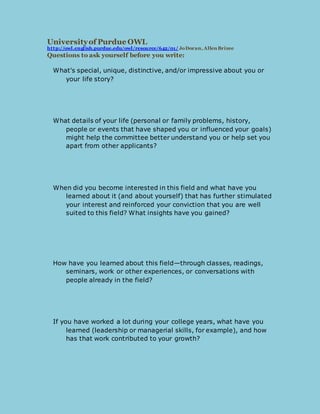
What's special, unique, distinctive, and/or impressive about you or 
your life story? 
What details of your life (personal or family problems, history, 
people or events that have shaped you or influenced your goals) 
might help the committee better understand you or help set you 
apart from other applicants? 
When did you become interested in this field and what have you 
learned about it (and about yourself) that has further stimulated 
your interest and reinforced your conviction that you are well 
suited to this field? What insights have you gained? 
How have you learned about this field—through classes, readings, 
seminars, work or other experiences, or conversations with 
people already in the field? 
If you have worked a lot during your college years, what have you 
learned (leadership or managerial skills, for example), and how 
has that work contributed to your growth?
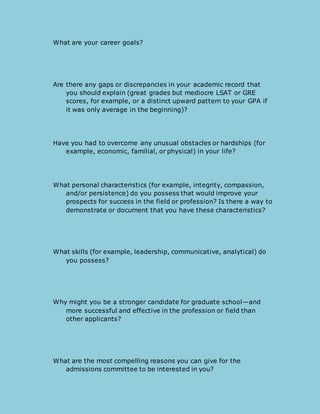
What are your career goals? 
Are there any gaps or discrepancies in your academic record that 
you should explain (great grades but mediocre LSAT or GRE 
scores, for example, or a distinct upward pattern to your GPA if 
it was only average in the beginning)? 
Have you had to overcome any unusual obstacles or hardships (for 
example, economic, familial, or physical) in your life? 
What personal characteristics (for example, integrity, compassion, 
and/or persistence) do you possess that would improve your 
prospects for success in the field or profession? Is there a way to 
demonstrate or document that you have these characteristics? 
What skills (for example, leadership, communicative, analytical) do 
you possess? 
Why might you be a stronger candidate for graduate school—and 
more successful and effective in the profession or field than 
other applicants? 
What are the most compelling reasons you can give for the 
admissions committee to be interested in you?
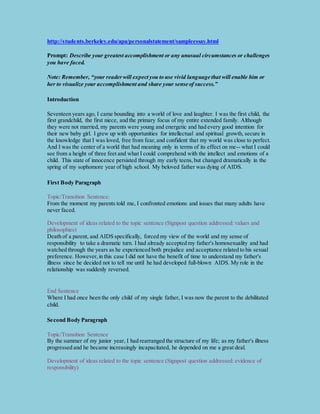
http://students.berkeley.edu/apa/personalstatement/sampleessay.html 
Prompt: Describe your greatest accomplishment or any unusual circumstances or challenges 
you have faced. 
Note: Remember, “your reader will expect you to use vivid language that will enable him or 
her to visualize your accomplishment and share your sense of success.” 
Introduction 
Seventeen years ago, I came bounding into a world of love and laughter. I was the first child, the 
first grandchild, the first niece, and the primary focus of my entire extended family. Although 
they were not married, my parents were young and energetic and had every good intention for 
their new baby girl. I grew up with opportunities for intellectual and spiritual growth, secure in 
the knowledge that I was loved, free from fear, and confident that my world was close to perfect. 
And I was the center of a world that had meaning only in terms of its effect on me-- what I could 
see from a height of three feet and what I could comprehend with the intellect and emotions of a 
child. This state of innocence persisted through my early teens, but changed dramatically in the 
spring of my sophomore year of high school. My beloved father was dying of AIDS. 
First Body Paragraph 
Topic/Transition Sentence: 
From the moment my parents told me, I confronted emotions and issues that many adults have 
never faced. 
Development of ideas related to the topic sentence (Signpost question addressed: values and 
philosophies) 
Death of a parent, and AIDS specifically, forced my view of the world and my sense of 
responsibility to take a dramatic turn. I had already accepted my father's homosexuality and had 
watched through the years as he experienced both prejudice and acceptance related to his sexual 
preference. However, in this case I did not have the benefit of time to understand my father's 
illness since he decided not to tell me until he had developed full-blown AIDS. My role in the 
relationship was suddenly reversed. 
End Sentence 
Where I had once been the only child of my single father, I was now the parent to the debilitated 
child. 
Second Body Paragraph 
Topic/Transition Sentence 
By the summer of my junior year, I had rearranged the structure of my life; as my father's illness 
progressed and he became increasingly incapacitated, he depended on me a great deal. 
Development of ideas related to the topic sentence (Signpost question addressed: evidence of 
responsibility)
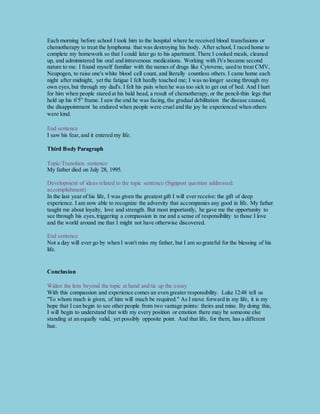
Each morning before school I took him to the hospital where he received blood transfusions or 
chemotherapy to treat the lymphoma that was destroying his body. After school, I raced home to 
complete my homework so that I could later go to his apartment. There I cooked meals, cleaned 
up, and administered his oral and intravenous medications. Working with IVs became second 
nature to me. I found myself familiar with the names of drugs like Cytovene, used to treat CMV, 
Neupogen, to raise one's white blood cell count, and literally countless others. I came home each 
night after midnight, yet the fatigue I felt hardly touched me; I was no longer seeing through my 
own eyes, but through my dad's. I felt his pain when he was too sick to get out of bed. And I hurt 
for him when people stared at his bald head, a result of chemotherapy, or the pencil-thin legs that 
held up his 6'5" frame. I saw the end he was facing, the gradual debilitation the disease caused, 
the disappointment he endured when people were cruel and the joy he experienced when others 
were kind. 
End sentence 
I saw his fear, and it entered my life. 
Third Body Paragraph 
Topic/Transition sentence 
My father died on July 28, 1995. 
Development of ideas related to the topic sentence (Signpost question addressed: 
accomplishment) 
In the last year of his life, I was given the greatest gift I will ever receive: the gift of deep 
experience. I am now able to recognize the adversity that accompanies any good in life. My father 
taught me about loyalty, love and strength. But most importantly, he gave me the opportunity to 
see through his eyes, triggering a compassion in me and a sense of responsibility to those I love 
and the world around me that I might not have otherwise discovered. 
End sentence 
Not a day will ever go by when I won't miss my father, but I am so grateful for the blessing of his 
life. 
Conclusion 
Widen the lens beyond the topic at hand and tie up the essay 
With this compassion and experience comes an even greater responsibility. Luke 12:48 tell us 
"To whom much is given, of him will much be required." As I move forward in my life, it is my 
hope that I can begin to see other people from two vantage points: theirs and mine. By doing this, 
I will begin to understand that with my every position or emotion there may be someone else 
standing at an equally valid, yet possibly opposite point. And that life, for them, has a different 
hue.
Sample Essay: 
Sample Responses to Select Questions on the NSF 
Graduate Research Fellowship Application 
These pages were downloaded from Writing Personal Statements Online, available at 
ht tps://www.e-educat ion.psu.edu/writ ingpersonalstatementsonline/ 
Question Summary: Describe your experiences in the following or describe how you 
would address the following in your professional career: integrating research and 
education, advancing diversity in science, enhancing scientific and technical 
understanding, and otherwise benefiting society. 
“A hundred years from now it will not matter what my bank account was, the sort of 
house I lived in, or the kind of car I drove. But the world may be different because I was 
important in the life of a [child].” 
—Forest Witcraft, Boy Scouts of America 
My belief in the veracity of the statement by Witcraft is one of the reasons I have decided 
to become a research professor. I believe that this career will allow me to share my fervor 
for science and discovery with future generations, especially young women. From a 
young age, and continuing throughout my college career, I have tried to embody this 
principle and to volunteer in other capacities in order to improve the community 
around me. 
One of the ways in which I have been able to share my field of bioengineering with 
others has been through the Biomedical Engineering Society (BMES). Last year, I 
worked with Prof. John Teacher and a few of my peers to co-found an undergraduate 
chapter of BMES at Mythic University. The purpose of this club, according to the BMES, 
is to “promote the increase of biomedical engineering knowledge and its utilization.” Our 
chapter seeks to fulfill this mission by bringing together undergraduate and graduate 
students and supporting activities such as mentoring, career informa tion sessions, and 
outside speakers. As part of our outreach, I had the opportunity to return to my high 
school over spring break to speak to science classes about biomedical engineering and to 
share some of my experiences of college life. I have also assisted the BMES at the annual 
Engineering Open House, which is an event geared to helping high school seniors learn 
more about the different engineering disciplines, hopefully encouraging them to consider 
engineering as a career. In addition, I have served as the captain of a BMES-sponsored 
intramural women’s soccer team. Team sports depend upon each player cooperating and 
putting forth 100% effort toward a common goal, which directly translates to the 
demands of a research environment. This team not only encouraged bioengineers to 
interact outside of classes, but it also gave me the opportunity to promote 
communication between science and non-science majors, since I actively invited non-bioengineers 
to join 
the team. 
Since beginning my honors thesis research as a sophomore, I have had many 
opportunities to share the knowledge I have gained by presenting my results in various 
settings. These have included a publication (“Procoagulant Stimulus Processing by the 
Intrinsic Pathway of Blood Plasma Coagulation,” in Biomaterials) and several poster 
presentations among members of my field. I also participated in a poster presentation that
included entries from all undergraduate majors. This presentation gave me the chance to 
explain my work to people from non-science backgrounds, challenging me to 
present technical details in a way that is meaningful to a wide variety of viewers. 
I have also positively impacted the lives of incoming freshmen by serving as a mentor for 
the Mythic University Honors College students. I have helped these freshmen to make a 
smooth transition from high school to college by offering advice on ways to succeed in 
and out of the classroom and also by lending an ear to whatever troubles they may be 
experiencing. One of my former mentees recently informed me that I inspired her to 
succeed in her engineering studies despite it being a traditionally male-dominated field. 
She also gained interest in working towards the Goldwater Scholarship as a result of my 
award last year. 
Finally, I seek to serve the rest of the surrounding community through my 
participation in 
Habitat for Humanity. Our chapter helps to raise money to build houses for people who 
would not ordinarily be able to afford them by performing odd jobs for people in the 
community, asking for donations from local people and businesses, and by holding an 
annual “House Walk,” in which each walker is sponsored by family, friends, and 
members of Mythic University community. 
Throughout my career, I hope to continue my commitment to public service by serving as 
a mentor to young women, volunteering for summer science enrichment programs, and 
performing other acts of community service such as participating in the Adopt-a- 
Highway program. In this way, I can share with others the blessings that have been given 
to me throughout my life.
Essay Writing Exercise 
Identify your admission institution and personal essay prompt. 
What will be the focus of your essay? 
Write the introductory paragraph.

Final

  • 2.
    University of PurdueOWL ht tp://owl.english.purdue.edu/owl/resource/642/01/ Jo Doran, Allen Brizee Questions to ask yourself before you write: What's special, unique, distinctive, and/or impressive about you or your life story? What details of your life (personal or family problems, history, people or events that have shaped you or influenced your goals) might help the committee better understand you or help set you apart from other applicants? When did you become interested in this field and what have you learned about it (and about yourself) that has further stimulated your interest and reinforced your conviction that you are well suited to this field? What insights have you gained? How have you learned about this field—through classes, readings, seminars, work or other experiences, or conversations with people already in the field? If you have worked a lot during your college years, what have you learned (leadership or managerial skills, for example), and how has that work contributed to your growth?
  • 3.
    What are yourcareer goals? Are there any gaps or discrepancies in your academic record that you should explain (great grades but mediocre LSAT or GRE scores, for example, or a distinct upward pattern to your GPA if it was only average in the beginning)? Have you had to overcome any unusual obstacles or hardships (for example, economic, familial, or physical) in your life? What personal characteristics (for example, integrity, compassion, and/or persistence) do you possess that would improve your prospects for success in the field or profession? Is there a way to demonstrate or document that you have these characteristics? What skills (for example, leadership, communicative, analytical) do you possess? Why might you be a stronger candidate for graduate school—and more successful and effective in the profession or field than other applicants? What are the most compelling reasons you can give for the admissions committee to be interested in you?
  • 4.
    http://students.berkeley.edu/apa/personalstatement/sampleessay.html Prompt: Describeyour greatest accomplishment or any unusual circumstances or challenges you have faced. Note: Remember, “your reader will expect you to use vivid language that will enable him or her to visualize your accomplishment and share your sense of success.” Introduction Seventeen years ago, I came bounding into a world of love and laughter. I was the first child, the first grandchild, the first niece, and the primary focus of my entire extended family. Although they were not married, my parents were young and energetic and had every good intention for their new baby girl. I grew up with opportunities for intellectual and spiritual growth, secure in the knowledge that I was loved, free from fear, and confident that my world was close to perfect. And I was the center of a world that had meaning only in terms of its effect on me-- what I could see from a height of three feet and what I could comprehend with the intellect and emotions of a child. This state of innocence persisted through my early teens, but changed dramatically in the spring of my sophomore year of high school. My beloved father was dying of AIDS. First Body Paragraph Topic/Transition Sentence: From the moment my parents told me, I confronted emotions and issues that many adults have never faced. Development of ideas related to the topic sentence (Signpost question addressed: values and philosophies) Death of a parent, and AIDS specifically, forced my view of the world and my sense of responsibility to take a dramatic turn. I had already accepted my father's homosexuality and had watched through the years as he experienced both prejudice and acceptance related to his sexual preference. However, in this case I did not have the benefit of time to understand my father's illness since he decided not to tell me until he had developed full-blown AIDS. My role in the relationship was suddenly reversed. End Sentence Where I had once been the only child of my single father, I was now the parent to the debilitated child. Second Body Paragraph Topic/Transition Sentence By the summer of my junior year, I had rearranged the structure of my life; as my father's illness progressed and he became increasingly incapacitated, he depended on me a great deal. Development of ideas related to the topic sentence (Signpost question addressed: evidence of responsibility)
  • 5.
    Each morning beforeschool I took him to the hospital where he received blood transfusions or chemotherapy to treat the lymphoma that was destroying his body. After school, I raced home to complete my homework so that I could later go to his apartment. There I cooked meals, cleaned up, and administered his oral and intravenous medications. Working with IVs became second nature to me. I found myself familiar with the names of drugs like Cytovene, used to treat CMV, Neupogen, to raise one's white blood cell count, and literally countless others. I came home each night after midnight, yet the fatigue I felt hardly touched me; I was no longer seeing through my own eyes, but through my dad's. I felt his pain when he was too sick to get out of bed. And I hurt for him when people stared at his bald head, a result of chemotherapy, or the pencil-thin legs that held up his 6'5" frame. I saw the end he was facing, the gradual debilitation the disease caused, the disappointment he endured when people were cruel and the joy he experienced when others were kind. End sentence I saw his fear, and it entered my life. Third Body Paragraph Topic/Transition sentence My father died on July 28, 1995. Development of ideas related to the topic sentence (Signpost question addressed: accomplishment) In the last year of his life, I was given the greatest gift I will ever receive: the gift of deep experience. I am now able to recognize the adversity that accompanies any good in life. My father taught me about loyalty, love and strength. But most importantly, he gave me the opportunity to see through his eyes, triggering a compassion in me and a sense of responsibility to those I love and the world around me that I might not have otherwise discovered. End sentence Not a day will ever go by when I won't miss my father, but I am so grateful for the blessing of his life. Conclusion Widen the lens beyond the topic at hand and tie up the essay With this compassion and experience comes an even greater responsibility. Luke 12:48 tell us "To whom much is given, of him will much be required." As I move forward in my life, it is my hope that I can begin to see other people from two vantage points: theirs and mine. By doing this, I will begin to understand that with my every position or emotion there may be someone else standing at an equally valid, yet possibly opposite point. And that life, for them, has a different hue.
  • 6.
    Sample Essay: SampleResponses to Select Questions on the NSF Graduate Research Fellowship Application These pages were downloaded from Writing Personal Statements Online, available at ht tps://www.e-educat ion.psu.edu/writ ingpersonalstatementsonline/ Question Summary: Describe your experiences in the following or describe how you would address the following in your professional career: integrating research and education, advancing diversity in science, enhancing scientific and technical understanding, and otherwise benefiting society. “A hundred years from now it will not matter what my bank account was, the sort of house I lived in, or the kind of car I drove. But the world may be different because I was important in the life of a [child].” —Forest Witcraft, Boy Scouts of America My belief in the veracity of the statement by Witcraft is one of the reasons I have decided to become a research professor. I believe that this career will allow me to share my fervor for science and discovery with future generations, especially young women. From a young age, and continuing throughout my college career, I have tried to embody this principle and to volunteer in other capacities in order to improve the community around me. One of the ways in which I have been able to share my field of bioengineering with others has been through the Biomedical Engineering Society (BMES). Last year, I worked with Prof. John Teacher and a few of my peers to co-found an undergraduate chapter of BMES at Mythic University. The purpose of this club, according to the BMES, is to “promote the increase of biomedical engineering knowledge and its utilization.” Our chapter seeks to fulfill this mission by bringing together undergraduate and graduate students and supporting activities such as mentoring, career informa tion sessions, and outside speakers. As part of our outreach, I had the opportunity to return to my high school over spring break to speak to science classes about biomedical engineering and to share some of my experiences of college life. I have also assisted the BMES at the annual Engineering Open House, which is an event geared to helping high school seniors learn more about the different engineering disciplines, hopefully encouraging them to consider engineering as a career. In addition, I have served as the captain of a BMES-sponsored intramural women’s soccer team. Team sports depend upon each player cooperating and putting forth 100% effort toward a common goal, which directly translates to the demands of a research environment. This team not only encouraged bioengineers to interact outside of classes, but it also gave me the opportunity to promote communication between science and non-science majors, since I actively invited non-bioengineers to join the team. Since beginning my honors thesis research as a sophomore, I have had many opportunities to share the knowledge I have gained by presenting my results in various settings. These have included a publication (“Procoagulant Stimulus Processing by the Intrinsic Pathway of Blood Plasma Coagulation,” in Biomaterials) and several poster presentations among members of my field. I also participated in a poster presentation that
  • 7.
    included entries fromall undergraduate majors. This presentation gave me the chance to explain my work to people from non-science backgrounds, challenging me to present technical details in a way that is meaningful to a wide variety of viewers. I have also positively impacted the lives of incoming freshmen by serving as a mentor for the Mythic University Honors College students. I have helped these freshmen to make a smooth transition from high school to college by offering advice on ways to succeed in and out of the classroom and also by lending an ear to whatever troubles they may be experiencing. One of my former mentees recently informed me that I inspired her to succeed in her engineering studies despite it being a traditionally male-dominated field. She also gained interest in working towards the Goldwater Scholarship as a result of my award last year. Finally, I seek to serve the rest of the surrounding community through my participation in Habitat for Humanity. Our chapter helps to raise money to build houses for people who would not ordinarily be able to afford them by performing odd jobs for people in the community, asking for donations from local people and businesses, and by holding an annual “House Walk,” in which each walker is sponsored by family, friends, and members of Mythic University community. Throughout my career, I hope to continue my commitment to public service by serving as a mentor to young women, volunteering for summer science enrichment programs, and performing other acts of community service such as participating in the Adopt-a- Highway program. In this way, I can share with others the blessings that have been given to me throughout my life.
  • 8.
    Essay Writing Exercise Identify your admission institution and personal essay prompt. What will be the focus of your essay? Write the introductory paragraph.