See it Cite it Sorted
Referencing using APA
APA 7th Edition
• The Publication Manual of the American Psychological Association,
Seventh Edition is the official source for APA Style.
• The 7th edition was published late 2019 so you should be using this
version by now
• Check with your tutor if you should be using the 6th OR 7th edition of
the APA referencing style
• Cite Them Right gives guidance on both versions
• There are print copies of the 7th edition manual available in the library
1st floor wing, shelfmark: 808.06615PUB
Aims and Objectives
In this session we will be:
•Evaluating information
•Exploring what is referencing
•Discussing what tools are available to help you
reference
Yeah we’ve found some information!! but is it any good….
Image by OpenClipart-Vectors from Pixabay
Evaluating Information
Just because you could use it doesn’t mean that you
should……
Source suitability
•Trust and Quality
•Authorship
•Appropriateness
•Purpose
Trust and Quality
•What makes you believe in the information?
•How accurate is it?
•Has it been quality controlled – peer reviewed?
•Are the opinions backed up with evidence like
data and references?
Authorship
•Who created the work?
•What are their qualifications and
credentials?
•Can you contact them?
•Does it say if they are being sponsored?
Appropriateness
•How relevant is the material to your work?
•When was it produced?
•Is it up to date?
Purpose
•What was the reason for creating the material?
•Does the author have an agenda?
•Is the agenda: commercial, educational,
political?
•How objective are the views presented?
•Who is the work aimed at?
Citation v Reference
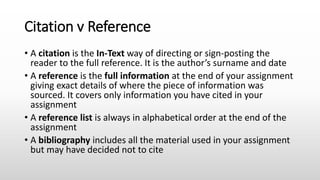
• A citation is the In-Text way of directing or sign-posting the
reader to the full reference. It is the author’s surname and date
• A reference is the full information at the end of your assignment
giving exact details of where the piece of information was
sourced. It covers only information you have cited in your
assignment
• A reference list is always in alphabetical order at the end of the
assignment
• A bibliography includes all the material used in your assignment
but may have decided not to cite
What is referencing and why it is important
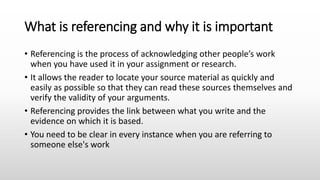
• Referencing is the process of acknowledging other people’s work
when you have used it in your assignment or research.
• It allows the reader to locate your source material as quickly and
easily as possible so that they can read these sources themselves and
verify the validity of your arguments.
• Referencing provides the link between what you write and the
evidence on which it is based.
• You need to be clear in every instance when you are referring to
someone else's work
Citations and References examples
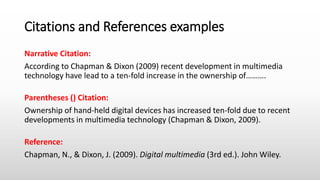
Narrative Citation:
According to Chapman & Dixon (2009) recent development in multimedia
technology have lead to a ten-fold increase in the ownership of……….
Parentheses () Citation:
Ownership of hand-held digital devices has increased ten-fold due to recent
developments in multimedia technology (Chapman & Dixon, 2009).
Reference:
Chapman, N., & Dixon, J. (2009). Digital multimedia (3rd ed.). John Wiley.
What do they mean?
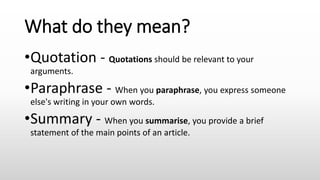
•Quotation - Quotations should be relevant to your
arguments.
•Paraphrase - When you paraphrase, you express someone
else's writing in your own words.
•Summary - When you summarise, you provide a brief
statement of the main points of an article.
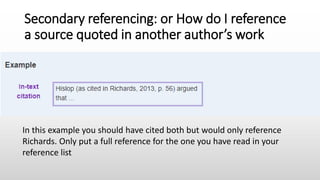
Secondary referencing: or How do I reference
a source quoted in another author’s work
In this example you should have cited both but would only reference
Richards. Only put a full reference for the one you have read in your
reference list
Why do we cite and
reference?
Why Cite/Reference?
• Give credit to the original author/creator
• Demonstrate that you have read widely on the subject and
have considered and evaluated the writings of others
• Show the evidence of your research by quoting,
paraphrasing or summarising from the original text
• Establish the credibility and authority of your ideas and
arguments by highlighting and backing-up relevant points
• Enable the reader to locate the original material you used
• Distinguish between your own ideas and opinions and
those of others
• Achieve a better mark or grade
• Avoid plagiarism.
Presentation title
When do we cite?
When do we cite?
• When we use someone else’s idea.
• When we use someone else’s words, images etc.
You don’t need to cite something if it is “common
knowledge”
However If you are unsure it is better to cite than not
to!
What citation style are we using?
APA
Harvard
MLA
MHRA
Chicago
OSCOLA
Vancouver
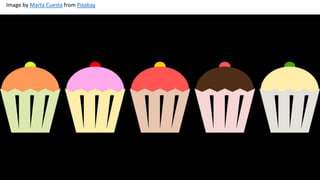
Image by Marta Cuesta from Pixabay
How to Create a Citation and Reference
What information do you need?
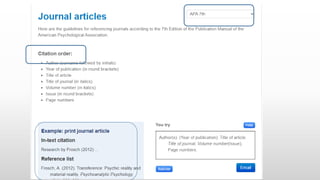
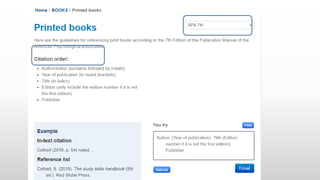
• Author of book, article
• Title of book, article
• Publisher
• Date of Publication
• Chapter title
• Chapter Author
• Edition
• Journal title
• Volume number
• Part number
• URL or DOI
• Last updated date
• Page number(s)
• Website name
Where is that information found?
• Title page – not the same as the book/journal cover
• Back of the title page
• Contents page
• ISBN/ISSN
• DOI – Digital object identifier
• URL box on websites
• MDX Library Search – remember the citation option click on the “
symbol, Google scholar and databases like PsycInfo
• Referencing software
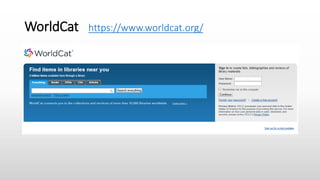
• Worldcat
WorldCat https://www.worldcat.org/
Citation and Reference
Help
I need help! What do I do?
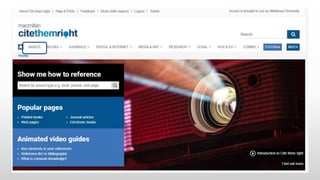
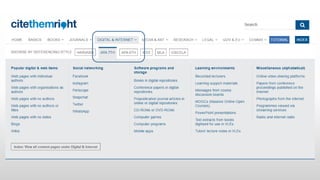
• Citethemright – Always check your references
https://www-citethemrightonline-com.ezproxy.mdx.ac.uk/
• The referencing style may have a website
for example: http://www.apastyle.org/
• Use the citation option on Library Search or on Google Scholar.
Remember the “ symbol?
• Chat to a librarian at the Study Hub 9-5 Monday – Friday, or to a
member of the Academic Writing Team drop in sessions 12-3 Monday
- Friday
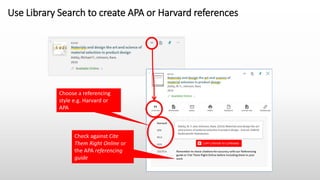
Use Library Search to create APA or Harvard references
Choose a referencing
style e.g. Harvard or
APA
Check against Cite
Them Right Online or
the APA referencing
guide
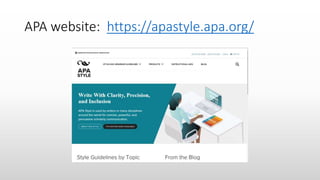
APA website: https://apastyle.apa.org/
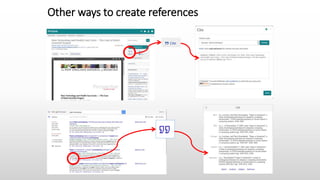
Other ways to create references
Example of an APA reference list
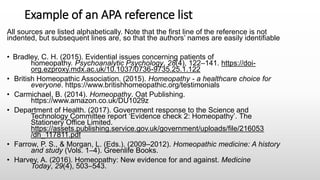
All sources are listed alphabetically. Note that the first line of the reference is not
indented, but subsequent lines are, so that the authors’ names are easily identifiable
• Bradley, C. H. (2015). Evidential issues concerning patients of
homeopathy. Psychoanalytic Psychology, 28(4), 122–141. https://doi-
org.ezproxy.mdx.ac.uk/10.1037/0736-9735.25.1.122
• British Homeopathic Association. (2015). Homeopathy - a healthcare choice for
everyone. https://www.britishhomeopathic.org/testimonials
• Carmichael, B. (2014). Homeopathy. Oat Publishing.
https://www.amazon.co.uk/DU1029z
• Department of Health. (2017). Government response to the Science and
Technology Committee report ‘Evidence check 2: Homeopathy’. The
Stationery Office Limited.
https://assets.publishing.service.gov.uk/government/uploads/file/216053
/dh_117811.pdf
• Farrow, P. S., & Morgan, L. (Eds.). (2009–2012). Homeopathic medicine: A history
and study (Vols. 1–4). Greenlife Books.
• Harvey, A. (2016). Homeopathy: New evidence for and against. Medicine
Today, 29(4), 503–543.
Top Tips
• Check your referencing style and version
• Ask for help from the LET or library staff
• Be organised – keep a record of ALL potentially useful sources as you
find them
• Be prepared – Read the basics section of Cite Them Right
• Be clear – Identify the type of resource and check against Cite Them
Right
• Be thorough – Check through your work before you submit. Make
sure all your citations and references match
• Don’t leave your referencing to the last minute!
BEWARE OF FREE SOFTWARE!
If you use referencing software of any kind to format your references,
but especially if you are using a free online tool like RefMe or
Citethisforme
YOU NEED TO CHECK REFERENCES YOURSELF
USING CITE THEM RIGHT BEFORE YOU SUBMIT YOUR
WORK
Further help
• Academic Writing team: 1st floor Sheppard library 12-3 drop in sessions
• Librarians available at the Study Hub (Sheppard library 1st floor) Monday-Friday 9-5
• http://libguides.mdx.ac.uk/plagiarismreferencing
• http://libguides.mdx.ac.uk/psych/referencing
Reference list
Pears, R., Shields, G., & Shields, G. (2019). Cite them right: the essential referencing guide.
(11th ed.). Macmillan Education.
Go to this link https://ispri.ng/k7MDR

PSY1020 Referencing - See it cite it sorted APA 7th ed.

  • 1.
    See it Citeit Sorted Referencing using APA
  • 2.
    APA 7th Edition •The Publication Manual of the American Psychological Association, Seventh Edition is the official source for APA Style. • The 7th edition was published late 2019 so you should be using this version by now • Check with your tutor if you should be using the 6th OR 7th edition of the APA referencing style • Cite Them Right gives guidance on both versions • There are print copies of the 7th edition manual available in the library 1st floor wing, shelfmark: 808.06615PUB
  • 3.
    Aims and Objectives Inthis session we will be: •Evaluating information •Exploring what is referencing •Discussing what tools are available to help you reference
  • 4.
    Yeah we’ve foundsome information!! but is it any good…. Image by OpenClipart-Vectors from Pixabay
  • 5.
    Evaluating Information Just becauseyou could use it doesn’t mean that you should……
  • 6.
    Source suitability •Trust andQuality •Authorship •Appropriateness •Purpose
  • 7.
    Trust and Quality •Whatmakes you believe in the information? •How accurate is it? •Has it been quality controlled – peer reviewed? •Are the opinions backed up with evidence like data and references?
  • 8.
    Authorship •Who created thework? •What are their qualifications and credentials? •Can you contact them? •Does it say if they are being sponsored?
  • 9.
    Appropriateness •How relevant isthe material to your work? •When was it produced? •Is it up to date?
  • 10.
    Purpose •What was thereason for creating the material? •Does the author have an agenda? •Is the agenda: commercial, educational, political? •How objective are the views presented? •Who is the work aimed at?
  • 12.
    Citation v Reference •A citation is the In-Text way of directing or sign-posting the reader to the full reference. It is the author’s surname and date • A reference is the full information at the end of your assignment giving exact details of where the piece of information was sourced. It covers only information you have cited in your assignment • A reference list is always in alphabetical order at the end of the assignment • A bibliography includes all the material used in your assignment but may have decided not to cite
  • 13.
    What is referencingand why it is important • Referencing is the process of acknowledging other people’s work when you have used it in your assignment or research. • It allows the reader to locate your source material as quickly and easily as possible so that they can read these sources themselves and verify the validity of your arguments. • Referencing provides the link between what you write and the evidence on which it is based. • You need to be clear in every instance when you are referring to someone else's work
  • 14.
    Citations and Referencesexamples Narrative Citation: According to Chapman & Dixon (2009) recent development in multimedia technology have lead to a ten-fold increase in the ownership of………. Parentheses () Citation: Ownership of hand-held digital devices has increased ten-fold due to recent developments in multimedia technology (Chapman & Dixon, 2009). Reference: Chapman, N., & Dixon, J. (2009). Digital multimedia (3rd ed.). John Wiley.
  • 15.
    What do theymean? •Quotation - Quotations should be relevant to your arguments. •Paraphrase - When you paraphrase, you express someone else's writing in your own words. •Summary - When you summarise, you provide a brief statement of the main points of an article.
  • 16.
    Secondary referencing: orHow do I reference a source quoted in another author’s work In this example you should have cited both but would only reference Richards. Only put a full reference for the one you have read in your reference list
  • 17.
    Why do wecite and reference?
  • 18.
    Why Cite/Reference? • Givecredit to the original author/creator • Demonstrate that you have read widely on the subject and have considered and evaluated the writings of others • Show the evidence of your research by quoting, paraphrasing or summarising from the original text • Establish the credibility and authority of your ideas and arguments by highlighting and backing-up relevant points • Enable the reader to locate the original material you used • Distinguish between your own ideas and opinions and those of others • Achieve a better mark or grade • Avoid plagiarism. Presentation title
  • 19.
  • 20.
    When do wecite? • When we use someone else’s idea. • When we use someone else’s words, images etc. You don’t need to cite something if it is “common knowledge” However If you are unsure it is better to cite than not to!
  • 21.
    What citation styleare we using? APA Harvard MLA MHRA Chicago OSCOLA Vancouver
  • 22.
    Image by MartaCuesta from Pixabay
  • 23.
    How to Createa Citation and Reference What information do you need? • Author of book, article • Title of book, article • Publisher • Date of Publication • Chapter title • Chapter Author • Edition • Journal title • Volume number • Part number • URL or DOI • Last updated date • Page number(s) • Website name
  • 24.
    Where is thatinformation found? • Title page – not the same as the book/journal cover • Back of the title page • Contents page • ISBN/ISSN • DOI – Digital object identifier • URL box on websites • MDX Library Search – remember the citation option click on the “ symbol, Google scholar and databases like PsycInfo • Referencing software • Worldcat
  • 25.
  • 26.
  • 27.
    I need help!What do I do? • Citethemright – Always check your references https://www-citethemrightonline-com.ezproxy.mdx.ac.uk/ • The referencing style may have a website for example: http://www.apastyle.org/ • Use the citation option on Library Search or on Google Scholar. Remember the “ symbol? • Chat to a librarian at the Study Hub 9-5 Monday – Friday, or to a member of the Academic Writing Team drop in sessions 12-3 Monday - Friday
  • 28.
    Use Library Searchto create APA or Harvard references Choose a referencing style e.g. Harvard or APA Check against Cite Them Right Online or the APA referencing guide
  • 29.
  • 30.
    Other ways tocreate references
  • 36.
    Example of anAPA reference list All sources are listed alphabetically. Note that the first line of the reference is not indented, but subsequent lines are, so that the authors’ names are easily identifiable • Bradley, C. H. (2015). Evidential issues concerning patients of homeopathy. Psychoanalytic Psychology, 28(4), 122–141. https://doi- org.ezproxy.mdx.ac.uk/10.1037/0736-9735.25.1.122 • British Homeopathic Association. (2015). Homeopathy - a healthcare choice for everyone. https://www.britishhomeopathic.org/testimonials • Carmichael, B. (2014). Homeopathy. Oat Publishing. https://www.amazon.co.uk/DU1029z • Department of Health. (2017). Government response to the Science and Technology Committee report ‘Evidence check 2: Homeopathy’. The Stationery Office Limited. https://assets.publishing.service.gov.uk/government/uploads/file/216053 /dh_117811.pdf • Farrow, P. S., & Morgan, L. (Eds.). (2009–2012). Homeopathic medicine: A history and study (Vols. 1–4). Greenlife Books. • Harvey, A. (2016). Homeopathy: New evidence for and against. Medicine Today, 29(4), 503–543.
  • 37.
    Top Tips • Checkyour referencing style and version • Ask for help from the LET or library staff • Be organised – keep a record of ALL potentially useful sources as you find them • Be prepared – Read the basics section of Cite Them Right • Be clear – Identify the type of resource and check against Cite Them Right • Be thorough – Check through your work before you submit. Make sure all your citations and references match • Don’t leave your referencing to the last minute!
  • 38.
    BEWARE OF FREESOFTWARE! If you use referencing software of any kind to format your references, but especially if you are using a free online tool like RefMe or Citethisforme YOU NEED TO CHECK REFERENCES YOURSELF USING CITE THEM RIGHT BEFORE YOU SUBMIT YOUR WORK
  • 39.
    Further help • AcademicWriting team: 1st floor Sheppard library 12-3 drop in sessions • Librarians available at the Study Hub (Sheppard library 1st floor) Monday-Friday 9-5 • http://libguides.mdx.ac.uk/plagiarismreferencing • http://libguides.mdx.ac.uk/psych/referencing Reference list Pears, R., Shields, G., & Shields, G. (2019). Cite them right: the essential referencing guide. (11th ed.). Macmillan Education.
  • 41.
    Go to thislink https://ispri.ng/k7MDR

Editor's Notes

  • #2 Welcome and intros.
  • #5 Image by OpenClipart-Vectors from Pixabay
  • #6 Before you start to cite and reference items for your assignment you need to evaluate them first
  • #7 Think about the sources suitability Trust and Quality Authorship Appropriateness Purpose
  • #12 Referencing involves 2 main parts In text citations Full reference details Do you know the difference between a citation and a reference?
  • #13 Every academic institution requires its students to reference in their work and your tutors will expect you to do this accurately, clearly and concisely. Your university or institution should issue you with guidelines on how they expect you to reference in your particular subject area. Follow these guidelines carefully. Reference list is always a-z don’t split it up by format and don’t arrange by citation order
  • #14 Referencing covers ideas, words and images
  • #15 Narrative citation – just date Parentheses citation – brackets with author and date A narrative citation is a citation in which the author name appears in the sentence itself, rather than within parentheses. The author name is part of the meaning of the sentence
  • #16 Quotations should be relevant to your arguments. Don’t use too many Your tutor will prefer to read your own interpretation of the information. Bear in mind that direct quotations are also counted in your assignment's total word count. Short direct quotations (up to two or three lines) should be enclosed in quotation marks (single or double – be consistent) and included in the body of your text. Give the author, date and page number(s)/URL that the quotation was taken from. Longer quotations should be entered as a separate paragraph and indented from the main text. Quotation marks are not required. Paraphrasing: When you paraphrase, you express someone else's writing in your own words. However, you must ensure that you do not change the original meaning and you must still cite and reference your source of information. Summarising: When you summarise, you provide a brief statement of the main points of an article, web page, chapter or book, known as a summary. This differs from paraphrasing as it only lists the main topics or headings, with most of the detailed information being left out.
  • #17 Secondary Referencing this is when you want to refer to a source that is mentioned or quoted in the work you are reading. Always try to read and reference the original where possible but if you can’t you should cite both sources in the text and use the phrase “as cited in” but only put a full reference for the one you have read in your reference list In this example you have cited both but would only reference Richards
  • #18 Ask for reasons
  • #19 Demonstrate that you have read widely on the subject and considered and evaluated the writings of others Show your tutor the evidence of your research and thereby appreciate your contribution to the topic Establish the credibility and authority of your ideas and arguments Enable the reader to locate the original material you used Give credit to the original author/creator Enable the reader to form their own views on the value of your sources and how you have interpreted them Distinguish between your own ideas and opinions and those of others Highlight and back-up relevant points by quoting, paraphrasing or summarising from the original text Achieve a better mark or grade Avoid plagiarism.
  • #21 There is no need to reference things that are considered common knowledge. This is generally defined as facts, dates, events and information that are expected to be known by someone studying or working in a particular subject area or field. In order to decide if the material you want to use in your assignment constitutes common knowledge, you need to ask yourself the following questions: Did I know this information before I started my course? Did this information or idea come from my own brain? If the answer to either or both of these questions is ‘no’, then the information is unlikely to be common knowledge to you. In these cases, you should cite and reference the sources. If you are unsure whether something is common knowledge, it is always advisable to cite and reference it.
  • #22 Always check which style you need to use for your assignment. Especially if you are doing a joint course. APA or Harvard Harvard doesn’t use Harvard
  • #23 Referencing like Cooking You have all the ingredients e.g. author, date, title, publisher place of publication You have to mix them altogether following the recipe to get the right result The referencing style is your recipe and the reference is your cake! Image by Marta Cuesta from Pixabay 
  • #26 WorldCat – claims to be the world’s largest catalogue. Useful for get full information on a reference if you have forgotten some of the info
  • #31 Google Scholar or Databases Always check but better than starting with a blank piece of paper
  • #32 Go to Cite them right My Library – Referencing link – Cite them right Search box – type in the type of information source you want to reference eg tattoo = Body art Source types you will need to reference include Books, Journal articles, Newspapers, reports and web pages
  • #33 DOI’s may need some explanation
  • #35 They need to establish whether a webpage has individual author(s), an institution is the author or it has no author. If it has not author they perhaps should not be using it.
  • #37 Notice the second and subsequent lines are indented
  • #38 Give students time to look at the reference lists. Rank them in order Discuss which is the best one and why. What can you identify? No books on best one though… A = Worst B = Better C = Best
  • #43 iSpring quiz