What have you noticed with this group of photos?
Which of the photo is different? Why would you say so?
What can be drawn out from the instance of seeing
photos?
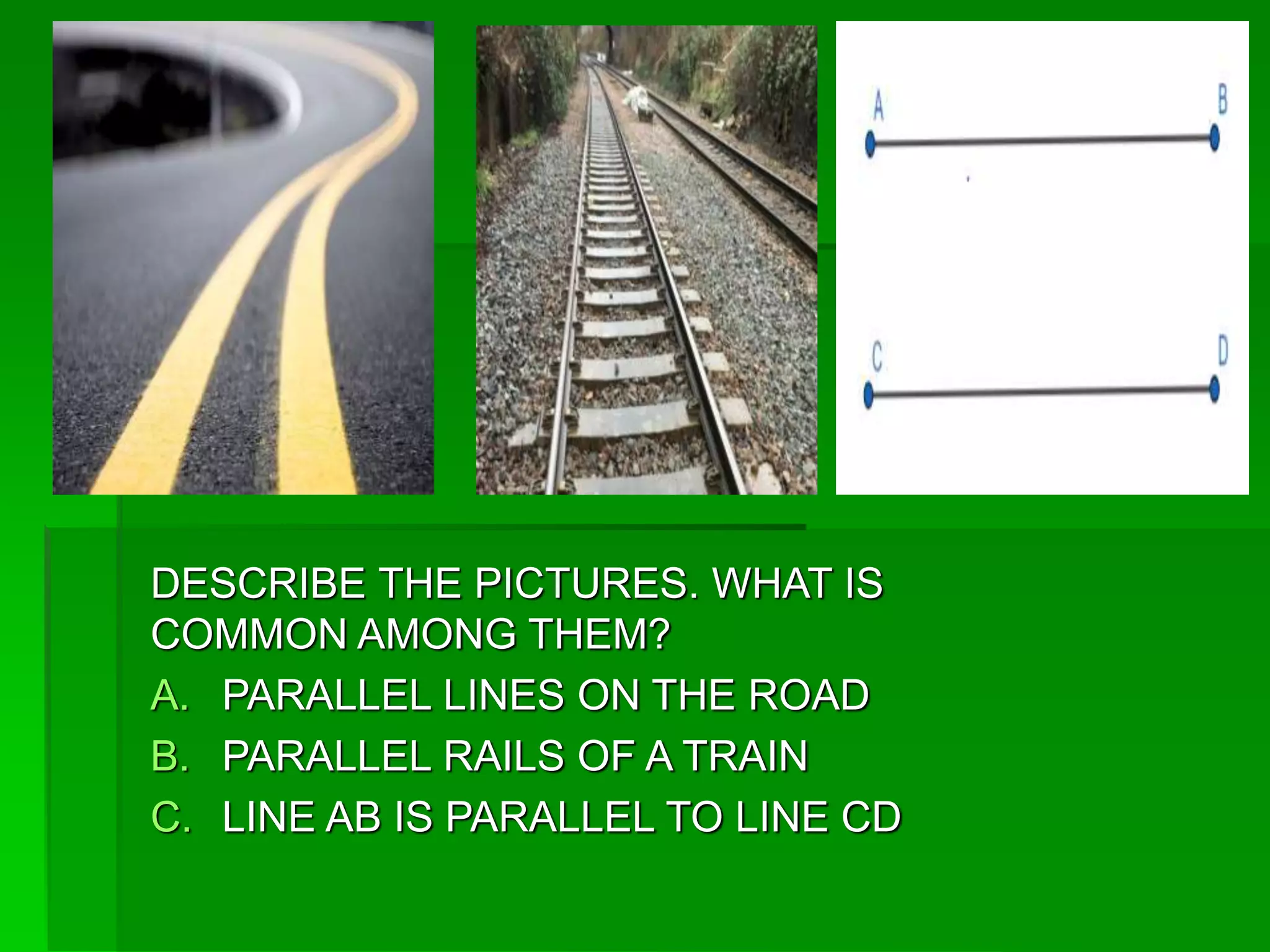
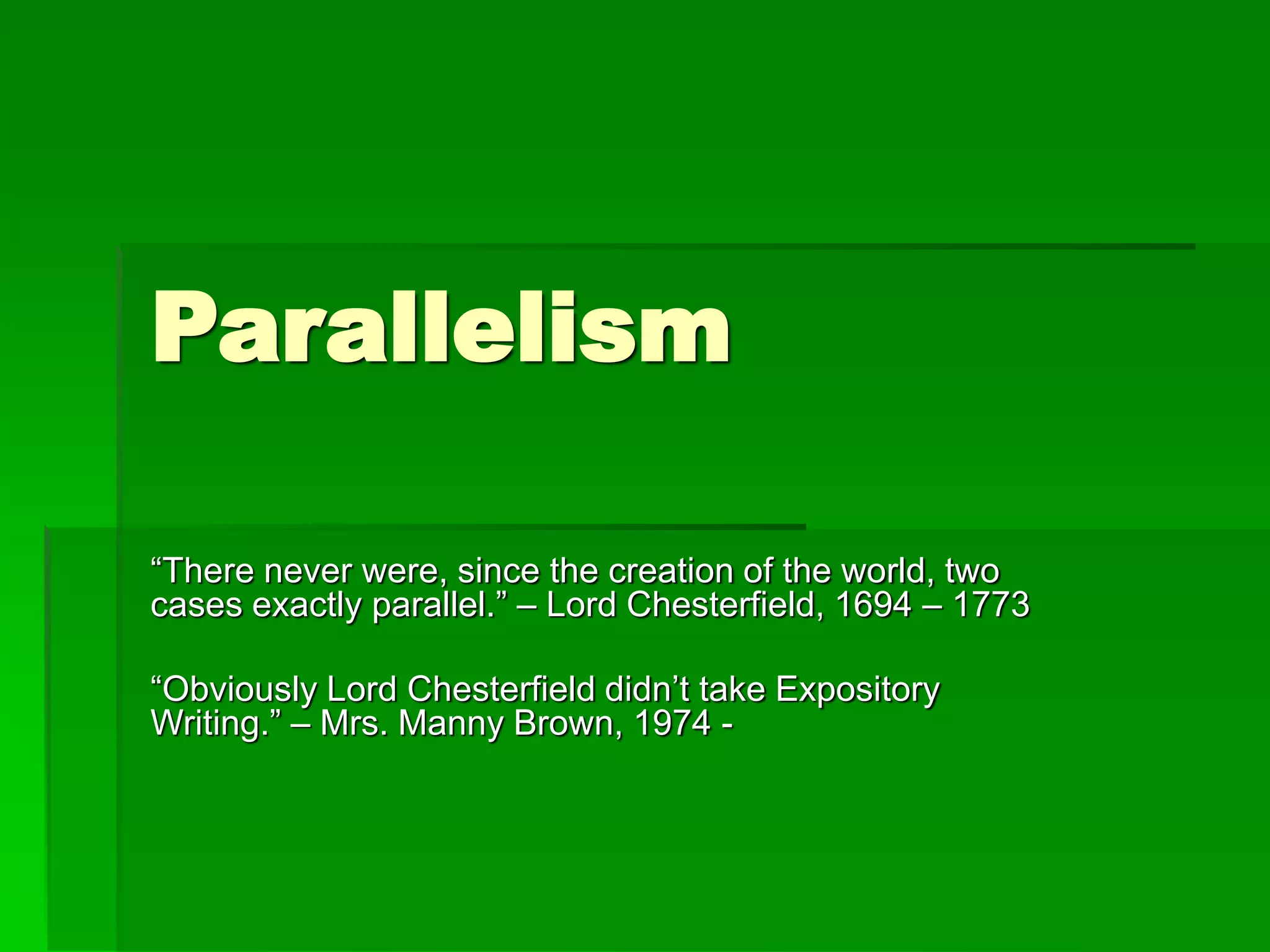
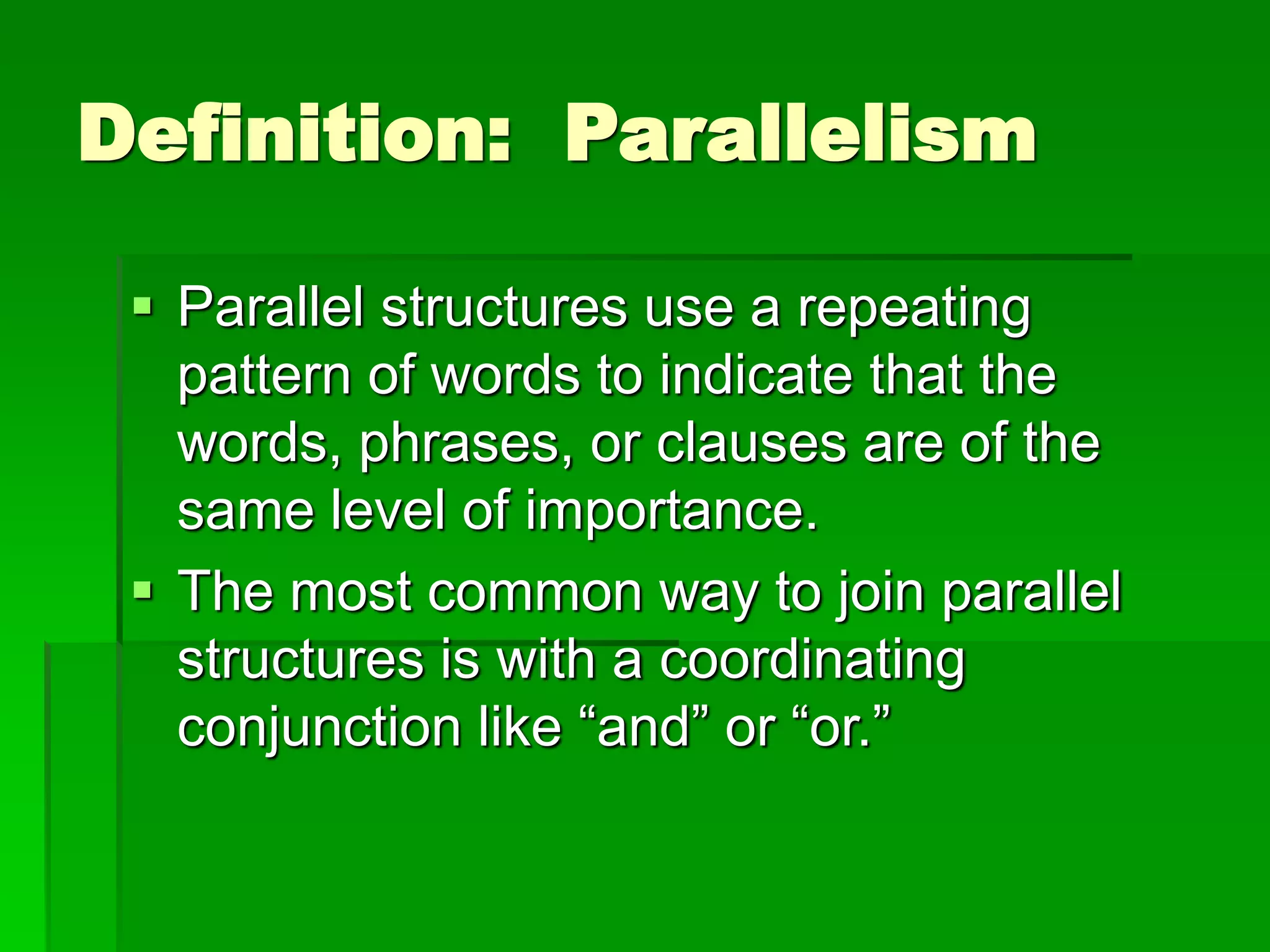
DESCRIBE THE PICTURES. WHAT IS
COMMON AMONG THEM?
A. PARALLEL LINES ON THE ROAD
B. PARALLEL RAILS OF A TRAIN
C. LINE AB IS PARALLEL TO LINE CD
Parallelism
“There never were, since the creation of the world, two
cases exactly parallel.” – Lord Chesterfield, 1694 – 1773
“Obviously Lord Chesterfield didn’t take Expository
Writing.” – Mrs. Manny Brown, 1974 -
Definition: Parallelism
 Parallel structures use a repeating
pattern of words to indicate that the
words, phrases, or clauses are of the
same level of importance.
 The most common way to join parallel
structures is with a coordinating
conjunction like “and” or “or.”
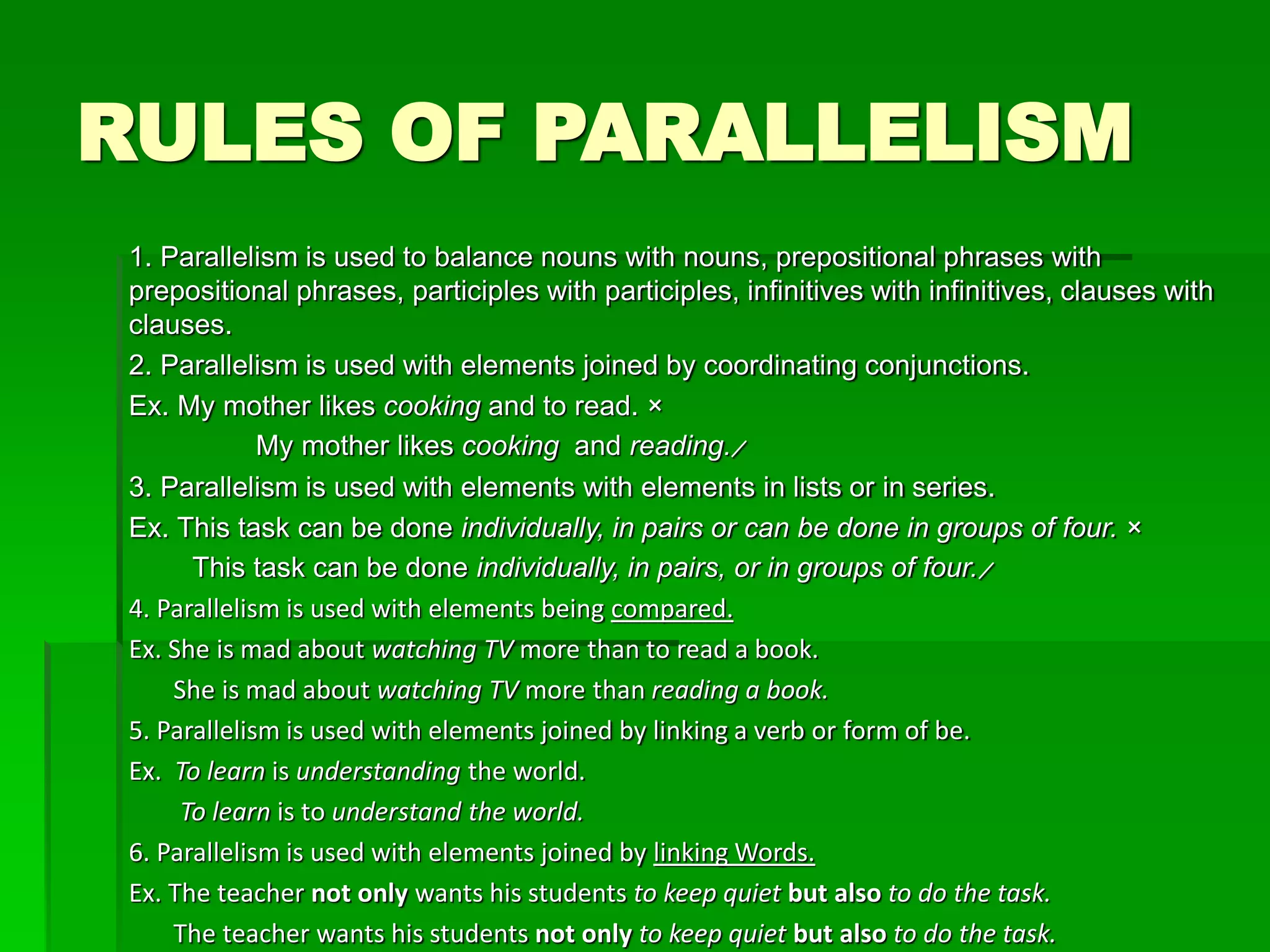
RULES OF PARALLELISM
1. Parallelism is used to balance nouns with nouns, prepositional phrases with
prepositional phrases, participles with participles, infinitives with infinitives, clauses with
clauses.
2. Parallelism is used with elements joined by coordinating conjunctions.
Ex. My mother likes cooking and to read. ×
My mother likes cooking and reading. ̷
3. Parallelism is used with elements with elements in lists or in series.
Ex. This task can be done individually, in pairs or can be done in groups of four. ×
This task can be done individually, in pairs, or in groups of four. ̷
4. Parallelism is used with elements being compared.
Ex. She is mad about watching TV more than to read a book.
She is mad about watching TV more than reading a book.
5. Parallelism is used with elements joined by linking a verb or form of be.
Ex. To learn is understanding the world.
To learn is to understand the world.
6. Parallelism is used with elements joined by linking Words.
Ex. The teacher not only wants his students to keep quiet but also to do the task.
The teacher wants his students not only to keep quiet but also to do the task.
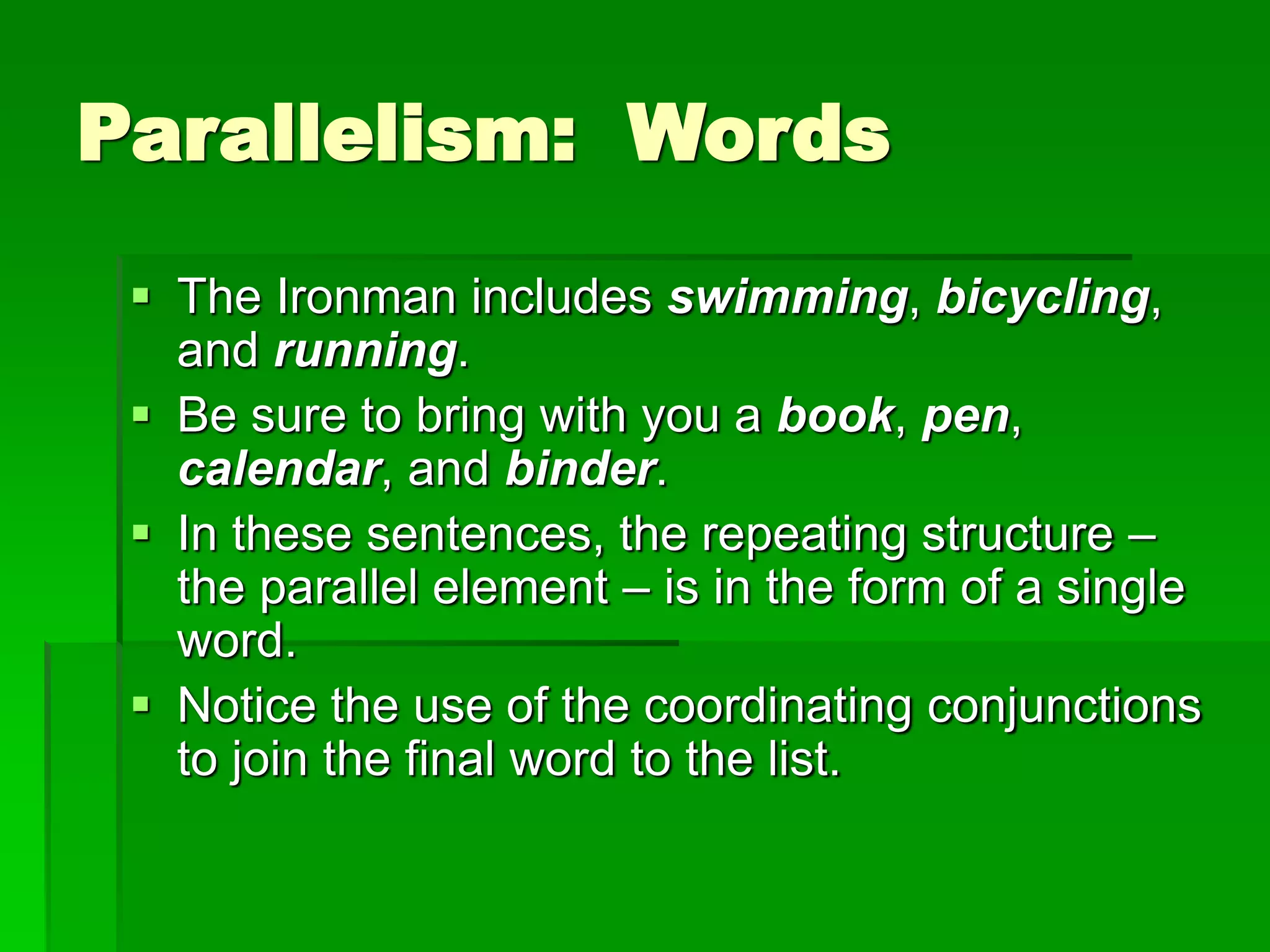
Parallelism: Words
 The Ironman includes swimming, bicycling,
and running.
 Be sure to bring with you a book, pen,
calendar, and binder.
 In these sentences, the repeating structure –
the parallel element – is in the form of a single
word.
 Notice the use of the coordinating conjunctions
to join the final word to the list.
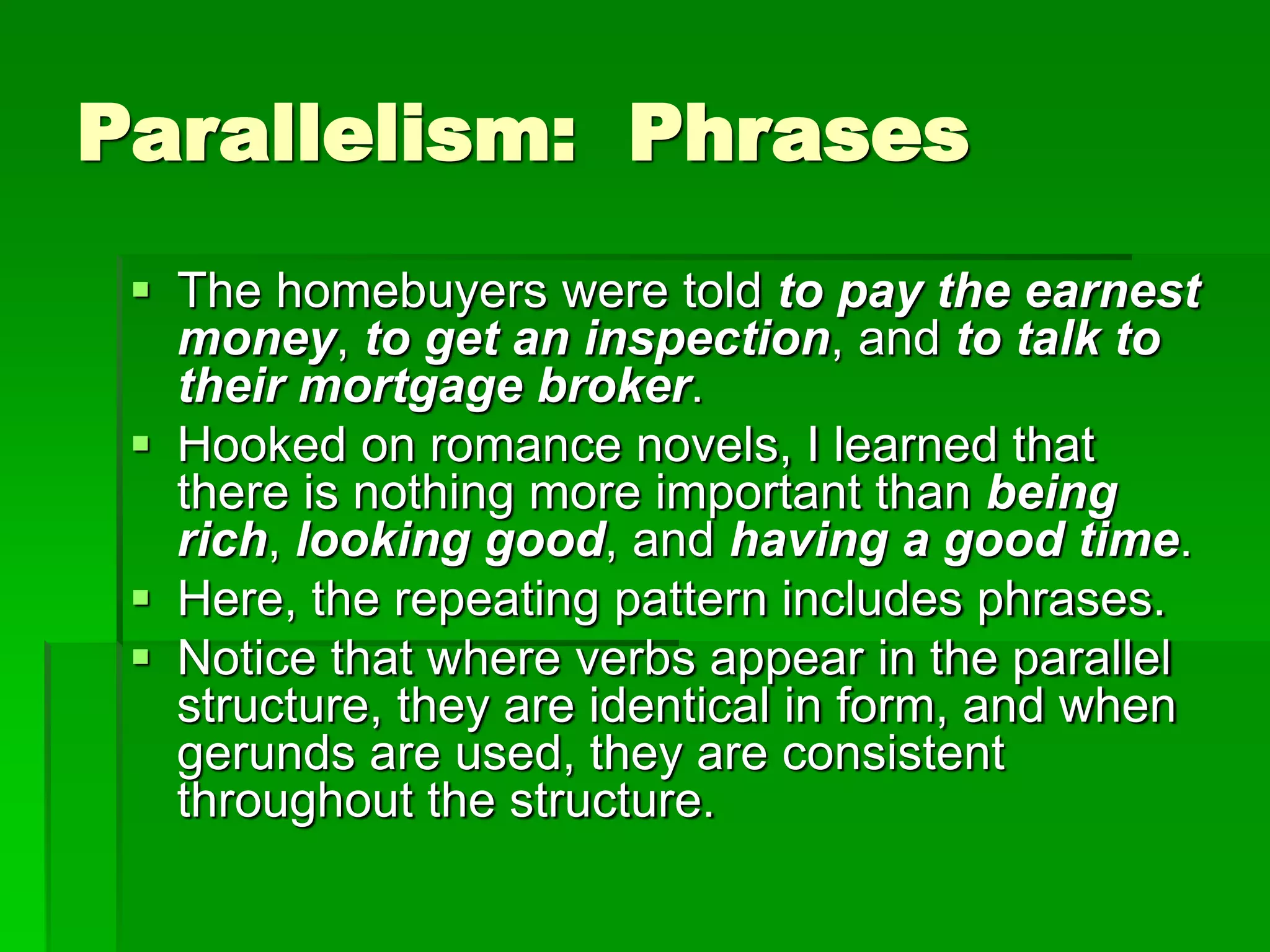
Parallelism: Phrases
 The homebuyers were told to pay the earnest
money, to get an inspection, and to talk to
their mortgage broker.
 Hooked on romance novels, I learned that
there is nothing more important than being
rich, looking good, and having a good time.
 Here, the repeating pattern includes phrases.
 Notice that where verbs appear in the parallel
structure, they are identical in form, and when
gerunds are used, they are consistent
throughout the structure.
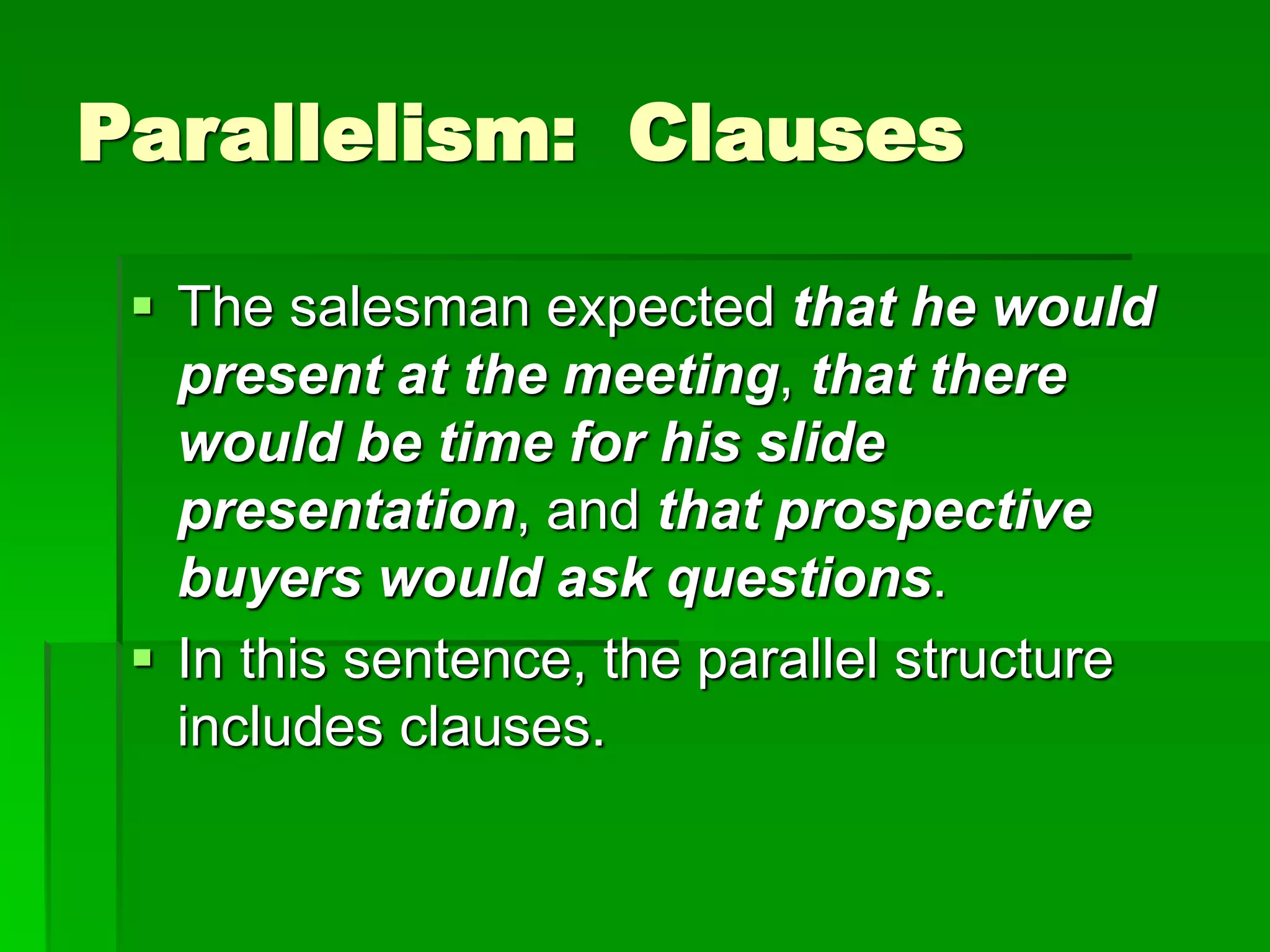
Parallelism: Clauses
 The salesman expected that he would
present at the meeting, that there
would be time for his slide
presentation, and that prospective
buyers would ask questions.
 In this sentence, the parallel structure
includes clauses.
Parallelism: Lists
 Abused children commonly exhibit one or more
of the following symptoms: withdrawal,
rebelliousness, restlessness, and depression.
 A thesaurus can be used to find: synonyms,
antonyms, connotations, and denotations.
 All items that appear in a list after a colon must
take the same form.
Parallelism: Items in Pairs
 At Lincoln High School, vandalism can result in
suspension or expulsion.
 Thomas Edison was not only a prolific inventor, but
also a successful entrepreneur.
 It is easier to speak in abstractions than to ground
one’s thoughts in reality.
 Each of these sentences uses a different technique to
join two items in a parallel pair.
 The first sentence uses the coordinating conjunction
“or;” the second uses a correlative conjunction, “not
only . . . but also;” the third uses the preposition “than.”
Parallelism: Function
Words
 To stop smoking, many smokers try switching
to a brand they find distasteful or to a low tar
and nicotine cigarette.
 Riley told me that she was late, that she
couldn’t be bothered to get a pass, and that I’d
just have to deal with it.
 Repeat function words to clarify parallels.
 Function words could include prepositions like
“by” or “to,” or subordinating conjunctions like
“that” or “because.”

parallelism.ppt

  • 1.
    What have younoticed with this group of photos? Which of the photo is different? Why would you say so? What can be drawn out from the instance of seeing photos?
  • 2.
    DESCRIBE THE PICTURES.WHAT IS COMMON AMONG THEM? A. PARALLEL LINES ON THE ROAD B. PARALLEL RAILS OF A TRAIN C. LINE AB IS PARALLEL TO LINE CD
  • 3.
    Parallelism “There never were,since the creation of the world, two cases exactly parallel.” – Lord Chesterfield, 1694 – 1773 “Obviously Lord Chesterfield didn’t take Expository Writing.” – Mrs. Manny Brown, 1974 -
  • 4.
    Definition: Parallelism  Parallelstructures use a repeating pattern of words to indicate that the words, phrases, or clauses are of the same level of importance.  The most common way to join parallel structures is with a coordinating conjunction like “and” or “or.”
  • 5.
    RULES OF PARALLELISM 1.Parallelism is used to balance nouns with nouns, prepositional phrases with prepositional phrases, participles with participles, infinitives with infinitives, clauses with clauses. 2. Parallelism is used with elements joined by coordinating conjunctions. Ex. My mother likes cooking and to read. × My mother likes cooking and reading. ̷ 3. Parallelism is used with elements with elements in lists or in series. Ex. This task can be done individually, in pairs or can be done in groups of four. × This task can be done individually, in pairs, or in groups of four. ̷ 4. Parallelism is used with elements being compared. Ex. She is mad about watching TV more than to read a book. She is mad about watching TV more than reading a book. 5. Parallelism is used with elements joined by linking a verb or form of be. Ex. To learn is understanding the world. To learn is to understand the world. 6. Parallelism is used with elements joined by linking Words. Ex. The teacher not only wants his students to keep quiet but also to do the task. The teacher wants his students not only to keep quiet but also to do the task.
  • 6.
    Parallelism: Words  TheIronman includes swimming, bicycling, and running.  Be sure to bring with you a book, pen, calendar, and binder.  In these sentences, the repeating structure – the parallel element – is in the form of a single word.  Notice the use of the coordinating conjunctions to join the final word to the list.
  • 7.
    Parallelism: Phrases  Thehomebuyers were told to pay the earnest money, to get an inspection, and to talk to their mortgage broker.  Hooked on romance novels, I learned that there is nothing more important than being rich, looking good, and having a good time.  Here, the repeating pattern includes phrases.  Notice that where verbs appear in the parallel structure, they are identical in form, and when gerunds are used, they are consistent throughout the structure.
  • 8.
    Parallelism: Clauses  Thesalesman expected that he would present at the meeting, that there would be time for his slide presentation, and that prospective buyers would ask questions.  In this sentence, the parallel structure includes clauses.
  • 9.
    Parallelism: Lists  Abusedchildren commonly exhibit one or more of the following symptoms: withdrawal, rebelliousness, restlessness, and depression.  A thesaurus can be used to find: synonyms, antonyms, connotations, and denotations.  All items that appear in a list after a colon must take the same form.
  • 10.
    Parallelism: Items inPairs  At Lincoln High School, vandalism can result in suspension or expulsion.  Thomas Edison was not only a prolific inventor, but also a successful entrepreneur.  It is easier to speak in abstractions than to ground one’s thoughts in reality.  Each of these sentences uses a different technique to join two items in a parallel pair.  The first sentence uses the coordinating conjunction “or;” the second uses a correlative conjunction, “not only . . . but also;” the third uses the preposition “than.”
  • 11.
    Parallelism: Function Words  Tostop smoking, many smokers try switching to a brand they find distasteful or to a low tar and nicotine cigarette.  Riley told me that she was late, that she couldn’t be bothered to get a pass, and that I’d just have to deal with it.  Repeat function words to clarify parallels.  Function words could include prepositions like “by” or “to,” or subordinating conjunctions like “that” or “because.”