CURRICULUM
DEVELOPMENT MODELS
Mirasol O. Gallogo
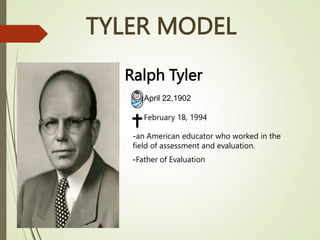
Ralph Tyler
April 22,1902
February 18, 1994
-an American educator who worked in the
field of assessment and evaluation.
-Father of Evaluation
TYLER MODEL
Ralf Tyler Model
 Presented in his Book- Basic Principles of Curriculum, and
Instruction published in 1949.
• Known as the objective Model and is among the most widely
used curriculum development models.
• Emphasizes on Planning phase and importance of planning in
creating curriculum.
• Deductive
• Administrators should design the curriculum, teachers are
implementers (top to bottom).
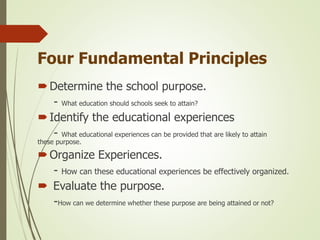
Four Fundamental Principles
Determine the school purpose.
- What education should schools seek to attain?
Identify the educational experiences
- What educational experiences can be provided that are likely to attain
these purpose.
Organize Experiences.
- How can these educational experiences be effectively organized.
 Evaluate the purpose.
-How can we determine whether these purpose are being attained or not?
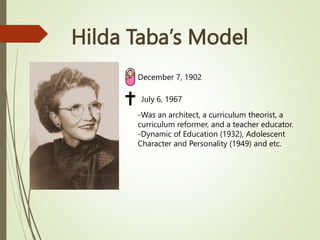
Hilda Taba’s Model
December 7, 1902
July 6, 1967
-Was an architect, a curriculum theorist, a
curriculum reformer, and a teacher educator.
-Dynamic of Education (1932), Adolescent
Character and Personality (1949) and etc.
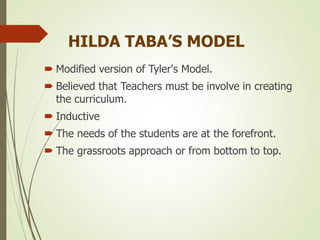
HILDA TABA’S MODEL
 Modified version of Tyler's Model.
 Believed that Teachers must be involve in creating
the curriculum.
 Inductive
 The needs of the students are at the forefront.
 The grassroots approach or from bottom to top.
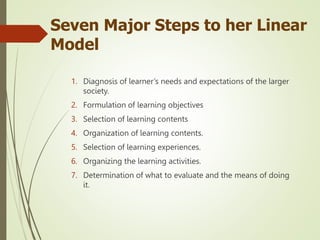
Seven Major Steps to her Linear
Model
1. Diagnosis of learner’s needs and expectations of the larger
society.
2. Formulation of learning objectives
3. Selection of learning contents
4. Organization of learning contents.
5. Selection of learning experiences.
6. Organizing the learning activities.
7. Determination of what to evaluate and the means of doing
it.
EDUC-203 curriculum development model.pptx

EDUC-203 curriculum development model.pptx

  • 1.
  • 2.
    Ralph Tyler April 22,1902 February18, 1994 -an American educator who worked in the field of assessment and evaluation. -Father of Evaluation TYLER MODEL
  • 3.
    Ralf Tyler Model Presented in his Book- Basic Principles of Curriculum, and Instruction published in 1949. • Known as the objective Model and is among the most widely used curriculum development models. • Emphasizes on Planning phase and importance of planning in creating curriculum. • Deductive • Administrators should design the curriculum, teachers are implementers (top to bottom).
  • 4.
    Four Fundamental Principles Determinethe school purpose. - What education should schools seek to attain? Identify the educational experiences - What educational experiences can be provided that are likely to attain these purpose. Organize Experiences. - How can these educational experiences be effectively organized.  Evaluate the purpose. -How can we determine whether these purpose are being attained or not?
  • 5.
    Hilda Taba’s Model December7, 1902 July 6, 1967 -Was an architect, a curriculum theorist, a curriculum reformer, and a teacher educator. -Dynamic of Education (1932), Adolescent Character and Personality (1949) and etc.
  • 6.
    HILDA TABA’S MODEL Modified version of Tyler's Model.  Believed that Teachers must be involve in creating the curriculum.  Inductive  The needs of the students are at the forefront.  The grassroots approach or from bottom to top.
  • 7.
    Seven Major Stepsto her Linear Model 1. Diagnosis of learner’s needs and expectations of the larger society. 2. Formulation of learning objectives 3. Selection of learning contents 4. Organization of learning contents. 5. Selection of learning experiences. 6. Organizing the learning activities. 7. Determination of what to evaluate and the means of doing it.