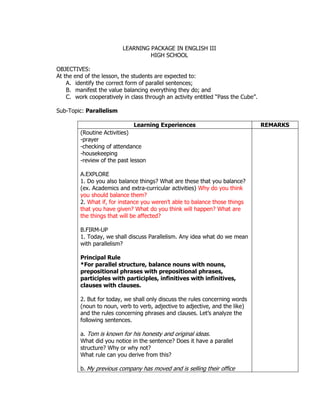
LEARNING PACKAGE IN ENGLISH III
                                   HIGH SCHOOL

OBJECTIVES:
At the end of the lesson, the students are expected to:
    A. identify the correct form of parallel sentences;
    B. manifest the value balancing everything they do; and
    C. work cooperatively in class through an activity entitled “Pass the Cube”.

Sub-Topic: Parallelism

                              Learning Experiences                                 REMARKS
         (Routine Activities)
         -prayer
         -checking of attendance
         -housekeeping
         -review of the past lesson

         A.EXPLORE
         1. Do you also balance things? What are these that you balance?
         (ex. Academics and extra-curricular activities) Why do you think
         you should balance them?
         2. What if, for instance you weren’t able to balance those things
         that you have given? What do you think will happen? What are
         the things that will be affected?

         B.FIRM-UP
         1. Today, we shall discuss Parallelism. Any idea what do we mean
         with parallelism?

         Principal Rule
         *For parallel structure, balance nouns with nouns,
         prepositional phrases with prepositional phrases,
         participles with participles, infinitives with infinitives,
         clauses with clauses.

         2. But for today, we shall only discuss the rules concerning words
         (noun to noun, verb to verb, adjective to adjective, and the like)
         and the rules concerning phrases and clauses. Let’s analyze the
         following sentences.

         a. Tom is known for his honesty and original ideas.
         What did you notice in the sentence? Does it have a parallel
         structure? Why or why not?
         What rule can you derive from this?

         b. My previous company has moved and is selling their office
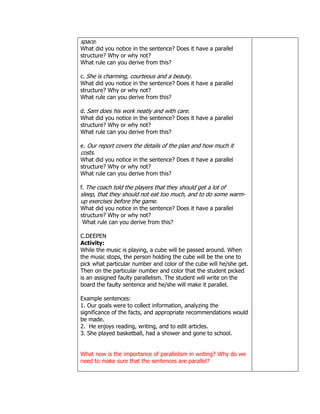
space.
What did you notice in the sentence? Does it have a parallel
structure? Why or why not?
What rule can you derive from this?

c. She is charming, courteous and a beauty.
What did you notice in the sentence? Does it have a parallel
structure? Why or why not?
What rule can you derive from this?

d. Sam does his work neatly and with care.
What did you notice in the sentence? Does it have a parallel
structure? Why or why not?
What rule can you derive from this?

e. Our report covers the details of the plan and how much it
costs.
What did you notice in the sentence? Does it have a parallel
structure? Why or why not?
What rule can you derive from this?

f. The coach told the players that they should get a lot of
sleep, that they should not eat too much, and to do some warm-
up exercises before the game.
What did you notice in the sentence? Does it have a parallel
structure? Why or why not?
 What rule can you derive from this?

C.DEEPEN
Activity:
While the music is playing, a cube will be passed around. When
the music stops, the person holding the cube will be the one to
pick what particular number and color of the cube will he/she get.
Then on the particular number and color that the student picked
is an assigned faulty parallelism. The student will write on the
board the faulty sentence and he/she will make it parallel.

Example sentences:
1. Our goals were to collect information, analyzing the
significance of the facts, and appropriate recommendations would
be made.
2. He enjoys reading, writing, and to edit articles.
3. She played basketball, had a shower and gone to school.


What now is the importance of parallelism in writing? Why do we
need to make sure that the sentences are parallel?
*Parallel construction prevents awkwardness and promotes clarity.
Balanced or symmetrical elements also tend to be more concise.
Writers who face the challenge of stating several ideas in one
sentence can often achieve this goal with remarkable clarity if they
arrange these ideas in a balanced series. This series might
comprise parallel nouns or phrases, or it might comprise a more
sophisticated sequence of parallel clauses. The result is not only
easier for the reader to follow but also more pleasing aesthetically.


                                                             Mina, Lorna Cammille
                                                                          BSEd-4

Lp for 9th actual off

  • 1.
    LEARNING PACKAGE INENGLISH III HIGH SCHOOL OBJECTIVES: At the end of the lesson, the students are expected to: A. identify the correct form of parallel sentences; B. manifest the value balancing everything they do; and C. work cooperatively in class through an activity entitled “Pass the Cube”. Sub-Topic: Parallelism Learning Experiences REMARKS (Routine Activities) -prayer -checking of attendance -housekeeping -review of the past lesson A.EXPLORE 1. Do you also balance things? What are these that you balance? (ex. Academics and extra-curricular activities) Why do you think you should balance them? 2. What if, for instance you weren’t able to balance those things that you have given? What do you think will happen? What are the things that will be affected? B.FIRM-UP 1. Today, we shall discuss Parallelism. Any idea what do we mean with parallelism? Principal Rule *For parallel structure, balance nouns with nouns, prepositional phrases with prepositional phrases, participles with participles, infinitives with infinitives, clauses with clauses. 2. But for today, we shall only discuss the rules concerning words (noun to noun, verb to verb, adjective to adjective, and the like) and the rules concerning phrases and clauses. Let’s analyze the following sentences. a. Tom is known for his honesty and original ideas. What did you notice in the sentence? Does it have a parallel structure? Why or why not? What rule can you derive from this? b. My previous company has moved and is selling their office
  • 2.
    space. What did younotice in the sentence? Does it have a parallel structure? Why or why not? What rule can you derive from this? c. She is charming, courteous and a beauty. What did you notice in the sentence? Does it have a parallel structure? Why or why not? What rule can you derive from this? d. Sam does his work neatly and with care. What did you notice in the sentence? Does it have a parallel structure? Why or why not? What rule can you derive from this? e. Our report covers the details of the plan and how much it costs. What did you notice in the sentence? Does it have a parallel structure? Why or why not? What rule can you derive from this? f. The coach told the players that they should get a lot of sleep, that they should not eat too much, and to do some warm- up exercises before the game. What did you notice in the sentence? Does it have a parallel structure? Why or why not? What rule can you derive from this? C.DEEPEN Activity: While the music is playing, a cube will be passed around. When the music stops, the person holding the cube will be the one to pick what particular number and color of the cube will he/she get. Then on the particular number and color that the student picked is an assigned faulty parallelism. The student will write on the board the faulty sentence and he/she will make it parallel. Example sentences: 1. Our goals were to collect information, analyzing the significance of the facts, and appropriate recommendations would be made. 2. He enjoys reading, writing, and to edit articles. 3. She played basketball, had a shower and gone to school. What now is the importance of parallelism in writing? Why do we need to make sure that the sentences are parallel?
  • 3.
    *Parallel construction preventsawkwardness and promotes clarity. Balanced or symmetrical elements also tend to be more concise. Writers who face the challenge of stating several ideas in one sentence can often achieve this goal with remarkable clarity if they arrange these ideas in a balanced series. This series might comprise parallel nouns or phrases, or it might comprise a more sophisticated sequence of parallel clauses. The result is not only easier for the reader to follow but also more pleasing aesthetically. Mina, Lorna Cammille BSEd-4