What is the purpose of a
critique?
   It is to evaluate somebody's work (a book, an
    essay, a movie, a painting...) in order to
    increase the reader's understanding of it.
   it expresses the writer's opinion or evaluation of
    a text
   a critical analysis is not merely to inform, but
    also to evaluate the worth, utility, excellence,
    distinction, truth, validity, beauty, or goodness of
    something
   Analysis means to break down and study the
    parts.
   Writing a critical paper requires two steps:
    critical reading and critical writing.
To critique a piece of writing is to
do the following:
 1) describe: give the reader a sense of
  the writer's overall purpose and meaning
 2) analyze: show how it is put together
  by dividing it into its main sections or
  aspects
 3) interpret: define the significance
  (meaning and importance) of each part
  (or missing parts)
 4) assess: make a judgment of the
  work's worth or value
Step 1: Read
 Read
 Re-read
 Re-read
 And read again.
 It is important to familiarize yourself with
  the document. There are multiple things
  you need to look for you can’t possibly
  find them all after the first read.
Step 2: Notes
   As you read, TAKE NOTES!!
   Circle, highlight, underline, and comment on your
    article.
   Look for:
     the author’s purpose of the paper
      ○ (very important)
    Is the purpose to inform with factual material?
    Is the purpose to persuade with appeal to reason or
    emotions?
   Is the purpose to entertain (to affect people's
    emotions)?
   Also look for:
     Patterns
     Tone: funny, serious
Step 3: Gather your
resources
 Find out where the work was published
  – does that help you figure out the
  author’s purpose and audience?
 What are the author’s obvious strategies
  in making his or her point?
 Are they successful?
Step 4: Investigate Further
 Look at underlying assumptions, both
  yours and the writer’s.
 Look for places where the author has left
  gaps
    – are these deliberate?
     Do they need to be filled?
     Does the author play on your emotions? How?
     Is he or she using any images or ideas that play
      on some abstract, for example patriotism?
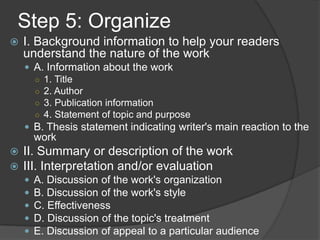
Step 5: Organize
   I. Background information to help your readers
    understand the nature of the work
     A. Information about the work
      ○ 1. Title
      ○ 2. Author
      ○ 3. Publication information
      ○ 4. Statement of topic and purpose
     B. Thesis statement indicating writer's main reaction to the
        work
   II. Summary or description of the work
   III. Interpretation and/or evaluation
       A. Discussion of the work's organization
       B. Discussion of the work's style
       C. Effectiveness
       D. Discussion of the topic's treatment
       E. Discussion of appeal to a particular audience
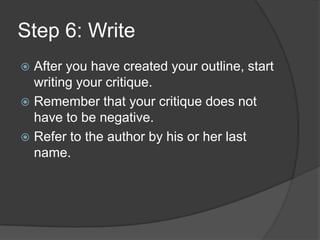
Step 6: Write
 After you have created your outline, start
  writing your critique.
 Remember that your critique does not
  have to be negative.
 Refer to the author by his or her last
  name.

Writing a Critique

  • 2.
    What is thepurpose of a critique?  It is to evaluate somebody's work (a book, an essay, a movie, a painting...) in order to increase the reader's understanding of it.  it expresses the writer's opinion or evaluation of a text  a critical analysis is not merely to inform, but also to evaluate the worth, utility, excellence, distinction, truth, validity, beauty, or goodness of something  Analysis means to break down and study the parts.  Writing a critical paper requires two steps: critical reading and critical writing.
  • 3.
    To critique apiece of writing is to do the following:  1) describe: give the reader a sense of the writer's overall purpose and meaning  2) analyze: show how it is put together by dividing it into its main sections or aspects  3) interpret: define the significance (meaning and importance) of each part (or missing parts)  4) assess: make a judgment of the work's worth or value
  • 4.
    Step 1: Read Read  Re-read  Re-read  And read again.  It is important to familiarize yourself with the document. There are multiple things you need to look for you can’t possibly find them all after the first read.
  • 5.
    Step 2: Notes  As you read, TAKE NOTES!!  Circle, highlight, underline, and comment on your article.  Look for:  the author’s purpose of the paper ○ (very important)  Is the purpose to inform with factual material?  Is the purpose to persuade with appeal to reason or emotions?  Is the purpose to entertain (to affect people's emotions)?  Also look for:  Patterns  Tone: funny, serious
  • 6.
    Step 3: Gatheryour resources  Find out where the work was published – does that help you figure out the author’s purpose and audience?  What are the author’s obvious strategies in making his or her point?  Are they successful?
  • 7.
    Step 4: InvestigateFurther  Look at underlying assumptions, both yours and the writer’s.  Look for places where the author has left gaps – are these deliberate?  Do they need to be filled?  Does the author play on your emotions? How?  Is he or she using any images or ideas that play on some abstract, for example patriotism?
  • 8.
    Step 5: Organize  I. Background information to help your readers understand the nature of the work  A. Information about the work ○ 1. Title ○ 2. Author ○ 3. Publication information ○ 4. Statement of topic and purpose  B. Thesis statement indicating writer's main reaction to the work  II. Summary or description of the work  III. Interpretation and/or evaluation  A. Discussion of the work's organization  B. Discussion of the work's style  C. Effectiveness  D. Discussion of the topic's treatment  E. Discussion of appeal to a particular audience
  • 9.
    Step 6: Write After you have created your outline, start writing your critique.  Remember that your critique does not have to be negative.  Refer to the author by his or her last name.