USING CONDITIONAL IN
EXPRESSING ARGUMENTS
(ZERO CONDITIONAL)
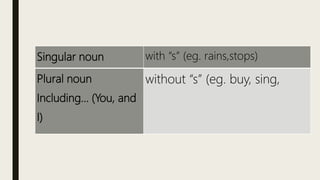
Singular noun with “s” (eg. rains,stops)
Plural noun
Including… (You, and
I)
without “s” (eg. buy, sing,
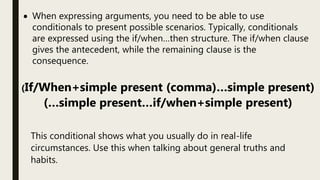
 When expressing arguments, you need to be able to use
conditionals to present possible scenarios. Typically, conditionals
are expressed using the if/when…then structure. The if/when clause
gives the antecedent, while the remaining clause is the
consequence.
(If/When+simple present (comma)…simple present)
(…simple present…if/when+simple present)
This conditional shows what you usually do in real-life
circumstances. Use this when talking about general truths and
habits.
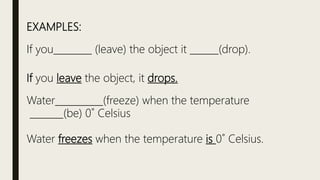
EXAMPLES:
If you________ (leave) the object it ______(drop).
If you leave the object, it drops.
Water__________(freeze) when the temperature
_______(be) 0˚ Celsius
Water freezes when the temperature is 0˚ Celsius.
USING CONDITIONALS IN
EXPRESSING ARGUMENTS
(FIRST CONDITIONAL)
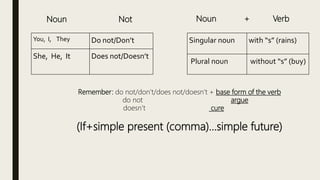
You, I, They Do not/Don’t
She, He, It Does not/Doesn’t
Singular noun with “s” (rains)
Plural noun without “s” (buy)
Noun Not Noun + Verb
Remember: do not/don’t/does not/doesn’t + base form of the verb
do not argue
doesn’t cure
(If+simple present (comma)…simple future)
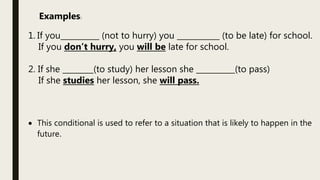
1. If you__________ (not to hurry) you ___________ (to be late) for school.
If you don’t hurry, you will be late for school.
2. If she ________(to study) her lesson she __________(to pass)
If she studies her lesson, she will pass.
 This conditional is used to refer to a situation that is likely to happen in the
future.
Examples:
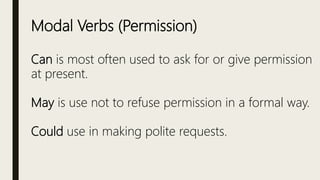
Modal Verbs (Permission)
Can is most often used to ask for or give permission
at present.
May is use not to refuse permission in a formal way.
Could use in making polite requests.
USING CONDITIONAL IN
EXPRESSING ARGUMENTS
(SECOND CONDITIONAL)
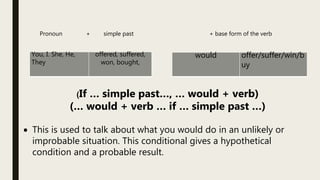
You, I. She, He,
They
offered, suffered,
won, bought,
would offer/suffer/win/b
uy
Pronoun + simple past + base form of the verb
(If … simple past…, … would + verb)
(… would + verb … if … simple past …)
 This is used to talk about what you would do in an unlikely or
improbable situation. This conditional gives a hypothetical
condition and a probable result.
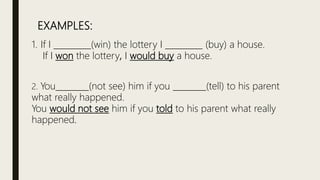
EXAMPLES:
1. If I _________(win) the lottery I _________ (buy) a house.
If I won the lottery, I would buy a house.
2. You________(not see) him if you ________(tell) to his parent
what really happened.
You would not see him if you told to his parent what really
happened.
USING CONDITIONALS IN
EXPRESSING ARGUMENTS
(THIRD CONDITIONAL)
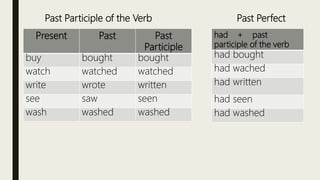
Past Participle of the Verb Past Perfect
Present Past Past
Participle
buy bought bought
watch watched watched
write wrote written
see saw seen
wash washed washed
had + past
participle of the verb
had bought
had wached
had written
had seen
had washed
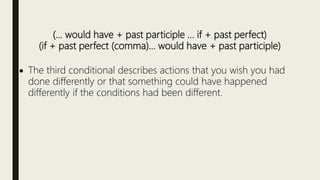
(… would have + past participle … if + past perfect)
(if + past perfect (comma)… would have + past participle)
 The third conditional describes actions that you wish you had
done differently or that something could have happened
differently if the conditions had been different.
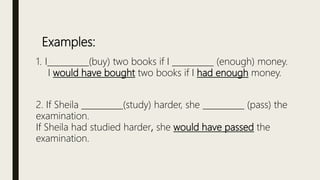
Examples:
1. I__________(buy) two books if I __________ (enough) money.
I would have bought two books if I had enough money.
2. If Sheila __________(study) harder, she __________ (pass) the
examination.
If Sheila had studied harder, she would have passed the
examination.

Using conditional-in-expressing-arguments

  • 1.
    USING CONDITIONAL IN EXPRESSINGARGUMENTS (ZERO CONDITIONAL)
  • 2.
    Singular noun with“s” (eg. rains,stops) Plural noun Including… (You, and I) without “s” (eg. buy, sing,
  • 3.
     When expressingarguments, you need to be able to use conditionals to present possible scenarios. Typically, conditionals are expressed using the if/when…then structure. The if/when clause gives the antecedent, while the remaining clause is the consequence. (If/When+simple present (comma)…simple present) (…simple present…if/when+simple present) This conditional shows what you usually do in real-life circumstances. Use this when talking about general truths and habits.
  • 4.
    EXAMPLES: If you________ (leave)the object it ______(drop). If you leave the object, it drops. Water__________(freeze) when the temperature _______(be) 0˚ Celsius Water freezes when the temperature is 0˚ Celsius.
  • 5.
    USING CONDITIONALS IN EXPRESSINGARGUMENTS (FIRST CONDITIONAL)
  • 6.
    You, I, TheyDo not/Don’t She, He, It Does not/Doesn’t Singular noun with “s” (rains) Plural noun without “s” (buy) Noun Not Noun + Verb Remember: do not/don’t/does not/doesn’t + base form of the verb do not argue doesn’t cure (If+simple present (comma)…simple future)
  • 7.
    1. If you__________(not to hurry) you ___________ (to be late) for school. If you don’t hurry, you will be late for school. 2. If she ________(to study) her lesson she __________(to pass) If she studies her lesson, she will pass.  This conditional is used to refer to a situation that is likely to happen in the future. Examples:
  • 8.
    Modal Verbs (Permission) Canis most often used to ask for or give permission at present. May is use not to refuse permission in a formal way. Could use in making polite requests.
  • 9.
    USING CONDITIONAL IN EXPRESSINGARGUMENTS (SECOND CONDITIONAL)
  • 10.
    You, I. She,He, They offered, suffered, won, bought, would offer/suffer/win/b uy Pronoun + simple past + base form of the verb (If … simple past…, … would + verb) (… would + verb … if … simple past …)  This is used to talk about what you would do in an unlikely or improbable situation. This conditional gives a hypothetical condition and a probable result.
  • 11.
    EXAMPLES: 1. If I_________(win) the lottery I _________ (buy) a house. If I won the lottery, I would buy a house. 2. You________(not see) him if you ________(tell) to his parent what really happened. You would not see him if you told to his parent what really happened.
  • 12.
    USING CONDITIONALS IN EXPRESSINGARGUMENTS (THIRD CONDITIONAL)
  • 13.
    Past Participle ofthe Verb Past Perfect Present Past Past Participle buy bought bought watch watched watched write wrote written see saw seen wash washed washed had + past participle of the verb had bought had wached had written had seen had washed
  • 14.
    (… would have+ past participle … if + past perfect) (if + past perfect (comma)… would have + past participle)  The third conditional describes actions that you wish you had done differently or that something could have happened differently if the conditions had been different.
  • 15.
    Examples: 1. I__________(buy) twobooks if I __________ (enough) money. I would have bought two books if I had enough money. 2. If Sheila __________(study) harder, she __________ (pass) the examination. If Sheila had studied harder, she would have passed the examination.