Electricity
Let’s Review…
Atoms have 3 subatomic
  particles                  Charged Atom (atom with a
      • Protons = positive    positive or negative charge)
      • Electrons = negative   • Object must gain or lose
                                 electrons
      • Neutrons = neutral     • ONLY THE ELECTRONS
                                   MOVE
Neutral Atom                     • Measured in Coulombs
  • “Normal” state
  • # Protons = # Electrons
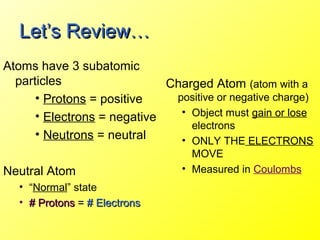
Charge & Force
Attraction
                                         “Opposites
  Forces pull together         + -
                                          Attract”


Repulsion
  Forces push apart        +         +


Rules of Charge
  Like charges repel (+/+ or -/-)
  Opposite charges attract (+/-)
Electricity
Definition: Electricity is the energy associated with
  charged particles as they move from place to place

The type of material determines how charges move
  through them

  Conductors
     • Materials that allow electric charges to move easily
     • Metals

   Insulators
      • Materials that do NOT allow electrons to flow freely
      • Rubber, plastic
Forms of Electricity
Static
    • Due to build up of charges in or on an
      object


Current
    • The flow of electrons in a circuit
Static Electricity
• Static electricity is electricity “AT REST”
• Occurs between 2 objects that become
  oppositely charged
• Objects involved have unequal electric
  charges
• Examples
  • Clothes sticking together in the dryer (if no
    dryer sheet is used)
  • Hair standing up after being brushed (on days
    with low humidity)
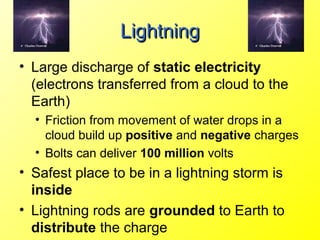
Lightning
• Large discharge of static electricity
  (electrons transferred from a cloud to the
  Earth)
  • Friction from movement of water drops in a
    cloud build up positive and negative charges
  • Bolts can deliver 100 million volts
• Safest place to be in a lightning storm is
  inside
• Lightning rods are grounded to Earth to
  distribute the charge
Electric Circuit
An electric circuit is a path for the
 electrons to flow
  • Flowing Electrons = current


Electricity can only flow through a CLOSED
  circuit (not an open one)

                    Hi-Lite
                     This!
Voltage (Potential Difference)
• The PUSH that makes electrons flow
  (electrons have potential to flow but won’t
  on their own)
• A difference between energy levels is
  needed for flow
  • Electrons flow in a circuit when there is an energy
    difference from one end of the energy source to
    the other end of the energy source (like a battery)
• Units = VOLTS (V)
• Symbol = V (capital)
• Measured with a Voltmeter
Electric Current
•   The FLOW of electric charges in a circuit
•   Units = Amperes (amps)
•   Symbol = I
•   Speed of Current is affected by
    • Type, length, & thickness of wire
    • Voltage
    • When Voltage , Current 
2 Types of Electric Current
Direct Current (DC)
  • Electron flow is always in the same direction
  • Ex: Batteries


Alternating Current (AC)
  • Electrons reverse the direction of flow 60
    times per second
  • Ex: Electricity in the Home
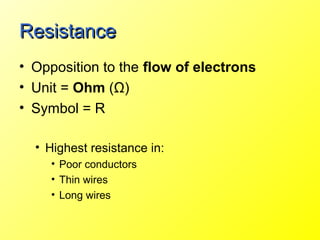
Resistance
• Opposition to the flow of electrons
• Unit = Ohm (Ω)
• Symbol = R

  • Highest resistance in:
    • Poor conductors
    • Thin wires
    • Long wires
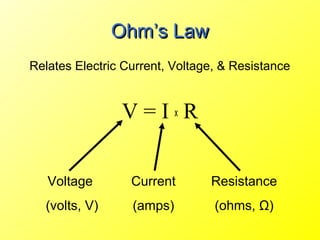
Ohm’s Law
Relates Electric Current, Voltage, & Resistance


                V=IxR


   Voltage        Current       Resistance
  (volts, V)      (amps)         (ohms, Ω)
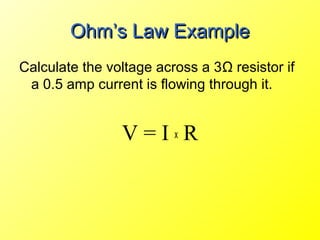
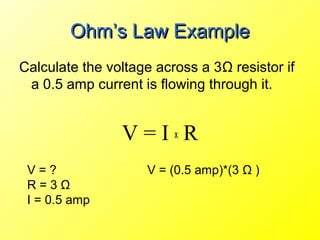
Ohm’s Law Example
Calculate the voltage across a 3Ω resistor if
 a 0.5 amp current is flowing through it.


                V=IxR
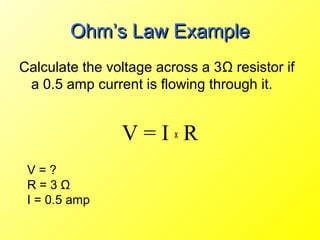
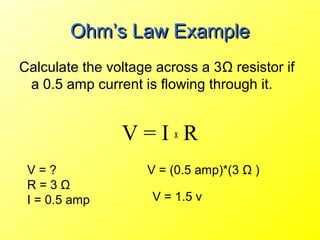
Ohm’s Law Example
Calculate the voltage across a 3Ω resistor if
 a 0.5 amp current is flowing through it.


                V=IxR
 V=?
 R=3Ω
 I = 0.5 amp
Ohm’s Law Example
Calculate the voltage across a 3Ω resistor if
 a 0.5 amp current is flowing through it.


                V=IxR
 V=?                V = (0.5 amp)*(3 Ω )
 R=3Ω
 I = 0.5 amp
Ohm’s Law Example
Calculate the voltage across a 3Ω resistor if
 a 0.5 amp current is flowing through it.


                V=IxR
 V=?                V = (0.5 amp)*(3 Ω )
 R=3Ω
 I = 0.5 amp         V = 1.5 v
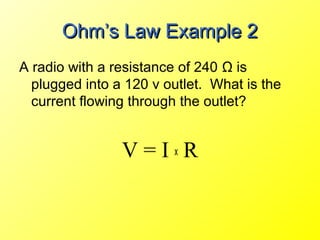
Ohm’s Law Example 2
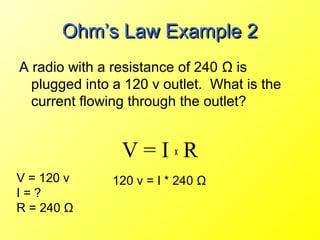
A radio with a resistance of 240 Ω is
  plugged into a 120 v outlet. What is the
  current flowing through the outlet?


                V=IxR
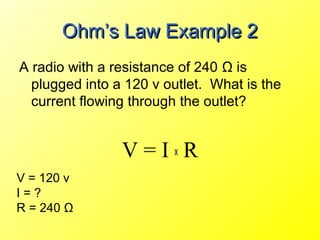
Ohm’s Law Example 2
A radio with a resistance of 240 Ω is
  plugged into a 120 v outlet. What is the
  current flowing through the outlet?


                V=IxR
V = 120 v
I=?
R = 240 Ω
Ohm’s Law Example 2
A radio with a resistance of 240 Ω is
  plugged into a 120 v outlet. What is the
  current flowing through the outlet?


                V=IxR
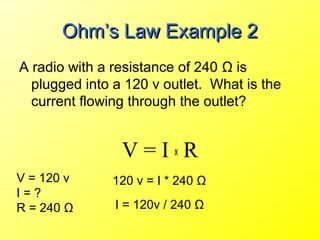
V = 120 v     120 v = I * 240 Ω
I=?
R = 240 Ω
Ohm’s Law Example 2
A radio with a resistance of 240 Ω is
  plugged into a 120 v outlet. What is the
  current flowing through the outlet?


                V=IxR
V = 120 v     120 v = I * 240 Ω
I=?
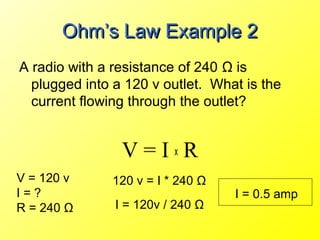
R = 240 Ω      I = 120v / 240 Ω
Ohm’s Law Example 2
A radio with a resistance of 240 Ω is
  plugged into a 120 v outlet. What is the
  current flowing through the outlet?


                V=IxR
V = 120 v     120 v = I * 240 Ω
I=?                               I = 0.5 amp
R = 240 Ω      I = 120v / 240 Ω
Power
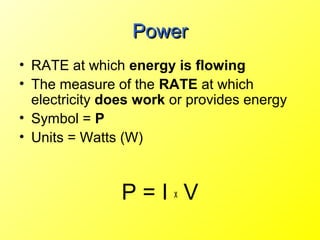
• RATE at which energy is flowing
• The measure of the RATE at which
  electricity does work or provides energy
• Symbol = P
• Units = Watts (W)


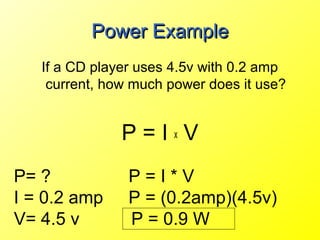
                P=IxV
Power Example
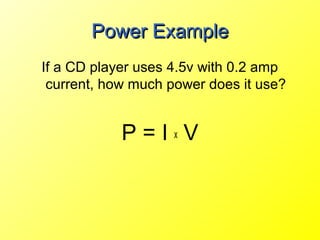
If a CD player uses 4.5v with 0.2 amp
 current, how much power does it use?


            P=IxV
Power Example
   If a CD player uses 4.5v with 0.2 amp
    current, how much power does it use?


               P=IxV
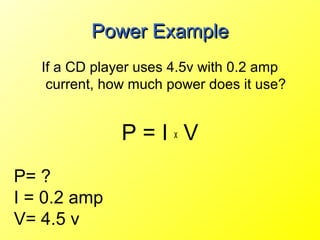
P= ?
I = 0.2 amp
V= 4.5 v
Power Example
   If a CD player uses 4.5v with 0.2 amp
    current, how much power does it use?


               P=IxV
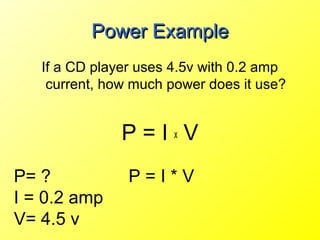
P= ?            P=I*V
I = 0.2 amp
V= 4.5 v
Power Example
   If a CD player uses 4.5v with 0.2 amp
    current, how much power does it use?


               P=IxV
P= ?            P=I*V
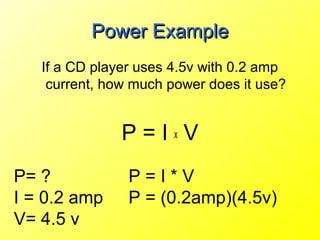
I = 0.2 amp     P = (0.2amp)(4.5v)
V= 4.5 v
Power Example
   If a CD player uses 4.5v with 0.2 amp
    current, how much power does it use?


               P=IxV
P= ?            P=I*V
I = 0.2 amp     P = (0.2amp)(4.5v)
V= 4.5 v        P = 0.9 W
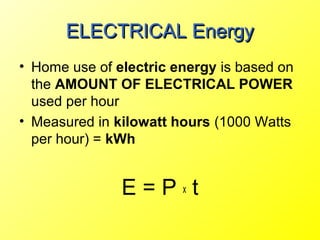
ELECTRICAL Energy
• Home use of electric energy is based on
  the AMOUNT OF ELECTRICAL POWER
  used per hour
• Measured in kilowatt hours (1000 Watts
  per hour) = kWh


               E=Pxt
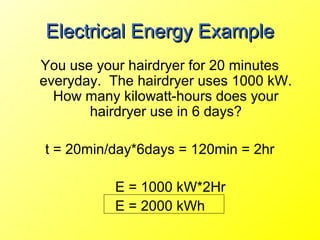
Electrical Energy Example
You use your hairdryer for 20 minutes
everyday. The hairdryer uses 1000 kW.
  How many kilowatt-hours does your
       hairdryer use in 6 days?

t = 20min/day*6days = 120min = 2hr

           E = 1000 kW*2Hr
           E = 2000 kWh
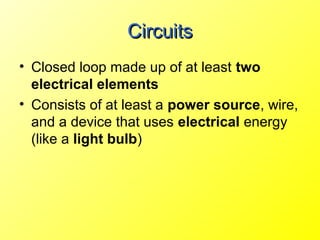
Circuits
• Closed loop made up of at least two
  electrical elements
• Consists of at least a power source, wire,
  and a device that uses electrical energy
  (like a light bulb)
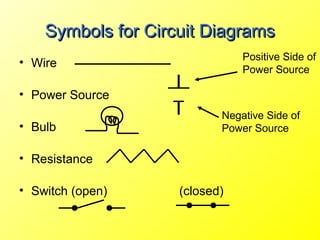
Symbols for Circuit Diagrams
                               Positive Side of
• Wire
                               Power Source

• Power Source
                           Negative Side of
• Bulb                     Power Source

• Resistance

• Switch (open)     (closed)
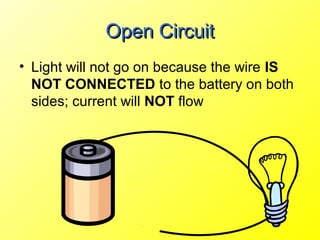
Open Circuit
• Light will not go on because the wire IS
  NOT CONNECTED to the battery on both
  sides; current will NOT flow
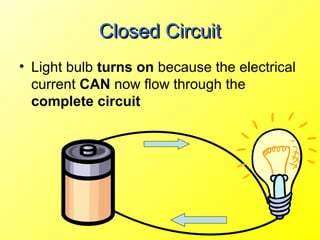
Closed Circuit
• Light bulb turns on because the electrical
  current CAN now flow through the
  complete circuit
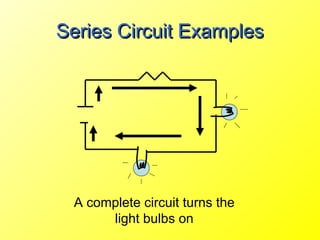
Series Circuit
• All parts of the circuit are connected one after
  another in a loop
• There is only one path for the electrons to
  follow
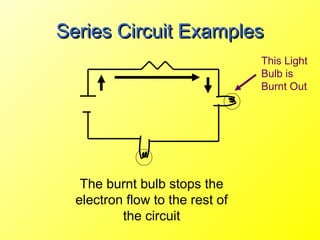
• If one part goes out
  • The circuit goes from closed to open
  • Electricity will not flow
  • All parts go out
• The voltage is split through each part of the
  circuit
• The current is the same throughout the circuit
• Example: Christmas Tree Lights
Series Circuit Examples


 A complete circuit turns the
      light bulbs on
Series Circuit Examples
                                 This Light
                                 Bulb is
                                 Burnt Out


   The burnt bulb stops the
  electron flow to the rest of
          the circuit
Parallel Circuit
• There is more than one path or branch for
  the electrons
• If a break occurs in one branch, the
  electrons can still flow in the other
• The voltage is the same throughout each
  branch
• The current is split through each branch
• Example: Household Wiring
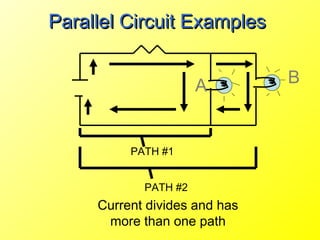
Parallel Circuit Examples


                      A        B


          PATH #1


            PATH #2
     Current divides and has
      more than one path
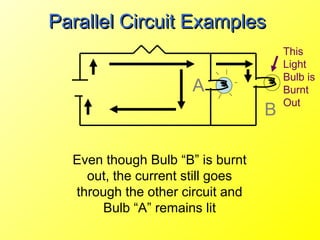
Parallel Circuit Examples
                                      This
                                      Light
                                      Bulb is
                      A               Burnt
                                      Out
                                  B

  Even though Bulb “B” is burnt
    out, the current still goes
  through the other circuit and
      Bulb “A” remains lit

Electricity

  • 1.
  • 2.
    Let’s Review… Atoms have3 subatomic particles Charged Atom (atom with a • Protons = positive positive or negative charge) • Electrons = negative • Object must gain or lose electrons • Neutrons = neutral • ONLY THE ELECTRONS MOVE Neutral Atom • Measured in Coulombs • “Normal” state • # Protons = # Electrons
  • 3.
    Charge & Force Attraction “Opposites Forces pull together + - Attract” Repulsion Forces push apart + + Rules of Charge Like charges repel (+/+ or -/-) Opposite charges attract (+/-)
  • 4.
    Electricity Definition: Electricity isthe energy associated with charged particles as they move from place to place The type of material determines how charges move through them Conductors • Materials that allow electric charges to move easily • Metals Insulators • Materials that do NOT allow electrons to flow freely • Rubber, plastic
  • 5.
    Forms of Electricity Static • Due to build up of charges in or on an object Current • The flow of electrons in a circuit
  • 6.
    Static Electricity • Staticelectricity is electricity “AT REST” • Occurs between 2 objects that become oppositely charged • Objects involved have unequal electric charges • Examples • Clothes sticking together in the dryer (if no dryer sheet is used) • Hair standing up after being brushed (on days with low humidity)
  • 7.
    Lightning • Large dischargeof static electricity (electrons transferred from a cloud to the Earth) • Friction from movement of water drops in a cloud build up positive and negative charges • Bolts can deliver 100 million volts • Safest place to be in a lightning storm is inside • Lightning rods are grounded to Earth to distribute the charge
  • 8.
    Electric Circuit An electriccircuit is a path for the electrons to flow • Flowing Electrons = current Electricity can only flow through a CLOSED circuit (not an open one) Hi-Lite This!
  • 9.
    Voltage (Potential Difference) •The PUSH that makes electrons flow (electrons have potential to flow but won’t on their own) • A difference between energy levels is needed for flow • Electrons flow in a circuit when there is an energy difference from one end of the energy source to the other end of the energy source (like a battery) • Units = VOLTS (V) • Symbol = V (capital) • Measured with a Voltmeter
  • 10.
    Electric Current • The FLOW of electric charges in a circuit • Units = Amperes (amps) • Symbol = I • Speed of Current is affected by • Type, length, & thickness of wire • Voltage • When Voltage , Current 
  • 11.
    2 Types ofElectric Current Direct Current (DC) • Electron flow is always in the same direction • Ex: Batteries Alternating Current (AC) • Electrons reverse the direction of flow 60 times per second • Ex: Electricity in the Home
  • 12.
    Resistance • Opposition tothe flow of electrons • Unit = Ohm (Ω) • Symbol = R • Highest resistance in: • Poor conductors • Thin wires • Long wires
  • 13.
    Ohm’s Law Relates ElectricCurrent, Voltage, & Resistance V=IxR Voltage Current Resistance (volts, V) (amps) (ohms, Ω)
  • 14.
    Ohm’s Law Example Calculatethe voltage across a 3Ω resistor if a 0.5 amp current is flowing through it. V=IxR
  • 15.
    Ohm’s Law Example Calculatethe voltage across a 3Ω resistor if a 0.5 amp current is flowing through it. V=IxR V=? R=3Ω I = 0.5 amp
  • 16.
    Ohm’s Law Example Calculatethe voltage across a 3Ω resistor if a 0.5 amp current is flowing through it. V=IxR V=? V = (0.5 amp)*(3 Ω ) R=3Ω I = 0.5 amp
  • 17.
    Ohm’s Law Example Calculatethe voltage across a 3Ω resistor if a 0.5 amp current is flowing through it. V=IxR V=? V = (0.5 amp)*(3 Ω ) R=3Ω I = 0.5 amp V = 1.5 v
  • 18.
    Ohm’s Law Example2 A radio with a resistance of 240 Ω is plugged into a 120 v outlet. What is the current flowing through the outlet? V=IxR
  • 19.
    Ohm’s Law Example2 A radio with a resistance of 240 Ω is plugged into a 120 v outlet. What is the current flowing through the outlet? V=IxR V = 120 v I=? R = 240 Ω
  • 20.
    Ohm’s Law Example2 A radio with a resistance of 240 Ω is plugged into a 120 v outlet. What is the current flowing through the outlet? V=IxR V = 120 v 120 v = I * 240 Ω I=? R = 240 Ω
  • 21.
    Ohm’s Law Example2 A radio with a resistance of 240 Ω is plugged into a 120 v outlet. What is the current flowing through the outlet? V=IxR V = 120 v 120 v = I * 240 Ω I=? R = 240 Ω I = 120v / 240 Ω
  • 22.
    Ohm’s Law Example2 A radio with a resistance of 240 Ω is plugged into a 120 v outlet. What is the current flowing through the outlet? V=IxR V = 120 v 120 v = I * 240 Ω I=? I = 0.5 amp R = 240 Ω I = 120v / 240 Ω
  • 23.
    Power • RATE atwhich energy is flowing • The measure of the RATE at which electricity does work or provides energy • Symbol = P • Units = Watts (W) P=IxV
  • 24.
    Power Example If aCD player uses 4.5v with 0.2 amp current, how much power does it use? P=IxV
  • 25.
    Power Example If a CD player uses 4.5v with 0.2 amp current, how much power does it use? P=IxV P= ? I = 0.2 amp V= 4.5 v
  • 26.
    Power Example If a CD player uses 4.5v with 0.2 amp current, how much power does it use? P=IxV P= ? P=I*V I = 0.2 amp V= 4.5 v
  • 27.
    Power Example If a CD player uses 4.5v with 0.2 amp current, how much power does it use? P=IxV P= ? P=I*V I = 0.2 amp P = (0.2amp)(4.5v) V= 4.5 v
  • 28.
    Power Example If a CD player uses 4.5v with 0.2 amp current, how much power does it use? P=IxV P= ? P=I*V I = 0.2 amp P = (0.2amp)(4.5v) V= 4.5 v P = 0.9 W
  • 29.
    ELECTRICAL Energy • Homeuse of electric energy is based on the AMOUNT OF ELECTRICAL POWER used per hour • Measured in kilowatt hours (1000 Watts per hour) = kWh E=Pxt
  • 30.
    Electrical Energy Example Youuse your hairdryer for 20 minutes everyday. The hairdryer uses 1000 kW. How many kilowatt-hours does your hairdryer use in 6 days? t = 20min/day*6days = 120min = 2hr E = 1000 kW*2Hr E = 2000 kWh
  • 31.
    Circuits • Closed loopmade up of at least two electrical elements • Consists of at least a power source, wire, and a device that uses electrical energy (like a light bulb)
  • 32.
    Symbols for CircuitDiagrams Positive Side of • Wire Power Source • Power Source Negative Side of • Bulb Power Source • Resistance • Switch (open) (closed)
  • 33.
    Open Circuit • Lightwill not go on because the wire IS NOT CONNECTED to the battery on both sides; current will NOT flow
  • 34.
    Closed Circuit • Lightbulb turns on because the electrical current CAN now flow through the complete circuit
  • 35.
    Series Circuit • Allparts of the circuit are connected one after another in a loop • There is only one path for the electrons to follow • If one part goes out • The circuit goes from closed to open • Electricity will not flow • All parts go out • The voltage is split through each part of the circuit • The current is the same throughout the circuit • Example: Christmas Tree Lights
  • 36.
    Series Circuit Examples A complete circuit turns the light bulbs on
  • 37.
    Series Circuit Examples This Light Bulb is Burnt Out The burnt bulb stops the electron flow to the rest of the circuit
  • 38.
    Parallel Circuit • Thereis more than one path or branch for the electrons • If a break occurs in one branch, the electrons can still flow in the other • The voltage is the same throughout each branch • The current is split through each branch • Example: Household Wiring
  • 39.
    Parallel Circuit Examples A B PATH #1 PATH #2 Current divides and has more than one path
  • 40.
    Parallel Circuit Examples This Light Bulb is A Burnt Out B Even though Bulb “B” is burnt out, the current still goes through the other circuit and Bulb “A” remains lit