What Teachers Can DoWhen Kids Can’t Read
No matter how misguided...Everyone Has a Vision Concerning Literacy
Teachers want to help struggling readersStruggling students want to be helpedThe right instruction can make a differenceThe Core Beliefs of the Text
Kylene Beers:“This book is designed to be a handbook…you might use the chart found in figure 3.2. [p. 28] to help you assess students’ needs. This chart lists some behaviors you might see in your dependent readers and then suggests a focus for instruction and directs you to appropriate chapters” (27).
Points to ConsiderThere is no one answer to understanding why some students struggle with reading.While there is no single answer, there are answers. This is a book about finding those answers .
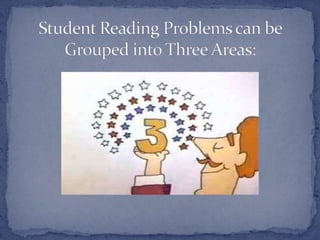
Student Reading Problems can be Grouped into Three Areas:
Dependent readers might lack the cognitive abilities to read independently.    Without this cognitive confidence, they might struggle with comprehension, vocabulary, word recognition, or fluency and automaticity. First,
   These readers may have negative attitudes towards reading. They might claim reading is boring. They have had so many moments of failure that they not only dislike like it but actually believe they’re incapable of doing it. They are disengaged from the reading process so that whether or not they have cognitive abilities to read independently doesn’t matter.    Their attitudes towards reading keep them distanced from reading. Second,
   Dependent readers don’t know what kinds of books they might enjoy. Our suggestions to “find a good book” aren’t helpful because they don’t know what writers or genres they’re interested in.    These students tend to read their textbooks the same as they would literature because they aren’t drawn in by the text. Difficult texts add to their struggles, with many students lacking the willpower to complete a book. Third,
As One Area Improves, The Others Do TooWhen working with students the areas comingle and create a ricochet effect— attending to one issue creates a momentum that ricochets to another confidence.
    First we must define what is working and what isn’t working. Once this determination is made, we know how instruction should proceed.    Not being able to read can mean many things depending on the student’s strengths and weaknesses.    Note the list on pages 24-26 for examples of differing deficiencies in reading.  Assessing Dependent Readers’ Needs
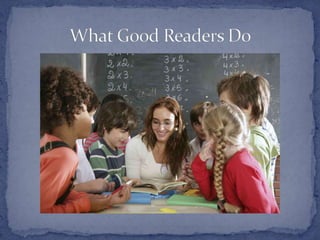
What Good Readers Do
Recognize that the purpose for reading is to get meaning.Use a variety of comprehension strategies that include predicting, summarizing, questioning and visualizing the text.Make a range of inferences about the text, from making their own examples too figuring out the meaning of a word based on the context in which it is used. Monitor their own understanding of a text.Good Readers:
Question the author’s purpose and point of view.Are aware of text features (headings, graphs, italicized terms, etc.) and use those features to aid in comprehension.Evaluate their engagement and enjoyment with a text.Know the meaning of many words and can use context clues to determine meaning if they are confused.Recognize most words automatically, read fluently, vary their reading rate to match the purpose and level of difficulty, and hear the text as they read.Good Readers also:
Students can be taught a wide range of comprehension strategies so that these strategies influence how they make meaning from a text.There are multiple ways to help students improve their comprehending abilities. Some are explicit; others less so. Teachers must adapt based on student needs.Contrary to popular belief, some students do benefit from direct, explicit instruction in comprehension strategies.Some students need and benefit from vocabulary study.Beers’ Personal Beliefs on Teaching Reading to Struggling Students
Some readers struggle through a text because they lack fluent word recognition. Strong word recognition skills are a major component of comprehending a text; however, they alone don’t ensure comprehension. Reading is a means of obtaining meaning, and meaning doesn’t exist  without understanding the words.Teachers who encourage and implement a wide range of reading strategies increase student opportunity for developing a positive attitude towards reading,  improving fluency, improving vocabulary, and improving comprehension. Reading is a social process, an interactive activity, one in which readers create meaning through interactions between the text, their prior knowledge,  the  context, and other readers.Personal Beliefs continued…
Teachers, not programs, are the critical element in a student’s success.The goal of reading is comprehension.Comprehension is a complex, abstract activity.Beers’ Beliefs on Teaching Reading
Explicit Instruction in Comprehension
Though we spend much time testing comprehension, we spend little time teaching it.   We sometimes confuse explaining to students what is happening in a text with teaching students how to comprehend texts.Teaching Comprehension
Decide on strategies to model and text to use.Tell students what strategy you’ll be practicing while reading the passage.Then, read the passage to students, modeling the strategy or strategies you are using. (Ex. Think-aloud)Next, during real reading situations, give students multiple chances to practice what you demonstrated.Continue modeling as students’ needs indicate or when the genre changes.Finally, give students opportunities to try the strategies without your feedback or support. Explicit and direct instruction strategies include the following practices:
    Inference – The ability to connect what is in the text with what is in the mind to create an educated guess.   Instead of vaguely asking students to make an inference, we can provide specific types of inferences for students to work with. Learning to Make an Inference
Look for pronouns and figure out what to connect them to.Figure out explanations for these events.Think about setting and see what details you can add.After you read this, see if you can explain why the character acted this way.Examples of Inferences
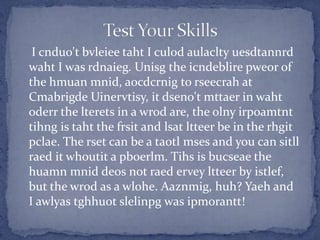
Test Your Skills    I cnduo'tbvleieetaht I culodaulacltyuesdtannrdwaht I was rdnaieg. Unisg the icndeblirepweor of the hmuanmnid, aocdcrnig to rseecrah at CmabrigdeUinervtisy, it dseno'tmttaer in wahtoderr the lterets in a wrod are, the olnyirpoamtnttihng is taht the frsit and lsatltteer be in the rhgitpclae. The rset can be a taotlmses and you can sitllraed it whoutit a pboerlm. Tihs is bucseae the huamnmniddeos not raederveyltteer by istlef, but the wrod as a wlohe. Aaznmig, huh? Yaeh and I awlyastghhuotslelinpg was ipmorantt!
Handout and Activity Time!That’s right. There’s more!
Strategies and BatonsJosie, in an Alternate Universe
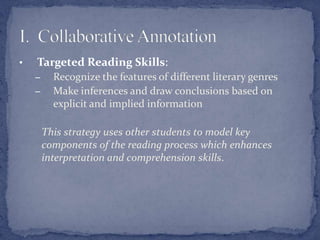
Targeted Reading Skills:
Recognize the features of different literary genres
Make inferences and draw conclusions based on explicit and implied information	This strategy uses other students to model key components of the reading process which enhances interpretation and comprehension skills.I.  Collaborative Annotation
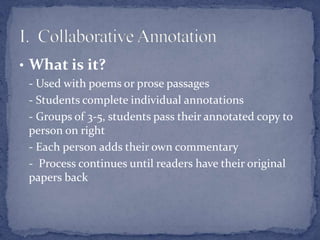
What is it?	- Used with poems or prose passages	- Students complete individual annotations	- Groups of 3-5, students pass their annotated copy to person on right	- Each person adds their own commentary	-  Process continues until readers have their original papers backI.  Collaborative Annotation
A New StrategyOverstream Example
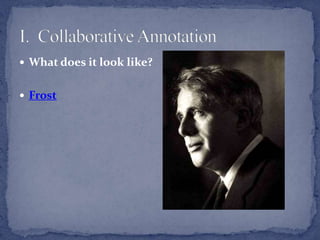
What does it look like?FrostI.  Collaborative Annotation
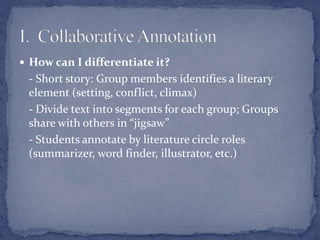
How can I differentiate it?	- Short story: Group members identifies a literary element (setting, conflict, climax)	- Divide text into segments for each group; Groups share with others in “jigsaw”	- Students annotate by literature circle roles (summarizer, word finder, illustrator, etc.)I.  Collaborative Annotation
Targeted Reading Skills:	- Formulate questions to be answered by reading     	text	- Recognize effects of one’s own point of view in 	interpreting texts	- Identify multiple levels of meanings	The strategy teaches students to ask insightful questions which will generate reflection and aid in discussion and/or writing.II.  Questions Only
What is it?	- Can be used with fiction, non-fiction texts	- Choose an area for students to focus … (example: questions could target content, literary elements, author’s intent, etc.)	- Students individually annotate text with “questions only”	- Questions are answered in classII.  Questions Only
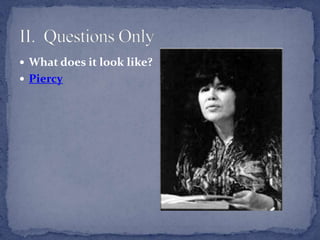
What does it look like?PiercyII.  Questions Only
How can I differentiate it?	- Distribute random questions to groups to answer and give their rationale 	- Compile list of questions and let students select 3 – 4 to answer for homework; quiz	- Use list of questions as writing prompts	- Students choose a question to answer for a writing assignment II.  Questions Only
Greece Central School District	P.O. Box 300	North Greece, NY  14515	(585) 966-2000www.greece.k12.ny.usSource:
Wait…there’s more!
Vocabulary PasswordAn innovative vocabulary assessment game for students of all agesPresented By: Bianca RobertsBeers Group
Introduction to Vocabulary PasswordVocabulary Password is an innovative game that allows teachers to assess students’ mastery of vocabulary while kids have a blast.If you are familiar with GSN’s $100 K Pyramid, then, you can play VP!VP can be used in any content area and/or with any kind of text.VP is fun, easy to set up and effective!
How to get startedBefore you can play the game, teachers should select vocabulary terms that the students should know for a particular lessonStudents should be familiar with the words, their meanings and the context in which they should be used.  It’s probably best for VP to be played at the end of a unit.
Teachers will create a PowerPoint presentation that includes all of the words/phrases that you want to assess. Each word should be on a separate slide.You will take volunteers to come forward one at a time as contestants.  The student will face the audience as the slideshow is reflected behind them. The teacher then reveals the word and the students in the audience have ten seconds to get the contestant to say the word using any clues to describe the word without using the word itself or any parts of it.
TrialI hope you were attentive to Lindsay’s portion of the presentation…It’s YOUR turn!! The best way to teach is by modeling! May I have the first volunteer?
Let’s Play…Vocabulary Password
WORD STUDY
CONTEXT CLUE
VOCABULARY TREE
AUTOMATICITY
GRAPHEME
FLUENCY
DECODING
WORD WALL
SPELLING PATTERNS
Vocabulary PasswordAn innovative vocabulary assessment game for students of all agesPresented By: Bianca RobertsBeers Group
Introduction to Vocabulary PasswordVocabulary Password is an innovative game that allows teachers to assess students’ mastery of vocabulary while kids have a blast.If you are familiar with GSN’s $100 K Pyramid, then, you can play VP!VP can be used in any content area and/or with any kind of text.VP is fun, easy to set up and effective!
How to get startedBefore you can play the game, teachers should select vocabulary terms that the students should know for a particular lessonStudents should be familiar with the words, their meanings and the context in which they should be used.  It’s probably best for VP to be played at the end of a unit.
Teachers will create a PowerPoint presentation that includes all of the words/phrases that you want to assess. Each word should be on a separate slide.You will take volunteers to come forward one at a time as contestants.  The student will face the audience as the slideshow is reflected behind them. The teacher then reveals the word and the students in the audience have ten seconds to get the contestant to say the word using any clues to describe the word without using the word itself or any parts of it.
TrialI hope you were attentive to Lindsay’s portion of the presentation…It’s YOUR turn!! The best way to teach is by modeling! May I have the first volunteer?
Let’s Play…Vocabulary Password
WORD STUDY
CONTEXT CLUE
VOCABULARY TREE

Ehs566

  • 1.
    What Teachers CanDoWhen Kids Can’t Read
  • 2.
    No matter howmisguided...Everyone Has a Vision Concerning Literacy
  • 3.
    Teachers want tohelp struggling readersStruggling students want to be helpedThe right instruction can make a differenceThe Core Beliefs of the Text
  • 4.
    Kylene Beers:“This bookis designed to be a handbook…you might use the chart found in figure 3.2. [p. 28] to help you assess students’ needs. This chart lists some behaviors you might see in your dependent readers and then suggests a focus for instruction and directs you to appropriate chapters” (27).
  • 5.
    Points to ConsiderThereis no one answer to understanding why some students struggle with reading.While there is no single answer, there are answers. This is a book about finding those answers .
  • 6.
    Student Reading Problemscan be Grouped into Three Areas:
  • 7.
    Dependent readers mightlack the cognitive abilities to read independently. Without this cognitive confidence, they might struggle with comprehension, vocabulary, word recognition, or fluency and automaticity. First,
  • 8.
    These readers may have negative attitudes towards reading. They might claim reading is boring. They have had so many moments of failure that they not only dislike like it but actually believe they’re incapable of doing it. They are disengaged from the reading process so that whether or not they have cognitive abilities to read independently doesn’t matter. Their attitudes towards reading keep them distanced from reading. Second,
  • 9.
    Dependent readers don’t know what kinds of books they might enjoy. Our suggestions to “find a good book” aren’t helpful because they don’t know what writers or genres they’re interested in. These students tend to read their textbooks the same as they would literature because they aren’t drawn in by the text. Difficult texts add to their struggles, with many students lacking the willpower to complete a book. Third,
  • 10.
    As One AreaImproves, The Others Do TooWhen working with students the areas comingle and create a ricochet effect— attending to one issue creates a momentum that ricochets to another confidence.
  • 11.
    First we must define what is working and what isn’t working. Once this determination is made, we know how instruction should proceed. Not being able to read can mean many things depending on the student’s strengths and weaknesses. Note the list on pages 24-26 for examples of differing deficiencies in reading. Assessing Dependent Readers’ Needs
  • 12.
  • 13.
    Recognize that thepurpose for reading is to get meaning.Use a variety of comprehension strategies that include predicting, summarizing, questioning and visualizing the text.Make a range of inferences about the text, from making their own examples too figuring out the meaning of a word based on the context in which it is used. Monitor their own understanding of a text.Good Readers:
  • 14.
    Question the author’spurpose and point of view.Are aware of text features (headings, graphs, italicized terms, etc.) and use those features to aid in comprehension.Evaluate their engagement and enjoyment with a text.Know the meaning of many words and can use context clues to determine meaning if they are confused.Recognize most words automatically, read fluently, vary their reading rate to match the purpose and level of difficulty, and hear the text as they read.Good Readers also:
  • 15.
    Students can betaught a wide range of comprehension strategies so that these strategies influence how they make meaning from a text.There are multiple ways to help students improve their comprehending abilities. Some are explicit; others less so. Teachers must adapt based on student needs.Contrary to popular belief, some students do benefit from direct, explicit instruction in comprehension strategies.Some students need and benefit from vocabulary study.Beers’ Personal Beliefs on Teaching Reading to Struggling Students
  • 16.
    Some readers strugglethrough a text because they lack fluent word recognition. Strong word recognition skills are a major component of comprehending a text; however, they alone don’t ensure comprehension. Reading is a means of obtaining meaning, and meaning doesn’t exist without understanding the words.Teachers who encourage and implement a wide range of reading strategies increase student opportunity for developing a positive attitude towards reading, improving fluency, improving vocabulary, and improving comprehension. Reading is a social process, an interactive activity, one in which readers create meaning through interactions between the text, their prior knowledge, the context, and other readers.Personal Beliefs continued…
  • 17.
    Teachers, not programs,are the critical element in a student’s success.The goal of reading is comprehension.Comprehension is a complex, abstract activity.Beers’ Beliefs on Teaching Reading
  • 18.
  • 19.
    Though we spendmuch time testing comprehension, we spend little time teaching it. We sometimes confuse explaining to students what is happening in a text with teaching students how to comprehend texts.Teaching Comprehension
  • 20.
    Decide on strategiesto model and text to use.Tell students what strategy you’ll be practicing while reading the passage.Then, read the passage to students, modeling the strategy or strategies you are using. (Ex. Think-aloud)Next, during real reading situations, give students multiple chances to practice what you demonstrated.Continue modeling as students’ needs indicate or when the genre changes.Finally, give students opportunities to try the strategies without your feedback or support. Explicit and direct instruction strategies include the following practices:
  • 21.
    Inference – The ability to connect what is in the text with what is in the mind to create an educated guess. Instead of vaguely asking students to make an inference, we can provide specific types of inferences for students to work with. Learning to Make an Inference
  • 22.
    Look for pronounsand figure out what to connect them to.Figure out explanations for these events.Think about setting and see what details you can add.After you read this, see if you can explain why the character acted this way.Examples of Inferences
  • 23.
    Test Your Skills I cnduo'tbvleieetaht I culodaulacltyuesdtannrdwaht I was rdnaieg. Unisg the icndeblirepweor of the hmuanmnid, aocdcrnig to rseecrah at CmabrigdeUinervtisy, it dseno'tmttaer in wahtoderr the lterets in a wrod are, the olnyirpoamtnttihng is taht the frsit and lsatltteer be in the rhgitpclae. The rset can be a taotlmses and you can sitllraed it whoutit a pboerlm. Tihs is bucseae the huamnmniddeos not raederveyltteer by istlef, but the wrod as a wlohe. Aaznmig, huh? Yaeh and I awlyastghhuotslelinpg was ipmorantt!
  • 24.
    Handout and ActivityTime!That’s right. There’s more!
  • 25.
    Strategies and BatonsJosie,in an Alternate Universe
  • 26.
  • 27.
    Recognize the featuresof different literary genres
  • 28.
    Make inferences anddraw conclusions based on explicit and implied information This strategy uses other students to model key components of the reading process which enhances interpretation and comprehension skills.I. Collaborative Annotation
  • 29.
    What is it? -Used with poems or prose passages - Students complete individual annotations - Groups of 3-5, students pass their annotated copy to person on right - Each person adds their own commentary - Process continues until readers have their original papers backI. Collaborative Annotation
  • 30.
  • 31.
    What does itlook like?FrostI. Collaborative Annotation
  • 32.
    How can Idifferentiate it? - Short story: Group members identifies a literary element (setting, conflict, climax) - Divide text into segments for each group; Groups share with others in “jigsaw” - Students annotate by literature circle roles (summarizer, word finder, illustrator, etc.)I. Collaborative Annotation
  • 33.
    Targeted Reading Skills: -Formulate questions to be answered by reading text - Recognize effects of one’s own point of view in interpreting texts - Identify multiple levels of meanings The strategy teaches students to ask insightful questions which will generate reflection and aid in discussion and/or writing.II. Questions Only
  • 34.
    What is it? -Can be used with fiction, non-fiction texts - Choose an area for students to focus … (example: questions could target content, literary elements, author’s intent, etc.) - Students individually annotate text with “questions only” - Questions are answered in classII. Questions Only
  • 35.
    What does itlook like?PiercyII. Questions Only
  • 36.
    How can Idifferentiate it? - Distribute random questions to groups to answer and give their rationale - Compile list of questions and let students select 3 – 4 to answer for homework; quiz - Use list of questions as writing prompts - Students choose a question to answer for a writing assignment II. Questions Only
  • 37.
    Greece Central SchoolDistrict P.O. Box 300 North Greece, NY 14515 (585) 966-2000www.greece.k12.ny.usSource:
  • 38.
  • 39.
    Vocabulary PasswordAn innovativevocabulary assessment game for students of all agesPresented By: Bianca RobertsBeers Group
  • 40.
    Introduction to VocabularyPasswordVocabulary Password is an innovative game that allows teachers to assess students’ mastery of vocabulary while kids have a blast.If you are familiar with GSN’s $100 K Pyramid, then, you can play VP!VP can be used in any content area and/or with any kind of text.VP is fun, easy to set up and effective!
  • 41.
    How to getstartedBefore you can play the game, teachers should select vocabulary terms that the students should know for a particular lessonStudents should be familiar with the words, their meanings and the context in which they should be used. It’s probably best for VP to be played at the end of a unit.
  • 42.
    Teachers will createa PowerPoint presentation that includes all of the words/phrases that you want to assess. Each word should be on a separate slide.You will take volunteers to come forward one at a time as contestants. The student will face the audience as the slideshow is reflected behind them. The teacher then reveals the word and the students in the audience have ten seconds to get the contestant to say the word using any clues to describe the word without using the word itself or any parts of it.
  • 43.
    TrialI hope youwere attentive to Lindsay’s portion of the presentation…It’s YOUR turn!! The best way to teach is by modeling! May I have the first volunteer?
  • 44.
  • 45.
  • 46.
  • 47.
  • 48.
  • 49.
  • 50.
  • 51.
  • 52.
  • 53.
  • 54.
    Vocabulary PasswordAn innovativevocabulary assessment game for students of all agesPresented By: Bianca RobertsBeers Group
  • 55.
    Introduction to VocabularyPasswordVocabulary Password is an innovative game that allows teachers to assess students’ mastery of vocabulary while kids have a blast.If you are familiar with GSN’s $100 K Pyramid, then, you can play VP!VP can be used in any content area and/or with any kind of text.VP is fun, easy to set up and effective!
  • 56.
    How to getstartedBefore you can play the game, teachers should select vocabulary terms that the students should know for a particular lessonStudents should be familiar with the words, their meanings and the context in which they should be used. It’s probably best for VP to be played at the end of a unit.
  • 57.
    Teachers will createa PowerPoint presentation that includes all of the words/phrases that you want to assess. Each word should be on a separate slide.You will take volunteers to come forward one at a time as contestants. The student will face the audience as the slideshow is reflected behind them. The teacher then reveals the word and the students in the audience have ten seconds to get the contestant to say the word using any clues to describe the word without using the word itself or any parts of it.
  • 58.
    TrialI hope youwere attentive to Lindsay’s portion of the presentation…It’s YOUR turn!! The best way to teach is by modeling! May I have the first volunteer?
  • 59.
  • 60.
  • 61.
  • 62.