SALIENT FETURES OF RENAISSANCE
LITERATURE
Dungrani Nirali
M.A sem:-1
Enrollment no:-2069108420180012
Roll no:-30
Paper no:-1
S.B.gardi Department of English
Bhavnagar University
RENAISSANCE:-
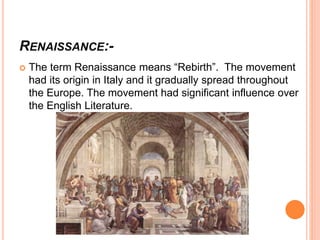
 The term Renaissance means “Rebirth”. The movement
had its origin in Italy and it gradually spread throughout
the Europe. The movement had significant influence over
the English Literature.
SALIENT FEATURES OF RENAISSANCE IN
ENGLISH LITERATURE:-
i. Reforms in the Institutions
ii. Dominance of Reason
iii. Man-Centred Society
iv. Development of Science
v. Era of Renowned Names
vi. The Counter Reformation
1) REFORMS IN THE INSTITUTIONS:-
 In the earlier times, literature was dominated by the
spirit of religion and blind faith.
 In the Renaissance Age, institutions were
questioned and re-evaluated.
 Renaissance broadened and took the cognitive
level of human mind to new heights.
 In the Renaissance age, it was the reason instead
of religion that governed the human behavior.
 Man was free to make the use of his power.
 Now reason dominated all the spheres of life that
decreased influence of religion over the people.
 Most of the blind faiths and practices were given
up.
2) DOMINANCE OF REASON:-
3) MAN-CENTRED SOCIETY:-
 Earlier religion was the centre of interest.
 Hence the main concern of literature was to deal
with the religion directly or indirectly.
 In the Renaissance age, the focus shifted from
religion to man and man became the centre of
interest.
4) DEVELOPMENT OF SCIENCE:-
 The age was accompanied by the birth of modern
science, mathematics, astronomy etc.
 In the 4th decade of 16th century Copernicus
replaced Aristotle’s system with sun, instead of
earth at the centre of universe.
 In addition to this there was the use of clocks,
telescopes, thermometers, compasses,
microscopes etc.
 Hence there was a considerable development in
the scientific field
5) ERA OF RENOWNED NAMES:-
 The literature of the English Renaissance contains
some of the greatest names in all world literature.
 Dramatists: Shakespeare, Marlowe, Webster and
Jonson.
 Poets: Sidney, Spenser, Donne and Milton.
 Prose: Bacon, Nashe, Raleigh, Browne and
Hooker.
 Authorised Version of Bible was published in
1611.
6) THE COUNTER REFORMATION:-
 The Counter-reformation also took birth in response
to reformation soon after the fame of the later
touched skies.
 It began with the Council of Trent (1545–1563).
 The primary objective of this movement was to
reform the Christian Catholic Church and counter
the influence of Protestantism.
Paper no 1

Paper no 1

  • 1.
    SALIENT FETURES OFRENAISSANCE LITERATURE Dungrani Nirali M.A sem:-1 Enrollment no:-2069108420180012 Roll no:-30 Paper no:-1 S.B.gardi Department of English Bhavnagar University
  • 2.
    RENAISSANCE:-  The termRenaissance means “Rebirth”. The movement had its origin in Italy and it gradually spread throughout the Europe. The movement had significant influence over the English Literature.
  • 3.
    SALIENT FEATURES OFRENAISSANCE IN ENGLISH LITERATURE:- i. Reforms in the Institutions ii. Dominance of Reason iii. Man-Centred Society iv. Development of Science v. Era of Renowned Names vi. The Counter Reformation
  • 4.
    1) REFORMS INTHE INSTITUTIONS:-  In the earlier times, literature was dominated by the spirit of religion and blind faith.  In the Renaissance Age, institutions were questioned and re-evaluated.  Renaissance broadened and took the cognitive level of human mind to new heights.
  • 5.
     In theRenaissance age, it was the reason instead of religion that governed the human behavior.  Man was free to make the use of his power.  Now reason dominated all the spheres of life that decreased influence of religion over the people.  Most of the blind faiths and practices were given up. 2) DOMINANCE OF REASON:-
  • 6.
    3) MAN-CENTRED SOCIETY:- Earlier religion was the centre of interest.  Hence the main concern of literature was to deal with the religion directly or indirectly.  In the Renaissance age, the focus shifted from religion to man and man became the centre of interest.
  • 7.
    4) DEVELOPMENT OFSCIENCE:-  The age was accompanied by the birth of modern science, mathematics, astronomy etc.  In the 4th decade of 16th century Copernicus replaced Aristotle’s system with sun, instead of earth at the centre of universe.  In addition to this there was the use of clocks, telescopes, thermometers, compasses, microscopes etc.  Hence there was a considerable development in the scientific field
  • 8.
    5) ERA OFRENOWNED NAMES:-  The literature of the English Renaissance contains some of the greatest names in all world literature.  Dramatists: Shakespeare, Marlowe, Webster and Jonson.  Poets: Sidney, Spenser, Donne and Milton.  Prose: Bacon, Nashe, Raleigh, Browne and Hooker.  Authorised Version of Bible was published in 1611.
  • 9.
    6) THE COUNTERREFORMATION:-  The Counter-reformation also took birth in response to reformation soon after the fame of the later touched skies.  It began with the Council of Trent (1545–1563).  The primary objective of this movement was to reform the Christian Catholic Church and counter the influence of Protestantism.