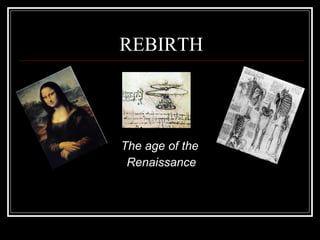
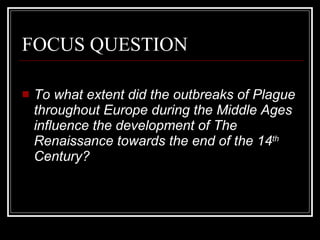
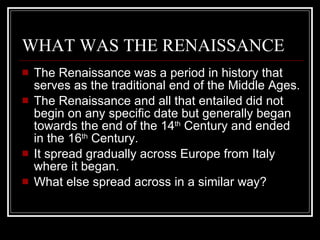
REBIRTH The age of the  Renaissance
FOCUS QUESTION To what extent did the outbreaks of Plague throughout Europe during the Middle Ages influence the development of The Renaissance towards the end of the 14 th  Century?
WHAT WAS THE RENAISSANCE The Renaissance was a period in history that serves as the traditional end of the Middle Ages. The Renaissance and all that entailed did not begin on any specific date but generally began towards the end of the 14 th  Century and ended in the 16 th  Century.  It spread gradually across Europe from Italy where it began.  What else spread across in a similar way?
REBIRTH The word  Renaissance  is French and it means ‘rebirth’. Of course the term ‘rebirth is a metaphor. What could be reborn during this age of humanity? Consider the shortcomings of the Middle Ages before answering this question.
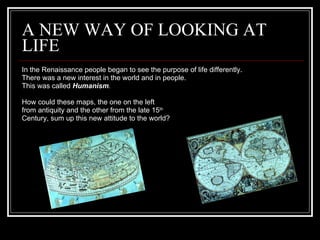
A NEW WAY OF LOOKING AT LIFE In the Renaissance people began to see the purpose of life differently. There was a new interest in the world and in people. This was called  Humanism . How could these maps, the one on the left from antiquity and the other from the late 15 th Century, sum up this new attitude to the world?
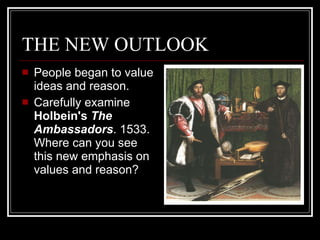
THE NEW OUTLOOK People began to value ideas and reason. Carefully examine  Holbein's  The Ambassadors . 1533. Where can you see this new emphasis on values and reason?
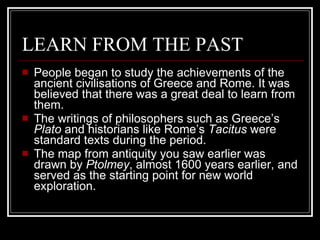
LEARN FROM THE PAST People began to study the achievements of the ancient civilisations of Greece and Rome. It was believed that there was a great deal to learn from them. The writings of philosophers such as Greece’s  Plato  and historians like Rome’s  Tacitus  were standard texts during the period.  The map from antiquity you saw earlier was drawn by  Ptolmey , almost 1600 years earlier, and served as the starting point for new world exploration.
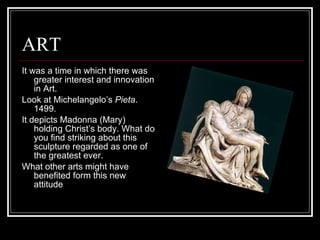
ART It was a time in which there was greater interest and innovation in Art. Look at Michelangelo’s  Pieta . 1499. It depicts Madonna (Mary) holding Christ’s body. What do you find striking about this sculpture regarded as one of the greatest ever. What other arts might have benefited form this new attitude
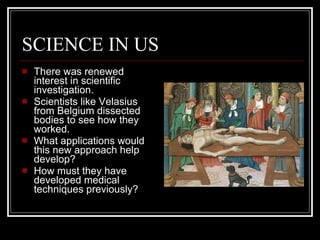
SCIENCE IN US There was renewed interest in scientific investigation. Scientists like Velasius from Belgium dissected bodies to see how they worked. What applications would this new approach help develop? How must they have developed medical techniques previously?
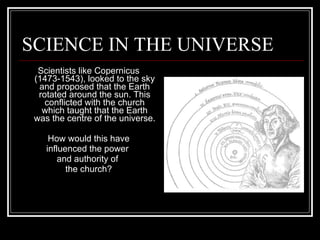
SCIENCE IN THE UNIVERSE Scientists like Copernicus (1473-1543), looked to the sky and proposed that the Earth rotated around the sun. This conflicted with the church which taught that the Earth was the centre of the universe. How would this have influenced the power  and authority of  the church?
THE POWER OF THE CHURCH For centuries the church in Europe ruled through a type of fear, superstition and intellectual dominance. Most people were illiterate, uneducated and lacked the mental capacity to question authorities. Those challenging the church were labelled  heretics  and were vilified. But ultimately this was a battle the church would lose. This new outlook on life coupled with recent historical disasters shattered the authority of the church in Europe.

Rebirth

  • 1.
    REBIRTH The ageof the Renaissance
  • 2.
    FOCUS QUESTION Towhat extent did the outbreaks of Plague throughout Europe during the Middle Ages influence the development of The Renaissance towards the end of the 14 th Century?
  • 3.
    WHAT WAS THERENAISSANCE The Renaissance was a period in history that serves as the traditional end of the Middle Ages. The Renaissance and all that entailed did not begin on any specific date but generally began towards the end of the 14 th Century and ended in the 16 th Century. It spread gradually across Europe from Italy where it began. What else spread across in a similar way?
  • 4.
    REBIRTH The word Renaissance is French and it means ‘rebirth’. Of course the term ‘rebirth is a metaphor. What could be reborn during this age of humanity? Consider the shortcomings of the Middle Ages before answering this question.
  • 5.
    A NEW WAYOF LOOKING AT LIFE In the Renaissance people began to see the purpose of life differently. There was a new interest in the world and in people. This was called Humanism . How could these maps, the one on the left from antiquity and the other from the late 15 th Century, sum up this new attitude to the world?
  • 6.
    THE NEW OUTLOOKPeople began to value ideas and reason. Carefully examine Holbein's The Ambassadors . 1533. Where can you see this new emphasis on values and reason?
  • 7.
    LEARN FROM THEPAST People began to study the achievements of the ancient civilisations of Greece and Rome. It was believed that there was a great deal to learn from them. The writings of philosophers such as Greece’s Plato and historians like Rome’s Tacitus were standard texts during the period. The map from antiquity you saw earlier was drawn by Ptolmey , almost 1600 years earlier, and served as the starting point for new world exploration.
  • 8.
    ART It wasa time in which there was greater interest and innovation in Art. Look at Michelangelo’s Pieta . 1499. It depicts Madonna (Mary) holding Christ’s body. What do you find striking about this sculpture regarded as one of the greatest ever. What other arts might have benefited form this new attitude
  • 9.
    SCIENCE IN USThere was renewed interest in scientific investigation. Scientists like Velasius from Belgium dissected bodies to see how they worked. What applications would this new approach help develop? How must they have developed medical techniques previously?
  • 10.
    SCIENCE IN THEUNIVERSE Scientists like Copernicus (1473-1543), looked to the sky and proposed that the Earth rotated around the sun. This conflicted with the church which taught that the Earth was the centre of the universe. How would this have influenced the power and authority of the church?
  • 11.
    THE POWER OFTHE CHURCH For centuries the church in Europe ruled through a type of fear, superstition and intellectual dominance. Most people were illiterate, uneducated and lacked the mental capacity to question authorities. Those challenging the church were labelled heretics and were vilified. But ultimately this was a battle the church would lose. This new outlook on life coupled with recent historical disasters shattered the authority of the church in Europe.