According to Copernican and Darwinian
Intellectual Revolutions
that defined Society
Intellectual Revolution
• Used to refer to Greek
speculation about the
“nature”
• Technical term are “pre-
Socratic” or “non-
theological”
• It is where the
advancement of science
and technology change
people
Nicholas Copernicus
•Born on February 19th,
1473
•Mathematicians and
Astronomer and
scientist
•Place of birth: Torum,
Poland
•Discovered the
heliocentric model
Heliocentric (Copernican)
System
•Sun center
•Uniform, circular
motion
•Moon orbited the
earth
•Retrograde motion of
the planets
Geocentric Model
• Accepted for 1400
years
•Also called
Ptolemaic system
• Earth is the center
• Formulated by
Alexandrian
Published upon Death
• In 1543, published his book called “DE REVOLUTIONIBUS
ORBIUM COELESTIUM LIBRI VI”
Phases of Venus
Galileo Galilei
• Turned a telescope toward the heavens
• Made observations:
-Contradicted the perfection of heavens
• Mountains, valleys
• Imperfections on the suns
-Supported the heliocentric universe
• Moons of jupiter
• Phases of venus – shows a full phase
• The church also began to find the idea
revoking and classified it is a heresy. Thus
the new theory was opposed mainly
religious grounds.
Why it is important?
EVOLUTION
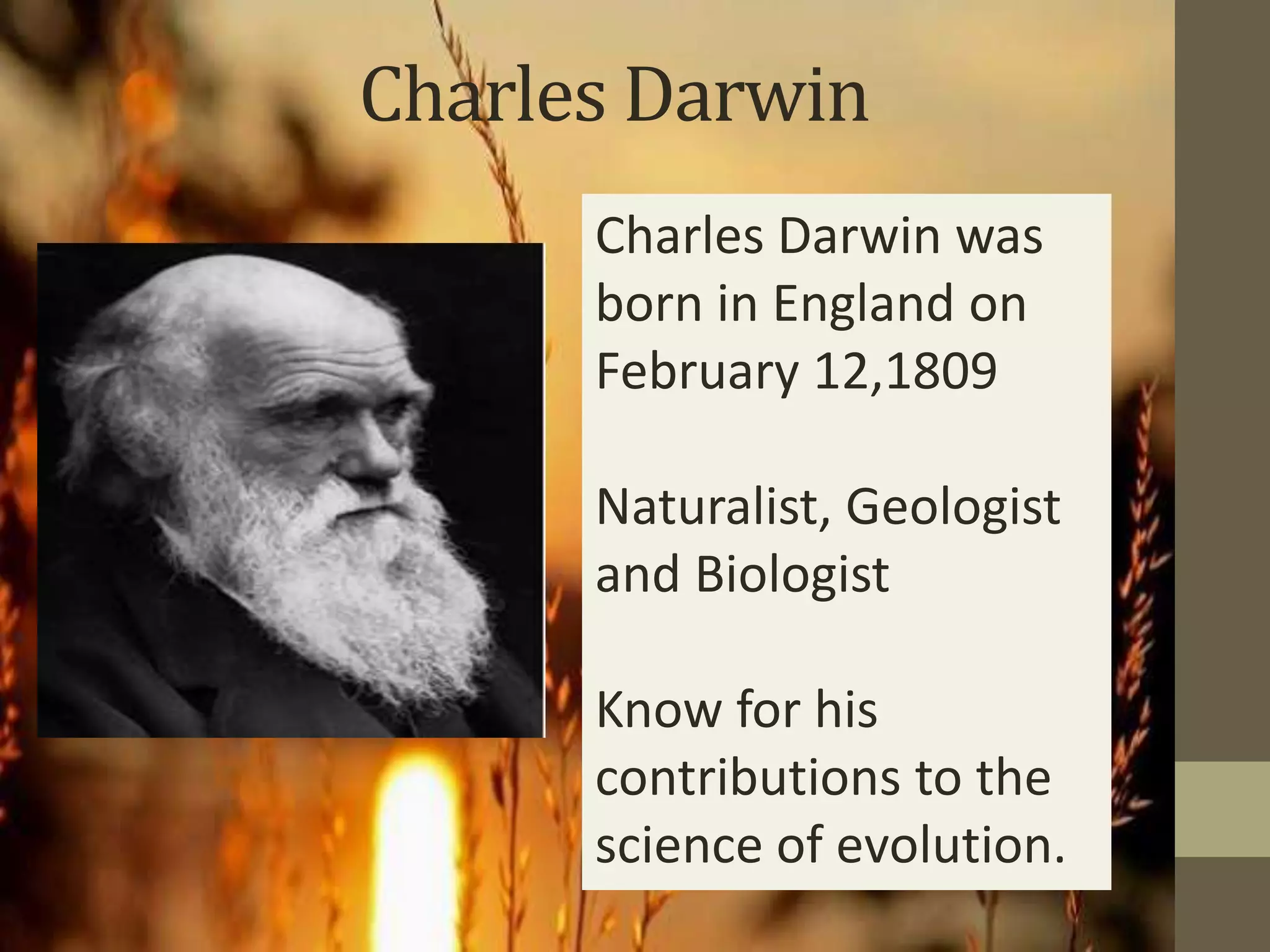
Charles Darwin
Charles Darwin was
born in England on
February 12,1809
Naturalist, Geologist
and Biologist
Know for his
contributions to the
science of evolution.
Charles Darwin
Darwin’s Theory of Evolution (Darwinism)
• Evolution, or change over time, is the process by which
modern organisms have descended from ancient
organisms.
• A scientific theory is a well-supported testable explanation
of phenomena that have occurred in the natural world.
How do you think Darwin came up with his
theory?
Voyage of the Beagle
• Dates: February 12th,
1831
• Captain: Charles
Darwin
• Ship: H.M.S. Beagle
• Destination: Voyage
around the world.
• Findings: evidence to
propose a revolutionary
hypothesis about how
life changes over time
Voyage of Beagle
• Darwin visited Argentina and Australia which had
similar grassland ecosystems.
.
Patterns of Diversity
 Darwin collected fossils.
 Some of those fossils resembled organisms that were
still alive today.
Living Organisms and Fossils
Fossils
The Galapagos Island
• The smallest, lowest islands were hot, dry, and nearly
barren-Hood Island-sparse vegetation
• The higher islands had greater rainfall and a different
assortment of plants and animals-Isabela- Island had
rich vegetation.
• Darwin was fascinated in particular by the land
tortoises and marine iguanas in the Galápagos.
• Giant tortoises varied in predictable ways from one
island to another.
• The shape of a tortoise's shell could be used to identify
which island a particular tortoise inhabited.
Animals found in the
Galapagos
Land Tortoises
Darwin Finches
Blue-Footed Booby
Marine Iguanas
Ideas that shaped Darwin’s
Thinking
•James Hutton:
• 1795 Theory of Geological
change
•Forces change
earth’s surface
shape
•Changes are slow
•Earth much older
than thousands of
years
Evolution by Natural Selection
• The Struggle for Existence-members of each species have to
compete for food, shelter, other life necessities
• Survival of the Fittest-Some individuals better suited for the
environment
Descent
 Descent with Modification-Each living organism has
descended, with changes from other species over time
 Common Descent- were derived from common ancestors
SIGMUND FREUD
is one of the most
influential scientist in the
field of psychology and
psychiatry.
• Because he developed theories about
the mind and its functioning and
founded psychoanalytical treatment
for psychological problems based on
those theories.
Psychoanalytic personality theory
Thank
you

Innah intellectual-revolutions-that-defined-society (1)

  • 2.
    According to Copernicanand Darwinian Intellectual Revolutions that defined Society
  • 3.
    Intellectual Revolution • Usedto refer to Greek speculation about the “nature” • Technical term are “pre- Socratic” or “non- theological” • It is where the advancement of science and technology change people
  • 4.
    Nicholas Copernicus •Born onFebruary 19th, 1473 •Mathematicians and Astronomer and scientist •Place of birth: Torum, Poland •Discovered the heliocentric model
  • 5.
    Heliocentric (Copernican) System •Sun center •Uniform,circular motion •Moon orbited the earth •Retrograde motion of the planets
  • 6.
    Geocentric Model • Acceptedfor 1400 years •Also called Ptolemaic system • Earth is the center • Formulated by Alexandrian
  • 7.
    Published upon Death •In 1543, published his book called “DE REVOLUTIONIBUS ORBIUM COELESTIUM LIBRI VI”
  • 8.
    Phases of Venus GalileoGalilei • Turned a telescope toward the heavens • Made observations: -Contradicted the perfection of heavens • Mountains, valleys • Imperfections on the suns -Supported the heliocentric universe • Moons of jupiter • Phases of venus – shows a full phase
  • 10.
    • The churchalso began to find the idea revoking and classified it is a heresy. Thus the new theory was opposed mainly religious grounds.
  • 11.
    Why it isimportant?
  • 12.
  • 13.
    Charles Darwin Charles Darwinwas born in England on February 12,1809 Naturalist, Geologist and Biologist Know for his contributions to the science of evolution. Charles Darwin
  • 14.
    Darwin’s Theory ofEvolution (Darwinism) • Evolution, or change over time, is the process by which modern organisms have descended from ancient organisms. • A scientific theory is a well-supported testable explanation of phenomena that have occurred in the natural world. How do you think Darwin came up with his theory?
  • 15.
  • 16.
    • Dates: February12th, 1831 • Captain: Charles Darwin • Ship: H.M.S. Beagle • Destination: Voyage around the world. • Findings: evidence to propose a revolutionary hypothesis about how life changes over time Voyage of Beagle
  • 17.
    • Darwin visitedArgentina and Australia which had similar grassland ecosystems. . Patterns of Diversity  Darwin collected fossils.  Some of those fossils resembled organisms that were still alive today. Living Organisms and Fossils
  • 18.
  • 19.
    The Galapagos Island •The smallest, lowest islands were hot, dry, and nearly barren-Hood Island-sparse vegetation • The higher islands had greater rainfall and a different assortment of plants and animals-Isabela- Island had rich vegetation. • Darwin was fascinated in particular by the land tortoises and marine iguanas in the Galápagos. • Giant tortoises varied in predictable ways from one island to another. • The shape of a tortoise's shell could be used to identify which island a particular tortoise inhabited.
  • 20.
    Animals found inthe Galapagos Land Tortoises Darwin Finches Blue-Footed Booby Marine Iguanas
  • 21.
    Ideas that shapedDarwin’s Thinking •James Hutton: • 1795 Theory of Geological change •Forces change earth’s surface shape •Changes are slow •Earth much older than thousands of years
  • 22.
    Evolution by NaturalSelection • The Struggle for Existence-members of each species have to compete for food, shelter, other life necessities • Survival of the Fittest-Some individuals better suited for the environment Descent  Descent with Modification-Each living organism has descended, with changes from other species over time  Common Descent- were derived from common ancestors
  • 24.
    SIGMUND FREUD is oneof the most influential scientist in the field of psychology and psychiatry.
  • 25.
    • Because hedeveloped theories about the mind and its functioning and founded psychoanalytical treatment for psychological problems based on those theories. Psychoanalytic personality theory
  • 27.

Editor's Notes