What is paper:
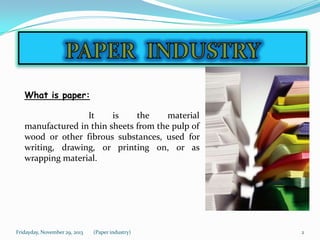
It
is
the
material
manufactured in thin sheets from the pulp of
wood or other fibrous substances, used for
writing, drawing, or printing on, or as
wrapping material.

Fridayday, November 29, 2013

(Paper industry)

2

The word paper is derived from
the name of a reedy plant papyrus,
which grew mostly along the River
Nile in Egypt around 3000B.C.


The invention of modern paper is
credit to Ts’ai Lun of china

Fridayday, November 29, 2013

(Paper industry)

Tsai-Lun of china

3
Paper is formed by pulp.

Pulp:
A mixture of
cellulose
material, such as wood, paper, and
rags, ground up and moistened to
make paper.

Fridayday, November 29, 2013

(Paper industry)

4
 Nonwoody raw material:

Wheat straw
Bagasse Bamboo
Cotton linter

Rice straw
Cotton stalk
Grasses

 Woody raw material:
Poplar (hard wood)
Eucalyptus (hard wood)
Douglas fir (soft wood)

Fridayday, November 29, 2013

(Paper industry)

5
Kraft process (Alkaline)

Sulphite (Acidic)

Neutral sulphite semi-chemical process (NSSC)

 In Pakistan NSSC process is mostly used for pulping.

Fridayday, November 29, 2013

(Paper industry)

6
• Cutting of Raw
material
• Drying Section

Screening
• Material Unit
• Blow Tank

Wet cleaning

Fridayday, November 29, 2013

• Centrifugal
Screening
• Washing

Ready for
paper making
• Bleaching
• Digesting Unit

Thicking

(Paper industry)

7


I.

This process utilizes sodium sulphite cooking liquor which is
buffered with sodium carbonate or NaOH to neutralize the organic
acid liberated from the raw materials.

Cutting of raw material:

The non-woody raw materials
come in the precut state and cut into
small chips before the further
processing.

Fridayday, November 29, 2013

(Paper industry)

8
 Dry & Wet Cleaning:
Wheat straw is collected from the storage and is then sent for the
dry cleaning. For this purpose air is blown into the raw material.
o
Dry wheat straw is then subjected to wet cleaning, which removes
the remaining dust particles.
o

 Screening:
o

In most paper processes some type of
screening operation is required to remove
oversized and unwanted particles. Vibratory,
gravity and centrifugal separators used for
this process.

Fridayday, November 29, 2013

(Paper industry)

9
 Digestion:
o As the raw material enters into the digester,

steam is introduced at the bottom and liquor
containing sodium sulphite is injected .
o It is revolved at 2.5 R.P.M and temperature
of 160-180oC is maintained

 Blow tank:
o

The cooked material from the digester
is blown into a blow tank and then pumped to
centrifugal screen for the separation of cooked
from uncooked materials.

Fridayday, November 29, 2013

(Paper industry)

10
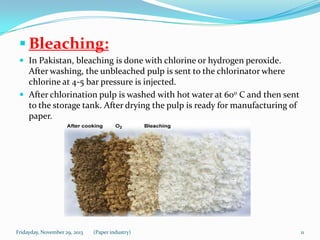
 Bleaching:
 In Pakistan, bleaching is done with chlorine or hydrogen peroxide.

After washing, the unbleached pulp is sent to the chlorinator where
chlorine at 4-5 bar pressure is injected.
 After chlorination pulp is washed with hot water at 60o C and then sent
to the storage tank. After drying the pulp is ready for manufacturing of
paper.

Fridayday, November 29, 2013

(Paper industry)

11
 Paper making machine
 A basic fourdrinier type machine is used for paper making and a brief

description of its major components is given below:

Flow spreader
Press suction
Reel
Fridayday, November 29, 2013

Head box
Dryer section

(Paper industry)

Fourdrinier
Calendar stock

12
 Recycling of paper:
Some industry sources estimate that an
ordinary sheet of paper made from cellulose
fibers derived from wood can survive only
four to six trips through the recycling process.
 The paper is chopped and then subjected to a mixture of chemicals
to remove impurities and de-inked it chemicals.
 An ordinary newspaper can be recycled five (5) times.
o

Fridayday, November 29, 2013

(Paper industry)

13
 Deforestation
Wood is used widely in the formation of
paper which cause deforestation.

 Air pollution
Nitrogen dioxide, sulfur dioxide and carbon
dioxide are emitted during paper manufacturing.

 Water pollution
From treated water of paper industry organic
matter dissolved in fresh water.

Fridayday, November 29, 2013

(Paper industry)

14
 According to the International organization for Standardization
(I.S.O) some recommended sizes are:
 Legal
 Letter
 Tabloid
 A0
 A1
 A2
 A3
 A4
 B1
Fridayday, November 29, 2013

(Paper industry)

15
 Usage of paper (million matric tone) in Pakistan is given in the following table:
S.N.

Particular

Time of
Information

01

Country

02

Population (Million)

180.0

2012

03

Total Pulp/Paper/Paperboard
Production

1.079

2010

03.1

Writing & printing

0.258

2010

03.2

Others

0.821

2010

04

Import

0.409

2010

05

Export

0.008

2010

06

Net Consumption

1.480

2010

07

Per Capita Consumption
(Kg./year/person)

8.22

2010

08

No. of Pulp/Paper Mills

App. 10

2010

Fridayday, November 29, 2013

Pakistan

(Paper industry)

16
Some major paper mills (Private & public sector)

names are given below:
 Bulleh Shah Paper Mill,
 Misk paper mills
 Empire Paper & Board Mills
 Fiaz Paper and Board mills
 Ali Murtaza Paper Mills
 Usama Paper mills
 Al Aziz Paper mills

Fridayday, November 29, 2013

(Paper industry)

17
COMPOSER:

• ADNAN ASLAM
• Muhammad Majid
• Muhammad Maaz
Akhtar

REG NO:

• (13-ME-008)
• (13-ME-109)
• (13-ME-108)

Subject:

• CHEMISTRY

Paper industry

  • 2.
    What is paper: It is the material manufacturedin thin sheets from the pulp of wood or other fibrous substances, used for writing, drawing, or printing on, or as wrapping material. Fridayday, November 29, 2013 (Paper industry) 2
  • 3.
     The word paperis derived from the name of a reedy plant papyrus, which grew mostly along the River Nile in Egypt around 3000B.C.  The invention of modern paper is credit to Ts’ai Lun of china Fridayday, November 29, 2013 (Paper industry) Tsai-Lun of china 3
  • 4.
    Paper is formedby pulp. Pulp: A mixture of cellulose material, such as wood, paper, and rags, ground up and moistened to make paper. Fridayday, November 29, 2013 (Paper industry) 4
  • 5.
     Nonwoody rawmaterial: Wheat straw Bagasse Bamboo Cotton linter Rice straw Cotton stalk Grasses  Woody raw material: Poplar (hard wood) Eucalyptus (hard wood) Douglas fir (soft wood) Fridayday, November 29, 2013 (Paper industry) 5
  • 6.
    Kraft process (Alkaline) Sulphite(Acidic) Neutral sulphite semi-chemical process (NSSC)  In Pakistan NSSC process is mostly used for pulping. Fridayday, November 29, 2013 (Paper industry) 6
  • 7.
    • Cutting ofRaw material • Drying Section Screening • Material Unit • Blow Tank Wet cleaning Fridayday, November 29, 2013 • Centrifugal Screening • Washing Ready for paper making • Bleaching • Digesting Unit Thicking (Paper industry) 7
  • 8.
     I. This process utilizessodium sulphite cooking liquor which is buffered with sodium carbonate or NaOH to neutralize the organic acid liberated from the raw materials. Cutting of raw material: The non-woody raw materials come in the precut state and cut into small chips before the further processing. Fridayday, November 29, 2013 (Paper industry) 8
  • 9.
     Dry &Wet Cleaning: Wheat straw is collected from the storage and is then sent for the dry cleaning. For this purpose air is blown into the raw material. o Dry wheat straw is then subjected to wet cleaning, which removes the remaining dust particles. o  Screening: o In most paper processes some type of screening operation is required to remove oversized and unwanted particles. Vibratory, gravity and centrifugal separators used for this process. Fridayday, November 29, 2013 (Paper industry) 9
  • 10.
     Digestion: o Asthe raw material enters into the digester, steam is introduced at the bottom and liquor containing sodium sulphite is injected . o It is revolved at 2.5 R.P.M and temperature of 160-180oC is maintained  Blow tank: o The cooked material from the digester is blown into a blow tank and then pumped to centrifugal screen for the separation of cooked from uncooked materials. Fridayday, November 29, 2013 (Paper industry) 10
  • 11.
     Bleaching:  InPakistan, bleaching is done with chlorine or hydrogen peroxide. After washing, the unbleached pulp is sent to the chlorinator where chlorine at 4-5 bar pressure is injected.  After chlorination pulp is washed with hot water at 60o C and then sent to the storage tank. After drying the pulp is ready for manufacturing of paper. Fridayday, November 29, 2013 (Paper industry) 11
  • 12.
     Paper makingmachine  A basic fourdrinier type machine is used for paper making and a brief description of its major components is given below: Flow spreader Press suction Reel Fridayday, November 29, 2013 Head box Dryer section (Paper industry) Fourdrinier Calendar stock 12
  • 13.
     Recycling ofpaper: Some industry sources estimate that an ordinary sheet of paper made from cellulose fibers derived from wood can survive only four to six trips through the recycling process.  The paper is chopped and then subjected to a mixture of chemicals to remove impurities and de-inked it chemicals.  An ordinary newspaper can be recycled five (5) times. o Fridayday, November 29, 2013 (Paper industry) 13
  • 14.
     Deforestation Wood isused widely in the formation of paper which cause deforestation.  Air pollution Nitrogen dioxide, sulfur dioxide and carbon dioxide are emitted during paper manufacturing.  Water pollution From treated water of paper industry organic matter dissolved in fresh water. Fridayday, November 29, 2013 (Paper industry) 14
  • 15.
     According tothe International organization for Standardization (I.S.O) some recommended sizes are:  Legal  Letter  Tabloid  A0  A1  A2  A3  A4  B1 Fridayday, November 29, 2013 (Paper industry) 15
  • 16.
     Usage ofpaper (million matric tone) in Pakistan is given in the following table: S.N. Particular Time of Information 01 Country 02 Population (Million) 180.0 2012 03 Total Pulp/Paper/Paperboard Production 1.079 2010 03.1 Writing & printing 0.258 2010 03.2 Others 0.821 2010 04 Import 0.409 2010 05 Export 0.008 2010 06 Net Consumption 1.480 2010 07 Per Capita Consumption (Kg./year/person) 8.22 2010 08 No. of Pulp/Paper Mills App. 10 2010 Fridayday, November 29, 2013 Pakistan (Paper industry) 16
  • 17.
    Some major papermills (Private & public sector) names are given below:  Bulleh Shah Paper Mill,  Misk paper mills  Empire Paper & Board Mills  Fiaz Paper and Board mills  Ali Murtaza Paper Mills  Usama Paper mills  Al Aziz Paper mills Fridayday, November 29, 2013 (Paper industry) 17
  • 18.
    COMPOSER: • ADNAN ASLAM •Muhammad Majid • Muhammad Maaz Akhtar REG NO: • (13-ME-008) • (13-ME-109) • (13-ME-108) Subject: • CHEMISTRY