RECYCLING PAPER
UNDER THE GUIDANCE OF: DR. BABU RAO GUDURI
PRESENTED BY: SUJAY PAWAR
(PG/M/2015/29)
CONTENTS
• INTRODUCTION
• WHAT PAPER IS RECYCLED?
• RECYCLED PAPER SOURCES
• RECYCLED PAPER PROCESSING
• ENVIRONMENTAL IMPACTS
• BENEFITS OF RECYCLING PAPER
• USES
• REFERENCES
INTRODUCTION
• Paper recycling is the process of turning waste
paper into new paper products.
• There are three categories of paper that can be
used as feedstock for making recycled paper:
mill broke, pre-consumer waste and post-
consumer waste.
PRECONSUMER WASTE
Pre-consumer waste consists of
wastes from the manufacturing
and papermaking process as well
as finished paper from obsolete
inventories.
POSTCONSUMER WASTE
Post-consumer waste consists of
paper, paperboard and fibrous
waste from retail stores, offices
and homes.
What Paper is Recycled?
Recycled Paper Sources
• Households
-Newspaper
-Mixed waste
• Retail and wholesale
-corrugated containers
• Offices, Institutions, Printers and converters
-High grade deinking
Recycled Paper Processing
• Sorting, Collection and Transportation
• Storage
• Re-pulping and Screening
• Cleaning
• Deinking
• Refining, Bleaching and Color stripping
• Paper making
Sorting, Collection and Transportation
Storage
Re-pulping and Screening
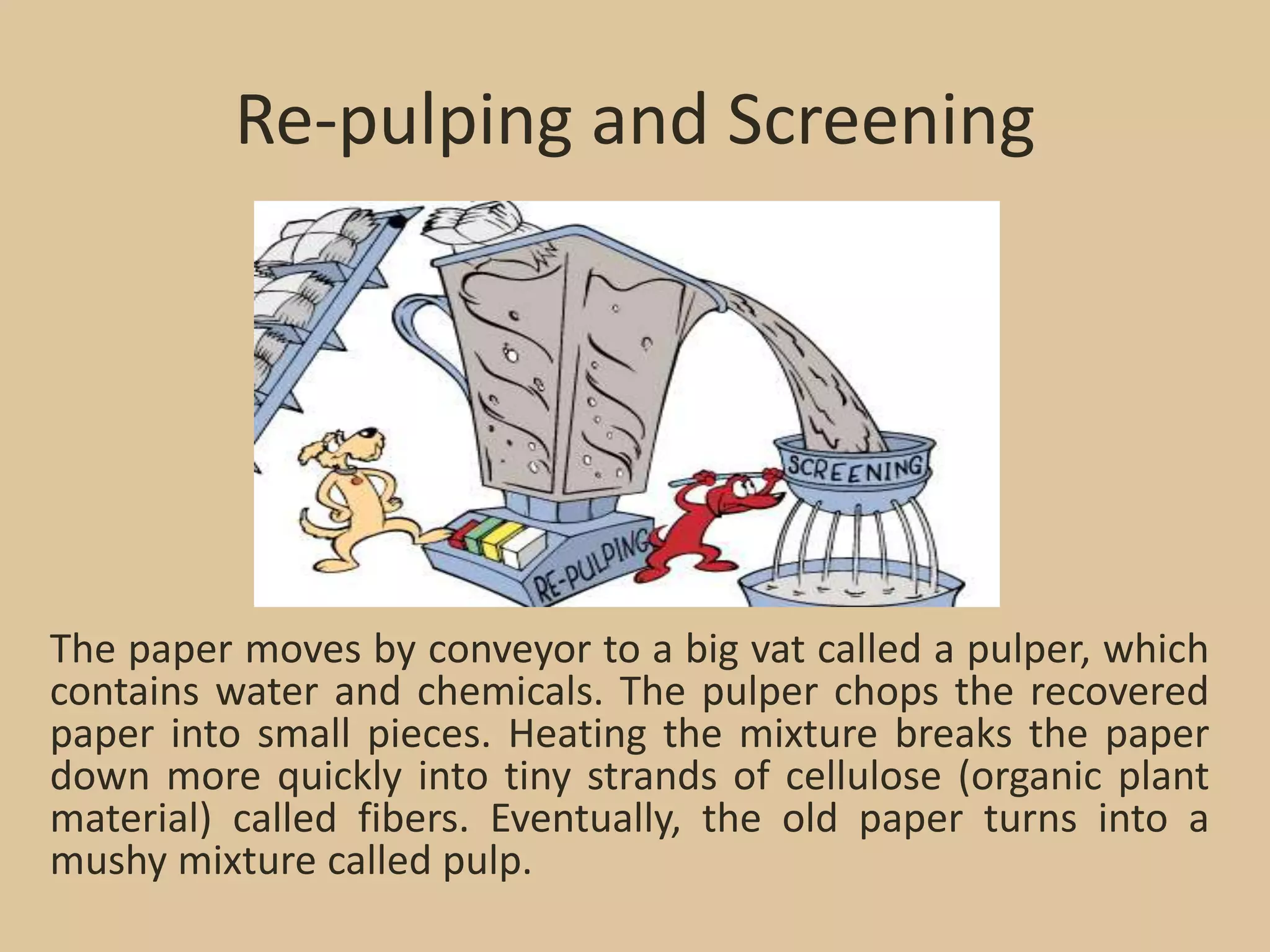
The paper moves by conveyor to a big vat called a pulper, which
contains water and chemicals. The pulper chops the recovered
paper into small pieces. Heating the mixture breaks the paper
down more quickly into tiny strands of cellulose (organic plant
material) called fibers. Eventually, the old paper turns into a
mushy mixture called pulp.
Screening
The pulp is forced through screens containing
holes and slots of various shapes and sizes.
The screens remove small contaminants such
as bits of plastic and globs of glue. This process
is called screening.
Cleaning
Mills also clean pulp by spinning it around in large cone-
shaped cylinders. Heavy contaminants like staples are
thrown to the outside of the cone and fall through the
bottom of the cylinder. Lighter contaminants collect in the
center of the cone and are removed. This process is called
cleaning.
Contaminant Removal
• Metals
• Chemicals
• Thread
• Plastic
• Paper clips, Staples
• Metal binders
• Ink
• Adhesives
• Wax
• Clay
• solvent
Deinking
• In the deinking stage, the goal
is to release and remove
the hydrophobic contaminants
from the recycled paper. The
contaminants are
mostly printing ink and stickies.
Several processes are used,
most commonly flotation or
washing.
• Small particles of ink are rinsed
from the pulp with water in a
process called washing. Larger
particles and stickies are
removed with air bubbles in
another process called
flotation.
Flotation Deinking
• The collector is added to the inlet
of the flotation. The process
temperatures are normally in the
range 45 - 55 °C. Air is blown into
the pulp suspension. The
collector has affinity both to the
ink particles and air bubbles,
causing them to attach. The air
bubbles lift the ink to the surface
and form a thick froth that can be
removed. Normally the setup is a
two stage system with 3, 4 or 5
flotation cells in series. Flotation
deinking is very effective in
removing ink particles larger than
about 10 µm.
Washing Process
• Wash deinking consists of a washing stage
where dispersants are added to wash out
the printing inks. When the pulp slurry is
dewatered (thickened), the medium to fine
particles are washed out. This process is most
useful for removing particles smaller than
about 30 µm, like water-based inks, fillers,
coating particles, fines and micro stickies.
Chemicals Used in Deinking
• Sodium hydroxide
• Soap
• Calcium salts
• Surfactants
• Hydrogen peroxide
• Talc
• Sulfuric acid
• Solvents
Refining, Bleaching and Color Stripping
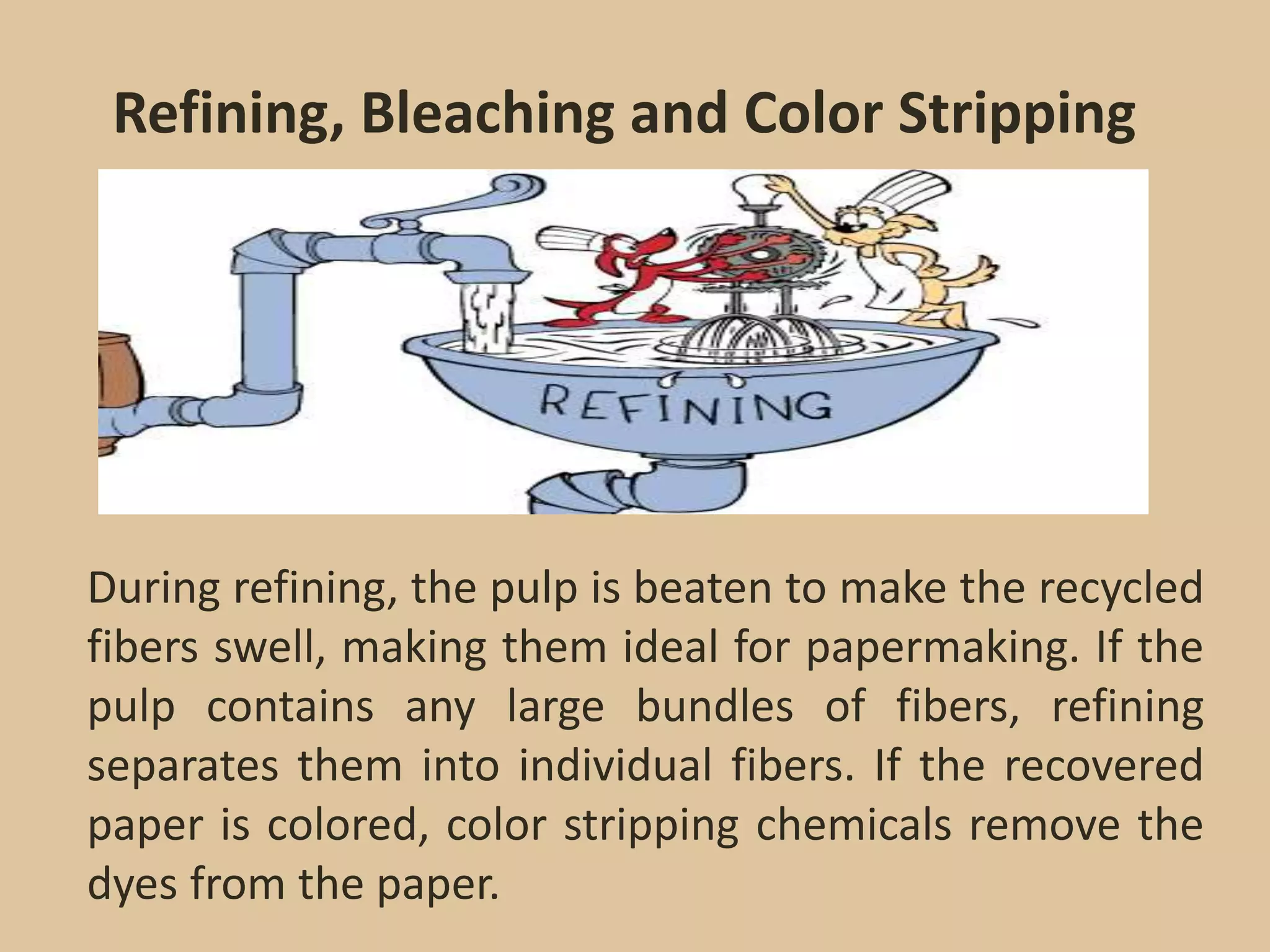
During refining, the pulp is beaten to make the recycled
fibers swell, making them ideal for papermaking. If the
pulp contains any large bundles of fibers, refining
separates them into individual fibers. If the recovered
paper is colored, color stripping chemicals remove the
dyes from the paper.
Papermaking
The pulp is mixed with water and chemicals to make it 99.5%
water. This watery pulp mixture enters the headbox, a giant
metal box at the beginning of the paper machine, and then is
sprayed in a continuous wide jet onto a huge flat wire screen
which is moving very quickly through the paper machine.
The sheet, which now resembles paper, passes through a
series of heated metal rollers which dry the paper. If
coated paper is being made, a coating mixture can be
applied near the end of the process, or in a separate
process after the papermaking is completed. coating gives
paper a smooth, glossy surface for printing.
Cont...
Finally, the finished paper is wound into a giant roll and
removed from the paper machine. One roll can be as
wide as 30 feet and weigh as much as 20 tons. The roll
of paper is cut into smaller rolls, or sometimes into
sheets, before being shipped to a converting plant
where it will be printed or made into products such as
envelopes, paper bags, or boxes.
Environmental Impact
• Effluent Processing
• Sludge
• Contaminant disposal
• Refining, Bleaching and color Stripping
Benefits of Recycling Paper
• Recycling newspaper saves 14% of landfill space
• Recycling one ton of paper can save 17 trees
• Reduces sulfur dioxide emissions
• Most paper can be recycled up to 8 times to
create new products
• Leaves more trees for the sustainability of our
environment
• Saves energy
Recycled paper uses
• Paperboard
• Folding box-board
• Corrugated boxes
• Egg cartons
• Paper towels
• Tissue
• Toilet paper
• Newspaper
• Paper Bags
• Notebooks
• Calendars
References
• www.tappi.org
• wikipedia.org
• paperproject.org
• Technology of paper recycling by R.W.J
McKinney
Recycling paper iip

Recycling paper iip

  • 1.
    RECYCLING PAPER UNDER THEGUIDANCE OF: DR. BABU RAO GUDURI PRESENTED BY: SUJAY PAWAR (PG/M/2015/29)
  • 2.
    CONTENTS • INTRODUCTION • WHATPAPER IS RECYCLED? • RECYCLED PAPER SOURCES • RECYCLED PAPER PROCESSING • ENVIRONMENTAL IMPACTS • BENEFITS OF RECYCLING PAPER • USES • REFERENCES
  • 3.
    INTRODUCTION • Paper recyclingis the process of turning waste paper into new paper products. • There are three categories of paper that can be used as feedstock for making recycled paper: mill broke, pre-consumer waste and post- consumer waste.
  • 4.
    PRECONSUMER WASTE Pre-consumer wasteconsists of wastes from the manufacturing and papermaking process as well as finished paper from obsolete inventories. POSTCONSUMER WASTE Post-consumer waste consists of paper, paperboard and fibrous waste from retail stores, offices and homes.
  • 5.
    What Paper isRecycled?
  • 6.
    Recycled Paper Sources •Households -Newspaper -Mixed waste • Retail and wholesale -corrugated containers • Offices, Institutions, Printers and converters -High grade deinking
  • 7.
    Recycled Paper Processing •Sorting, Collection and Transportation • Storage • Re-pulping and Screening • Cleaning • Deinking • Refining, Bleaching and Color stripping • Paper making
  • 8.
  • 9.
  • 10.
    Re-pulping and Screening Thepaper moves by conveyor to a big vat called a pulper, which contains water and chemicals. The pulper chops the recovered paper into small pieces. Heating the mixture breaks the paper down more quickly into tiny strands of cellulose (organic plant material) called fibers. Eventually, the old paper turns into a mushy mixture called pulp.
  • 11.
    Screening The pulp isforced through screens containing holes and slots of various shapes and sizes. The screens remove small contaminants such as bits of plastic and globs of glue. This process is called screening.
  • 12.
    Cleaning Mills also cleanpulp by spinning it around in large cone- shaped cylinders. Heavy contaminants like staples are thrown to the outside of the cone and fall through the bottom of the cylinder. Lighter contaminants collect in the center of the cone and are removed. This process is called cleaning.
  • 13.
    Contaminant Removal • Metals •Chemicals • Thread • Plastic • Paper clips, Staples • Metal binders • Ink • Adhesives • Wax • Clay • solvent
  • 14.
    Deinking • In thedeinking stage, the goal is to release and remove the hydrophobic contaminants from the recycled paper. The contaminants are mostly printing ink and stickies. Several processes are used, most commonly flotation or washing. • Small particles of ink are rinsed from the pulp with water in a process called washing. Larger particles and stickies are removed with air bubbles in another process called flotation.
  • 15.
    Flotation Deinking • Thecollector is added to the inlet of the flotation. The process temperatures are normally in the range 45 - 55 °C. Air is blown into the pulp suspension. The collector has affinity both to the ink particles and air bubbles, causing them to attach. The air bubbles lift the ink to the surface and form a thick froth that can be removed. Normally the setup is a two stage system with 3, 4 or 5 flotation cells in series. Flotation deinking is very effective in removing ink particles larger than about 10 µm.
  • 16.
    Washing Process • Washdeinking consists of a washing stage where dispersants are added to wash out the printing inks. When the pulp slurry is dewatered (thickened), the medium to fine particles are washed out. This process is most useful for removing particles smaller than about 30 µm, like water-based inks, fillers, coating particles, fines and micro stickies.
  • 17.
    Chemicals Used inDeinking • Sodium hydroxide • Soap • Calcium salts • Surfactants • Hydrogen peroxide • Talc • Sulfuric acid • Solvents
  • 18.
    Refining, Bleaching andColor Stripping During refining, the pulp is beaten to make the recycled fibers swell, making them ideal for papermaking. If the pulp contains any large bundles of fibers, refining separates them into individual fibers. If the recovered paper is colored, color stripping chemicals remove the dyes from the paper.
  • 19.
    Papermaking The pulp ismixed with water and chemicals to make it 99.5% water. This watery pulp mixture enters the headbox, a giant metal box at the beginning of the paper machine, and then is sprayed in a continuous wide jet onto a huge flat wire screen which is moving very quickly through the paper machine.
  • 20.
    The sheet, whichnow resembles paper, passes through a series of heated metal rollers which dry the paper. If coated paper is being made, a coating mixture can be applied near the end of the process, or in a separate process after the papermaking is completed. coating gives paper a smooth, glossy surface for printing. Cont...
  • 21.
    Finally, the finishedpaper is wound into a giant roll and removed from the paper machine. One roll can be as wide as 30 feet and weigh as much as 20 tons. The roll of paper is cut into smaller rolls, or sometimes into sheets, before being shipped to a converting plant where it will be printed or made into products such as envelopes, paper bags, or boxes.
  • 22.
    Environmental Impact • EffluentProcessing • Sludge • Contaminant disposal • Refining, Bleaching and color Stripping
  • 23.
    Benefits of RecyclingPaper • Recycling newspaper saves 14% of landfill space • Recycling one ton of paper can save 17 trees • Reduces sulfur dioxide emissions • Most paper can be recycled up to 8 times to create new products • Leaves more trees for the sustainability of our environment • Saves energy
  • 24.
    Recycled paper uses •Paperboard • Folding box-board • Corrugated boxes • Egg cartons • Paper towels • Tissue • Toilet paper • Newspaper • Paper Bags • Notebooks • Calendars
  • 25.
    References • www.tappi.org • wikipedia.org •paperproject.org • Technology of paper recycling by R.W.J McKinney