‫أكاديمية الحكومة اإللكترونية الفلسطينية‬
           The Palestinian eGovernment Academy
                      www.egovacademy.ps


Tutorial 4: Ontology Engineering & Lexical Semantics

                      Session 8.2
         Stepwise Methodologies


                  Dr. Mustafa Jarrar
                     University of Birzeit
                     mjarrar@birzeit.edu
                       www.jarrar.info

                         PalGov © 2011                 1
About

This tutorial is part of the PalGov project, funded by the TEMPUS IV program of the
Commission of the European Communities, grant agreement 511159-TEMPUS-1-
2010-1-PS-TEMPUS-JPHES. The project website: www.egovacademy.ps
Project Consortium:

             Birzeit University, Palestine
                                                           University of Trento, Italy
             (Coordinator )


             Palestine Polytechnic University, Palestine   Vrije Universiteit Brussel, Belgium


             Palestine Technical University, Palestine
                                                           Université de Savoie, France

             Ministry of Telecom and IT, Palestine
                                                           University of Namur, Belgium
             Ministry of Interior, Palestine
                                                           TrueTrust, UK
             Ministry of Local Government, Palestine


Coordinator:
Dr. Mustafa Jarrar
Birzeit University, P.O.Box 14- Birzeit, Palestine
Telfax:+972 2 2982935 mjarrar@birzeit.eduPalGov © 2011
                                                                                                 2
© Copyright Notes
Everyone is encouraged to use this material, or part of it, but should
properly cite the project (logo and website), and the author of that part.


No part of this tutorial may be reproduced or modified in any form or by
any means, without prior written permission from the project, who have
the full copyrights on the material.


                 Attribution-NonCommercial-ShareAlike
                              CC-BY-NC-SA

This license lets others remix, tweak, and build upon your work non-
commercially, as long as they credit you and license their new creations
under the identical terms.

                                 PalGov © 2011                               3
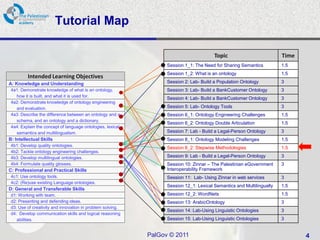
Tutorial Map

                                                                                        Topic                          Time
                                                                  Session 1_1: The Need for Sharing Semantics          1.5
                                                                  Session 1_2: What is an ontology                     1.5
         Intended Learning Objectives
A: Knowledge and Understanding                                    Session 2: Lab- Build a Population Ontology          3
 4a1: Demonstrate knowledge of what is an ontology,               Session 3: Lab- Build a BankCustomer Ontology        3
   how it is built, and what it is used for.
                                                                  Session 4: Lab- Build a BankCustomer Ontology        3
 4a2: Demonstrate knowledge of ontology engineering
   and evaluation.                                                Session 5: Lab- Ontology Tools                       3
 4a3: Describe the difference between an ontology and a           Session 6_1: Ontology Engineering Challenges         1.5
   schema, and an ontology and a dictionary.
                                                                  Session 6_2: Ontology Double Articulation            1.5
 4a4: Explain the concept of language ontologies, lexical
   semantics and multilingualism.                                 Session 7: Lab - Build a Legal-Person Ontology       3
B: Intellectual Skills                                            Session 8_1: Ontology Modeling Challenges            1.5
 4b1: Develop quality ontologies.
                                                                  Session 8_2: Stepwise Methodologies                  1.5
 4b2: Tackle ontology engineering challenges.
 4b3: Develop multilingual ontologies.                            Session 9: Lab - Build a Legal-Person Ontology       3
 4b4: Formulate quality glosses.                                  Session 10: Zinnar – The Palestinian eGovernment     3
C: Professional and Practical Skills                              Interoperability Framework
 4c1: Use ontology tools.                                         Session 11: Lab- Using Zinnar in web services        3
 4c2: (Re)use existing Language ontologies.
                                                                  Session 12_1: Lexical Semantics and Multilingually   1.5
D: General and Transferable Skills
 d1: Working with team.                                           Session 12_2: WordNets                               1.5
 d2: Presenting and defending ideas.                              Session 13: ArabicOntology                           3
 d3: Use of creativity and innovation in problem solving.
                                                                  Session 14: Lab-Using Linguistic Ontologies          3
 d4: Develop communication skills and logical reasoning
    abilities.                                                    Session 15: Lab-Using Linguistic Ontologies          3


                                                            PalGov © 2011                                                     4
Outline and Session ILOs


This session will help student to:

4a1: Demonstrate knowledge of what is an ontology, how it is
 built, and what it is used for.

4b1: Develop quality ontologies.


                       PalGov © 2011                       5
Methodology


What are the phases of the ontology development life
cycle? taking into account that Ontologies might be built
collaboratively by many people.

Let’s discuss from where to start, if you want to build an
ontology for:
      • E-government
      • E-Banking
      • E-Health
      • Bioinformatics
      • Multilingual search engine
      • …

                        PalGov © 2011                        6
Methodological Questions

    – Which tools and techniques to use?
    – Which languages should be used in which circumstances, and in
      which order?
    – What quality measures should we care about?
    – What things can be reused?
    – Which people should be assigned which tasks?
    – ....

• Many Methodologies exist ! But non is good! Because each
  project/application/domain is different, and the background of the
  people involved are also different, etc.

• We will overview some common steps in this lecture, thus try to learn
  smartly, and don’t follow these steps literally. You should have your
  own methodology for each ontology.

                               PalGov © 2011                           7
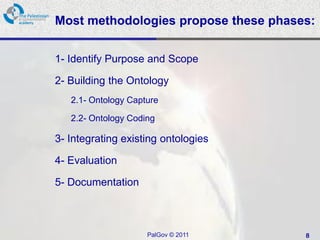
Most methodologies propose these phases:


1- Identify Purpose and Scope

2- Building the Ontology
   2.1- Ontology Capture

   2.2- Ontology Coding

3- Integrating existing ontologies

4- Evaluation

5- Documentation


                     PalGov © 2011    8
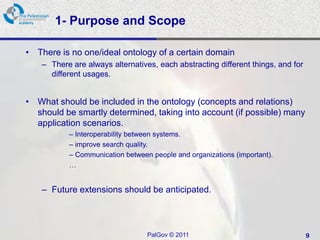
1- Purpose and Scope

• There is no one/ideal ontology of a certain domain
    – There are always alternatives, each abstracting different things, and for
      different usages.


• What should be included in the ontology (concepts and relations)
  should be smartly determined, taking into account (if possible) many
  application scenarios.
           – Interoperability between systems.
           – improve search quality.
           – Communication between people and organizations (important).
           …


    – Future extensions should be anticipated.


                                  PalGov © 2011                                   9
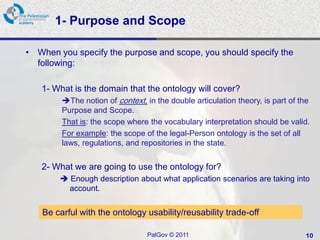
1- Purpose and Scope

• When you specify the purpose and scope, you should specify the
  following:

   1- What is the domain that the ontology will cover?
        The notion of context, in the double articulation theory, is part of the
        Purpose and Scope.
        That is: the scope where the vocabulary interpretation should be valid.
        For example: the scope of the legal-Person ontology is the set of all
        laws, regulations, and repositories in the state.


   2- What we are going to use the ontology for?
         Enough description about what application scenarios are taking into
          account.


   Be carful with the ontology usability/reusability trade-off

                                 PalGov © 2011                                 10
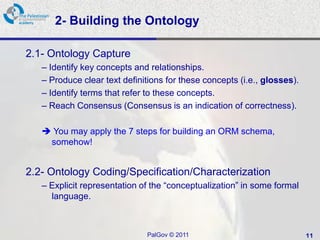
2- Building the Ontology

2.1- Ontology Capture
   – Identify key concepts and relationships.
   – Produce clear text definitions for these concepts (i.e., glosses).
   – Identify terms that refer to these concepts.
   – Reach Consensus (Consensus is an indication of correctness).

    You may apply the 7 steps for building an ORM schema,
    somehow!


2.2- Ontology Coding/Specification/Characterization
   – Explicit representation of the “conceptualization” in some formal
     language.


                              PalGov © 2011                               11
2.1- Ontology Capture: Scoping

• Brainstorming
    – Produce all potentially relevant terms and phrases.
        • Nouns form the basis for concept names
        • Verbs (or verb phrases) form the basis for property and names.

       This step can be semi- automated somehow, as candidate concepts and
       relations can be extracted automatically from relevant documents, laws,
       forms, DB schemes....


• Organize candidate concepts into groups
    Group related terms together.
    – Exclude some terms if not relevant (w.r.t., purpose and scope)
    – Keep notes of these decisions.
    – Group similar terms and potential synonyms together.


                                    PalGov © 2011                            12
2.1- Ontology Capture: Produce Definitions

• Use suitable meta-ontology
    – i.e., use modeling primitives in a consistent manner (e.g. Type,
      role, entity, instance, relationship...)

• When several people are involved, each might be responsible on a
  group of terms
    – Semantic overlap with others must be right in the first place,
      otherwise lot of redundant re-working.

• Terms: Produce definitions/glosses in a middle-out fashion
    – Define a gloss for each term. This helps get deeper understanding
      of the domain.
    – These glosses will have to be revised later, after defining the
      relationships/ subsumptions between concepts.
    – This is called middle-out, rather than top-down or bottom up. – will
      be discussed later.
                               PalGov © 2011                             13
Define Taxonomy

•   Relevant terms must be organized in a taxonomic hierarchy (i.e.,
    subsumptions)
     – Opinions differ on whether it is more efficient to do this in a top-
       down or a bottom-up fashion.

•   Ensure that hierarchy is indeed a taxonomy:
     – If A subsumes B, then every instance of A must also be a
       subsume B (compatible with semantics of rdfs:subClassOf)
     – Insuring the correctness of subsumptions needs philosophical
       thinking (apply the OntoClean Methodology).

•   The semantics of subsumption demands that whenever A subsumes
    B, every property that holds for instances of B must also apply to
    instances of A (called inheritance).
     – It makes sense to attach properties to the highest class in the
        hierarchy to which they apply.
                              PalGov © 2011                             14
Define Properties

• Determine the relevant properties for each concept. Such
  properties must be essential –to describe the meaning-, or
  relevant to the applications.

• While attaching properties to concepts, it is useful to
  determine its range (its datatype/value, or relations with
  other concepts).


                          PalGov © 2011                        15
Add Rules and Restrictions

• Cardinality Restrictions

• Which properties should be unique, mandatory,
  disjunctions, restricted values…etc.

• Relational Characteristics
   – symmetry, transitivity, inverse properties, functional values

    You must avoid the situation that the added rules are DB integrity
    constraints.
    Some/all rules should be verbalized –in pseudo natural language
    sentences- so to enable other people review it and give feedback.


                              PalGov © 2011                          16
Define Some Important Instances

• Some important instances (might) be added to the
  ontology, if needed. Such entities can be:
   – Country: Palestine
   – Person: Arafat
   – Capital: Jerusalem


•  in case of a large instances, it is more convenient to
  have them separately .
     - See the Entity and Address servers in Zinnar


                          PalGov © 2011                      17
Advantages of the Middle-out Approaches

• A bottom-up approach results in a high degree of detail
   – increases overall effort
   – makes it difficult to spot commonality between related concepts.
   – increases risk of inconsistencies and re-work.


• Top-down allow better control of degree of detail
   – risk of arbitrary high-level categories
   – risk of limited stability


• Middle-out strikes is a compromise, but it allow the ontology
   evolve gradually, you need to come back to some steps.

• The higher level concepts naturally arise and are thus more
   likely to be stable.
                                   PalGov © 2011                        18
Reaching Agreement: Some suggestions

 Ontologies are made to be agreed and shared, thus it is VERY
  important to make sure that people agree on them.
 How to facilitate reaching agreement?

• Produce a natural language text definitions.
   - Ask domain experts to review the context, glosses, verbalized rules,
      and the ontology itself in a graphical/diagramatic form.

• Ensure consistency with terms already in use
    – use existing thesauri and dictionaries
    – avoid introducing new terms in the definitions


• Indicate relationships with other commonly used terms
    – synonyms, variants, such referring to different dimensions


• Give examples                   PalGov © 2011                         19
Integrating Existing Ontologies

• Check overlap with existing ontologies

• Establish formal links
   – Produce mappings to existing concept definitions
   – Import and extend existing ontologies


• Avoid re-inventing the wheel!


                             PalGov © 2011              20
Ontology Evaluation

Several Type of evaluations:
   1. Usability Evaluation: Validate whether the ontology produced
      satisfies (at least) the intended applications’ requirements.

   2. Syntax evaluation: Validate whether the ontology is well-formed
      w.r.t the used language.

   3. Logical evaluation: Validate whether the ontology has axioms
      contradicting or implying each other.

   4. Ontological Evaluation: Validate whether the ontology has
      concepts that should be instances, sub-concepts that should be
      roles, etc. (The OntoClean methodology is very good for this
      evaluation)


                            PalGov © 2011                             21
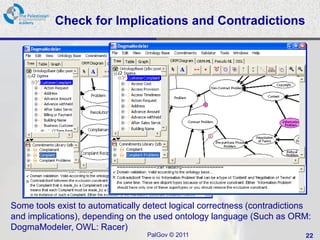
Check for Implications and Contradictions


Some tools exist to automatically detect logical correctness (contradictions
and implications), depending on the used ontology language (Such as ORM:
DogmaModeler, OWL: Racer)
                                  PalGov © 2011                           22
Some Guidelines

Clarity: The ontology engineer should communicate effectively with
   the domain experts (= ask the right questions):
    – Natural language definitions.
    – Give examples, alternatives, and contradictions, elicit knowledge.
    – emphasize distinctions.


Coherence: The ontology should be internally consistent
    – Syntactically correct.
    – Logically consistent.
    – Ontologically consistent.


Extensibility: modularize the ontology in a way it is easy to build, understand,
   and maintain. What should be in a module?


Reusability and Usability: be innovative to tradeoff this smartly.

                                  PalGov © 2011                               23
References


Mike Uschol: Building Ontologies: Towards a Unified Methodology.
Proceedings of Expert Systems th Annual Conference
of the British Computer Society Specialist Group on Expert Systems. 1996
http://www.imamu.edu.sa/Scientific_selections/Documents/IT/96-es96-unified-
method.pdf

Mustafa Jarrar: Towards methodological principles for ontology
engineering. PhD Thesis. Vrije Universiteit Brussel. (May 2005)
http://www.jarrar.info/phd-thesis/

Fernández López: Overview Of Methodologies For Building Ontologies.
Proceedings of the IJCAI99 Workshop on Ontologies and
ProblemSolvingMethods Lessons Learned and Future Trends CEUR
Publications.
http://citeseerx.ist.psu.edu/viewdoc/summary?doi=10.1.1.39.6002


                                  PalGov © 2011                               24

Pal gov.tutorial4.session8 2.stepwisemethodologies

  • 1.
    ‫أكاديمية الحكومة اإللكترونيةالفلسطينية‬ The Palestinian eGovernment Academy www.egovacademy.ps Tutorial 4: Ontology Engineering & Lexical Semantics Session 8.2 Stepwise Methodologies Dr. Mustafa Jarrar University of Birzeit mjarrar@birzeit.edu www.jarrar.info PalGov © 2011 1
  • 2.
    About This tutorial ispart of the PalGov project, funded by the TEMPUS IV program of the Commission of the European Communities, grant agreement 511159-TEMPUS-1- 2010-1-PS-TEMPUS-JPHES. The project website: www.egovacademy.ps Project Consortium: Birzeit University, Palestine University of Trento, Italy (Coordinator ) Palestine Polytechnic University, Palestine Vrije Universiteit Brussel, Belgium Palestine Technical University, Palestine Université de Savoie, France Ministry of Telecom and IT, Palestine University of Namur, Belgium Ministry of Interior, Palestine TrueTrust, UK Ministry of Local Government, Palestine Coordinator: Dr. Mustafa Jarrar Birzeit University, P.O.Box 14- Birzeit, Palestine Telfax:+972 2 2982935 mjarrar@birzeit.eduPalGov © 2011 2
  • 3.
    © Copyright Notes Everyoneis encouraged to use this material, or part of it, but should properly cite the project (logo and website), and the author of that part. No part of this tutorial may be reproduced or modified in any form or by any means, without prior written permission from the project, who have the full copyrights on the material. Attribution-NonCommercial-ShareAlike CC-BY-NC-SA This license lets others remix, tweak, and build upon your work non- commercially, as long as they credit you and license their new creations under the identical terms. PalGov © 2011 3
  • 4.
    Tutorial Map Topic Time Session 1_1: The Need for Sharing Semantics 1.5 Session 1_2: What is an ontology 1.5 Intended Learning Objectives A: Knowledge and Understanding Session 2: Lab- Build a Population Ontology 3 4a1: Demonstrate knowledge of what is an ontology, Session 3: Lab- Build a BankCustomer Ontology 3 how it is built, and what it is used for. Session 4: Lab- Build a BankCustomer Ontology 3 4a2: Demonstrate knowledge of ontology engineering and evaluation. Session 5: Lab- Ontology Tools 3 4a3: Describe the difference between an ontology and a Session 6_1: Ontology Engineering Challenges 1.5 schema, and an ontology and a dictionary. Session 6_2: Ontology Double Articulation 1.5 4a4: Explain the concept of language ontologies, lexical semantics and multilingualism. Session 7: Lab - Build a Legal-Person Ontology 3 B: Intellectual Skills Session 8_1: Ontology Modeling Challenges 1.5 4b1: Develop quality ontologies. Session 8_2: Stepwise Methodologies 1.5 4b2: Tackle ontology engineering challenges. 4b3: Develop multilingual ontologies. Session 9: Lab - Build a Legal-Person Ontology 3 4b4: Formulate quality glosses. Session 10: Zinnar – The Palestinian eGovernment 3 C: Professional and Practical Skills Interoperability Framework 4c1: Use ontology tools. Session 11: Lab- Using Zinnar in web services 3 4c2: (Re)use existing Language ontologies. Session 12_1: Lexical Semantics and Multilingually 1.5 D: General and Transferable Skills d1: Working with team. Session 12_2: WordNets 1.5 d2: Presenting and defending ideas. Session 13: ArabicOntology 3 d3: Use of creativity and innovation in problem solving. Session 14: Lab-Using Linguistic Ontologies 3 d4: Develop communication skills and logical reasoning abilities. Session 15: Lab-Using Linguistic Ontologies 3 PalGov © 2011 4
  • 5.
    Outline and SessionILOs This session will help student to: 4a1: Demonstrate knowledge of what is an ontology, how it is built, and what it is used for. 4b1: Develop quality ontologies. PalGov © 2011 5
  • 6.
    Methodology What are thephases of the ontology development life cycle? taking into account that Ontologies might be built collaboratively by many people. Let’s discuss from where to start, if you want to build an ontology for: • E-government • E-Banking • E-Health • Bioinformatics • Multilingual search engine • … PalGov © 2011 6
  • 7.
    Methodological Questions – Which tools and techniques to use? – Which languages should be used in which circumstances, and in which order? – What quality measures should we care about? – What things can be reused? – Which people should be assigned which tasks? – .... • Many Methodologies exist ! But non is good! Because each project/application/domain is different, and the background of the people involved are also different, etc. • We will overview some common steps in this lecture, thus try to learn smartly, and don’t follow these steps literally. You should have your own methodology for each ontology. PalGov © 2011 7
  • 8.
    Most methodologies proposethese phases: 1- Identify Purpose and Scope 2- Building the Ontology 2.1- Ontology Capture 2.2- Ontology Coding 3- Integrating existing ontologies 4- Evaluation 5- Documentation PalGov © 2011 8
  • 9.
    1- Purpose andScope • There is no one/ideal ontology of a certain domain – There are always alternatives, each abstracting different things, and for different usages. • What should be included in the ontology (concepts and relations) should be smartly determined, taking into account (if possible) many application scenarios. – Interoperability between systems. – improve search quality. – Communication between people and organizations (important). … – Future extensions should be anticipated. PalGov © 2011 9
  • 10.
    1- Purpose andScope • When you specify the purpose and scope, you should specify the following: 1- What is the domain that the ontology will cover? The notion of context, in the double articulation theory, is part of the Purpose and Scope. That is: the scope where the vocabulary interpretation should be valid. For example: the scope of the legal-Person ontology is the set of all laws, regulations, and repositories in the state. 2- What we are going to use the ontology for?  Enough description about what application scenarios are taking into account. Be carful with the ontology usability/reusability trade-off PalGov © 2011 10
  • 11.
    2- Building theOntology 2.1- Ontology Capture – Identify key concepts and relationships. – Produce clear text definitions for these concepts (i.e., glosses). – Identify terms that refer to these concepts. – Reach Consensus (Consensus is an indication of correctness).  You may apply the 7 steps for building an ORM schema, somehow! 2.2- Ontology Coding/Specification/Characterization – Explicit representation of the “conceptualization” in some formal language. PalGov © 2011 11
  • 12.
    2.1- Ontology Capture:Scoping • Brainstorming – Produce all potentially relevant terms and phrases. • Nouns form the basis for concept names • Verbs (or verb phrases) form the basis for property and names. This step can be semi- automated somehow, as candidate concepts and relations can be extracted automatically from relevant documents, laws, forms, DB schemes.... • Organize candidate concepts into groups Group related terms together. – Exclude some terms if not relevant (w.r.t., purpose and scope) – Keep notes of these decisions. – Group similar terms and potential synonyms together. PalGov © 2011 12
  • 13.
    2.1- Ontology Capture:Produce Definitions • Use suitable meta-ontology – i.e., use modeling primitives in a consistent manner (e.g. Type, role, entity, instance, relationship...) • When several people are involved, each might be responsible on a group of terms – Semantic overlap with others must be right in the first place, otherwise lot of redundant re-working. • Terms: Produce definitions/glosses in a middle-out fashion – Define a gloss for each term. This helps get deeper understanding of the domain. – These glosses will have to be revised later, after defining the relationships/ subsumptions between concepts. – This is called middle-out, rather than top-down or bottom up. – will be discussed later. PalGov © 2011 13
  • 14.
    Define Taxonomy • Relevant terms must be organized in a taxonomic hierarchy (i.e., subsumptions) – Opinions differ on whether it is more efficient to do this in a top- down or a bottom-up fashion. • Ensure that hierarchy is indeed a taxonomy: – If A subsumes B, then every instance of A must also be a subsume B (compatible with semantics of rdfs:subClassOf) – Insuring the correctness of subsumptions needs philosophical thinking (apply the OntoClean Methodology). • The semantics of subsumption demands that whenever A subsumes B, every property that holds for instances of B must also apply to instances of A (called inheritance). – It makes sense to attach properties to the highest class in the hierarchy to which they apply. PalGov © 2011 14
  • 15.
    Define Properties • Determinethe relevant properties for each concept. Such properties must be essential –to describe the meaning-, or relevant to the applications. • While attaching properties to concepts, it is useful to determine its range (its datatype/value, or relations with other concepts). PalGov © 2011 15
  • 16.
    Add Rules andRestrictions • Cardinality Restrictions • Which properties should be unique, mandatory, disjunctions, restricted values…etc. • Relational Characteristics – symmetry, transitivity, inverse properties, functional values  You must avoid the situation that the added rules are DB integrity constraints.  Some/all rules should be verbalized –in pseudo natural language sentences- so to enable other people review it and give feedback. PalGov © 2011 16
  • 17.
    Define Some ImportantInstances • Some important instances (might) be added to the ontology, if needed. Such entities can be: – Country: Palestine – Person: Arafat – Capital: Jerusalem •  in case of a large instances, it is more convenient to have them separately . - See the Entity and Address servers in Zinnar PalGov © 2011 17
  • 18.
    Advantages of theMiddle-out Approaches • A bottom-up approach results in a high degree of detail – increases overall effort – makes it difficult to spot commonality between related concepts. – increases risk of inconsistencies and re-work. • Top-down allow better control of degree of detail – risk of arbitrary high-level categories – risk of limited stability • Middle-out strikes is a compromise, but it allow the ontology evolve gradually, you need to come back to some steps. • The higher level concepts naturally arise and are thus more likely to be stable. PalGov © 2011 18
  • 19.
    Reaching Agreement: Somesuggestions  Ontologies are made to be agreed and shared, thus it is VERY important to make sure that people agree on them.  How to facilitate reaching agreement? • Produce a natural language text definitions. - Ask domain experts to review the context, glosses, verbalized rules, and the ontology itself in a graphical/diagramatic form. • Ensure consistency with terms already in use – use existing thesauri and dictionaries – avoid introducing new terms in the definitions • Indicate relationships with other commonly used terms – synonyms, variants, such referring to different dimensions • Give examples PalGov © 2011 19
  • 20.
    Integrating Existing Ontologies •Check overlap with existing ontologies • Establish formal links – Produce mappings to existing concept definitions – Import and extend existing ontologies • Avoid re-inventing the wheel! PalGov © 2011 20
  • 21.
    Ontology Evaluation Several Typeof evaluations: 1. Usability Evaluation: Validate whether the ontology produced satisfies (at least) the intended applications’ requirements. 2. Syntax evaluation: Validate whether the ontology is well-formed w.r.t the used language. 3. Logical evaluation: Validate whether the ontology has axioms contradicting or implying each other. 4. Ontological Evaluation: Validate whether the ontology has concepts that should be instances, sub-concepts that should be roles, etc. (The OntoClean methodology is very good for this evaluation) PalGov © 2011 21
  • 22.
    Check for Implicationsand Contradictions Some tools exist to automatically detect logical correctness (contradictions and implications), depending on the used ontology language (Such as ORM: DogmaModeler, OWL: Racer) PalGov © 2011 22
  • 23.
    Some Guidelines Clarity: Theontology engineer should communicate effectively with the domain experts (= ask the right questions): – Natural language definitions. – Give examples, alternatives, and contradictions, elicit knowledge. – emphasize distinctions. Coherence: The ontology should be internally consistent – Syntactically correct. – Logically consistent. – Ontologically consistent. Extensibility: modularize the ontology in a way it is easy to build, understand, and maintain. What should be in a module? Reusability and Usability: be innovative to tradeoff this smartly. PalGov © 2011 23
  • 24.
    References Mike Uschol: BuildingOntologies: Towards a Unified Methodology. Proceedings of Expert Systems th Annual Conference of the British Computer Society Specialist Group on Expert Systems. 1996 http://www.imamu.edu.sa/Scientific_selections/Documents/IT/96-es96-unified- method.pdf Mustafa Jarrar: Towards methodological principles for ontology engineering. PhD Thesis. Vrije Universiteit Brussel. (May 2005) http://www.jarrar.info/phd-thesis/ Fernández López: Overview Of Methodologies For Building Ontologies. Proceedings of the IJCAI99 Workshop on Ontologies and ProblemSolvingMethods Lessons Learned and Future Trends CEUR Publications. http://citeseerx.ist.psu.edu/viewdoc/summary?doi=10.1.1.39.6002 PalGov © 2011 24