Continual Lifelong Learning
with Neural Networks
April 16, 2019 -Tutorial @ INNSBDDL2019
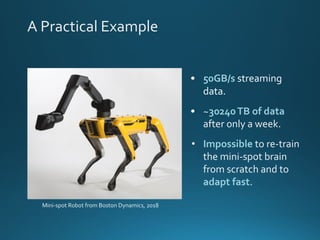
A Practical Example
• 50GB/s streaming
data.
• ~30240TB of data
after only a week.
• Impossible to re-train
the mini-spot brain
from scratch and to
adapt fast.
Mini-spot Robot from Boston Dynamics, 2018
Continual Learning (CL)
• Ability to continually acquire, fine-tune, and transfer
new knowledge and skills
• Higher and realistic time-scale where data (and tasks)
become available only during time.
• No access to previously encountered data.
• Constrained computational and memory resources.
paper
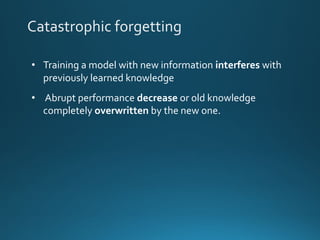
Catastrophic forgetting
• Training a model with new information interferes with
previously learned knowledge
• Abrupt performance decrease or old knowledge
completely overwritten by the new one.
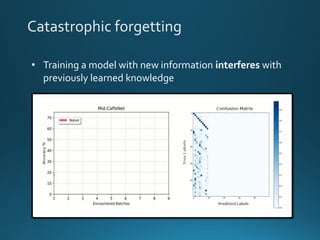
Catastrophic forgetting
• Training a model with new information interferes with
previously learned knowledge
• Abrupt performance decrease or old knowledge
completely overwritten by the new one.
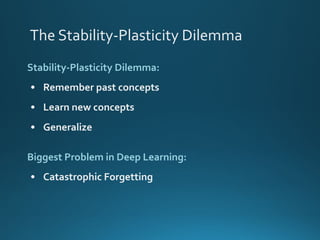
The Stability-Plasticity Dilemma
Stability-Plasticity Dilemma:
• Remember past concepts
• Learn new concepts
• Generalize
Biggest Problem in Deep Learning:
• Catastrophic Forgetting
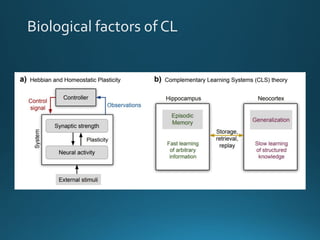
Biological factors of CL
• Structural Plasticity
• Neurosynaptic adaptation to changes in the environment
• Change of physical structure as the result of learning
• Stability-plasticity balance
• Complementary Learning Systems
• Retaining episodic memories (memorization)
• Extracting statistical structure (generalization)
• Memory replay
Biological factors of CL
•
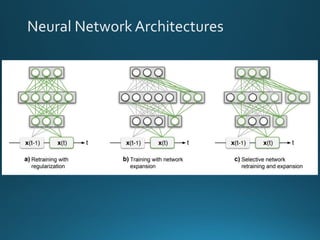
Neural Network Architectures
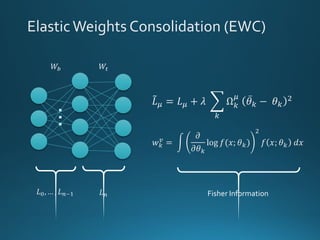
ElasticWeights Consolidation (EWC)
Fisher Information
...
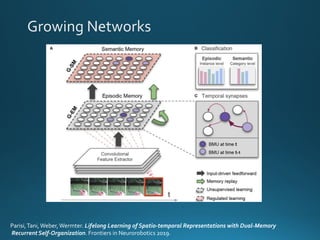
Growing Networks
Parisi,Tani,Weber,Wermter. Lifelong Learning of Spatio-temporal Representations with Dual-Memory
Recurrent Self-Organization. Frontiers in Neurorobotics 2019.
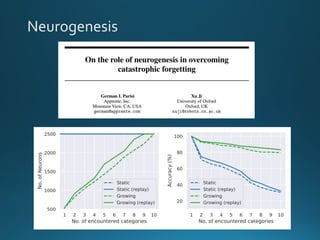
Neurogenesis
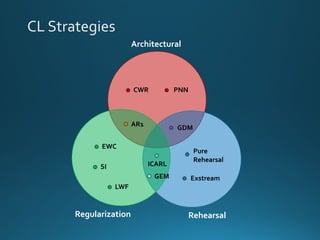
CL Strategies
Architectural
Regularization Rehearsal
CWR PNN
EWC
SI
LWF
ICARL
AR1
GEM
Pure
Rehearsal
GDM
Exstream
Continual Learning
Benchmarks
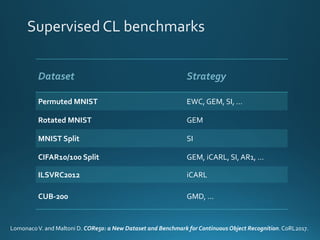
Supervised CL benchmarks
Dataset Strategy
Permuted MNIST EWC, GEM, SI, ...
Rotated MNIST GEM
MNIST Split SI
CIFAR10/100 Split GEM, iCARL, SI, AR1, ...
ILSVRC2012 iCARL
CUB-200 GMD, ...
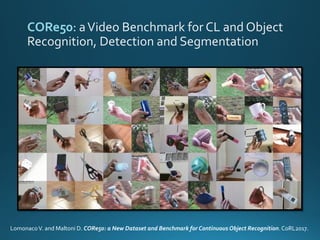
LomonacoV. and Maltoni D. CORe50: a New Dataset and Benchmark for Continuous Object Recognition. CoRL2017.
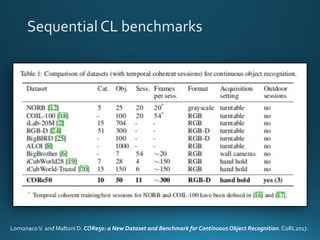
Sequential CL benchmarks
LomonacoV. and Maltoni D. CORe50: a New Dataset and Benchmark for Continuous Object Recognition. CoRL2017.
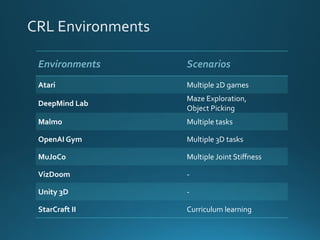
CRL Environments
Environments Scenarios
Atari Multiple 2D games
DeepMind Lab
Maze Exploration,
Object Picking
Malmo Multiple tasks
OpenAI Gym Multiple 3D tasks
MuJoCo Multiple Joint Stiffness
VizDoom -
Unity 3D -
StarCraft II Curriculum learning
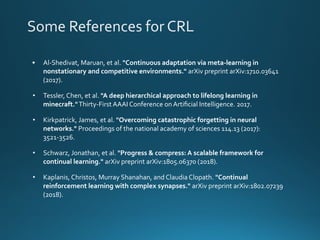
Some References for CRL
• Al-Shedivat, Maruan, et al. "Continuous adaptation via meta-learning in
nonstationary and competitive environments." arXiv preprint arXiv:1710.03641
(2017).
• Tessler, Chen, et al. "A deep hierarchical approach to lifelong learning in
minecraft."Thirty-First AAAI Conference on Artificial Intelligence. 2017.
• Kirkpatrick, James, et al. "Overcoming catastrophic forgetting in neural
networks." Proceedings of the national academy of sciences 114.13 (2017):
3521-3526.
• Schwarz, Jonathan, et al. "Progress & compress: A scalable framework for
continual learning." arXiv preprint arXiv:1805.06370 (2018).
• Kaplanis, Christos, Murray Shanahan, and Claudia Clopath. "Continual
reinforcement learning with complex synapses." arXiv preprint arXiv:1802.07239
(2018).
LomonacoV. and Maltoni D. CORe50: a New Dataset and Benchmark for Continuous Object Recognition. CoRL2017.
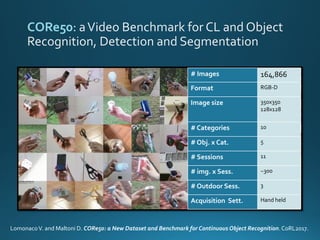
CORe50: aVideo Benchmark for CL and Object
Recognition, Detection and Segmentation
# Images 164,866
Format RGB-D
Image size 350x350
128x128
# Categories 10
# Obj. x Cat. 5
# Sessions 11
# img. x Sess. ~300
# Outdoor Sess. 3
Acquisition Sett. Hand held
LomonacoV. and Maltoni D. CORe50: a New Dataset and Benchmark for Continuous Object Recognition. CoRL2017.
CORe50: aVideo Benchmark for CL and Object
Recognition, Detection and Segmentation
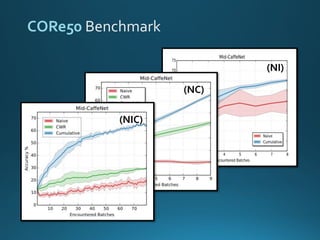
CORe50 Benchmark
(NI)
(NC)
(NIC)
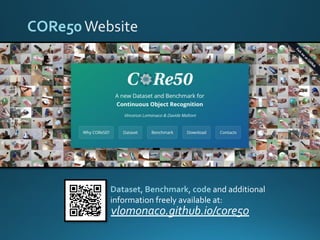
CORe50Website
Dataset, Benchmark, code and additional
information freely available at:
vlomonaco.github.io/core50
CRL in 3D non-stationary environment
LomonacoV., Desai K., Maltoni D. and Culurciello, E. Continual Reinforcement Learning in 3D non-stationary
environments. Submitted to ECML-PKDD, 2019.
VIDEO!
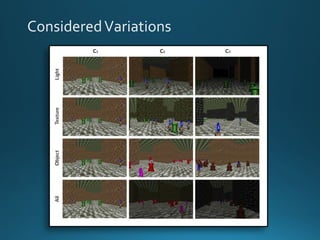
ConsideredVariations
Lifelong Learning
Metrics
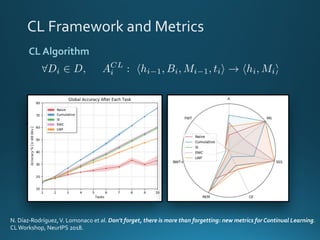
CL Framework and Metrics
CL Algorithm
N. Díaz-Rodríguez,V. Lomonaco et al. Don't forget, there is more than forgetting: new metrics for Continual Learning.
CLWorkshop, NeurIPS 2018.
Continual Learning:
Where to start?
ContinualAI non-profit Research Organization
http://continualai.org https://continualai.herokuapp.com/
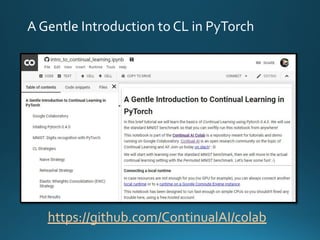
A Gentle Introduction to CL in PyTorch
https://github.com/ContinualAI/colab
Limitations and FutureWorks
Limitations
• Young line of research
• Theoretical foundations
• Real-world applications
What’s next?
• Towards Biological Synaptic Plasticity, learning and
memory.
• Robustness, flexibility, and efficiency.
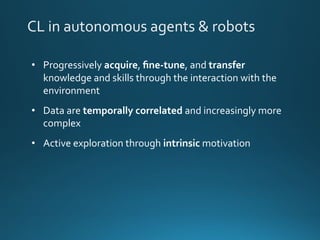
CL in autonomous agents & robots
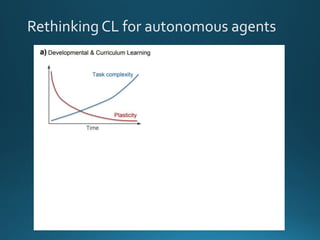
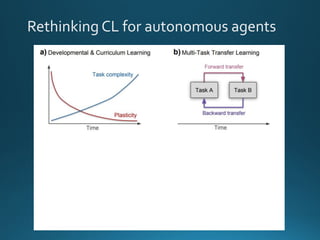
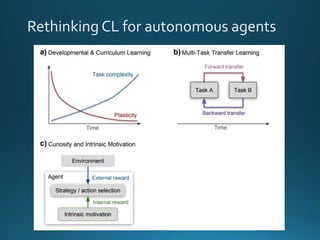
• Progressively acquire, fine-tune, and transfer
knowledge and skills through the interaction with the
environment
• Data are temporally correlated and increasingly more
complex
• Active exploration through intrinsic motivation
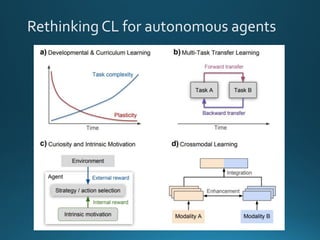
Rethinking CL for autonomous agents

Tutorial inns2019 full

  • 1.
    Continual Lifelong Learning withNeural Networks April 16, 2019 -Tutorial @ INNSBDDL2019
  • 2.
    A Practical Example •50GB/s streaming data. • ~30240TB of data after only a week. • Impossible to re-train the mini-spot brain from scratch and to adapt fast. Mini-spot Robot from Boston Dynamics, 2018
  • 3.
    Continual Learning (CL) •Ability to continually acquire, fine-tune, and transfer new knowledge and skills • Higher and realistic time-scale where data (and tasks) become available only during time. • No access to previously encountered data. • Constrained computational and memory resources.
  • 4.
  • 5.
    Catastrophic forgetting • Traininga model with new information interferes with previously learned knowledge • Abrupt performance decrease or old knowledge completely overwritten by the new one.
  • 6.
    Catastrophic forgetting • Traininga model with new information interferes with previously learned knowledge • Abrupt performance decrease or old knowledge completely overwritten by the new one.
  • 7.
    The Stability-Plasticity Dilemma Stability-PlasticityDilemma: • Remember past concepts • Learn new concepts • Generalize Biggest Problem in Deep Learning: • Catastrophic Forgetting
  • 8.
    Biological factors ofCL • Structural Plasticity • Neurosynaptic adaptation to changes in the environment • Change of physical structure as the result of learning • Stability-plasticity balance • Complementary Learning Systems • Retaining episodic memories (memorization) • Extracting statistical structure (generalization) • Memory replay
  • 9.
  • 10.
  • 11.
  • 12.
    Growing Networks Parisi,Tani,Weber,Wermter. LifelongLearning of Spatio-temporal Representations with Dual-Memory Recurrent Self-Organization. Frontiers in Neurorobotics 2019.
  • 13.
  • 14.
    CL Strategies Architectural Regularization Rehearsal CWRPNN EWC SI LWF ICARL AR1 GEM Pure Rehearsal GDM Exstream
  • 15.
  • 16.
    Supervised CL benchmarks DatasetStrategy Permuted MNIST EWC, GEM, SI, ... Rotated MNIST GEM MNIST Split SI CIFAR10/100 Split GEM, iCARL, SI, AR1, ... ILSVRC2012 iCARL CUB-200 GMD, ... LomonacoV. and Maltoni D. CORe50: a New Dataset and Benchmark for Continuous Object Recognition. CoRL2017.
  • 17.
    Sequential CL benchmarks LomonacoV.and Maltoni D. CORe50: a New Dataset and Benchmark for Continuous Object Recognition. CoRL2017.
  • 18.
    CRL Environments Environments Scenarios AtariMultiple 2D games DeepMind Lab Maze Exploration, Object Picking Malmo Multiple tasks OpenAI Gym Multiple 3D tasks MuJoCo Multiple Joint Stiffness VizDoom - Unity 3D - StarCraft II Curriculum learning
  • 19.
    Some References forCRL • Al-Shedivat, Maruan, et al. "Continuous adaptation via meta-learning in nonstationary and competitive environments." arXiv preprint arXiv:1710.03641 (2017). • Tessler, Chen, et al. "A deep hierarchical approach to lifelong learning in minecraft."Thirty-First AAAI Conference on Artificial Intelligence. 2017. • Kirkpatrick, James, et al. "Overcoming catastrophic forgetting in neural networks." Proceedings of the national academy of sciences 114.13 (2017): 3521-3526. • Schwarz, Jonathan, et al. "Progress & compress: A scalable framework for continual learning." arXiv preprint arXiv:1805.06370 (2018). • Kaplanis, Christos, Murray Shanahan, and Claudia Clopath. "Continual reinforcement learning with complex synapses." arXiv preprint arXiv:1802.07239 (2018).
  • 20.
    LomonacoV. and MaltoniD. CORe50: a New Dataset and Benchmark for Continuous Object Recognition. CoRL2017. CORe50: aVideo Benchmark for CL and Object Recognition, Detection and Segmentation
  • 21.
    # Images 164,866 FormatRGB-D Image size 350x350 128x128 # Categories 10 # Obj. x Cat. 5 # Sessions 11 # img. x Sess. ~300 # Outdoor Sess. 3 Acquisition Sett. Hand held LomonacoV. and Maltoni D. CORe50: a New Dataset and Benchmark for Continuous Object Recognition. CoRL2017. CORe50: aVideo Benchmark for CL and Object Recognition, Detection and Segmentation
  • 22.
  • 23.
    CORe50Website Dataset, Benchmark, codeand additional information freely available at: vlomonaco.github.io/core50
  • 24.
    CRL in 3Dnon-stationary environment LomonacoV., Desai K., Maltoni D. and Culurciello, E. Continual Reinforcement Learning in 3D non-stationary environments. Submitted to ECML-PKDD, 2019. VIDEO!
  • 25.
  • 26.
  • 27.
    CL Framework andMetrics CL Algorithm N. Díaz-Rodríguez,V. Lomonaco et al. Don't forget, there is more than forgetting: new metrics for Continual Learning. CLWorkshop, NeurIPS 2018.
  • 28.
  • 29.
    ContinualAI non-profit ResearchOrganization http://continualai.org https://continualai.herokuapp.com/
  • 30.
    A Gentle Introductionto CL in PyTorch https://github.com/ContinualAI/colab
  • 31.
    Limitations and FutureWorks Limitations •Young line of research • Theoretical foundations • Real-world applications What’s next? • Towards Biological Synaptic Plasticity, learning and memory. • Robustness, flexibility, and efficiency.
  • 32.
    CL in autonomousagents & robots • Progressively acquire, fine-tune, and transfer knowledge and skills through the interaction with the environment • Data are temporally correlated and increasingly more complex • Active exploration through intrinsic motivation
  • 33.
    Rethinking CL forautonomous agents
  • 34.
    Rethinking CL forautonomous agents
  • 35.
    Rethinking CL forautonomous agents
  • 36.
    Rethinking CL forautonomous agents