, 1
Discreet Mathematics
Outline and Motivation
Lecture Notes on Discrete Mathematics (Comp233).
Birzeit University, Palestine, 2015
mjarrar©2015
Mustafa Jarrar
Computer Science
Birzeit University, Palestine
mjarrar@birzeit.edu
http://www.jarrar.info
, 2
Watch this lecture
and download the slides
Acknowledgement:
This lecture is based on (but not limited to) to chapter 5 in “Discrete Mathematics with Applications
by Susanna S. Epp (3rd Edition)”.
More Online Courses at: http://www.jarrar.info
Course Page: http://www.jarrar.info/courses/DMath/
, 3
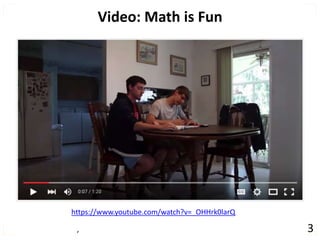
Video: Math is Fun
https://www.youtube.com/watch?v=_OHHrk0larQ
, 4
Video: History of Mathematics
https://www.youtube.com/watch?v=cy-8lPVKLIo
, 5
Video: We Use Math
https://www.youtube.com/watch?v=aYIv4jggQJc
, 6
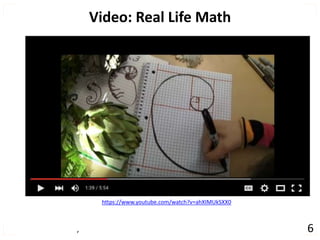
Video: Real Life Math
https://www.youtube.com/watch?v=ahXIMUkSXX0
, 7
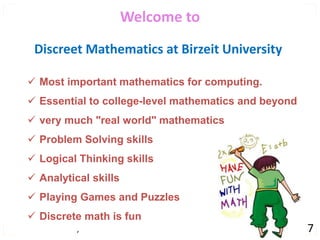
Welcome to
 Most important mathematics for computing.
 Essential to college-level mathematics and beyond
 very much "real world" mathematics
 Problem Solving skills
 Logical Thinking skills
 Analytical skills
 Playing Games and Puzzles
 Discrete math is fun
Discreet Mathematics at Birzeit University
, 8
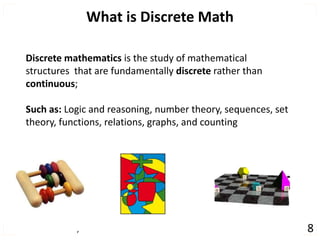
What is Discrete Math
Discrete mathematics is the study of mathematical
structures that are fundamentally discrete rather than
continuous;
Such as: Logic and reasoning, number theory, sequences, set
theory, functions, relations, graphs, and counting
, 9
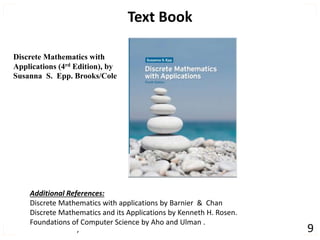
Text Book
Discrete Mathematics with
Applications (4rd Edition), by
Susanna S. Epp. Brooks/Cole
Additional References:
Discrete Mathematics with applications by Barnier & Chan
Discrete Mathematics and its Applications by Kenneth H. Rosen.
Foundations of Computer Science by Aho and Ulman .
, 10
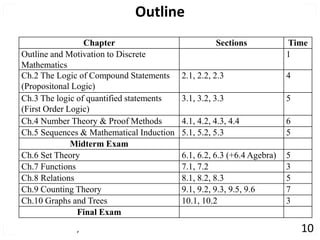
Outline
Chapter Sections Time
Outline and Motivation to Discrete
Mathematics
1
Ch.2 The Logic of Compound Statements
(Propositonal Logic)
2.1, 2.2, 2.3 4
Ch.3 The logic of quantified statements
(First Order Logic)
3.1, 3.2, 3.3 5
Ch.4 Number Theory & Proof Methods 4.1, 4.2, 4.3, 4.4 6
Ch.5 Sequences & Mathematical Induction 5.1, 5.2, 5.3 5
Midterm Exam
Ch.6 Set Theory 6.1, 6.2, 6.3 (+6.4 Agebra) 5
Ch.7 Functions 7.1, 7.2 3
Ch.8 Relations 8.1, 8.2, 8.3 5
Ch.9 Counting Theory 9.1, 9.2, 9.3, 9.5, 9.6 7
Ch.10 Graphs and Trees 10.1, 10.2 3
Final Exam
, 11
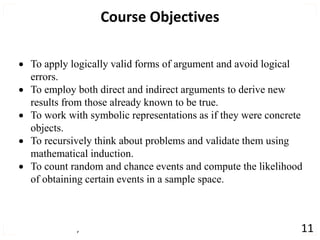
Course Objectives
 To apply logically valid forms of argument and avoid logical
errors.
 To employ both direct and indirect arguments to derive new
results from those already known to be true.
 To work with symbolic representations as if they were concrete
objects.
 To recursively think about problems and validate them using
mathematical induction.
 To count random and chance events and compute the likelihood
of obtaining certain events in a sample space.
, 12
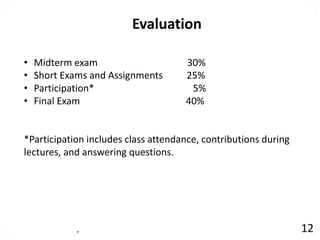
Evaluation
• Midterm exam 30%
• Short Exams and Assignments 25%
• Participation* 5%
• Final Exam 40%
*Participation includes class attendance, contributions during
lectures, and answering questions.
, 13
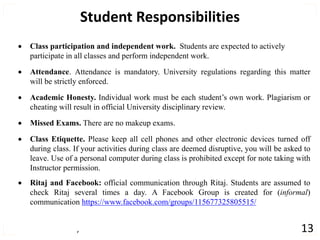
Student Responsibilities
 Class participation and independent work. Students are expected to actively
participate in all classes and perform independent work.
 Attendance. Attendance is mandatory. University regulations regarding this matter
will be strictly enforced.
 Academic Honesty. Individual work must be each student’s own work. Plagiarism or
cheating will result in official University disciplinary review.
 Missed Exams. There are no makeup exams.
 Class Etiquette. Please keep all cell phones and other electronic devices turned off
during class. If your activities during class are deemed disruptive, you will be asked to
leave. Use of a personal computer during class is prohibited except for note taking with
Instructor permission.
 Ritaj and Facebook: official communication through Ritaj. Students are assumed to
check Ritaj several times a day. A Facebook Group is created for (informal)
communication https://www.facebook.com/groups/115677325805515/

Discrete Mathematics Course Outline

  • 1.
    , 1 Discreet Mathematics Outlineand Motivation Lecture Notes on Discrete Mathematics (Comp233). Birzeit University, Palestine, 2015 mjarrar©2015 Mustafa Jarrar Computer Science Birzeit University, Palestine mjarrar@birzeit.edu http://www.jarrar.info
  • 2.
    , 2 Watch thislecture and download the slides Acknowledgement: This lecture is based on (but not limited to) to chapter 5 in “Discrete Mathematics with Applications by Susanna S. Epp (3rd Edition)”. More Online Courses at: http://www.jarrar.info Course Page: http://www.jarrar.info/courses/DMath/
  • 3.
    , 3 Video: Mathis Fun https://www.youtube.com/watch?v=_OHHrk0larQ
  • 4.
    , 4 Video: Historyof Mathematics https://www.youtube.com/watch?v=cy-8lPVKLIo
  • 5.
    , 5 Video: WeUse Math https://www.youtube.com/watch?v=aYIv4jggQJc
  • 6.
    , 6 Video: RealLife Math https://www.youtube.com/watch?v=ahXIMUkSXX0
  • 7.
    , 7 Welcome to Most important mathematics for computing.  Essential to college-level mathematics and beyond  very much "real world" mathematics  Problem Solving skills  Logical Thinking skills  Analytical skills  Playing Games and Puzzles  Discrete math is fun Discreet Mathematics at Birzeit University
  • 8.
    , 8 What isDiscrete Math Discrete mathematics is the study of mathematical structures that are fundamentally discrete rather than continuous; Such as: Logic and reasoning, number theory, sequences, set theory, functions, relations, graphs, and counting
  • 9.
    , 9 Text Book DiscreteMathematics with Applications (4rd Edition), by Susanna S. Epp. Brooks/Cole Additional References: Discrete Mathematics with applications by Barnier & Chan Discrete Mathematics and its Applications by Kenneth H. Rosen. Foundations of Computer Science by Aho and Ulman .
  • 10.
    , 10 Outline Chapter SectionsTime Outline and Motivation to Discrete Mathematics 1 Ch.2 The Logic of Compound Statements (Propositonal Logic) 2.1, 2.2, 2.3 4 Ch.3 The logic of quantified statements (First Order Logic) 3.1, 3.2, 3.3 5 Ch.4 Number Theory & Proof Methods 4.1, 4.2, 4.3, 4.4 6 Ch.5 Sequences & Mathematical Induction 5.1, 5.2, 5.3 5 Midterm Exam Ch.6 Set Theory 6.1, 6.2, 6.3 (+6.4 Agebra) 5 Ch.7 Functions 7.1, 7.2 3 Ch.8 Relations 8.1, 8.2, 8.3 5 Ch.9 Counting Theory 9.1, 9.2, 9.3, 9.5, 9.6 7 Ch.10 Graphs and Trees 10.1, 10.2 3 Final Exam
  • 11.
    , 11 Course Objectives To apply logically valid forms of argument and avoid logical errors.  To employ both direct and indirect arguments to derive new results from those already known to be true.  To work with symbolic representations as if they were concrete objects.  To recursively think about problems and validate them using mathematical induction.  To count random and chance events and compute the likelihood of obtaining certain events in a sample space.
  • 12.
    , 12 Evaluation • Midtermexam 30% • Short Exams and Assignments 25% • Participation* 5% • Final Exam 40% *Participation includes class attendance, contributions during lectures, and answering questions.
  • 13.
    , 13 Student Responsibilities Class participation and independent work. Students are expected to actively participate in all classes and perform independent work.  Attendance. Attendance is mandatory. University regulations regarding this matter will be strictly enforced.  Academic Honesty. Individual work must be each student’s own work. Plagiarism or cheating will result in official University disciplinary review.  Missed Exams. There are no makeup exams.  Class Etiquette. Please keep all cell phones and other electronic devices turned off during class. If your activities during class are deemed disruptive, you will be asked to leave. Use of a personal computer during class is prohibited except for note taking with Instructor permission.  Ritaj and Facebook: official communication through Ritaj. Students are assumed to check Ritaj several times a day. A Facebook Group is created for (informal) communication https://www.facebook.com/groups/115677325805515/