‫أكاديمية الحكومة اإللكترونية الفلسطينية‬
           The Palestinian eGovernment Academy
                      www.egovacademy.ps


Tutorial 4: Ontology Engineering & Lexical Semantics

                      Session 6.1
   Ontology Engineering Challenges


                  Dr. Mustafa Jarrar
                     University of Birzeit
                     mjarrar@birzeit.edu
                       www.jarrar.info

                         PalGov © 2011                 1
About

This tutorial is part of the PalGov project, funded by the TEMPUS IV program of the
Commission of the European Communities, grant agreement 511159-TEMPUS-1-
2010-1-PS-TEMPUS-JPHES. The project website: www.egovacademy.ps
Project Consortium:
             Birzeit University, Palestine
                                                           University of Trento, Italy
             (Coordinator )


             Palestine Polytechnic University, Palestine   Vrije Universiteit Brussel, Belgium


             Palestine Technical University, Palestine
                                                           Université de Savoie, France

             Ministry of Telecom and IT, Palestine
                                                           University of Namur, Belgium
             Ministry of Interior, Palestine
                                                           TrueTrust, UK
             Ministry of Local Government, Palestine


Coordinator:
Dr. Mustafa Jarrar
Birzeit University, P.O.Box 14- Birzeit, Palestine
Telfax:+972 2 2982935 mjarrar@birzeit.eduPalGov © 2011
                                                                                                 2
© Copyright Notes
Everyone is encouraged to use this material, or part of it, but should
properly cite the project (logo and website), and the author of that part.


No part of this tutorial may be reproduced or modified in any form or by
any means, without prior written permission from the project, who have
the full copyrights on the material.


                 Attribution-NonCommercial-ShareAlike
                              CC-BY-NC-SA

This license lets others remix, tweak, and build upon your work non-
commercially, as long as they credit you and license their new creations
under the identical terms.

                                 PalGov © 2011                               3
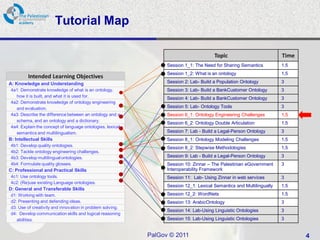
Tutorial Map

                                                                                        Topic                          Time
                                                                  Session 1_1: The Need for Sharing Semantics          1.5
                                                                  Session 1_2: What is an ontology                     1.5
         Intended Learning Objectives
A: Knowledge and Understanding                                    Session 2: Lab- Build a Population Ontology          3
 4a1: Demonstrate knowledge of what is an ontology,               Session 3: Lab- Build a BankCustomer Ontology        3
    how it is built, and what it is used for.                     Session 4: Lab- Build a BankCustomer Ontology        3
 4a2: Demonstrate knowledge of ontology engineering
    and evaluation.                                               Session 5: Lab- Ontology Tools                       3
 4a3: Describe the difference between an ontology and a           Session 6_1: Ontology Engineering Challenges         1.5
    schema, and an ontology and a dictionary.
                                                                  Session 6_2: Ontology Double Articulation            1.5
 4a4: Explain the concept of language ontologies, lexical
    semantics and multilingualism.                                Session 7: Lab - Build a Legal-Person Ontology       3
B: Intellectual Skills                                            Session 8_1: Ontology Modeling Challenges            1.5
 4b1: Develop quality ontologies.                                 Session 8_2: Stepwise Methodologies                  1.5
 4b2: Tackle ontology engineering challenges.
 4b3: Develop multilingual ontologies.                            Session 9: Lab - Build a Legal-Person Ontology       3
 4b4: Formulate quality glosses.                                  Session 10: Zinnar – The Palestinian eGovernment     3
C: Professional and Practical Skills                              Interoperability Framework
 4c1: Use ontology tools.                                         Session 11: Lab- Using Zinnar in web services        3
 4c2: (Re)use existing Language ontologies.
                                                                  Session 12_1: Lexical Semantics and Multilingually   1.5
D: General and Transferable Skills
 d1: Working with team.                                           Session 12_2: WordNets                               1.5
 d2: Presenting and defending ideas.                              Session 13: ArabicOntology                           3
 d3: Use of creativity and innovation in problem solving.
                                                                  Session 14: Lab-Using Linguistic Ontologies          3
 d4: Develop communication skills and logical reasoning
    abilities.                                                    Session 15: Lab-Using Linguistic Ontologies          3


                                                            PalGov © 2011                                                     4
Outline and Session ILOs


This session will help students to:

4a2: Demonstrate knowledge of ontology engineering and evaluation.

4b2: Tackle ontology engineering challenges.


                           PalGov © 2011                         5
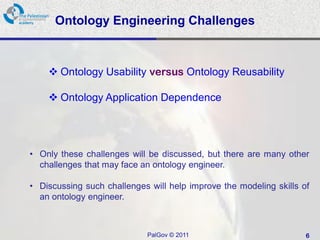
Ontology Engineering Challenges


     Ontology Usability versus Ontology Reusability

     Ontology Application Dependence


• Only these challenges will be discussed, but there are many other
  challenges that may face an ontology engineer.

• Discussing such challenges will help improve the modeling skills of
  an ontology engineer.


                             PalGov © 2011                          6
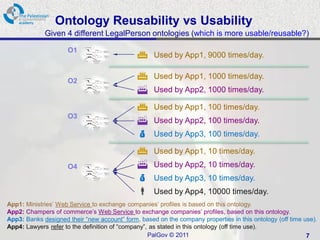
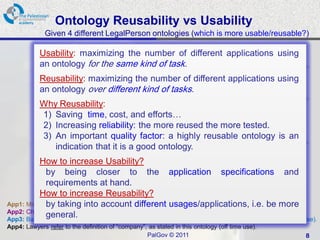
Ontology Reusability vs Usability
              Given 4 different LegalPerson ontologies (which is more usable/reusable?)

                      O1
                                                 Used by App1, 9000 times/day.

                                                 Used by App1, 1000 times/day.
                      O2
                                                 Used by App2, 1000 times/day.
                                                 Used by App1, 100 times/day.
                      O3
                                                 Used by App2, 100 times/day.
                                                 Used by App3, 100 times/day.
                                                     Used by App1, 10 times/day.
                      O4                             Used by App2, 10 times/day.
                                                     Used by App3, 10 times/day.
                                                     Used by App4, 10000 times/day.
App1:   Ministries’ Web Service to exchange companies’ profiles is based on this ontology.
App2:   Champers of commerce’s Web Service to exchange companies’ profiles, based on this ontology.
App3:   Banks designed their “new account” form, based on the company properties in this ontology (off time use).
App4:   Lawyers refer to the definition of “company”, as stated in this ontology (off time use).
                                                     PalGov © 2011                                           7
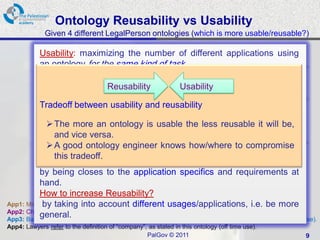
Ontology Reusability vs Usability
              Given 4 different LegalPerson ontologies (which is more usable/reusable?)

                    O1
                                     Used of different times/day.
            Usability: maximizing the numberby App1, 9000 applications using
            an ontology for the same kind of task.
                                      Used by App1, 1000 times/day.
            Reusability: maximizing the number of different applications using
                   O2
                                      Used by App2, 1000 times/day.
            an ontology over different kind of tasks.
            Why Reusability:            Used by App1, 100 times/day.
            1) Saving time, cost, and efforts…
                  O3
                                        Used by App2, 100 times/day.
            2) Increasing reliability: the more reused the more tested.
            3) An important quality  Used by App3, 100 times/day.
                                        factor: a highly reusable ontology is an
               indication that it is a good ontology.
                                        Used by App1, 10 times/day.
           How to increase Usability? Used by App2, 10 times/day.
                                             
                    O4
              by being closer to the application specifications and
              requirements at hand.
                                              Used by App3, 10 times/day.
                                             
           How to increase Reusability?Used by App4, 10 times/day.
App1: Ministries Web Service to exchange companies profiles is based on this ontology. i.e. be more
              by taking into account different usages/applications,
App2: Champers of commerce’s Web Service to exchange companies profiles, based on this ontology.
              general.
App3: Banks designed their “new account” form, based on the company properties in this ontology (off time use).
App4: Lawyers refer to the definition of “company”, as stated in this ontology (off time use).
                                                   PalGov © 2011                                          8
Ontology Reusability vs Usability
              Given 4 different LegalPerson ontologies (which is more usable/reusable?)

                    O1
                                     Used of different times/day.
            Usability: maximizing the numberby App1, 9000 applications using
            an ontology for the same kind of task.
                                      Used by App1, 1000 times/day.
            Reusability: maximizing the number of different applications using
                   O2
            an ontology over Reusability Used by App2, 1000 times/day.
                                                Usability
                             different kind of tasks.
           Why Reusability: usability and reusability 100 times/day.
           Tradeoff between                   Used by App1,
           1) Savings in time, cost, and efforts…
                     O3
                                              Used by App2, 100 times/day.
           2) The more an ontology is more reusedless more tested. be,
                  Increasing reliability: the usable the the reusable it will
           3) and important quality  Used by App3, 100 times/day.
                  An vice versa.             factor: a highly resalable ontology is an
               A good ontologyis a good ontology.
                  indication that it engineer knowsApp1, 10 times/day.
                                              Used by how/where to compromise
                 this tradeoff.
           How to increase Usability? Used by App2, 10 times/day.
                                             
                     O4
           by being closes to the application specifics and requirements at
           hand.
                                              Used by App3, 10 times/day.
                                             
           How to increase Reusability?Used by App4, 10 times/day.
App1: Ministries Web Service to exchange companies profiles is based on this ontology. i.e. be more
            by taking into account different usages/applications,
App2: Champers of commerce’s Web Service to exchange companies profiles, based on this ontology.
           general.
App3: Banks designed their “new account” form, based on the company properties in this ontology (off time use).
App4: Lawyers refer to the definition of “company”, as stated in this ontology (off time use).
                                                   PalGov © 2011                                          9
Ontology Application Dependence

  Ontologies are supposed to capture knowledge at the domain level
  independently of application requirements [G97] [GB99] [CJB99].


The problem is that when building an ontology, there will always be
intended or expected usability requirements -“at hand”- which influence
the independency level of ontology axioms.


This problem is as the Interaction Problem:
      “Representing knowledge for the purpose of solving some
      problem is strongly affected by the nature of the problem and
      the inference strategy to be applied to the problem.”
                                               Bylander and Chandrasekaran in [BC88]


                               PalGov © 2011                                           10
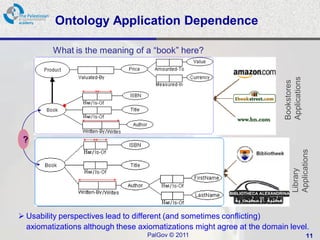
Ontology Application Dependence

         What is the meaning of a “book” here?


                                                                          Applications
                                                                          Bookstores
 ?


                                                                               Applications
                                                                               Library
 Usability perspectives lead to different (and sometimes conflicting)
  axiomatizations although these axiomatizations might agree at the domain level.
                                   PalGov © 2011                                         11
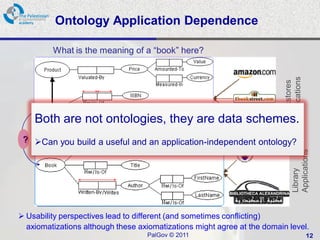
Ontology Application Dependence

         What is the meaning of a “book” here?


                                                                          Applications
                                                                          Bookstores
    Both are not ontologies, they are data schemes.
 ? Can you build a useful and an application-independent ontology?


                                                                               Applications
                                                                               Library
 Usability perspectives lead to different (and sometimes conflicting)
  axiomatizations although these axiomatizations might agree at the domain level.
                                   PalGov © 2011                                         12
References

Mustafa Jarrar: Towards methodological principles for ontology engineering. PhD
  Thesis. Vrije Universiteit Brussel. (May 2005)

Thomas R. Gruber: Toward Principles for the Design of Ontologies Used for Knowledge
  Sharing http://tomgruber.org/writing/onto-design.pdf

Nicola Guarino: Formal Ontology and Information Systems http://www.loa-
   cnr.it/Papers/FOIS98.pdf

Guarino, N.: Understanding, building, and using ontologies: A commentary to “Using
  Explicit Ontologies in KBS Development”, by van Heijst, Schreiber, and Wielinga."
  International Journal of Human and Computer Studies No. 46. (1997) pp. 293–310

[HV93] Hemmann, T., Voss, H.: A Reusable and Specializable Interpretation Model for
   ModelBased Diagnosis. In: Luckenhoff, C., Fensel, D., Studer, D. (eds.): Proceeding
   3rd KADS Meeting Siemens AG. Munich. March (1993) pp. 189–205


                                     PalGov © 2011                                       13

Pal gov.tutorial4.session6 1.ontologyengineeringchallenges

  • 1.
    ‫أكاديمية الحكومة اإللكترونيةالفلسطينية‬ The Palestinian eGovernment Academy www.egovacademy.ps Tutorial 4: Ontology Engineering & Lexical Semantics Session 6.1 Ontology Engineering Challenges Dr. Mustafa Jarrar University of Birzeit mjarrar@birzeit.edu www.jarrar.info PalGov © 2011 1
  • 2.
    About This tutorial ispart of the PalGov project, funded by the TEMPUS IV program of the Commission of the European Communities, grant agreement 511159-TEMPUS-1- 2010-1-PS-TEMPUS-JPHES. The project website: www.egovacademy.ps Project Consortium: Birzeit University, Palestine University of Trento, Italy (Coordinator ) Palestine Polytechnic University, Palestine Vrije Universiteit Brussel, Belgium Palestine Technical University, Palestine Université de Savoie, France Ministry of Telecom and IT, Palestine University of Namur, Belgium Ministry of Interior, Palestine TrueTrust, UK Ministry of Local Government, Palestine Coordinator: Dr. Mustafa Jarrar Birzeit University, P.O.Box 14- Birzeit, Palestine Telfax:+972 2 2982935 mjarrar@birzeit.eduPalGov © 2011 2
  • 3.
    © Copyright Notes Everyoneis encouraged to use this material, or part of it, but should properly cite the project (logo and website), and the author of that part. No part of this tutorial may be reproduced or modified in any form or by any means, without prior written permission from the project, who have the full copyrights on the material. Attribution-NonCommercial-ShareAlike CC-BY-NC-SA This license lets others remix, tweak, and build upon your work non- commercially, as long as they credit you and license their new creations under the identical terms. PalGov © 2011 3
  • 4.
    Tutorial Map Topic Time Session 1_1: The Need for Sharing Semantics 1.5 Session 1_2: What is an ontology 1.5 Intended Learning Objectives A: Knowledge and Understanding Session 2: Lab- Build a Population Ontology 3 4a1: Demonstrate knowledge of what is an ontology, Session 3: Lab- Build a BankCustomer Ontology 3 how it is built, and what it is used for. Session 4: Lab- Build a BankCustomer Ontology 3 4a2: Demonstrate knowledge of ontology engineering and evaluation. Session 5: Lab- Ontology Tools 3 4a3: Describe the difference between an ontology and a Session 6_1: Ontology Engineering Challenges 1.5 schema, and an ontology and a dictionary. Session 6_2: Ontology Double Articulation 1.5 4a4: Explain the concept of language ontologies, lexical semantics and multilingualism. Session 7: Lab - Build a Legal-Person Ontology 3 B: Intellectual Skills Session 8_1: Ontology Modeling Challenges 1.5 4b1: Develop quality ontologies. Session 8_2: Stepwise Methodologies 1.5 4b2: Tackle ontology engineering challenges. 4b3: Develop multilingual ontologies. Session 9: Lab - Build a Legal-Person Ontology 3 4b4: Formulate quality glosses. Session 10: Zinnar – The Palestinian eGovernment 3 C: Professional and Practical Skills Interoperability Framework 4c1: Use ontology tools. Session 11: Lab- Using Zinnar in web services 3 4c2: (Re)use existing Language ontologies. Session 12_1: Lexical Semantics and Multilingually 1.5 D: General and Transferable Skills d1: Working with team. Session 12_2: WordNets 1.5 d2: Presenting and defending ideas. Session 13: ArabicOntology 3 d3: Use of creativity and innovation in problem solving. Session 14: Lab-Using Linguistic Ontologies 3 d4: Develop communication skills and logical reasoning abilities. Session 15: Lab-Using Linguistic Ontologies 3 PalGov © 2011 4
  • 5.
    Outline and SessionILOs This session will help students to: 4a2: Demonstrate knowledge of ontology engineering and evaluation. 4b2: Tackle ontology engineering challenges. PalGov © 2011 5
  • 6.
    Ontology Engineering Challenges  Ontology Usability versus Ontology Reusability  Ontology Application Dependence • Only these challenges will be discussed, but there are many other challenges that may face an ontology engineer. • Discussing such challenges will help improve the modeling skills of an ontology engineer. PalGov © 2011 6
  • 7.
    Ontology Reusability vsUsability Given 4 different LegalPerson ontologies (which is more usable/reusable?) O1  Used by App1, 9000 times/day.  Used by App1, 1000 times/day. O2  Used by App2, 1000 times/day.  Used by App1, 100 times/day. O3  Used by App2, 100 times/day.  Used by App3, 100 times/day.  Used by App1, 10 times/day. O4  Used by App2, 10 times/day.  Used by App3, 10 times/day.  Used by App4, 10000 times/day. App1: Ministries’ Web Service to exchange companies’ profiles is based on this ontology. App2: Champers of commerce’s Web Service to exchange companies’ profiles, based on this ontology. App3: Banks designed their “new account” form, based on the company properties in this ontology (off time use). App4: Lawyers refer to the definition of “company”, as stated in this ontology (off time use). PalGov © 2011 7
  • 8.
    Ontology Reusability vsUsability Given 4 different LegalPerson ontologies (which is more usable/reusable?) O1  Used of different times/day. Usability: maximizing the numberby App1, 9000 applications using an ontology for the same kind of task.  Used by App1, 1000 times/day. Reusability: maximizing the number of different applications using O2  Used by App2, 1000 times/day. an ontology over different kind of tasks. Why Reusability:  Used by App1, 100 times/day. 1) Saving time, cost, and efforts… O3  Used by App2, 100 times/day. 2) Increasing reliability: the more reused the more tested. 3) An important quality  Used by App3, 100 times/day. factor: a highly reusable ontology is an indication that it is a good ontology.  Used by App1, 10 times/day. How to increase Usability? Used by App2, 10 times/day.  O4 by being closer to the application specifications and requirements at hand.  Used by App3, 10 times/day.  How to increase Reusability?Used by App4, 10 times/day. App1: Ministries Web Service to exchange companies profiles is based on this ontology. i.e. be more by taking into account different usages/applications, App2: Champers of commerce’s Web Service to exchange companies profiles, based on this ontology. general. App3: Banks designed their “new account” form, based on the company properties in this ontology (off time use). App4: Lawyers refer to the definition of “company”, as stated in this ontology (off time use). PalGov © 2011 8
  • 9.
    Ontology Reusability vsUsability Given 4 different LegalPerson ontologies (which is more usable/reusable?) O1  Used of different times/day. Usability: maximizing the numberby App1, 9000 applications using an ontology for the same kind of task.  Used by App1, 1000 times/day. Reusability: maximizing the number of different applications using O2 an ontology over Reusability Used by App2, 1000 times/day.  Usability different kind of tasks. Why Reusability: usability and reusability 100 times/day. Tradeoff between  Used by App1, 1) Savings in time, cost, and efforts… O3  Used by App2, 100 times/day. 2) The more an ontology is more reusedless more tested. be, Increasing reliability: the usable the the reusable it will 3) and important quality  Used by App3, 100 times/day. An vice versa. factor: a highly resalable ontology is an  A good ontologyis a good ontology. indication that it engineer knowsApp1, 10 times/day.  Used by how/where to compromise this tradeoff. How to increase Usability? Used by App2, 10 times/day.  O4 by being closes to the application specifics and requirements at hand.  Used by App3, 10 times/day.  How to increase Reusability?Used by App4, 10 times/day. App1: Ministries Web Service to exchange companies profiles is based on this ontology. i.e. be more by taking into account different usages/applications, App2: Champers of commerce’s Web Service to exchange companies profiles, based on this ontology. general. App3: Banks designed their “new account” form, based on the company properties in this ontology (off time use). App4: Lawyers refer to the definition of “company”, as stated in this ontology (off time use). PalGov © 2011 9
  • 10.
    Ontology Application Dependence Ontologies are supposed to capture knowledge at the domain level independently of application requirements [G97] [GB99] [CJB99]. The problem is that when building an ontology, there will always be intended or expected usability requirements -“at hand”- which influence the independency level of ontology axioms. This problem is as the Interaction Problem: “Representing knowledge for the purpose of solving some problem is strongly affected by the nature of the problem and the inference strategy to be applied to the problem.” Bylander and Chandrasekaran in [BC88] PalGov © 2011 10
  • 11.
    Ontology Application Dependence What is the meaning of a “book” here? Applications Bookstores ? Applications Library  Usability perspectives lead to different (and sometimes conflicting) axiomatizations although these axiomatizations might agree at the domain level. PalGov © 2011 11
  • 12.
    Ontology Application Dependence What is the meaning of a “book” here? Applications Bookstores Both are not ontologies, they are data schemes. ? Can you build a useful and an application-independent ontology? Applications Library  Usability perspectives lead to different (and sometimes conflicting) axiomatizations although these axiomatizations might agree at the domain level. PalGov © 2011 12
  • 13.
    References Mustafa Jarrar: Towardsmethodological principles for ontology engineering. PhD Thesis. Vrije Universiteit Brussel. (May 2005) Thomas R. Gruber: Toward Principles for the Design of Ontologies Used for Knowledge Sharing http://tomgruber.org/writing/onto-design.pdf Nicola Guarino: Formal Ontology and Information Systems http://www.loa- cnr.it/Papers/FOIS98.pdf Guarino, N.: Understanding, building, and using ontologies: A commentary to “Using Explicit Ontologies in KBS Development”, by van Heijst, Schreiber, and Wielinga." International Journal of Human and Computer Studies No. 46. (1997) pp. 293–310 [HV93] Hemmann, T., Voss, H.: A Reusable and Specializable Interpretation Model for ModelBased Diagnosis. In: Luckenhoff, C., Fensel, D., Studer, D. (eds.): Proceeding 3rd KADS Meeting Siemens AG. Munich. March (1993) pp. 189–205 PalGov © 2011 13