
SIERA Workshop on
The Pillars of Horizon2020
Prof. Paolo Bouquet
University of Trento / OKKAM SL
paolo.bouquet@unitn.it / bouquet@okkam.it
SIERA (GA #295006)
Birzeit University, Palestine
02/04/2014
A changed context
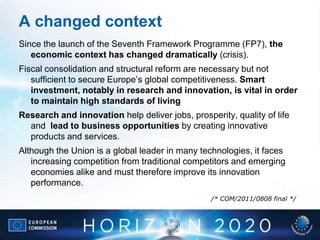
Since the launch of the Seventh Framework Programme (FP7), the
economic context has changed dramatically (crisis).
Fiscal consolidation and structural reform are necessary but not
sufficient to secure Europe’s global competitiveness. Smart
investment, notably in research and innovation, is vital in order
to maintain high standards of living
Research and innovation help deliver jobs, prosperity, quality of life
and lead to business opportunities by creating innovative
products and services.
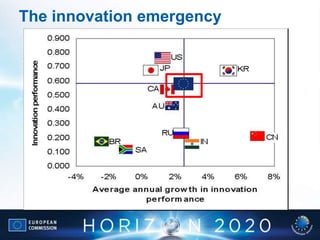
Although the Union is a global leader in many technologies, it faces
increasing competition from traditional competitors and emerging
economies alike and must therefore improve its innovation
performance.
/* COM/2011/0808 final */
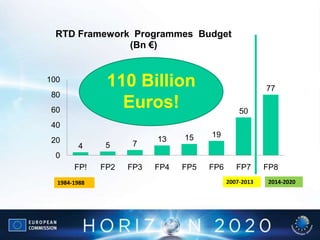
4 5 7
13 15 19
50
77
0
20
40
60
80
100
FP! FP2 FP3 FP4 FP5 FP6 FP7 FP8
RTD Framework Programmes Budget
(Bn €)
110 Billion
Euros!
1984-1988 2007-2013 2014-2020
The innovation emergency
Key novelties
• The integration of research and innovation by
providing seamless and coherent funding from
idea to market
• More support for innovation and activities
close to the market, leading to a direct
economic stimulus;
• A strong focus on creating business
opportunities out of our response to the major
concerns common to people in Europe and
beyond, i.e. “societal challenges”
/* COM/2011/0808 final */
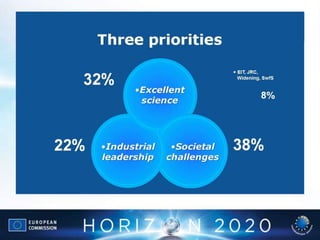
Priority 1 Excellent science
Why:
• World class science is the foundation of tomorrow’s
technologies, jobs and wellbeing
• Europe needs to develop, attract and retain research
talent
• Researchers need access to the best infrastructures
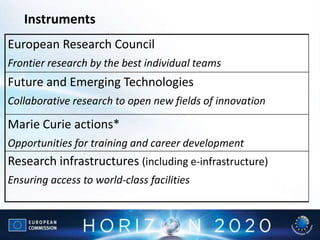
European Research Council
Frontier research by the best individual teams
Future and Emerging Technologies
Collaborative research to open new fields of innovation
Marie Curie actions*
Opportunities for training and career development
Research infrastructures (including e-infrastructure)
Ensuring access to world-class facilities
Instruments
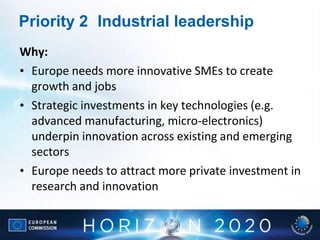
Priority 2 Industrial leadership
Why:
• Europe needs more innovative SMEs to create
growth and jobs
• Strategic investments in key technologies (e.g.
advanced manufacturing, micro-electronics)
underpin innovation across existing and emerging
sectors
• Europe needs to attract more private investment in
research and innovation
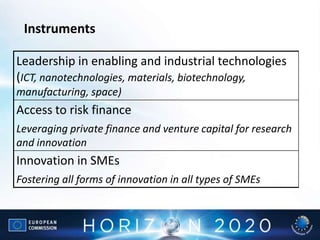
Leadership in enabling and industrial technologies
(ICT, nanotechnologies, materials, biotechnology,
manufacturing, space)
Access to risk finance
Leveraging private finance and venture capital for research
and innovation
Innovation in SMEs
Fostering all forms of innovation in all types of SMEs
Instruments
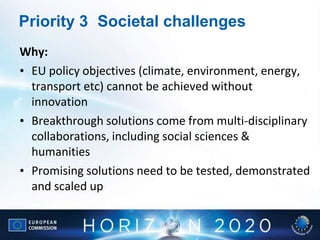
Priority 3 Societal challenges
Why:
• EU policy objectives (climate, environment, energy,
transport etc) cannot be achieved without
innovation
• Breakthrough solutions come from multi-disciplinary
collaborations, including social sciences &
humanities
• Promising solutions need to be tested, demonstrated
and scaled up
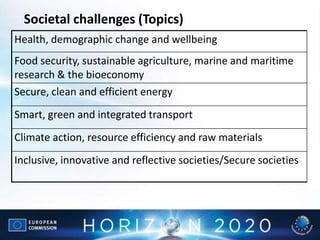
Health, demographic change and wellbeing
Food security, sustainable agriculture, marine and maritime
research & the bioeconomy
Secure, clean and efficient energy
Smart, green and integrated transport
Climate action, resource efficiency and raw materials
Inclusive, innovative and reflective societies/Secure societies
Societal challenges (Topics)
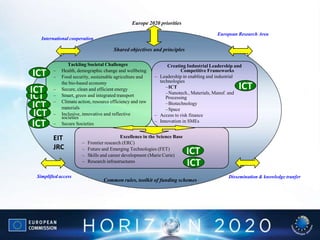
Creating Industrial Leadership and
Competitive Frameworks
Leadership in enabling and industrial
technologies
ICT
Nanotech., Materials, Manuf. and
Processing
Biotechnology
Space
Access to risk finance
Innovation in SMEs
Excellence in the Science Base
Frontier research (ERC)
Future and Emerging Technologies (FET)
Skills and career development (Marie Curie)
Research infrastructures
Shared objectives and principles
Common rules, toolkit of funding schemes
Europe 2020 priorities
European Research Area
Simplified access
International cooperation
Dissemination & knowledge tranfer
Tackling Societal Challenges
Health, demographic change and wellbeing
Food security, sustainable agriculture and
the bio-based economy
Secure, clean and efficient energy
Smart, green and integrated transport
Climate action, resource efficiency and raw
materials
Inclusive, innovative and reflective
societies
Secure Societies
EIT
JRC
ICT
ICT
ICT
ICT
ICT
ICT
ICT
ICT
ICT
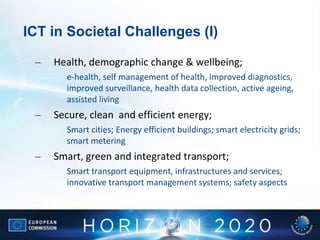
ICT in Societal Challenges (I)
– Health, demographic change & wellbeing;
e-health, self management of health, improved diagnostics,
improved surveillance, health data collection, active ageing,
assisted living
– Secure, clean and efficient energy;
Smart cities; Energy efficient buildings; smart electricity grids;
smart metering
– Smart, green and integrated transport;
Smart transport equipment, infrastructures and services;
innovative transport management systems; safety aspects
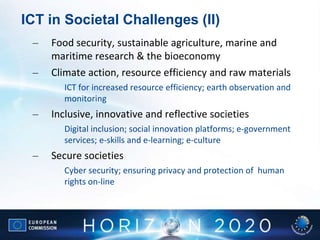
ICT in Societal Challenges (II)
– Food security, sustainable agriculture, marine and
maritime research & the bioeconomy
– Climate action, resource efficiency and raw materials
ICT for increased resource efficiency; earth observation and
monitoring
– Inclusive, innovative and reflective societies
Digital inclusion; social innovation platforms; e-government
services; e-skills and e-learning; e-culture
– Secure societies
Cyber security; ensuring privacy and protection of human
rights on-line
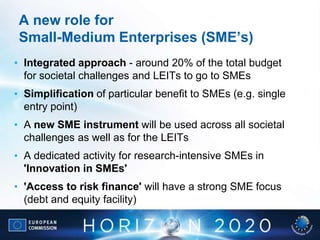
A new role for
Small-Medium Enterprises (SME’s)
• Integrated approach - around 20% of the total budget
for societal challenges and LEITs to go to SMEs
• Simplification of particular benefit to SMEs (e.g. single
entry point)
• A new SME instrument will be used across all societal
challenges as well as for the LEITs
• A dedicated activity for research-intensive SMEs in
'Innovation in SMEs'
• 'Access to risk finance' will have a strong SME focus
(debt and equity facility)
PRACTICALITIES
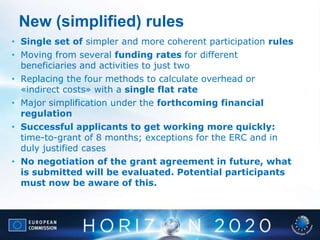
New (simplified) rules
• Single set of simpler and more coherent participation rules
• Moving from several funding rates for different
beneficiaries and activities to just two
• Replacing the four methods to calculate overhead or
«indirect costs» with a single flat rate
• Major simplification under the forthcoming financial
regulation
• Successful applicants to get working more quickly:
time-to-grant of 8 months; exceptions for the ERC and in
duly justified cases
• No negotiation of the grant agreement in future, what
is submitted will be evaluated. Potential participants
must now be aware of this.
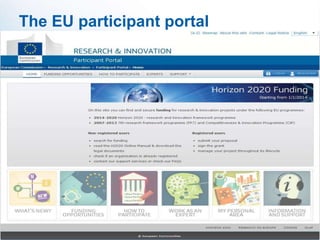
The EU participant portal
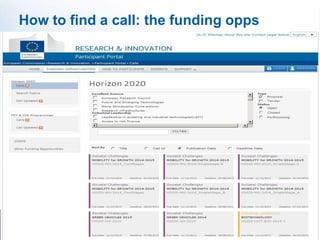
How to find a call: the funding opps
Types of actions
• Research and innovation actions (R&I)
• comparable to FP7 STREPs & IPs
• Innovation actions
• comparable to CIP Pilot B projects (+ "some
research")
• Coordination and Support Actions
• similar to FP7 CSA, but no more distinction between
CA and SA
Research & Innovation actions
• Actions primarily consisting of activities aiming
to establish new knowledge and/or to explore
the feasibility of a new or improved technology,
product, process, service or solution.
• For this purpose they may include basic and
applied research, technology development and
integration, testing and validation on a small-
scale prototype in a laboratory or simulated
environment.
Innovation actions
• Actions primarily consisting of activities directly
aiming at producing plans and arrangements or
designs for new, altered or improved
products, processes or services
• For this purpose they may include prototyping,
testing, demonstrating, piloting, large-scale
product validation and market replication
Coordination and Support Actions
Actions consisting primarily of accompanying
measures such as standardisation,
dissemination, awareness-raising and
communication, networking, coordination or
support services, policy dialogues and mutual
learning exercises and studies, including
design studies for new infrastructure and
may also include complementary activities of
networking and coordination between
programmes in different countries.
Eligibility conditions
Research and Innovation actions
• At least 3 mutually independent legal entities, each
established in different MS/AC
Innovation actions
• At least 3 mutually independent legal entities, each
established in different MS/AC
Coordination and Support Actions
• One legal entity established in a Member State or
associated country
Grant
One reimbursement rate by action (same rate for all all
activities):
• Up to 100% for Research and Innovation actions (and CSA)
• Up to 70% for innovation (non-profit entities up to 100%) and
programme co-fund actions.
• WP may specify a different reimbursement rate
One method for calculation of indirect costs:
• Flat rate of 25% of total direct costs, excluding subcontracting,
costs of third parties and financial support to third parties
• If provided in WP, lump sum or unit costs
No-profit rule (as in FP7)
Evaluation criteria / scoring / weights
Criteria: Excellence / Impact / Implementation
• As in FP7: each criterion scored out of 5;
individual threshold of 3; overall threshold of 10
• For Innovation Actions
• Impact criterion weighted by factor of 1.5
• For Research and Innovation Actions:
• No weighting of evaluation criteria
H2020 for non-EU contries
Applicants from non-EU countries (or «third
countries») are always free to take part in
H2020 programmes
However, they are not always automatically
entitled to funding!
Opportunities for Palestine / Birzeit
The good news is that Palestine is among
the countries which are automatically
eligible
In addition, there are calls which are
especially targeted to non-EU countries
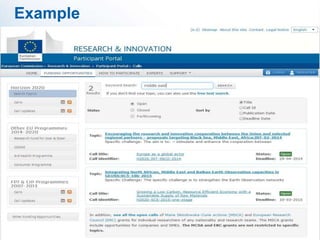
(search for Middle East in the participant
portal)
Example
Conclusions
• H2020 can be a great opportunity for
Birzeit University and Palestine
• However:
• Project ideas should not focus on your
problems, but on EU challenges
• We need to build convincing arguments for
EU partners to include BU in a consortium
• The business orientation is extremely
important (no curiosity-driven research!)
• Find the right travelling companions
THANKS!

Bouquet: SIERA Workshop on The Pillars of Horizon2020

  • 1.
    SIERA Workshop on ThePillars of Horizon2020 Prof. Paolo Bouquet University of Trento / OKKAM SL paolo.bouquet@unitn.it / bouquet@okkam.it SIERA (GA #295006) Birzeit University, Palestine 02/04/2014
  • 2.
    A changed context Sincethe launch of the Seventh Framework Programme (FP7), the economic context has changed dramatically (crisis). Fiscal consolidation and structural reform are necessary but not sufficient to secure Europe’s global competitiveness. Smart investment, notably in research and innovation, is vital in order to maintain high standards of living Research and innovation help deliver jobs, prosperity, quality of life and lead to business opportunities by creating innovative products and services. Although the Union is a global leader in many technologies, it faces increasing competition from traditional competitors and emerging economies alike and must therefore improve its innovation performance. /* COM/2011/0808 final */
  • 3.
    4 5 7 1315 19 50 77 0 20 40 60 80 100 FP! FP2 FP3 FP4 FP5 FP6 FP7 FP8 RTD Framework Programmes Budget (Bn €) 110 Billion Euros! 1984-1988 2007-2013 2014-2020
  • 4.
  • 5.
    Key novelties • Theintegration of research and innovation by providing seamless and coherent funding from idea to market • More support for innovation and activities close to the market, leading to a direct economic stimulus; • A strong focus on creating business opportunities out of our response to the major concerns common to people in Europe and beyond, i.e. “societal challenges” /* COM/2011/0808 final */
  • 7.
    Priority 1 Excellentscience Why: • World class science is the foundation of tomorrow’s technologies, jobs and wellbeing • Europe needs to develop, attract and retain research talent • Researchers need access to the best infrastructures
  • 8.
    European Research Council Frontierresearch by the best individual teams Future and Emerging Technologies Collaborative research to open new fields of innovation Marie Curie actions* Opportunities for training and career development Research infrastructures (including e-infrastructure) Ensuring access to world-class facilities Instruments
  • 9.
    Priority 2 Industrialleadership Why: • Europe needs more innovative SMEs to create growth and jobs • Strategic investments in key technologies (e.g. advanced manufacturing, micro-electronics) underpin innovation across existing and emerging sectors • Europe needs to attract more private investment in research and innovation
  • 10.
    Leadership in enablingand industrial technologies (ICT, nanotechnologies, materials, biotechnology, manufacturing, space) Access to risk finance Leveraging private finance and venture capital for research and innovation Innovation in SMEs Fostering all forms of innovation in all types of SMEs Instruments
  • 11.
    Priority 3 Societalchallenges Why: • EU policy objectives (climate, environment, energy, transport etc) cannot be achieved without innovation • Breakthrough solutions come from multi-disciplinary collaborations, including social sciences & humanities • Promising solutions need to be tested, demonstrated and scaled up
  • 12.
    Health, demographic changeand wellbeing Food security, sustainable agriculture, marine and maritime research & the bioeconomy Secure, clean and efficient energy Smart, green and integrated transport Climate action, resource efficiency and raw materials Inclusive, innovative and reflective societies/Secure societies Societal challenges (Topics)
  • 13.
    Creating Industrial Leadershipand Competitive Frameworks Leadership in enabling and industrial technologies ICT Nanotech., Materials, Manuf. and Processing Biotechnology Space Access to risk finance Innovation in SMEs Excellence in the Science Base Frontier research (ERC) Future and Emerging Technologies (FET) Skills and career development (Marie Curie) Research infrastructures Shared objectives and principles Common rules, toolkit of funding schemes Europe 2020 priorities European Research Area Simplified access International cooperation Dissemination & knowledge tranfer Tackling Societal Challenges Health, demographic change and wellbeing Food security, sustainable agriculture and the bio-based economy Secure, clean and efficient energy Smart, green and integrated transport Climate action, resource efficiency and raw materials Inclusive, innovative and reflective societies Secure Societies EIT JRC ICT ICT ICT ICT ICT ICT ICT ICT ICT
  • 14.
    ICT in SocietalChallenges (I) – Health, demographic change & wellbeing; e-health, self management of health, improved diagnostics, improved surveillance, health data collection, active ageing, assisted living – Secure, clean and efficient energy; Smart cities; Energy efficient buildings; smart electricity grids; smart metering – Smart, green and integrated transport; Smart transport equipment, infrastructures and services; innovative transport management systems; safety aspects
  • 15.
    ICT in SocietalChallenges (II) – Food security, sustainable agriculture, marine and maritime research & the bioeconomy – Climate action, resource efficiency and raw materials ICT for increased resource efficiency; earth observation and monitoring – Inclusive, innovative and reflective societies Digital inclusion; social innovation platforms; e-government services; e-skills and e-learning; e-culture – Secure societies Cyber security; ensuring privacy and protection of human rights on-line
  • 16.
    A new rolefor Small-Medium Enterprises (SME’s) • Integrated approach - around 20% of the total budget for societal challenges and LEITs to go to SMEs • Simplification of particular benefit to SMEs (e.g. single entry point) • A new SME instrument will be used across all societal challenges as well as for the LEITs • A dedicated activity for research-intensive SMEs in 'Innovation in SMEs' • 'Access to risk finance' will have a strong SME focus (debt and equity facility)
  • 17.
  • 18.
    New (simplified) rules •Single set of simpler and more coherent participation rules • Moving from several funding rates for different beneficiaries and activities to just two • Replacing the four methods to calculate overhead or «indirect costs» with a single flat rate • Major simplification under the forthcoming financial regulation • Successful applicants to get working more quickly: time-to-grant of 8 months; exceptions for the ERC and in duly justified cases • No negotiation of the grant agreement in future, what is submitted will be evaluated. Potential participants must now be aware of this.
  • 19.
  • 20.
    How to finda call: the funding opps
  • 21.
    Types of actions •Research and innovation actions (R&I) • comparable to FP7 STREPs & IPs • Innovation actions • comparable to CIP Pilot B projects (+ "some research") • Coordination and Support Actions • similar to FP7 CSA, but no more distinction between CA and SA
  • 22.
    Research & Innovationactions • Actions primarily consisting of activities aiming to establish new knowledge and/or to explore the feasibility of a new or improved technology, product, process, service or solution. • For this purpose they may include basic and applied research, technology development and integration, testing and validation on a small- scale prototype in a laboratory or simulated environment.
  • 23.
    Innovation actions • Actionsprimarily consisting of activities directly aiming at producing plans and arrangements or designs for new, altered or improved products, processes or services • For this purpose they may include prototyping, testing, demonstrating, piloting, large-scale product validation and market replication
  • 24.
    Coordination and SupportActions Actions consisting primarily of accompanying measures such as standardisation, dissemination, awareness-raising and communication, networking, coordination or support services, policy dialogues and mutual learning exercises and studies, including design studies for new infrastructure and may also include complementary activities of networking and coordination between programmes in different countries.
  • 25.
    Eligibility conditions Research andInnovation actions • At least 3 mutually independent legal entities, each established in different MS/AC Innovation actions • At least 3 mutually independent legal entities, each established in different MS/AC Coordination and Support Actions • One legal entity established in a Member State or associated country
  • 26.
    Grant One reimbursement rateby action (same rate for all all activities): • Up to 100% for Research and Innovation actions (and CSA) • Up to 70% for innovation (non-profit entities up to 100%) and programme co-fund actions. • WP may specify a different reimbursement rate One method for calculation of indirect costs: • Flat rate of 25% of total direct costs, excluding subcontracting, costs of third parties and financial support to third parties • If provided in WP, lump sum or unit costs No-profit rule (as in FP7)
  • 27.
    Evaluation criteria /scoring / weights Criteria: Excellence / Impact / Implementation • As in FP7: each criterion scored out of 5; individual threshold of 3; overall threshold of 10 • For Innovation Actions • Impact criterion weighted by factor of 1.5 • For Research and Innovation Actions: • No weighting of evaluation criteria
  • 28.
    H2020 for non-EUcontries Applicants from non-EU countries (or «third countries») are always free to take part in H2020 programmes However, they are not always automatically entitled to funding!
  • 29.
    Opportunities for Palestine/ Birzeit The good news is that Palestine is among the countries which are automatically eligible In addition, there are calls which are especially targeted to non-EU countries (search for Middle East in the participant portal)
  • 30.
  • 31.
    Conclusions • H2020 canbe a great opportunity for Birzeit University and Palestine • However: • Project ideas should not focus on your problems, but on EU challenges • We need to build convincing arguments for EU partners to include BU in a consortium • The business orientation is extremely important (no curiosity-driven research!) • Find the right travelling companions
  • 32.