‫أكاديمية الحكومة اإللكترونية الفلسطينية‬
           The Palestinian eGovernment Academy
                      www.egovacademy.ps


Tutorial 4: Ontology Engineering & Lexical Semantics

                      Session 1.1
     The Need for Shared Semantics


                  Dr. Mustafa Jarrar
                     University of Birzeit
                     mjarrar@birzeit.edu
                       www.jarrar.info

                         PalGov © 2011                 1
About

This tutorial is part of the PalGov project, funded by the TEMPUS IV program of the
Commission of the European Communities, grant agreement 511159-TEMPUS-1-
2010-1-PS-TEMPUS-JPHES. The project website: www.egovacademy.ps
Project Consortium:
             Birzeit University, Palestine
                                                           University of Trento, Italy
             (Coordinator )


             Palestine Polytechnic University, Palestine   Vrije Universiteit Brussel, Belgium


             Palestine Technical University, Palestine
                                                           Université de Savoie, France

             Ministry of Telecom and IT, Palestine
                                                           University of Namur, Belgium
             Ministry of Interior, Palestine
                                                           TrueTrust, UK
             Ministry of Local Government, Palestine


Coordinator:
Dr. Mustafa Jarrar
Birzeit University, P.O.Box 14- Birzeit, Palestine
Telfax:+972 2 2982935 mjarrar@birzeit.eduPalGov © 2011
                                                                                                 2
© Copyright Notes
Everyone is encouraged to use this material, or part of it, but should
properly cite the project (logo and website), and the author of that part.


No part of this tutorial may be reproduced or modified in any form or by
any means, without prior written permission from the project, who have
the full copyrights on the material.


                 Attribution-NonCommercial-ShareAlike
                              CC-BY-NC-SA

This license lets others remix, tweak, and build upon your work non-
commercially, as long as they credit you and license their new creations
under the identical terms.

                                 PalGov © 2011                               3
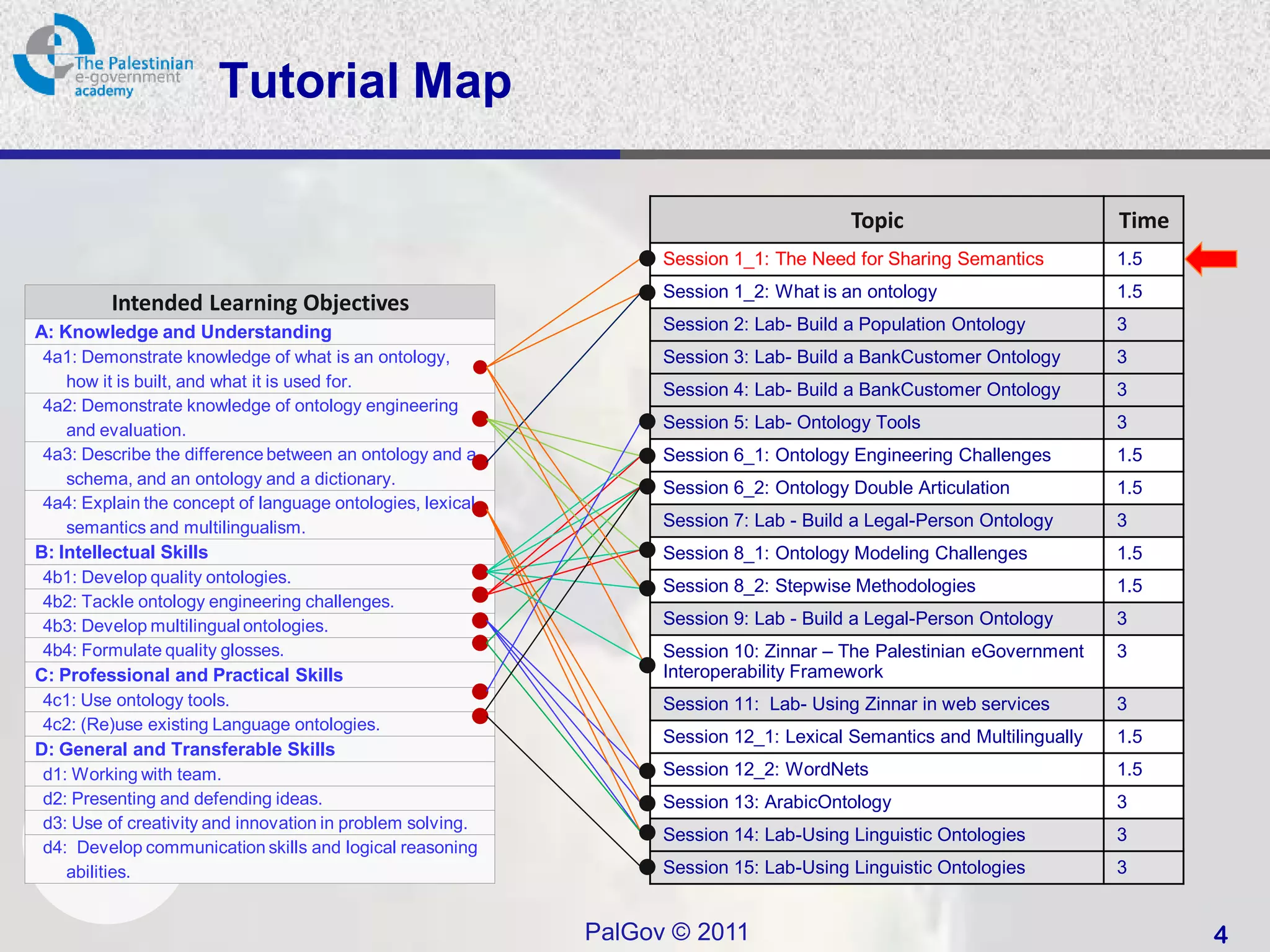
Tutorial Map

                                                                                        Topic                          Time
                                                                  Session 1_1: The Need for Sharing Semantics          1.5
                                                                  Session 1_2: What is an ontology                     1.5
         Intended Learning Objectives
A: Knowledge and Understanding                                    Session 2: Lab- Build a Population Ontology          3
 4a1: Demonstrate knowledge of what is an ontology,               Session 3: Lab- Build a BankCustomer Ontology        3
    how it is built, and what it is used for.                     Session 4: Lab- Build a BankCustomer Ontology        3
 4a2: Demonstrate knowledge of ontology engineering
    and evaluation.                                               Session 5: Lab- Ontology Tools                       3
 4a3: Describe the difference between an ontology and a           Session 6_1: Ontology Engineering Challenges         1.5
    schema, and an ontology and a dictionary.
                                                                  Session 6_2: Ontology Double Articulation            1.5
 4a4: Explain the concept of language ontologies, lexical
    semantics and multilingualism.                                Session 7: Lab - Build a Legal-Person Ontology       3
B: Intellectual Skills                                            Session 8_1: Ontology Modeling Challenges            1.5
 4b1: Develop quality ontologies.                                 Session 8_2: Stepwise Methodologies                  1.5
 4b2: Tackle ontology engineering challenges.
 4b3: Develop multilingual ontologies.                            Session 9: Lab - Build a Legal-Person Ontology       3
 4b4: Formulate quality glosses.                                  Session 10: Zinnar – The Palestinian eGovernment     3
C: Professional and Practical Skills                              Interoperability Framework
 4c1: Use ontology tools.                                         Session 11: Lab- Using Zinnar in web services        3
 4c2: (Re)use existing Language ontologies.
                                                                  Session 12_1: Lexical Semantics and Multilingually   1.5
D: General and Transferable Skills
 d1: Working with team.                                           Session 12_2: WordNets                               1.5
 d2: Presenting and defending ideas.                              Session 13: ArabicOntology                           3
 d3: Use of creativity and innovation in problem solving.
                                                                  Session 14: Lab-Using Linguistic Ontologies          3
 d4: Develop communication skills and logical reasoning
    abilities.                                                    Session 15: Lab-Using Linguistic Ontologies          3


                                                            PalGov © 2011                                                     4
Session ILOs


This session will help student to:
   4a1: Demonstrate knowledge of what is an ontology, how it is
       built, and what it is used for


                            PalGov © 2011                         5
Ontology-based Applications
       (i) Open Information Systems (Data Integration and Interoperability)

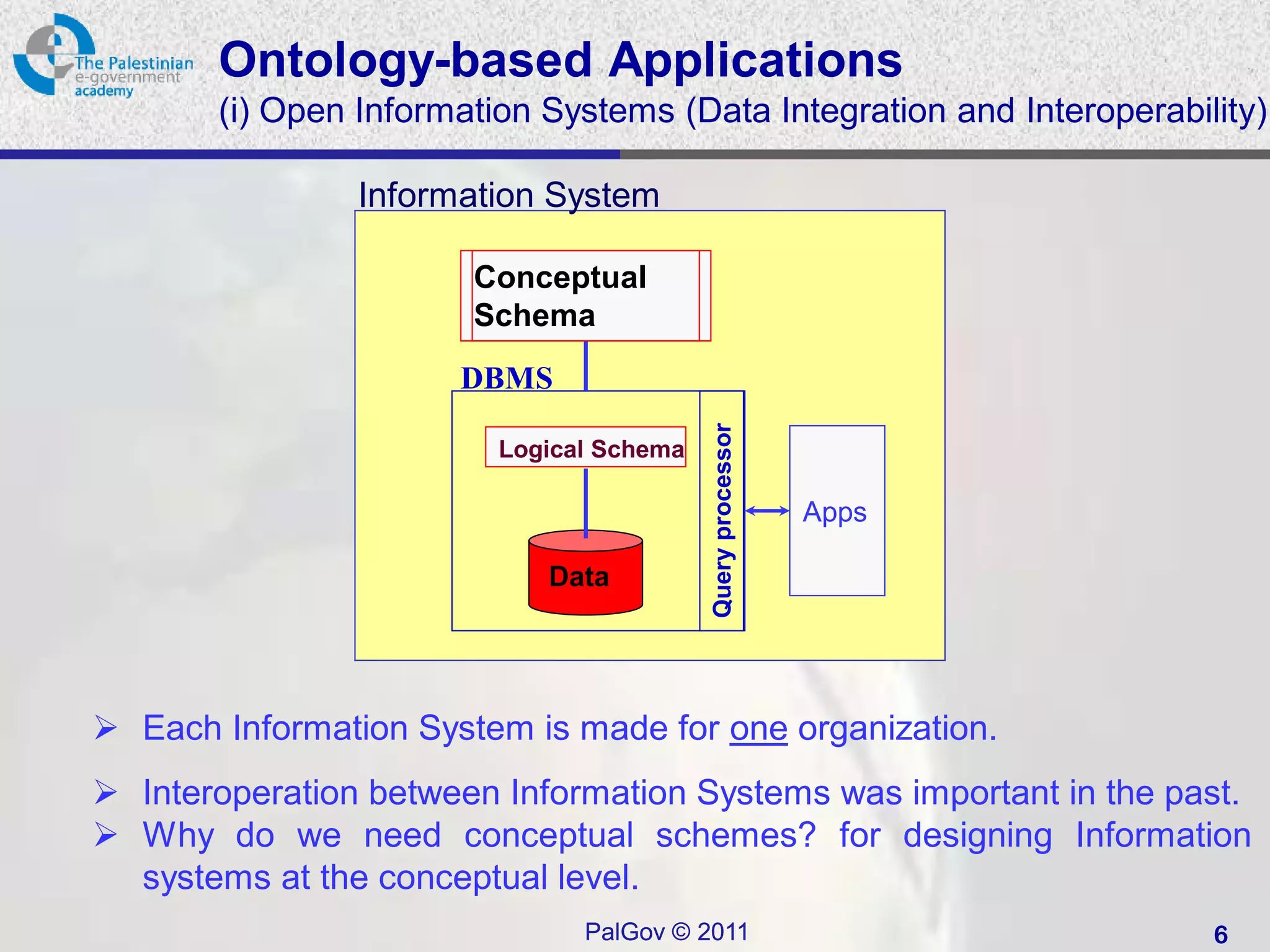
                Information System

                       Conceptual
                       Schema
                      DBMS


                                          Query processor
                         Logical Schema

                                                            Apps

                            Data


 Each Information System is made for one organization.
 Interoperation between Information Systems was important in the past.
 Why do we need conceptual schemes? for designing Information
  systems at the conceptual level.
                               PalGov © 2011                           6
Ontology-based Applications
                  (i) Open Information Systems (Data Integration and Interoperability)


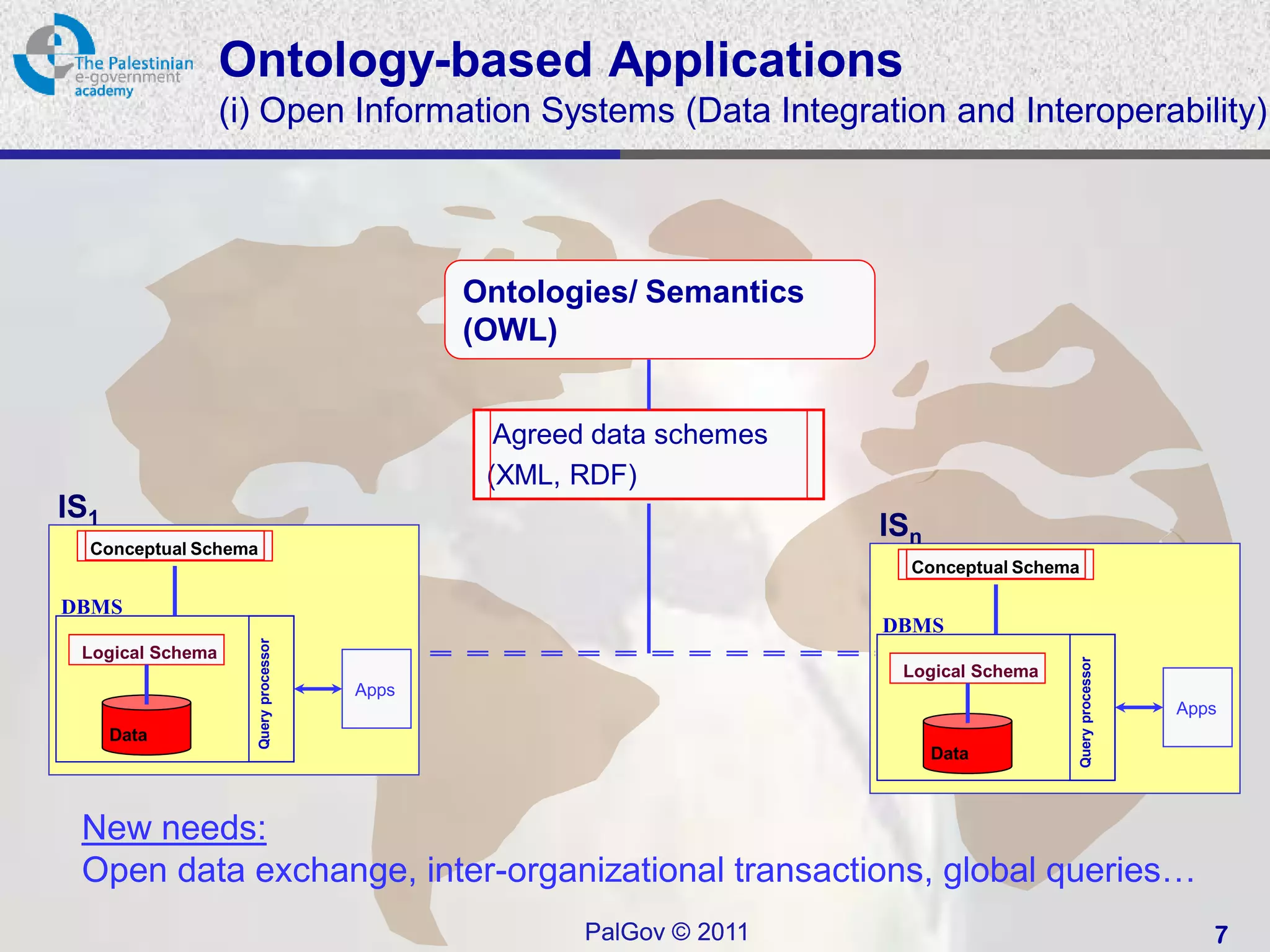
                                               Ontologies/ Semantics
                                               (OWL)


                                                 Agreed data schemes
                                                (XML, RDF)
IS1
                                                                       ISn
  Conceptual Schema
                                                                         Conceptual Schema

DBMS
                                                                       DBMS
                      Query processor


 Logical Schema


                                                                                             Query processor
                                                                        Logical Schema
                                        Apps
                                                                                                               Apps
      Data
                                                                             Data


 New needs:
 Open data exchange, inter-organizational transactions, global queries…
                                                      PalGov © 2011                                               7
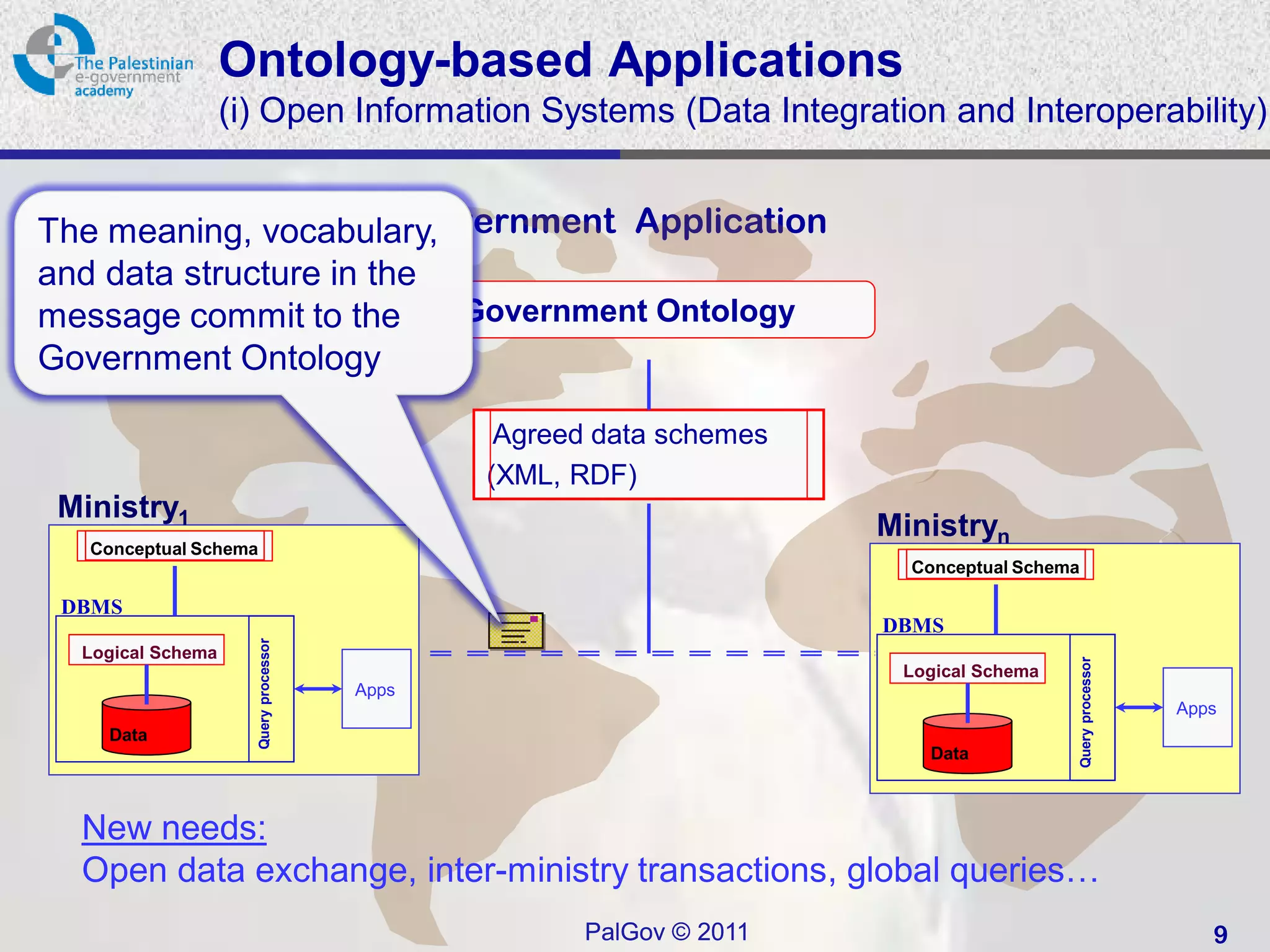
Ontology-based Applications
                  (i) Open Information Systems (Data Integration and Interoperability)


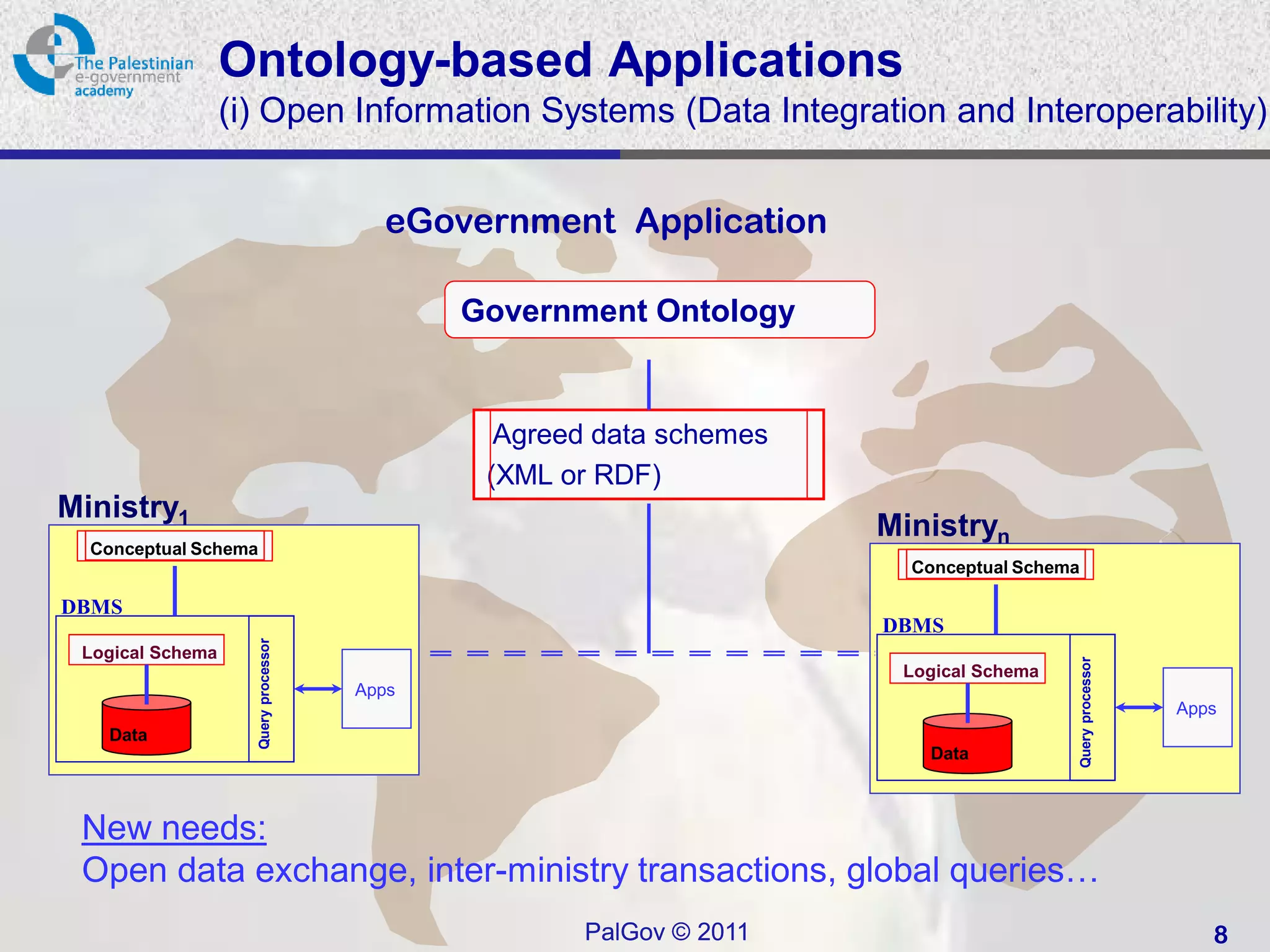
                                          eGovernment Application

                                               Government Ontology


                                                 Agreed data schemes
                                                (XML or RDF)
Ministry1
                                                                       Ministryn
  Conceptual Schema
                                                                         Conceptual Schema

DBMS
                                                                       DBMS
                      Query processor


 Logical Schema


                                                                                             Query processor
                                                                        Logical Schema
                                        Apps
                                                                                                               Apps
   Data
                                                                          Data


 New needs:
 Open data exchange, inter-ministry transactions, global queries…
                                                      PalGov © 2011                                               8
Ontology-based Applications
                   (i) Open Information Systems (Data Integration and Interoperability)


                       eGovernment Application
The meaning, vocabulary,
and data structure in the
message commit to the     Government Ontology
Government Ontology

                                                 Agreed data schemes
                                                (XML, RDF)
 Ministry1
                                                                       Ministryn
   Conceptual Schema
                                                                         Conceptual Schema

 DBMS
                                                                       DBMS
                       Query processor


  Logical Schema


                                                                                             Query processor
                                                                        Logical Schema
                                         Apps
                                                                                                               Apps
    Data
                                                                          Data


  New needs:
  Open data exchange, inter-ministry transactions, global queries…
                                                      PalGov © 2011                                               9
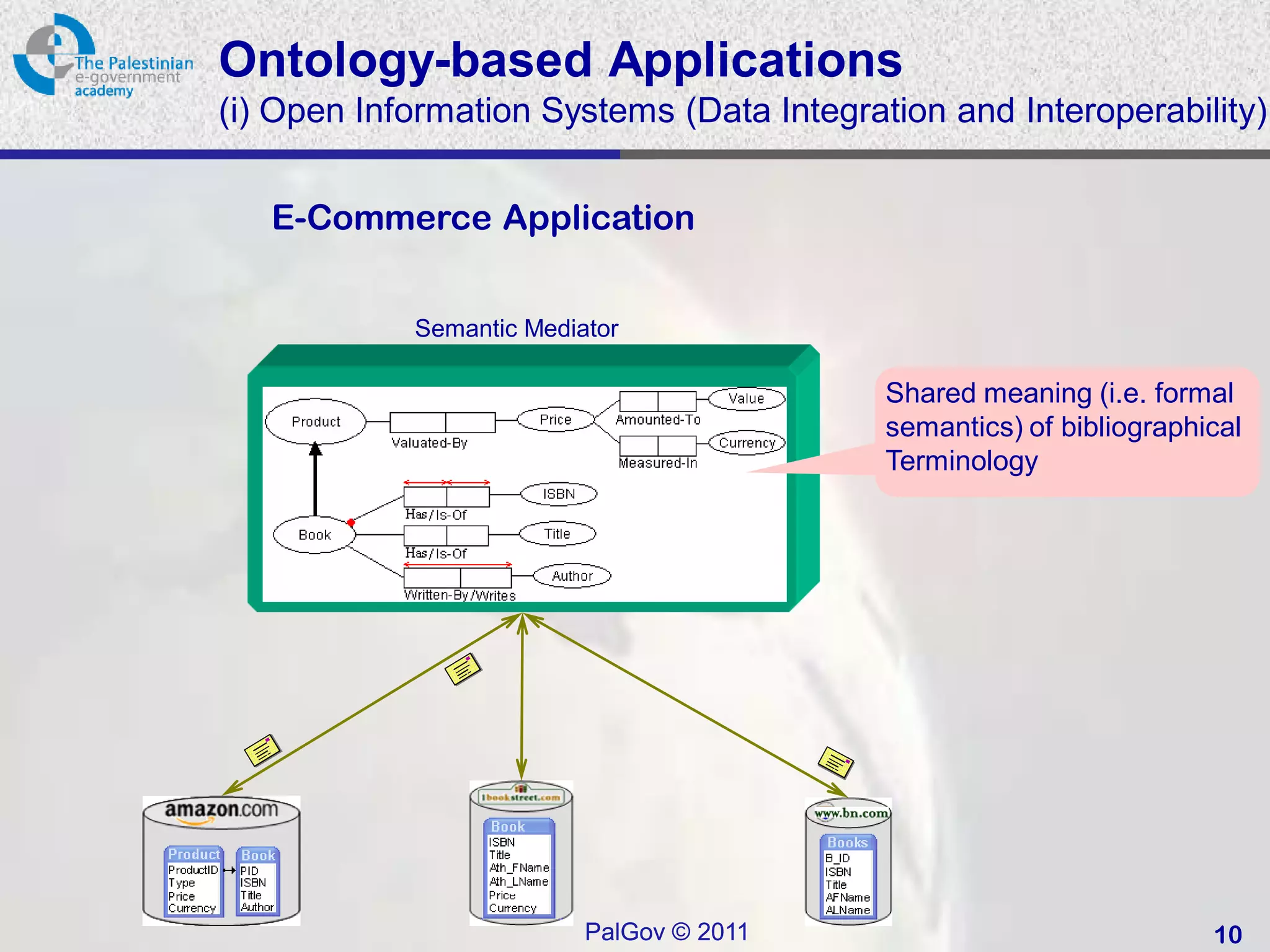
Ontology-based Applications
(i) Open Information Systems (Data Integration and Interoperability)


   E-Commerce Application


            Semantic Mediator

                                           Shared meaning (i.e. formal
            Bookstore Ontology             semantics) of bibliographical
                                           Terminology


                          PalGov © 2011                              10
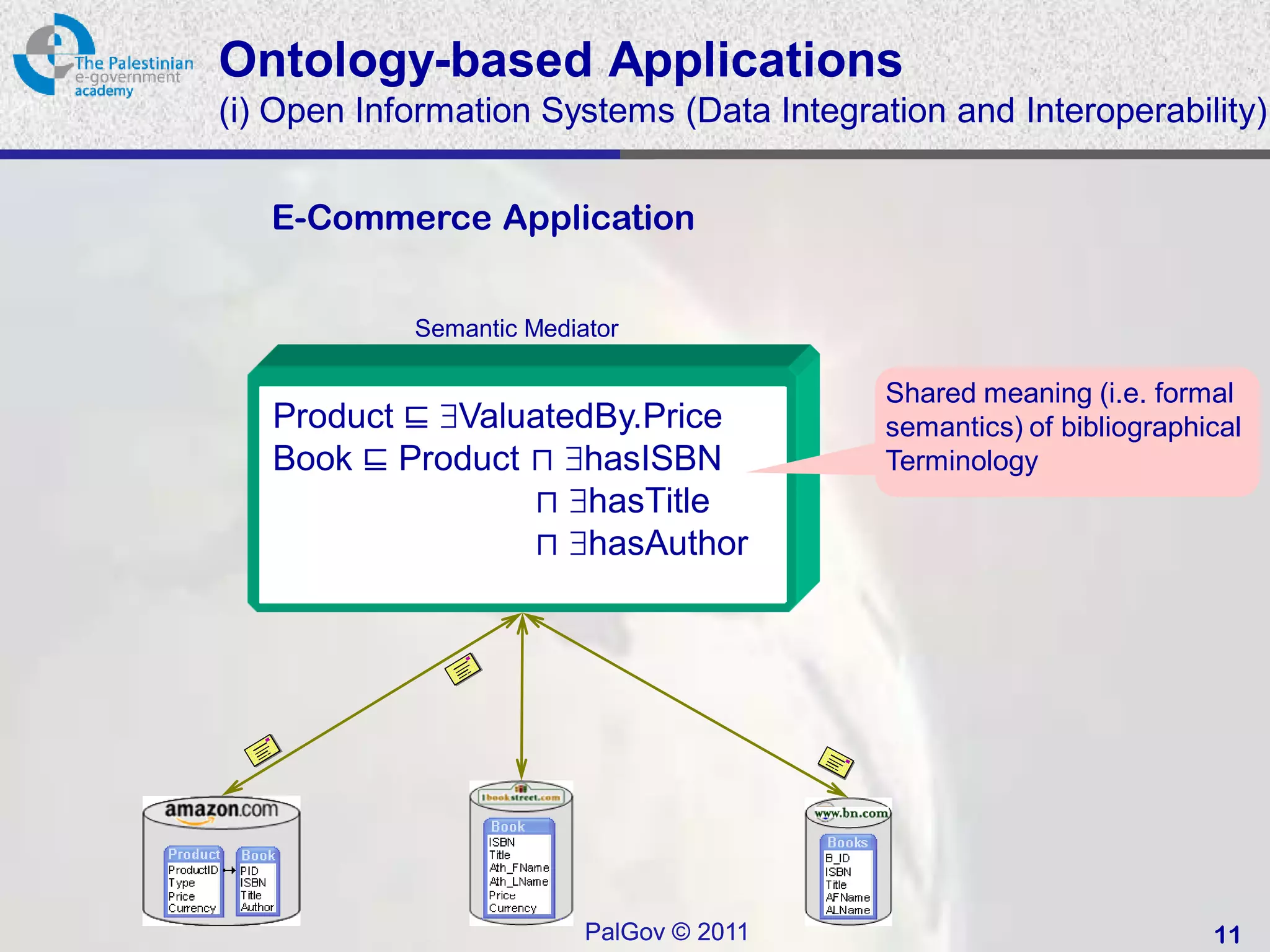
Ontology-based Applications
(i) Open Information Systems (Data Integration and Interoperability)


   E-Commerce Application


            Semantic Mediator

                                           Shared meaning (i.e. formal
   Product ⊑ ValuatedBy.Price
           Bookstore Ontology              semantics) of bibliographical
   Book ⊑ Product ⊓ hasISBN               Terminology
                     ⊓ hasTitle
                     ⊓ hasAuthor


                          PalGov © 2011                              11
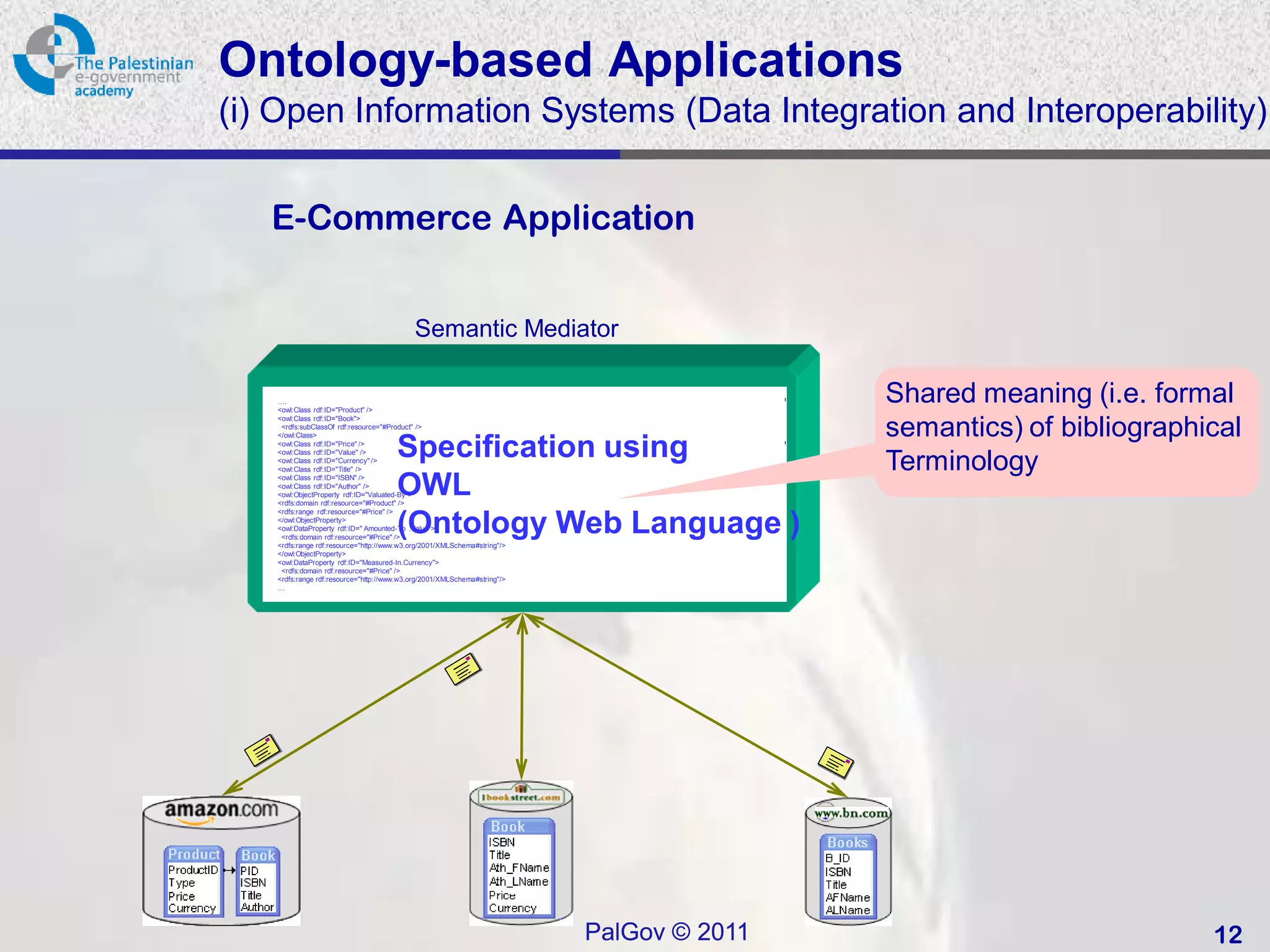
Ontology-based Applications
(i) Open Information Systems (Data Integration and Interoperability)


   E-Commerce Application


                                           Semantic Mediator

   ….
   <owl:Class rdf:ID="Product" />
                                                                                          Shared meaning (i.e. formal
   <owl:Class rdf:ID="Book">
                                            Bookstore Ontology
    <rdfs:subClassOf rdf:resource="#Product" />
   </owl:Class>                                                                           semantics) of bibliographical
   <owl:Class rdf:ID="Price" />
   <owl:Class rdf:ID="Value" />
   <owl:Class rdf:ID="Currency" />
   <owl:Class rdf:ID="Title" />
                                      Specification using                                 Terminology
   <owl:Class rdf:ID="ISBN" />
   <owl:Class rdf:ID="Author" />
                                      OWL
   <owl:ObjectProperty rdf:ID="Valuated-By">
   <rdfs:domain rdf:resource="#Product" />
   <rdfs:range rdf:resource="#Price" />
   </owl:ObjectProperty>
                                      (Ontology Web Language )
   <owl:DataProperty rdf:ID=" Amounted-To .Value">
    <rdfs:domain rdf:resource="#Price" />
   <rdfs:range rdf:resource="http://www.w3.org/2001/XMLSchema#string"/>
   </owl:ObjectProperty>
   <owl:DataProperty rdf:ID="Measured-In.Currency">
    <rdfs:domain rdf:resource="#Price" />
   <rdfs:range rdf:resource="http://www.w3.org/2001/XMLSchema#string"/>
   …


                                                                          PalGov © 2011                             12
Ontology-based Applications
       (ii)The Semantic Web scenario (RDFa)


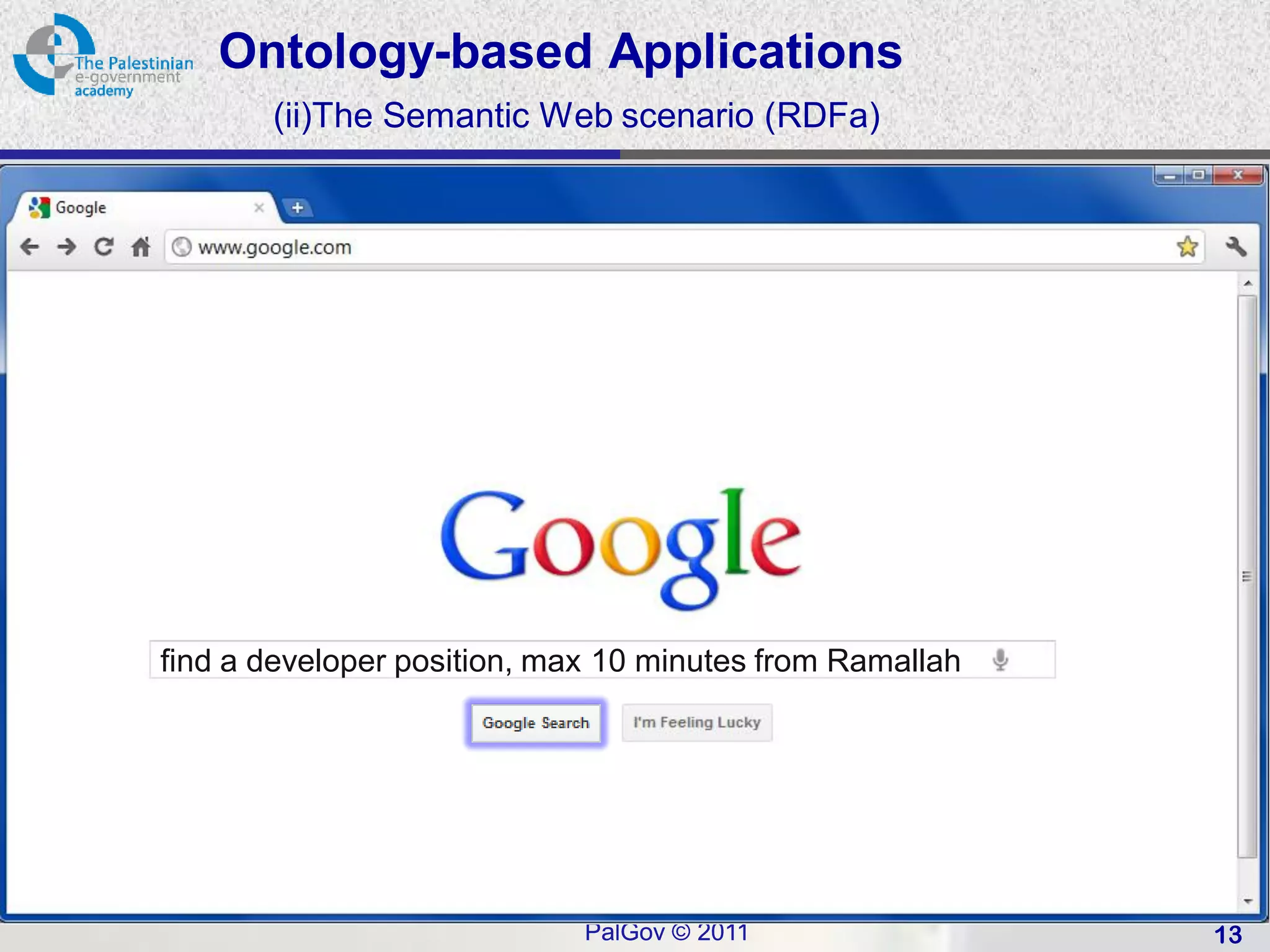
find a developer position, max 10 minutes from Ramallah


                             PalGov © 2011                13
Ontology-based Applications
       (ii)The Semantic Web scenario (RDFa)


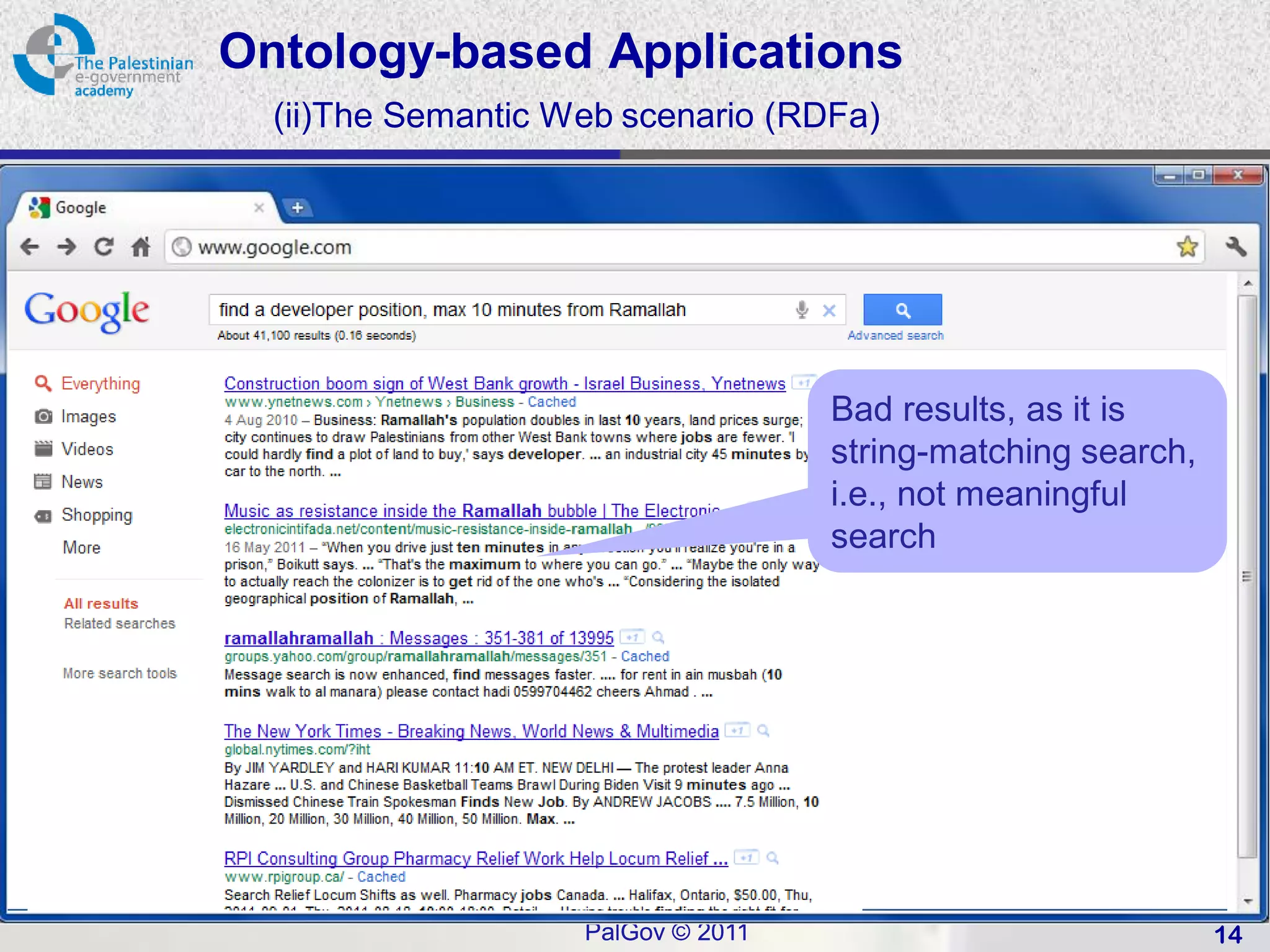
                                              Bad results, as it is
                                              string-matching search,
                                              i.e., not meaningful
                                              search


find a developer position, max 10 minutes from Ramallah


                             PalGov © 2011                              14
Ontology-based Applications
                     (ii)The Semantic Web scenario (RDFa)

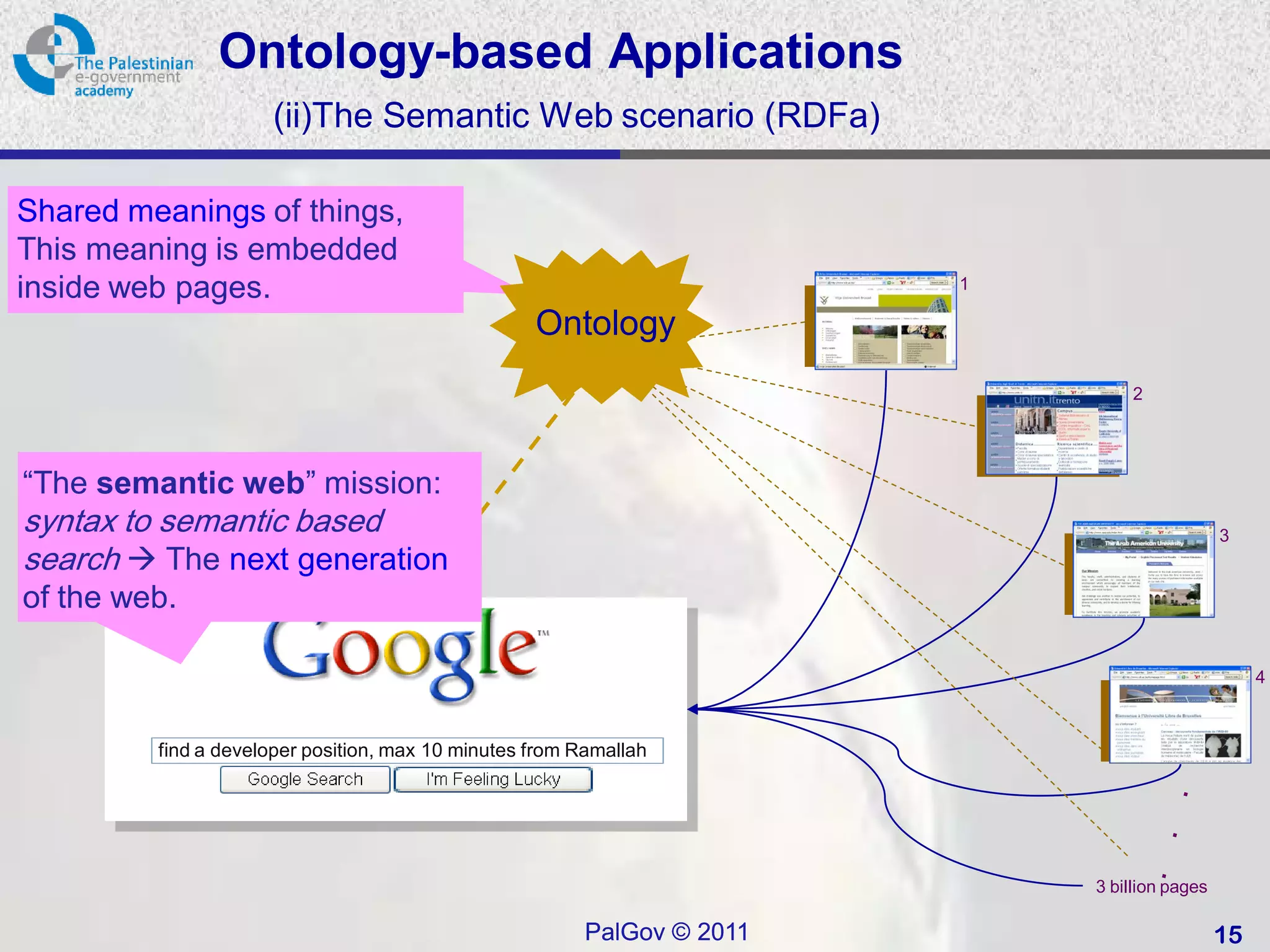
Shared meanings of things,


                                              
This meaning is embedded
inside web pages.                                                        1

                                                   Ontology
                                                                                 2


“The semantic web” mission:
syntax to semantic based                                                                       3
search  The next generation
of the web.

                                                                                                    4


         find a developer position, max 10 minutes from Ramallah


                                                                             3 billion pages

                                                         PalGov © 2011                         15
Ontology-based Applications
                 (iii) Shared semantics in e-Commerce

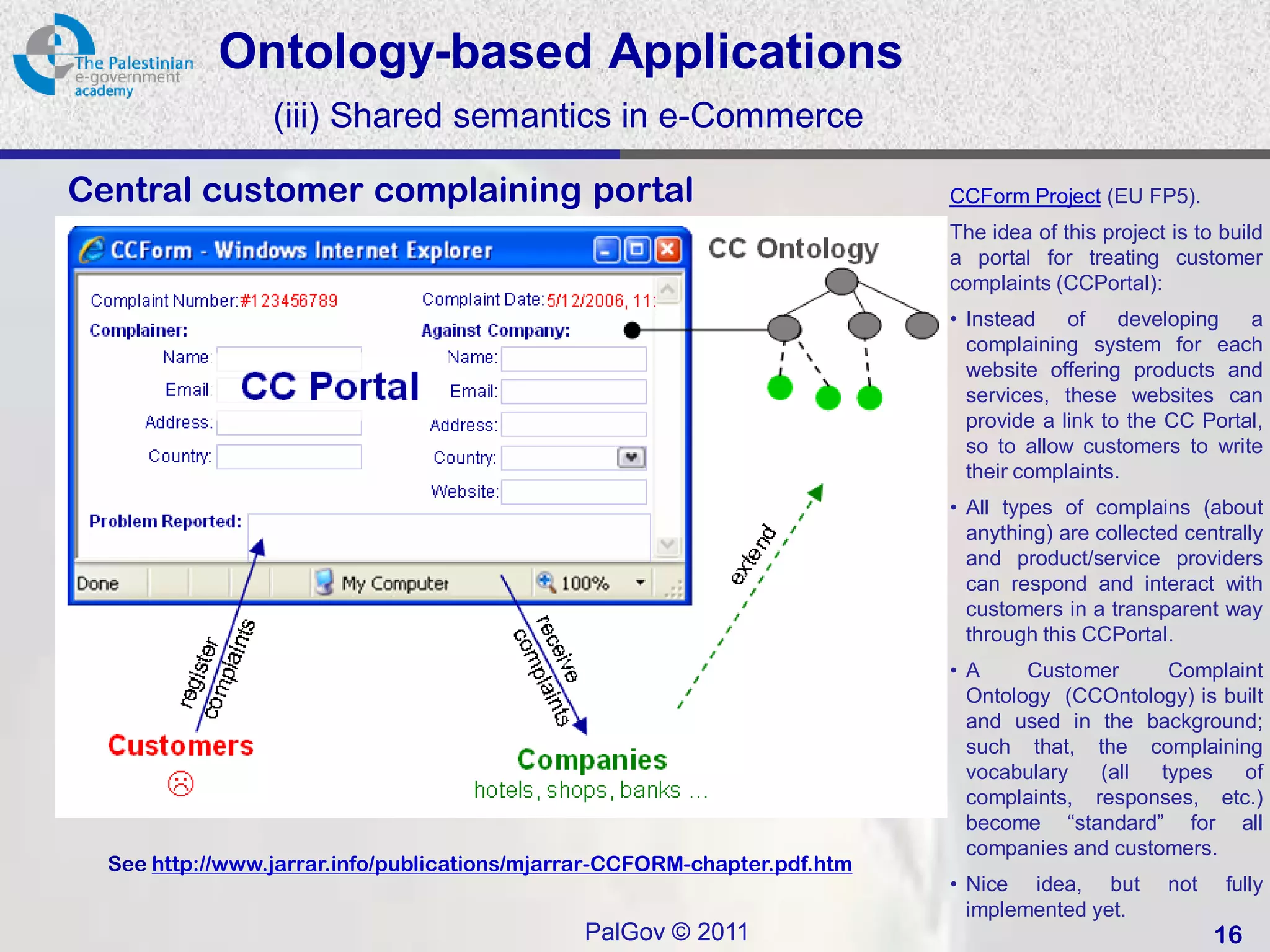
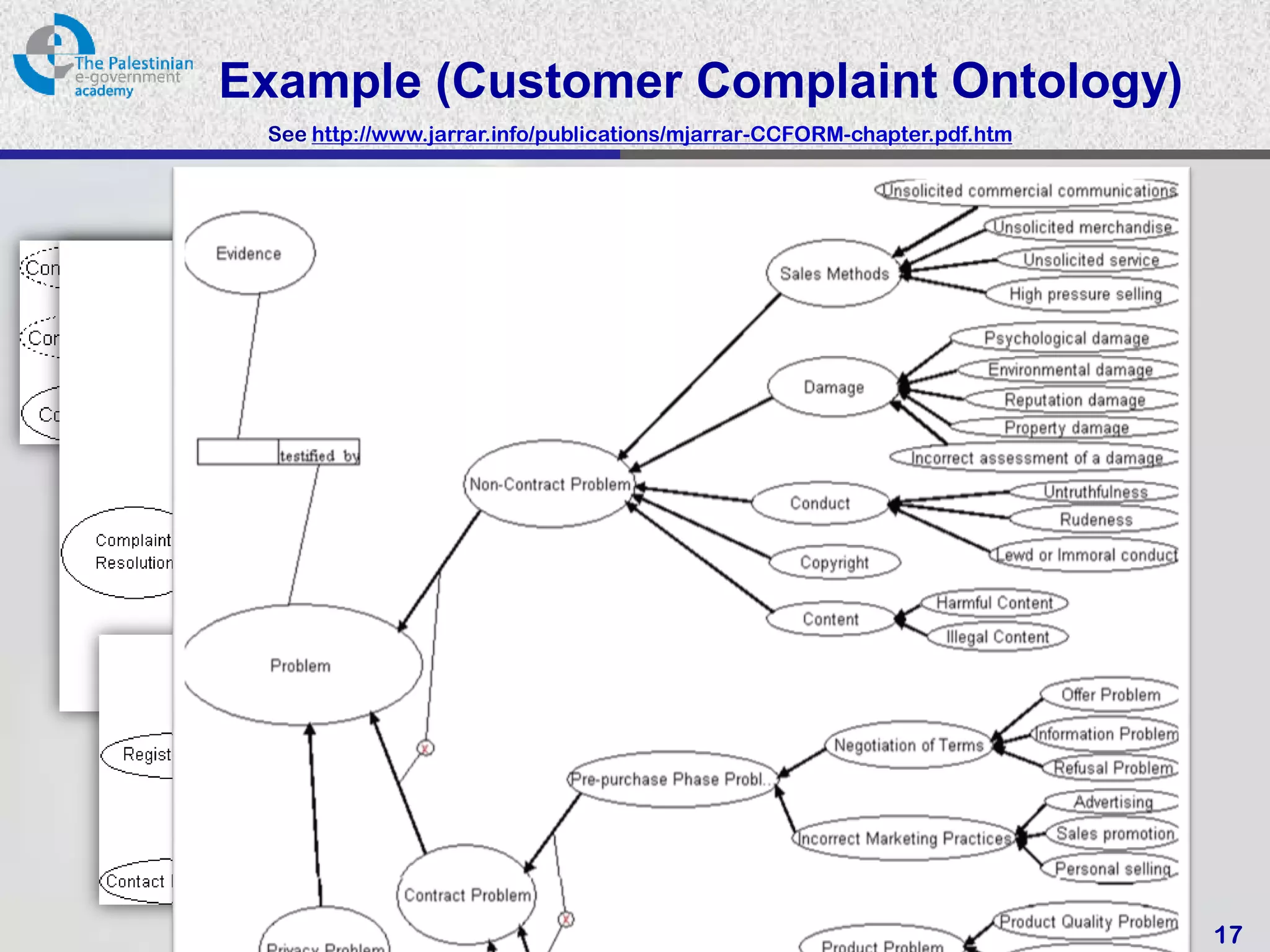
Central customer complaining portal                                        CCForm Project (EU FP5).
                                                                           The idea of this project is to build
                                                                           a portal for treating customer
                                                                           complaints (CCPortal):
                                                                           • Instead    of    developing   a
                                                                             complaining system for each
                                                                             website offering products and
                                                                             services, these websites can
                                                                             provide a link to the CC Portal,
                                                                             so to allow customers to write
                                                                             their complaints.
                                                                           • All types of complains (about
                                                                             anything) are collected centrally
                                                                             and product/service providers
                                                                             can respond and interact with
                                                                             customers in a transparent way
                                                                             through this CCPortal.
                                                                           • A     Customer      Complaint
                                                                             Ontology (CCOntology) is built
                                                                             and used in the background;
                                                                             such that, the complaining
                                                                             vocabulary   (all  types   of
                                                                             complaints, responses, etc.)
                                                                             become “standard” for all
                                                                             companies and customers.
  See http://www.jarrar.info/publications/mjarrar-CCFORM-chapter.pdf.htm
                                                                           • Nice idea, but         not   fully
                                                                             implemented yet.
                                              PalGov © 2011                                               16
Example (Customer Complaint Ontology)
 See http://www.jarrar.info/publications/mjarrar-CCFORM-chapter.pdf.htm


                              PalGov © 2011                               17
The Need for a Shared Understanding


•   The Internet and the open connectivity environments are creating a
    huge demand not only for sharing data but also its semantics.

•   Not only humans but also computers needs to communicate
    meaningfully.

•   However, due to different needs and background contexts, there can be
    widely varying viewpoints and assumptions regarding what is essentially
    the same subject matter; each may have differing, overlapping and/ or
    mis-matched concepts. [Martin Hepp]

•   The consequent lack of a shared understanding leads to poor
    communication within and between people, organizations, and systems.


                                 PalGov © 2011                           18
The Need for Meaning Mediation


“Lack of technologies and products to dynamically mediate
discrepancies in business semantics will limit the adoption
of advanced Web services for large public communities
whose participants have disparate business processes”

                                  Gartner Research, February 28, 2002


                         PalGov © 2011                              19
XML vs Ontology
        Common Alphabet is not Enough…

  One may ask:
  Can we use XML instead of ontologies?

  <aaa>                                  <Book>
    <bbb> Orientalism </bbb>               <Title> Orientalism </Title>
    <ccc>Edward Said</ccc>                 <Author>Edward Said</Author>
    <ddd>11</ddd>                          <Price>11</Price>
  </aaa>                                 </Book>


“XML is only the first step to ensuring that computers can communicate
freely. XML is an alphabet for computers, and as everyone who travels in
Europe knows, knowing the alphabet doesn’t mean you can speak Italian
or French” [Business Week, March 18, 2002]

XML provides syntax, ontologies provide
semanticsmeaning.
                               PalGov © 2011                              20
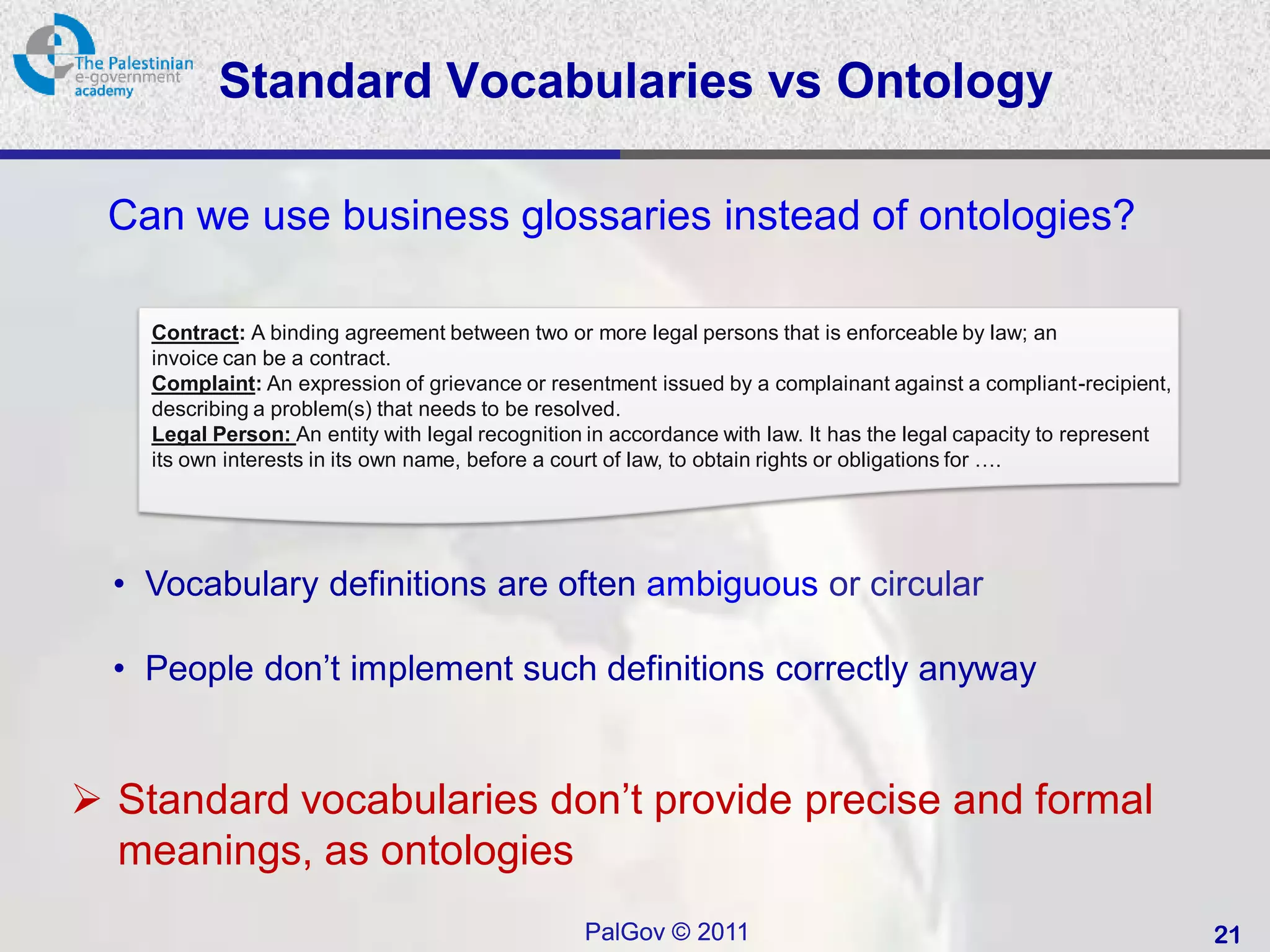
Standard Vocabularies vs Ontology

 Can we use business glossaries instead of ontologies?

    Contract: A binding agreement between two or more legal persons that is enforceable by law; an
    invoice can be a contract.
    Complaint: An expression of grievance or resentment issued by a complainant against a compliant-recipient,
    describing a problem(s) that needs to be resolved.
    Legal Person: An entity with legal recognition in accordance with law. It has the legal capacity to represent
    its own interests in its own name, before a court of law, to obtain rights or obligations for ….


  • Vocabulary definitions are often ambiguous or circular

  • People don’t implement such definitions correctly anyway


 Standard vocabularies don’t provide precise and formal
  meanings, as ontologies
                                                  PalGov © 2011                                                     21
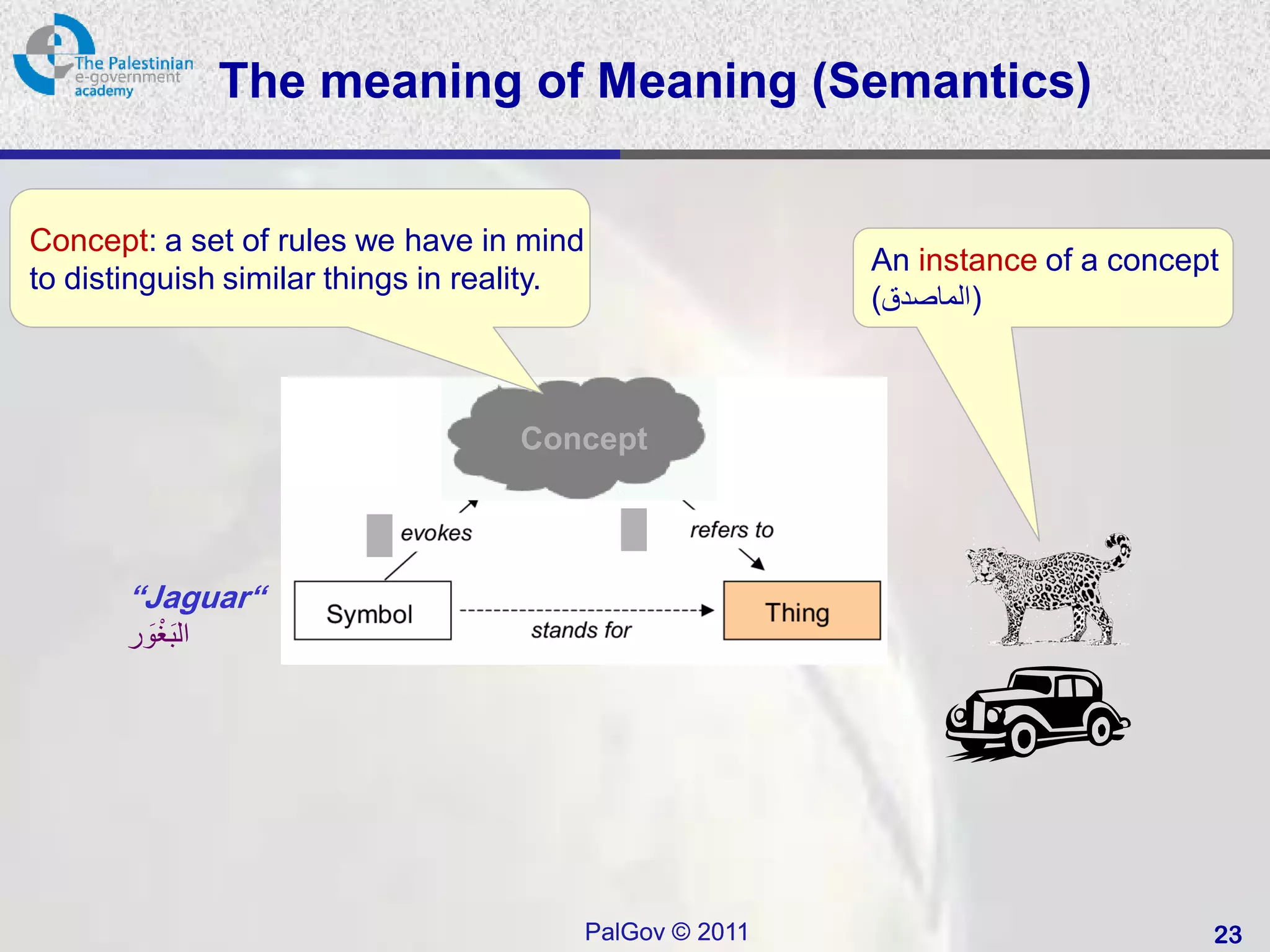
The meaning of Meaning (Semantics)

•      Humans require words (or at least symbols) to communicate
       efficiently. The mapping of words to things is indirect. We do it by
       creating concepts that refer to things.

•      The relation between symbols and things has been described in the
       form of the meaning triangle:


                                                   Concept


    “Jaguar“
      َْ
    ‫ال َبغور‬


               Ogden, C. K. & Richards, I. A. 1923. "The Meaning of
               Meaning." 8th Ed. New York, Harcourt, Brace & World, Inc
                     [Carole Goble, Nigel Shadbolt, Ontologies and the Grid Tutorial]

                                                         PalGov © 2011                  22
The meaning of Meaning (Semantics)


Concept: a set of rules we have in mind
                                                            An instance of a concept
to distinguish similar things in reality.
                                                            (‫)الماصدق‬


                                    Concept


       “Jaguar“
         َْ
       ‫ال َبغور‬


                                            PalGov © 2011                          23
The meaning of Meaning (Semantics)


• A Term (/symbol) may refer to different concepts (Animal: Jaguar,
  Car:Jaguar)
• A Concept might not be agreed on among all people (i.e., not exactly
  the same set of rules are agreed by all people)


Dictionaries represent meanings approximately and informally, mixed
  with lexical aspects.
Ontologies specify the meaning formally and precisely.


 We will come to this topic (Lexical Semantics) in
  more details later
                              PalGov © 2011                           24
Levels of Ontological Precision
                                                                                                                  [Guarino]


                                                                   game(x) → activity(x)
                                                                   athletic game(x) → game(x)
                                                                   court game(x) ↔ athletic game(x) ∧ ∃y. played_in(x,y) ∧ court(y)
                          game                                     tennis(x) → court game(x)
                          NT athletic game                         double fault(x) → fault(x) ∧ ∃y. part_of(x,y) ∧ tennis(y)
                          NT court game
                           RT court
Catalog                    NT tennis           game
                                                                                                        Axiomatized
           Glossary         RT double fault     athletic game                                           Theories
                            Thesaurus             court game
          tennis
                                                    tennis
          football
                                                 outdoor game
          game
                                                     field game
          field game
                                                        football
          court game
          athletic game
                                                 Taxonomy
          outdoor game                                   OO/DB
                                                         schema


  Ontological Precision


                                              PalGov © 2011                                                                 25
References

•   Mustafa Jarrar: Towards Effectiveness and Transparency in e-
    Business Transactions, An Ontology for Customer Complaint
    Management.

•   Ogden, C. K. & Richards, I. A. 1923. "The Meaning of Meaning." 8th
    Ed. New York, Harcourt, Brace & World, Inc.

•   Carole Goble and Nigel Shadbolt: Ontologies and the Grid Tutorial.


                               PalGov © 2011                             26
Thank you!


   PalGov © 2011   27

Pal gov.tutorial4.session1 1.needforsharedsemantics

  • 1.
    ‫أكاديمية الحكومة اإللكترونيةالفلسطينية‬ The Palestinian eGovernment Academy www.egovacademy.ps Tutorial 4: Ontology Engineering & Lexical Semantics Session 1.1 The Need for Shared Semantics Dr. Mustafa Jarrar University of Birzeit mjarrar@birzeit.edu www.jarrar.info PalGov © 2011 1
  • 2.
    About This tutorial ispart of the PalGov project, funded by the TEMPUS IV program of the Commission of the European Communities, grant agreement 511159-TEMPUS-1- 2010-1-PS-TEMPUS-JPHES. The project website: www.egovacademy.ps Project Consortium: Birzeit University, Palestine University of Trento, Italy (Coordinator ) Palestine Polytechnic University, Palestine Vrije Universiteit Brussel, Belgium Palestine Technical University, Palestine Université de Savoie, France Ministry of Telecom and IT, Palestine University of Namur, Belgium Ministry of Interior, Palestine TrueTrust, UK Ministry of Local Government, Palestine Coordinator: Dr. Mustafa Jarrar Birzeit University, P.O.Box 14- Birzeit, Palestine Telfax:+972 2 2982935 mjarrar@birzeit.eduPalGov © 2011 2
  • 3.
    © Copyright Notes Everyoneis encouraged to use this material, or part of it, but should properly cite the project (logo and website), and the author of that part. No part of this tutorial may be reproduced or modified in any form or by any means, without prior written permission from the project, who have the full copyrights on the material. Attribution-NonCommercial-ShareAlike CC-BY-NC-SA This license lets others remix, tweak, and build upon your work non- commercially, as long as they credit you and license their new creations under the identical terms. PalGov © 2011 3
  • 4.
    Tutorial Map Topic Time Session 1_1: The Need for Sharing Semantics 1.5 Session 1_2: What is an ontology 1.5 Intended Learning Objectives A: Knowledge and Understanding Session 2: Lab- Build a Population Ontology 3 4a1: Demonstrate knowledge of what is an ontology, Session 3: Lab- Build a BankCustomer Ontology 3 how it is built, and what it is used for. Session 4: Lab- Build a BankCustomer Ontology 3 4a2: Demonstrate knowledge of ontology engineering and evaluation. Session 5: Lab- Ontology Tools 3 4a3: Describe the difference between an ontology and a Session 6_1: Ontology Engineering Challenges 1.5 schema, and an ontology and a dictionary. Session 6_2: Ontology Double Articulation 1.5 4a4: Explain the concept of language ontologies, lexical semantics and multilingualism. Session 7: Lab - Build a Legal-Person Ontology 3 B: Intellectual Skills Session 8_1: Ontology Modeling Challenges 1.5 4b1: Develop quality ontologies. Session 8_2: Stepwise Methodologies 1.5 4b2: Tackle ontology engineering challenges. 4b3: Develop multilingual ontologies. Session 9: Lab - Build a Legal-Person Ontology 3 4b4: Formulate quality glosses. Session 10: Zinnar – The Palestinian eGovernment 3 C: Professional and Practical Skills Interoperability Framework 4c1: Use ontology tools. Session 11: Lab- Using Zinnar in web services 3 4c2: (Re)use existing Language ontologies. Session 12_1: Lexical Semantics and Multilingually 1.5 D: General and Transferable Skills d1: Working with team. Session 12_2: WordNets 1.5 d2: Presenting and defending ideas. Session 13: ArabicOntology 3 d3: Use of creativity and innovation in problem solving. Session 14: Lab-Using Linguistic Ontologies 3 d4: Develop communication skills and logical reasoning abilities. Session 15: Lab-Using Linguistic Ontologies 3 PalGov © 2011 4
  • 5.
    Session ILOs This sessionwill help student to: 4a1: Demonstrate knowledge of what is an ontology, how it is built, and what it is used for PalGov © 2011 5
  • 6.
    Ontology-based Applications (i) Open Information Systems (Data Integration and Interoperability) Information System Conceptual Schema DBMS Query processor Logical Schema Apps Data  Each Information System is made for one organization.  Interoperation between Information Systems was important in the past.  Why do we need conceptual schemes? for designing Information systems at the conceptual level. PalGov © 2011 6
  • 7.
    Ontology-based Applications (i) Open Information Systems (Data Integration and Interoperability) Ontologies/ Semantics (OWL) Agreed data schemes (XML, RDF) IS1 ISn Conceptual Schema Conceptual Schema DBMS DBMS Query processor Logical Schema Query processor Logical Schema Apps Apps Data Data New needs: Open data exchange, inter-organizational transactions, global queries… PalGov © 2011 7
  • 8.
    Ontology-based Applications (i) Open Information Systems (Data Integration and Interoperability) eGovernment Application Government Ontology Agreed data schemes (XML or RDF) Ministry1 Ministryn Conceptual Schema Conceptual Schema DBMS DBMS Query processor Logical Schema Query processor Logical Schema Apps Apps Data Data New needs: Open data exchange, inter-ministry transactions, global queries… PalGov © 2011 8
  • 9.
    Ontology-based Applications (i) Open Information Systems (Data Integration and Interoperability) eGovernment Application The meaning, vocabulary, and data structure in the message commit to the Government Ontology Government Ontology Agreed data schemes (XML, RDF) Ministry1 Ministryn Conceptual Schema Conceptual Schema DBMS DBMS Query processor Logical Schema Query processor Logical Schema Apps Apps Data Data New needs: Open data exchange, inter-ministry transactions, global queries… PalGov © 2011 9
  • 10.
    Ontology-based Applications (i) OpenInformation Systems (Data Integration and Interoperability) E-Commerce Application Semantic Mediator Shared meaning (i.e. formal Bookstore Ontology semantics) of bibliographical Terminology PalGov © 2011 10
  • 11.
    Ontology-based Applications (i) OpenInformation Systems (Data Integration and Interoperability) E-Commerce Application Semantic Mediator Shared meaning (i.e. formal Product ⊑ ValuatedBy.Price Bookstore Ontology semantics) of bibliographical Book ⊑ Product ⊓ hasISBN Terminology ⊓ hasTitle ⊓ hasAuthor PalGov © 2011 11
  • 12.
    Ontology-based Applications (i) OpenInformation Systems (Data Integration and Interoperability) E-Commerce Application Semantic Mediator …. <owl:Class rdf:ID="Product" /> Shared meaning (i.e. formal <owl:Class rdf:ID="Book"> Bookstore Ontology <rdfs:subClassOf rdf:resource="#Product" /> </owl:Class> semantics) of bibliographical <owl:Class rdf:ID="Price" /> <owl:Class rdf:ID="Value" /> <owl:Class rdf:ID="Currency" /> <owl:Class rdf:ID="Title" /> Specification using Terminology <owl:Class rdf:ID="ISBN" /> <owl:Class rdf:ID="Author" /> OWL <owl:ObjectProperty rdf:ID="Valuated-By"> <rdfs:domain rdf:resource="#Product" /> <rdfs:range rdf:resource="#Price" /> </owl:ObjectProperty> (Ontology Web Language ) <owl:DataProperty rdf:ID=" Amounted-To .Value"> <rdfs:domain rdf:resource="#Price" /> <rdfs:range rdf:resource="http://www.w3.org/2001/XMLSchema#string"/> </owl:ObjectProperty> <owl:DataProperty rdf:ID="Measured-In.Currency"> <rdfs:domain rdf:resource="#Price" /> <rdfs:range rdf:resource="http://www.w3.org/2001/XMLSchema#string"/> … PalGov © 2011 12
  • 13.
    Ontology-based Applications (ii)The Semantic Web scenario (RDFa) find a developer position, max 10 minutes from Ramallah PalGov © 2011 13
  • 14.
    Ontology-based Applications (ii)The Semantic Web scenario (RDFa) Bad results, as it is string-matching search, i.e., not meaningful search find a developer position, max 10 minutes from Ramallah PalGov © 2011 14
  • 15.
    Ontology-based Applications (ii)The Semantic Web scenario (RDFa) Shared meanings of things,  This meaning is embedded inside web pages. 1 Ontology 2 “The semantic web” mission: syntax to semantic based 3 search  The next generation of the web. 4 find a developer position, max 10 minutes from Ramallah 3 billion pages PalGov © 2011 15
  • 16.
    Ontology-based Applications (iii) Shared semantics in e-Commerce Central customer complaining portal CCForm Project (EU FP5). The idea of this project is to build a portal for treating customer complaints (CCPortal): • Instead of developing a complaining system for each website offering products and services, these websites can provide a link to the CC Portal, so to allow customers to write their complaints. • All types of complains (about anything) are collected centrally and product/service providers can respond and interact with customers in a transparent way through this CCPortal. • A Customer Complaint Ontology (CCOntology) is built and used in the background; such that, the complaining vocabulary (all types of complaints, responses, etc.) become “standard” for all companies and customers. See http://www.jarrar.info/publications/mjarrar-CCFORM-chapter.pdf.htm • Nice idea, but not fully implemented yet. PalGov © 2011 16
  • 17.
    Example (Customer ComplaintOntology) See http://www.jarrar.info/publications/mjarrar-CCFORM-chapter.pdf.htm PalGov © 2011 17
  • 18.
    The Need fora Shared Understanding • The Internet and the open connectivity environments are creating a huge demand not only for sharing data but also its semantics. • Not only humans but also computers needs to communicate meaningfully. • However, due to different needs and background contexts, there can be widely varying viewpoints and assumptions regarding what is essentially the same subject matter; each may have differing, overlapping and/ or mis-matched concepts. [Martin Hepp] • The consequent lack of a shared understanding leads to poor communication within and between people, organizations, and systems. PalGov © 2011 18
  • 19.
    The Need forMeaning Mediation “Lack of technologies and products to dynamically mediate discrepancies in business semantics will limit the adoption of advanced Web services for large public communities whose participants have disparate business processes” Gartner Research, February 28, 2002 PalGov © 2011 19
  • 20.
    XML vs Ontology Common Alphabet is not Enough… One may ask: Can we use XML instead of ontologies? <aaa> <Book> <bbb> Orientalism </bbb> <Title> Orientalism </Title> <ccc>Edward Said</ccc> <Author>Edward Said</Author> <ddd>11</ddd> <Price>11</Price> </aaa> </Book> “XML is only the first step to ensuring that computers can communicate freely. XML is an alphabet for computers, and as everyone who travels in Europe knows, knowing the alphabet doesn’t mean you can speak Italian or French” [Business Week, March 18, 2002] XML provides syntax, ontologies provide semanticsmeaning. PalGov © 2011 20
  • 21.
    Standard Vocabularies vsOntology Can we use business glossaries instead of ontologies? Contract: A binding agreement between two or more legal persons that is enforceable by law; an invoice can be a contract. Complaint: An expression of grievance or resentment issued by a complainant against a compliant-recipient, describing a problem(s) that needs to be resolved. Legal Person: An entity with legal recognition in accordance with law. It has the legal capacity to represent its own interests in its own name, before a court of law, to obtain rights or obligations for …. • Vocabulary definitions are often ambiguous or circular • People don’t implement such definitions correctly anyway  Standard vocabularies don’t provide precise and formal meanings, as ontologies PalGov © 2011 21
  • 22.
    The meaning ofMeaning (Semantics) • Humans require words (or at least symbols) to communicate efficiently. The mapping of words to things is indirect. We do it by creating concepts that refer to things. • The relation between symbols and things has been described in the form of the meaning triangle: Concept “Jaguar“ َْ ‫ال َبغور‬ Ogden, C. K. & Richards, I. A. 1923. "The Meaning of Meaning." 8th Ed. New York, Harcourt, Brace & World, Inc [Carole Goble, Nigel Shadbolt, Ontologies and the Grid Tutorial] PalGov © 2011 22
  • 23.
    The meaning ofMeaning (Semantics) Concept: a set of rules we have in mind An instance of a concept to distinguish similar things in reality. (‫)الماصدق‬ Concept “Jaguar“ َْ ‫ال َبغور‬ PalGov © 2011 23
  • 24.
    The meaning ofMeaning (Semantics) • A Term (/symbol) may refer to different concepts (Animal: Jaguar, Car:Jaguar) • A Concept might not be agreed on among all people (i.e., not exactly the same set of rules are agreed by all people) Dictionaries represent meanings approximately and informally, mixed with lexical aspects. Ontologies specify the meaning formally and precisely.  We will come to this topic (Lexical Semantics) in more details later PalGov © 2011 24
  • 25.
    Levels of OntologicalPrecision [Guarino] game(x) → activity(x) athletic game(x) → game(x) court game(x) ↔ athletic game(x) ∧ ∃y. played_in(x,y) ∧ court(y) game tennis(x) → court game(x) NT athletic game double fault(x) → fault(x) ∧ ∃y. part_of(x,y) ∧ tennis(y) NT court game RT court Catalog NT tennis game Axiomatized Glossary RT double fault athletic game Theories Thesaurus court game tennis tennis football outdoor game game field game field game football court game athletic game Taxonomy outdoor game OO/DB schema Ontological Precision PalGov © 2011 25
  • 26.
    References • Mustafa Jarrar: Towards Effectiveness and Transparency in e- Business Transactions, An Ontology for Customer Complaint Management. • Ogden, C. K. & Richards, I. A. 1923. "The Meaning of Meaning." 8th Ed. New York, Harcourt, Brace & World, Inc. • Carole Goble and Nigel Shadbolt: Ontologies and the Grid Tutorial. PalGov © 2011 26
  • 27.
    Thank you! PalGov © 2011 27