‫أكاديمية الحكومة اإللكترونية الفلسطينية‬
              The Palestinian eGovernment Academy
                         www.egovacademy.ps

Tutorial II: Data Integration and Open Information Systems


                   Session 8 (Practical )
         (National Student Registry)

                    Dr. Mustafa Jarrar
                       University of Birzeit
                       mjarrar@birzeit.edu
                         www.jarrar.info

                             PalGov © 2011                1
About

This tutorial is part of the PalGov project, funded by the TEMPUS IV program of the
Commission of the European Communities, grant agreement 511159-TEMPUS-1-
2010-1-PS-TEMPUS-JPHES. The project website: www.egovacademy.ps
Project Consortium:

             Birzeit University, Palestine
                                                           University of Trento, Italy
             (Coordinator )


             Palestine Polytechnic University, Palestine   Vrije Universiteit Brussel, Belgium


             Palestine Technical University, Palestine
                                                           Université de Savoie, France

             Ministry of Telecom and IT, Palestine
                                                           University of Namur, Belgium
             Ministry of Interior, Palestine
                                                           TrueTrust, UK
             Ministry of Local Government, Palestine


Coordinator:
Dr. Mustafa Jarrar
Birzeit University, P.O.Box 14- Birzeit, Palestine
Telfax:+972 2 2982935 mjarrar@birzeit.eduPalGov © 2011
                                                                                                 2
© Copyright Notes
Everyone is encouraged to use this material, or part of it, but should
properly cite the project (logo and website), and the author of that part.


No part of this tutorial may be reproduced or modified in any form or by
any means, without prior written permission from the project, who have
the full copyrights on the material.


                 Attribution-NonCommercial-ShareAlike
                              CC-BY-NC-SA

This license lets others remix, tweak, and build upon your work non-
commercially, as long as they credit you and license their new creations
under the identical terms.

                                 PalGov © 2011                               3
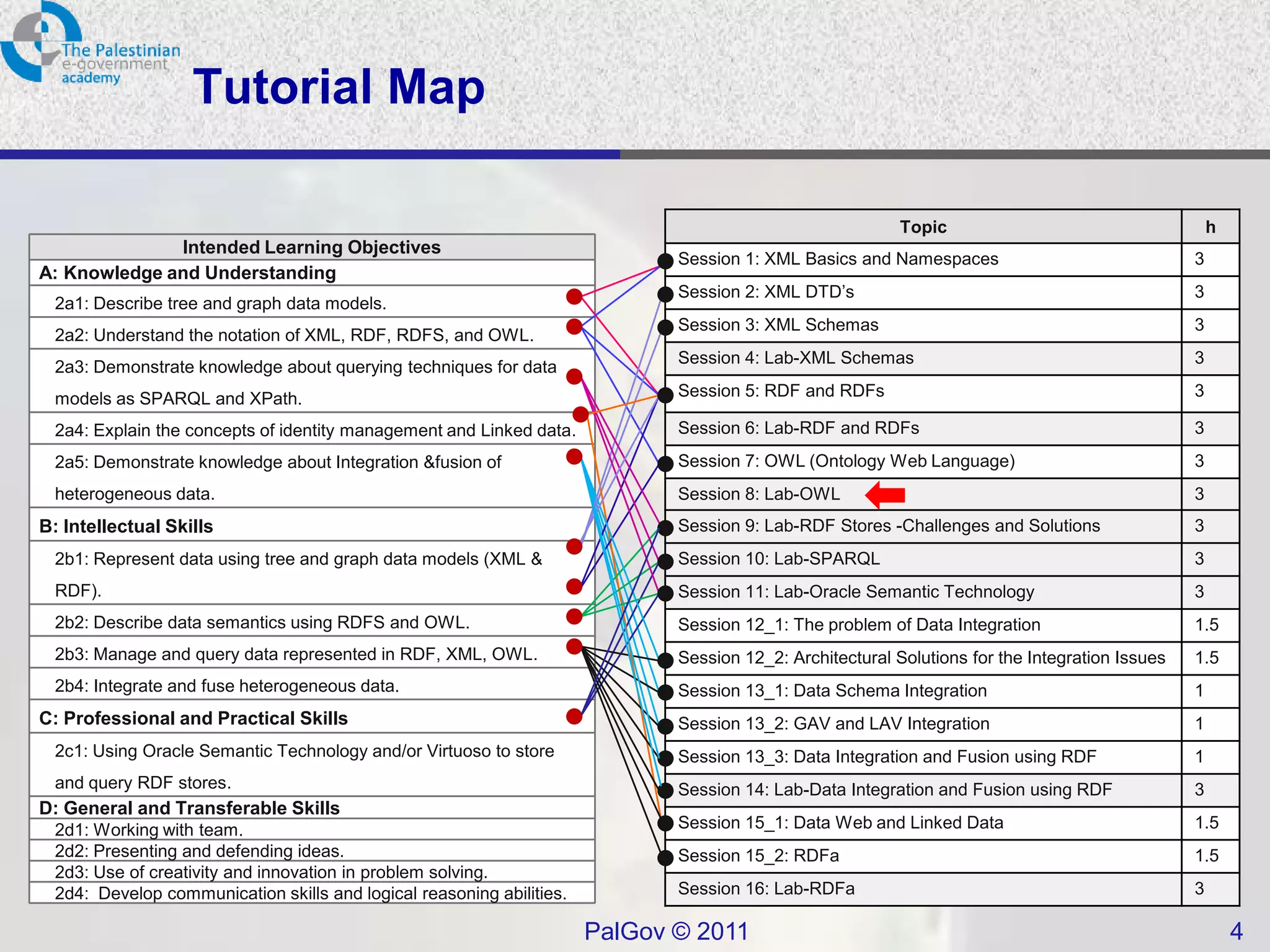
Tutorial Map

                                                                                                           Topic                                     h
              Intended Learning Objectives
                                                                              Session 1: XML Basics and Namespaces                               3
A: Knowledge and Understanding
                                                                              Session 2: XML DTD’s                                               3
  2a1: Describe tree and graph data models.
                                                                              Session 3: XML Schemas                                             3
  2a2: Understand the notation of XML, RDF, RDFS, and OWL.
                                                                              Session 4: Lab-XML Schemas                                         3
  2a3: Demonstrate knowledge about querying techniques for data
  models as SPARQL and XPath.                                                 Session 5: RDF and RDFs                                            3

  2a4: Explain the concepts of identity management and Linked data.           Session 6: Lab-RDF and RDFs                                        3
  2a5: Demonstrate knowledge about Integration &fusion of                     Session 7: OWL (Ontology Web Language)                             3
  heterogeneous data.                                                         Session 8: Lab-OWL                                                 3
B: Intellectual Skills                                                        Session 9: Lab-RDF Stores -Challenges and Solutions                3
  2b1: Represent data using tree and graph data models (XML &                 Session 10: Lab-SPARQL                                             3
  RDF).                                                                       Session 11: Lab-Oracle Semantic Technology                         3
  2b2: Describe data semantics using RDFS and OWL.                            Session 12_1: The problem of Data Integration                      1.5
  2b3: Manage and query data represented in RDF, XML, OWL.                    Session 12_2: Architectural Solutions for the Integration Issues   1.5
  2b4: Integrate and fuse heterogeneous data.                                 Session 13_1: Data Schema Integration                              1
C: Professional and Practical Skills                                          Session 13_2: GAV and LAV Integration                              1
  2c1: Using Oracle Semantic Technology and/or Virtuoso to store              Session 13_3: Data Integration and Fusion using RDF                1
  and query RDF stores.                                                       Session 14: Lab-Data Integration and Fusion using RDF              3
D: General and Transferable Skills
  2d1: Working with team.                                                     Session 15_1: Data Web and Linked Data                             1.5
  2d2: Presenting and defending ideas.                                        Session 15_2: RDFa                                                 1.5
  2d3: Use of creativity and innovation in problem solving.
  2d4: Develop communication skills and logical reasoning abilities.          Session 16: Lab-RDFa                                               3

                                                                       PalGov © 2011                                                                     4
Practical Session (National Student Registry)

Description:
Based on the previous practical session: “The               central management of students’
profiles by the ministry of education is becoming an urgent need in the last years. Many
students in Palestine move from one university to another, and they need to transfer their
academic records. Also, the ministry of higher education needs to certify the diplomas and
mark sheets of students. Moreover, there is a need to centrally manage/monitor students
financial aids. Therefore, the ministry of higher education has decided to build a national
student registry, such that, each semester every university has to send the academic record
of every student to the ministry of education. The ministry will then update and integrate the
academic records according to the data combined from all universities into the national
student registry.”


The ministry wants to specify a shared ontology (in OWL) such that all
universities can exchange their students profiles in RDF format and the
data can be automatically validated and integrated after that. Build this
ontology in OWL.


                                       PalGov © 2011                                      5
Practical Session (National Student Registry)

• Each student should work alone.
• Students are expected to extend their RDFs model (in the previous project)
  and enrich it with OWL constructs in order to better specify and constraint the
  semantics of the exchanged data.
• You must expect to present your OWL model in front of all student and collect
  comments and feedback.
• Students are expected to re-use standard and common ontologies such as
  FOAF, DOAC, etc.
• Each student should also build two RDF files that contains the data of two
  different mark sheets coming from two different universities.
• Each student must validate their model and RDF files using the online
  standard OWL and RDF validator.
• Each student must publish his/her OWL model and the two RDF files online.
• The final delivery should include the three links of the OWL and RDF files.

                                  PalGov © 2011                                 6
Thank you!


   PalGov © 2011   7

Pal gov.tutorial2.session8.lab owl

  • 1.
    ‫أكاديمية الحكومة اإللكترونيةالفلسطينية‬ The Palestinian eGovernment Academy www.egovacademy.ps Tutorial II: Data Integration and Open Information Systems Session 8 (Practical ) (National Student Registry) Dr. Mustafa Jarrar University of Birzeit mjarrar@birzeit.edu www.jarrar.info PalGov © 2011 1
  • 2.
    About This tutorial ispart of the PalGov project, funded by the TEMPUS IV program of the Commission of the European Communities, grant agreement 511159-TEMPUS-1- 2010-1-PS-TEMPUS-JPHES. The project website: www.egovacademy.ps Project Consortium: Birzeit University, Palestine University of Trento, Italy (Coordinator ) Palestine Polytechnic University, Palestine Vrije Universiteit Brussel, Belgium Palestine Technical University, Palestine Université de Savoie, France Ministry of Telecom and IT, Palestine University of Namur, Belgium Ministry of Interior, Palestine TrueTrust, UK Ministry of Local Government, Palestine Coordinator: Dr. Mustafa Jarrar Birzeit University, P.O.Box 14- Birzeit, Palestine Telfax:+972 2 2982935 mjarrar@birzeit.eduPalGov © 2011 2
  • 3.
    © Copyright Notes Everyoneis encouraged to use this material, or part of it, but should properly cite the project (logo and website), and the author of that part. No part of this tutorial may be reproduced or modified in any form or by any means, without prior written permission from the project, who have the full copyrights on the material. Attribution-NonCommercial-ShareAlike CC-BY-NC-SA This license lets others remix, tweak, and build upon your work non- commercially, as long as they credit you and license their new creations under the identical terms. PalGov © 2011 3
  • 4.
    Tutorial Map Topic h Intended Learning Objectives Session 1: XML Basics and Namespaces 3 A: Knowledge and Understanding Session 2: XML DTD’s 3 2a1: Describe tree and graph data models. Session 3: XML Schemas 3 2a2: Understand the notation of XML, RDF, RDFS, and OWL. Session 4: Lab-XML Schemas 3 2a3: Demonstrate knowledge about querying techniques for data models as SPARQL and XPath. Session 5: RDF and RDFs 3 2a4: Explain the concepts of identity management and Linked data. Session 6: Lab-RDF and RDFs 3 2a5: Demonstrate knowledge about Integration &fusion of Session 7: OWL (Ontology Web Language) 3 heterogeneous data. Session 8: Lab-OWL 3 B: Intellectual Skills Session 9: Lab-RDF Stores -Challenges and Solutions 3 2b1: Represent data using tree and graph data models (XML & Session 10: Lab-SPARQL 3 RDF). Session 11: Lab-Oracle Semantic Technology 3 2b2: Describe data semantics using RDFS and OWL. Session 12_1: The problem of Data Integration 1.5 2b3: Manage and query data represented in RDF, XML, OWL. Session 12_2: Architectural Solutions for the Integration Issues 1.5 2b4: Integrate and fuse heterogeneous data. Session 13_1: Data Schema Integration 1 C: Professional and Practical Skills Session 13_2: GAV and LAV Integration 1 2c1: Using Oracle Semantic Technology and/or Virtuoso to store Session 13_3: Data Integration and Fusion using RDF 1 and query RDF stores. Session 14: Lab-Data Integration and Fusion using RDF 3 D: General and Transferable Skills 2d1: Working with team. Session 15_1: Data Web and Linked Data 1.5 2d2: Presenting and defending ideas. Session 15_2: RDFa 1.5 2d3: Use of creativity and innovation in problem solving. 2d4: Develop communication skills and logical reasoning abilities. Session 16: Lab-RDFa 3 PalGov © 2011 4
  • 5.
    Practical Session (NationalStudent Registry) Description: Based on the previous practical session: “The central management of students’ profiles by the ministry of education is becoming an urgent need in the last years. Many students in Palestine move from one university to another, and they need to transfer their academic records. Also, the ministry of higher education needs to certify the diplomas and mark sheets of students. Moreover, there is a need to centrally manage/monitor students financial aids. Therefore, the ministry of higher education has decided to build a national student registry, such that, each semester every university has to send the academic record of every student to the ministry of education. The ministry will then update and integrate the academic records according to the data combined from all universities into the national student registry.” The ministry wants to specify a shared ontology (in OWL) such that all universities can exchange their students profiles in RDF format and the data can be automatically validated and integrated after that. Build this ontology in OWL. PalGov © 2011 5
  • 6.
    Practical Session (NationalStudent Registry) • Each student should work alone. • Students are expected to extend their RDFs model (in the previous project) and enrich it with OWL constructs in order to better specify and constraint the semantics of the exchanged data. • You must expect to present your OWL model in front of all student and collect comments and feedback. • Students are expected to re-use standard and common ontologies such as FOAF, DOAC, etc. • Each student should also build two RDF files that contains the data of two different mark sheets coming from two different universities. • Each student must validate their model and RDF files using the online standard OWL and RDF validator. • Each student must publish his/her OWL model and the two RDF files online. • The final delivery should include the three links of the OWL and RDF files. PalGov © 2011 6
  • 7.
    Thank you! PalGov © 2011 7