‫أكاديمية الحكومة اإللكترونية الفلسطينية‬
              The Palestinian eGovernment Academy
                         www.egovacademy.ps


Tutorial II: Data Integration and Open Information Systems

                          Session 10
   SPARQL (RDF Query Language)

                    Dr. Mustafa Jarrar
                       University of Birzeit
                       mjarrar@birzeit.edu
                         www.jarrar.info


                             PalGov © 2011                1
About

This tutorial is part of the PalGov project, funded by the TEMPUS IV program of the
Commission of the European Communities, grant agreement 511159-TEMPUS-1-
2010-1-PS-TEMPUS-JPHES. The project website: www.egovacademy.ps
Project Consortium:

             Birzeit University, Palestine
                                                           University of Trento, Italy
             (Coordinator )


             Palestine Polytechnic University, Palestine   Vrije Universiteit Brussel, Belgium


             Palestine Technical University, Palestine
                                                           Université de Savoie, France

             Ministry of Telecom and IT, Palestine
                                                           University of Namur, Belgium
             Ministry of Interior, Palestine
                                                           TrueTrust, UK
             Ministry of Local Government, Palestine


Coordinator:
Dr. Mustafa Jarrar
Birzeit University, P.O.Box 14- Birzeit, Palestine
Telfax:+972 2 2982935 mjarrar@birzeit.eduPalGov © 2011
                                                                                                 2
© Copyright Notes
Everyone is encouraged to use this material, or part of it, but should
properly cite the project (logo and website), and the author of that part.


No part of this tutorial may be reproduced or modified in any form or by
any means, without prior written permission from the project, who have
the full copyrights on the material.


                 Attribution-NonCommercial-ShareAlike
                              CC-BY-NC-SA

This license lets others remix, tweak, and build upon your work non-
commercially, as long as they credit you and license their new creations
under the identical terms.

                                 PalGov © 2011                               3
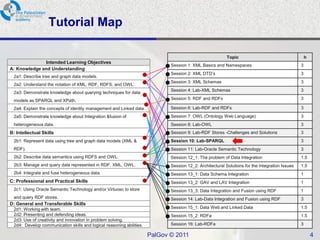
Tutorial Map

                                                                                                           Topic                                     h
              Intended Learning Objectives
                                                                              Session 1: XML Basics and Namespaces                               3
A: Knowledge and Understanding
                                                                              Session 2: XML DTD’s                                               3
  2a1: Describe tree and graph data models.
                                                                              Session 3: XML Schemas                                             3
  2a2: Understand the notation of XML, RDF, RDFS, and OWL.
                                                                              Session 4: Lab-XML Schemas                                         3
  2a3: Demonstrate knowledge about querying techniques for data
  models as SPARQL and XPath.                                                 Session 5: RDF and RDFs                                            3

  2a4: Explain the concepts of identity management and Linked data.           Session 6: Lab-RDF and RDFs                                        3
  2a5: Demonstrate knowledge about Integration &fusion of                     Session 7: OWL (Ontology Web Language)                             3
  heterogeneous data.                                                         Session 8: Lab-OWL                                                 3
B: Intellectual Skills                                                        Session 9: Lab-RDF Stores -Challenges and Solutions                3
  2b1: Represent data using tree and graph data models (XML &                 Session 10: Lab-SPARQL                                             3
  RDF).                                                                       Session 11: Lab-Oracle Semantic Technology                         3
  2b2: Describe data semantics using RDFS and OWL.                            Session 12_1: The problem of Data Integration                      1.5
  2b3: Manage and query data represented in RDF, XML, OWL.                    Session 12_2: Architectural Solutions for the Integration Issues   1.5
  2b4: Integrate and fuse heterogeneous data.                                 Session 13_1: Data Schema Integration                              1
C: Professional and Practical Skills                                          Session 13_2: GAV and LAV Integration                              1
  2c1: Using Oracle Semantic Technology and/or Virtuoso to store              Session 13_3: Data Integration and Fusion using RDF                1
  and query RDF stores.                                                       Session 14: Lab-Data Integration and Fusion using RDF              3
D: General and Transferable Skills
  2d1: Working with team.                                                     Session 15_1: Data Web and Linked Data                             1.5
  2d2: Presenting and defending ideas.                                        Session 15_2: RDFa                                                 1.5
  2d3: Use of creativity and innovation in problem solving.
  2d4: Develop communication skills and logical reasoning abilities.          Session 16: Lab-RDFa                                               3

                                                                       PalGov © 2011                                                                     4
Module ILOs


After completing this module students will be
able to:
   - Demonstrate knowledge about querying techniques for
   data models as SPARQL.


                         PalGov © 2011                     5
SPARQL

• As we have learned, RDF is a graph-shaped data model.

• Until now, we have queried RDF stored in relational
  databases using standard SQL.

• What about a standard query language that is dedicated
  for querying RDF graphs?
   – Offering a more intuitive method for querying graph-shaped data
     (using graph patterns).
   – Offering a way for the queries and their respective results to be
     transported between applications / services.
   – Allowing querying information from multiple Web sites (mashups).
   – Allowing querying information from multiple enterprise databases.

                             PalGov © 2011                               6
SPARQL

• SPARQL (pronounced: Sparkle). The name is a recursive
  acronym for:
       “SPARQL Protocol and RDF Query Language”

• The “Protocol” part of SPARQL’s name refers to the rules
  for how a client program and a SPARQL processing server
  exchange SPARQL queries and results (here, we focus on
  the query language).


                        PalGov © 2011                     7
SPARQL: Jumping right in

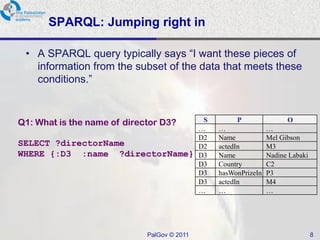
 • A SPARQL query typically says “I want these pieces of
   information from the subset of the data that meets these
   conditions.”


Q1: What is the name of director D3?          S        P                O
                                             …    …               …
                                             D2   Name            Mel Gibson
SELECT ?directorName                         D2   actedIn         M3
WHERE {:D3 :name ?directorName}              D3   Name            Nadine Labaki
                                             D3   Country         C2
                                             D3   hasWonPrizeIn   P3
                                             D3   actedIn         M4
                                             …    …               …


                             PalGov © 2011                                        8
Variables

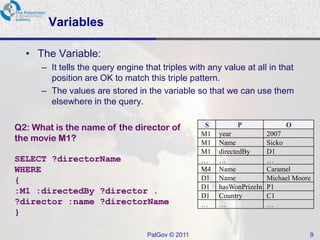
  • The Variable:
      – It tells the query engine that triples with any value at all in that
        position are OK to match this triple pattern.
      – The values are stored in the variable so that we can use them
        elsewhere in the query.

Q2: What is the name of the director of             S        P               O
                                                   M1   year            2007
the movie M1?                                      M1   Name            Sicko
                                                   M1   directedBy      D1
SELECT ?directorName                               …    …               …
WHERE                                              M4   Name            Caramel
{                                                  D1   Name            Michael Moore
                                                   D1   hasWonPrizeIn   P1
:M1 :directedBy ?director .
                                                   D1   Country         C1
?director :name ?directorName                      …    …               …
}

                                   PalGov © 2011                                    9
Example
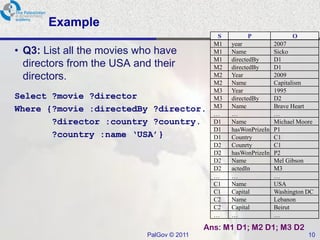
                                              S        P                O
                                             M1   year            2007
• Q3: List all the movies who have           M1   Name            Sicko
                                             M1   directedBy      D1
  directors from the USA and their           M2   directedBy      D1
  directors.                                 M2   Year            2009
                                             M2   Name            Capitalism
                                             M3   Year            1995
Select ?movie ?director                      M3   directedBy      D2
                                             M3   Name            Brave Heart
Where {?movie :directedBy ?director.
                                             …    …               …
       ?director :country ?country.          D1   Name            Michael Moore
                                             D1   hasWonPrizeIn   P1
       ?country :name ‘USA’}                 D1   Country         C1
                                             D2   Counrty         C1
                                             D2   hasWonPrizeIn   P2
                                             D2   Name            Mel Gibson
                                             D2   actedIn         M3
                                             …    …               …
                                             C1   Name            USA
                                             C1   Capital         Washington DC
                                             C2   Name            Lebanon
                                             C2   Capital         Beirut
                                             …    …               …

                                           Ans: M1 D1; M2 D1; M3 D2
                           PalGov © 2011                                     10
How to Query RDF data stored in one table?

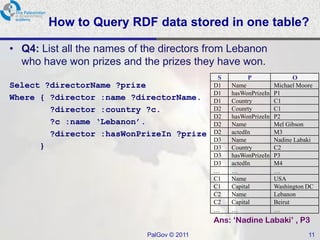
• Q4: List all the names of the directors from Lebanon
  who have won prizes and the prizes they have won.
                                             S        P               O
Select ?directorName ?prize                 D1   Name          Michael Moore
                                            D1   hasWonPrizeIn P1
Where { ?director :name ?directorName.      D1   Country       C1
        ?director :country ?c.              D2   Counrty       C1
                                            D2   hasWonPrizeIn P2
        ?c :name ‘Lebanon’.                 D2   Name          Mel Gibson
        ?director :hasWonPrizeIn ?prize     D2   actedIn       M3
                                            D3   Name          Nadine Labaki
      }                                     D3   Country       C2
                                            D3   hasWonPrizeIn P3
                                            D3   actedIn       M4
                                            …    …             …
                                            C1   Name          USA
                                            C1   Capital       Washington DC
                                            C2   Name          Lebanon
                                            C2   Capital       Beirut
                                            …    …             …
                                            Ans: „Nadine Labaki‟ , P3
                            PalGov © 2011                                 11
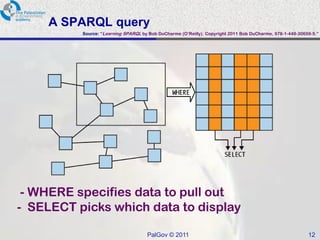
A SPARQL query
          Source: “Learning SPARQL by Bob DuCharme (O‟Reilly). Copyright 2011 Bob DuCharme, 978-1-449-30659-5.”


 - WHERE specifies data to pull out
- SELECT picks which data to display

                                     PalGov © 2011                                                        12
RDF and SPARQL in accurate syntax

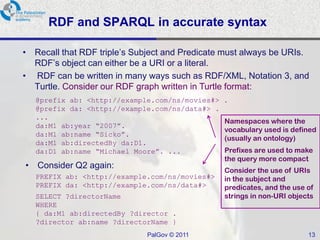
• Recall that RDF triple’s Subject and Predicate must always be URIs.
  RDF’s object can either be a URI or a literal.
• RDF can be written in many ways such as RDF/XML, Notation 3, and
  Turtle. Consider our RDF graph written in Turtle format:
   @prefix ab: <http://example.com/ns/movies#>   .
   @prefix da: <http://example.com/ns/data#> .
   ...
                                                 Namespaces where the
   da:M1 ab:year “2007”.
                                                 vocabulary used is defined
   da:M1 ab:name “Sicko”.
                                                 (usually an ontology)
   da:M1 ab:directedBy da:D1.
   da:D1 ab:name “Michael Moore”. ...            Prefixes are used to make
                                                 the query more compact
• Consider Q2 again:
                                                 Consider the use of URIs
   PREFIX ab: <http://example.com/ns/movies#>    in the subject and
   PREFIX da: <http://example.com/ns/data#>      predicates, and the use of
   SELECT ?directorName                          strings in non-URI objects
   WHERE
   { da:M1 ab:directedBy ?director .
   ?director ab:name ?directorName }
                             PalGov © 2011                               13
Graph Patterns
      Basic and Group Graph Patterns

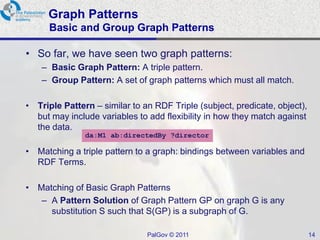
• So far, we have seen two graph patterns:
    – Basic Graph Pattern: A triple pattern.
    – Group Pattern: A set of graph patterns which must all match.

• Triple Pattern – similar to an RDF Triple (subject, predicate, object),
  but may include variables to add flexibility in how they match against
  the data.
               da:M1 ab:directedBy ?director

• Matching a triple pattern to a graph: bindings between variables and
  RDF Terms.

• Matching of Basic Graph Patterns
   – A Pattern Solution of Graph Pattern GP on graph G is any
     substitution S such that S(GP) is a subgraph of G.

                               PalGov © 2011                                14
Graph Patterns
      Basic and Group Graph Patterns


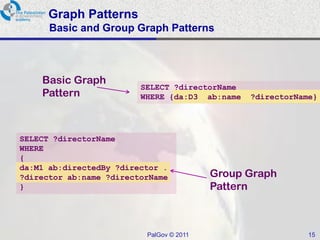
    Basic Graph
                         SELECT ?directorName
    Pattern              WHERE {da:D3 ab:name   ?directorName}


SELECT ?directorName
WHERE
{
da:M1 ab:directedBy ?director .
?director ab:name ?directorName           Group Graph
}                                         Pattern


                          PalGov © 2011                     15
Graph Patterns
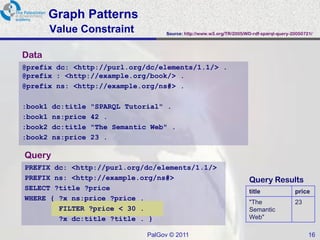
         Value Constraint             Source: http://www.w3.org/TR/2005/WD-rdf-sparql-query-20050721/


Data
@prefix dc: <http://purl.org/dc/elements/1.1/> .
@prefix : <http://example.org/book/> .
@prefix ns: <http://example.org/ns#> .

:book1   dc:title   "SPARQL Tutorial" .
:book1   ns:price   42 .
:book2   dc:title   "The Semantic Web" .
:book2   ns:price   23 .

Query
PREFIX dc: <http://purl.org/dc/elements/1.1/>
PREFIX ns: <http://example.org/ns#>                                      Query Results
SELECT ?title ?price                                                     title               price
WHERE { ?x ns:price ?price .
                                                                         "The                23
        FILTER ?price < 30 .                                             Semantic
        ?x dc:title ?title . }                                           Web"

                                 PalGov © 2011                                                     16
Graph Patterns
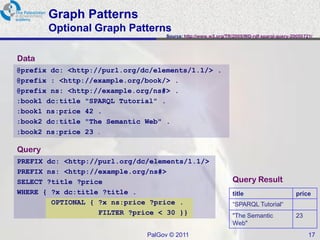
        Optional Graph Patterns
                                   Source: http://www.w3.org/TR/2005/WD-rdf-sparql-query-20050721/


Data
@prefix dc: <http://purl.org/dc/elements/1.1/> .
@prefix : <http://example.org/book/> .
@prefix ns: <http://example.org/ns#> .
:book1 dc:title "SPARQL Tutorial" .
:book1 ns:price 42 .
:book2 dc:title "The Semantic Web" .
:book2 ns:price 23 .

Query
PREFIX dc: <http://purl.org/dc/elements/1.1/>
PREFIX ns: <http://example.org/ns#>
SELECT ?title ?price                                           Query Result
WHERE { ?x dc:title ?title .                                   title                      price
        OPTIONAL { ?x ns:price ?price .                        “SPARQL Tutorial“
                   FILTER ?price < 30 }}                       "The Semantic              23
                                                               Web"
                              PalGov © 2011                                                     17
Graph Patterns
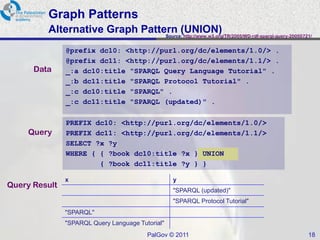
         Alternative Graph Pattern (UNION)
                                Source: http://www.w3.org/TR/2005/WD-rdf-sparql-query-20050721/


               @prefix dc10: <http://purl.org/dc/elements/1.0/> .
               @prefix dc11: <http://purl.org/dc/elements/1.1/> .
      Data     _:a dc10:title "SPARQL Query Language Tutorial" .
               _:b dc11:title "SPARQL Protocol Tutorial" .
               _:c dc10:title "SPARQL" .
               _:c dc11:title "SPARQL (updated)" .

               PREFIX dc10: <http://purl.org/dc/elements/1.0/>
     Query     PREFIX dc11: <http://purl.org/dc/elements/1.1/>
               SELECT ?x ?y
               WHERE { { ?book dc10:title ?x } UNION
                       { ?book dc11:title ?y } }

               x                                  y
Query Result
                                                  "SPARQL (updated)"
                                                  "SPARQL Protocol Tutorial"
               "SPARQL"
               "SPARQL Query Language Tutorial"
                                         PalGov © 2011                                       18
Sorting, Aggregating, Finding the Biggest, …
                Source: “Learning SPARQL by Bob DuCharme (O‟Reilly). Copyright 2011 Bob DuCharme, 978-1-449-30659-5.”


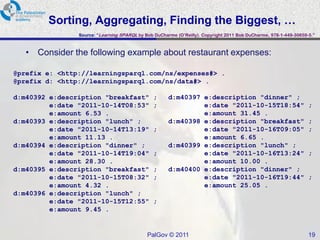
   • Consider the following example about restaurant expenses:

@prefix e: <http://learningsparql.com/ns/expenses#> .
@prefix d: <http://learningsparql.com/ns/data#> .

d:m40392 e:description "breakfast"             ;      d:m40397 e:description "dinner" ;
         e:date "2011-10-14T08:53"             ;               e:date "2011-10-15T18:54"                          ;
         e:amount 6.53 .                                       e:amount 31.45 .
d:m40393 e:description "lunch" ;                      d:m40398 e:description "breakfast"                          ;
         e:date "2011-10-14T13:19"             ;               e:date "2011-10-16T09:05"                          ;
         e:amount 11.13 .                                      e:amount 6.65 .
d:m40394 e:description "dinner" ;                     d:m40399 e:description "lunch" ;
         e:date "2011-10-14T19:04"             ;               e:date "2011-10-16T13:24"                          ;
         e:amount 28.30 .                                      e:amount 10.00 .
d:m40395 e:description "breakfast"             ;      d:m40400 e:description "dinner" ;
         e:date "2011-10-15T08:32"             ;               e:date "2011-10-16T19:44"                          ;
         e:amount 4.32 .                                       e:amount 25.05 .
d:m40396 e:description "lunch" ;
         e:date "2011-10-15T12:55"             ;
         e:amount 9.45 .


                                             PalGov © 2011                                                        19
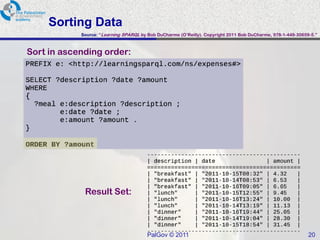
Sorting Data
            Source: “Learning SPARQL by Bob DuCharme (O‟Reilly). Copyright 2011 Bob DuCharme, 978-1-449-30659-5.”


Sort in ascending order:


             Result Set:


                                        PalGov © 2011                                                        20
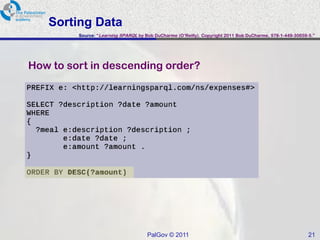
Sorting Data
         Source: “Learning SPARQL by Bob DuCharme (O‟Reilly). Copyright 2011 Bob DuCharme, 978-1-449-30659-5.”


How to sort in descending order?


                                      PalGov © 2011                                                        21
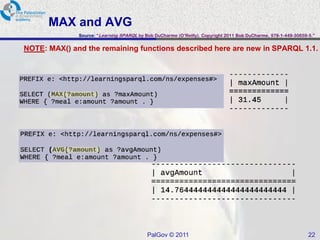
MAX and AVG
              Source: “Learning SPARQL by Bob DuCharme (O‟Reilly). Copyright 2011 Bob DuCharme, 978-1-449-30659-5.”


NOTE: MAX() and the remaining functions described here are new in SPARQL 1.1.


                                           PalGov © 2011                                                        22
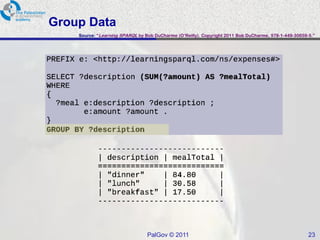
Group Data
    Source: “Learning SPARQL by Bob DuCharme (O‟Reilly). Copyright 2011 Bob DuCharme, 978-1-449-30659-5.”


                                 PalGov © 2011                                                        23
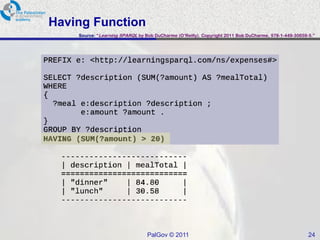
Having Function
    Source: “Learning SPARQL by Bob DuCharme (O‟Reilly). Copyright 2011 Bob DuCharme, 978-1-449-30659-5.”


                                 PalGov © 2011                                                        24
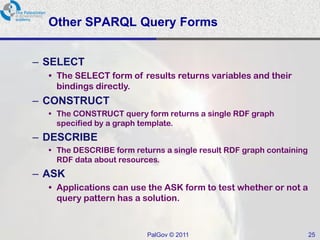
Other SPARQL Query Forms


– SELECT
  • The SELECT form of results returns variables and their
    bindings directly.
– CONSTRUCT
  • The CONSTRUCT query form returns a single RDF graph
    specified by a graph template.
– DESCRIBE
  • The DESCRIBE form returns a single result RDF graph containing
    RDF data about resources.
– ASK
  • Applications can use the ASK form to test whether or not a
    query pattern has a solution.


                          PalGov © 2011                              25
Data Integration and Open Information Systems (Tutorial II)
                                             The Palestinian e-Government Academy
                                                                     January, 2012


Tutorial II: Data Integration and Open Information Systems


                      Module VI
              Practical Session


                          PalGov © 2011                                             26
Practical Session

• This practical session is divided into two parts:
    (1) Querying DBPedia (a huge RDF dataset built from Wikipedia
        Infoboxes and data), using the online SPARQL endpoint.
    (2) Querying the same graph of Practical Session I, but this time
        using SPARQL.

PART 1:
Each student must do the following:
(i) Execute the following three sample queries using the online Virtuoso
     SPARQL Query Editor: http://dbpedia.org/sparql.
(ii) Construct additional 3 meaningful complex queries on DBPedia or
     any other dataset using an online SPARQL endpoint.


                              PalGov © 2011                             27
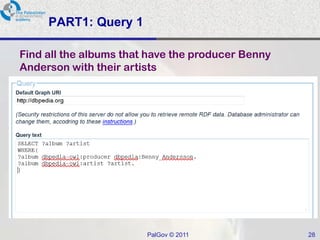
PART1: Query 1

Find all the albums that have the producer Benny
Anderson with their artists


                        PalGov © 2011              28
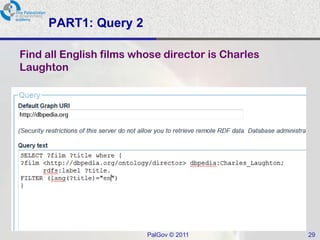
PART1: Query 2

Find all English films whose director is Charles
Laughton


                         PalGov © 2011             29
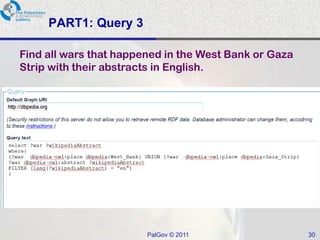
PART1: Query 3

Find all wars that happened in the West Bank or Gaza
Strip with their abstracts in English.


                        PalGov © 2011                  30
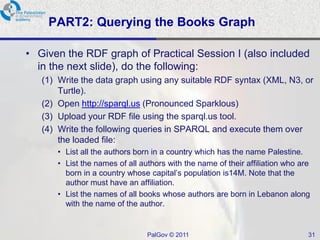
PART2: Querying the Books Graph

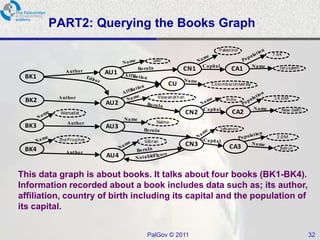
• Given the RDF graph of Practical Session I (also included
  in the next slide), do the following:
   (1) Write the data graph using any suitable RDF syntax (XML, N3, or
       Turtle).
   (2) Open http://sparql.us (Pronounced Sparklous)
   (3) Upload your RDF file using the sparql.us tool.
   (4) Write the following queries in SPARQL and execute them over
       the loaded file:
      • List all the authors born in a country which has the name Palestine.
      • List the names of all authors with the name of their affiliation who are
        born in a country whose capital’s population is14M. Note that the
        author must have an affiliation.
      • List the names of all books whose authors are born in Lebanon along
        with the name of the author.


                                PalGov © 2011                                  31
PART2: Querying the Books Graph
                                                                    Palestine
                                                                                              7.6K
                                        Said
                                                              Capital                  Name
                                                    CN1                     CA1                 Jerusalem
                        AU1
 BK1
                                               CU                Colombia University

          Author                          Viswanathan                                         14.0M
 BK2                    AU2
                                                                          India

                                                              Capital                  Name      New Delhi
          Wamadat                                       CN2                 CA2
                              Name
             Author                       Naima
 BK3                    AU3                                             Lebanon
                                                                                               2.0M
          The Prophet                Gibran
                                                        CN3                CA3
 BK4                                                                                             Beirut
            Author
                        AU4

This data graph is about books. It talks about four books (BK1-BK4).
Information recorded about a book includes data such as; its author,
affiliation, country of birth including its capital and the population of
its capital.


                                      PalGov © 2011                                                          32
Practical Session - Instructions

• Each student should work alone.
• In part 2 of this practical session, the student is strongly recommended
  to write two additional queries, execute them on the data graph, and
  hand them along with the required queries.
• In part 2 of this practical session, the student is encouraged to compare
  the results of the queries with those from Practical Session I.
• Each student must expect to present and discuss his/her queries at
  class and compare them with the work of other students.
• The final delivery should include: (i) The 6 queries constructed in Part 1
  with the links of their results. (ii) A link to the RDF file. (iii) The queries
  executed over the RDF file in sparq.us along with snapshots of their
  results. These must be handed in a report form in PDF Format.


                                   PalGov © 2011                                33
References

• http://www.w3.org

• Anton Deik, Bilal Faraj, Ala Hawash, Mustafa Jarrar: Towards Query
  Optimization for the Data Web - Two Disk-Based algorithms: Trace
  Equivalence and Bisimilarity.

• Learning SPARQL by Bob DuCharme (O’Reilly). Copyright 2011 Bob
  DuCharme, 978-1-449-30659-5.


                             PalGov © 2011                             34
Thank you!


  PalGov © 2011   35

Pal gov.tutorial2.session10.sparql

  • 1.
    ‫أكاديمية الحكومة اإللكترونيةالفلسطينية‬ The Palestinian eGovernment Academy www.egovacademy.ps Tutorial II: Data Integration and Open Information Systems Session 10 SPARQL (RDF Query Language) Dr. Mustafa Jarrar University of Birzeit mjarrar@birzeit.edu www.jarrar.info PalGov © 2011 1
  • 2.
    About This tutorial ispart of the PalGov project, funded by the TEMPUS IV program of the Commission of the European Communities, grant agreement 511159-TEMPUS-1- 2010-1-PS-TEMPUS-JPHES. The project website: www.egovacademy.ps Project Consortium: Birzeit University, Palestine University of Trento, Italy (Coordinator ) Palestine Polytechnic University, Palestine Vrije Universiteit Brussel, Belgium Palestine Technical University, Palestine Université de Savoie, France Ministry of Telecom and IT, Palestine University of Namur, Belgium Ministry of Interior, Palestine TrueTrust, UK Ministry of Local Government, Palestine Coordinator: Dr. Mustafa Jarrar Birzeit University, P.O.Box 14- Birzeit, Palestine Telfax:+972 2 2982935 mjarrar@birzeit.eduPalGov © 2011 2
  • 3.
    © Copyright Notes Everyoneis encouraged to use this material, or part of it, but should properly cite the project (logo and website), and the author of that part. No part of this tutorial may be reproduced or modified in any form or by any means, without prior written permission from the project, who have the full copyrights on the material. Attribution-NonCommercial-ShareAlike CC-BY-NC-SA This license lets others remix, tweak, and build upon your work non- commercially, as long as they credit you and license their new creations under the identical terms. PalGov © 2011 3
  • 4.
    Tutorial Map Topic h Intended Learning Objectives Session 1: XML Basics and Namespaces 3 A: Knowledge and Understanding Session 2: XML DTD’s 3 2a1: Describe tree and graph data models. Session 3: XML Schemas 3 2a2: Understand the notation of XML, RDF, RDFS, and OWL. Session 4: Lab-XML Schemas 3 2a3: Demonstrate knowledge about querying techniques for data models as SPARQL and XPath. Session 5: RDF and RDFs 3 2a4: Explain the concepts of identity management and Linked data. Session 6: Lab-RDF and RDFs 3 2a5: Demonstrate knowledge about Integration &fusion of Session 7: OWL (Ontology Web Language) 3 heterogeneous data. Session 8: Lab-OWL 3 B: Intellectual Skills Session 9: Lab-RDF Stores -Challenges and Solutions 3 2b1: Represent data using tree and graph data models (XML & Session 10: Lab-SPARQL 3 RDF). Session 11: Lab-Oracle Semantic Technology 3 2b2: Describe data semantics using RDFS and OWL. Session 12_1: The problem of Data Integration 1.5 2b3: Manage and query data represented in RDF, XML, OWL. Session 12_2: Architectural Solutions for the Integration Issues 1.5 2b4: Integrate and fuse heterogeneous data. Session 13_1: Data Schema Integration 1 C: Professional and Practical Skills Session 13_2: GAV and LAV Integration 1 2c1: Using Oracle Semantic Technology and/or Virtuoso to store Session 13_3: Data Integration and Fusion using RDF 1 and query RDF stores. Session 14: Lab-Data Integration and Fusion using RDF 3 D: General and Transferable Skills 2d1: Working with team. Session 15_1: Data Web and Linked Data 1.5 2d2: Presenting and defending ideas. Session 15_2: RDFa 1.5 2d3: Use of creativity and innovation in problem solving. 2d4: Develop communication skills and logical reasoning abilities. Session 16: Lab-RDFa 3 PalGov © 2011 4
  • 5.
    Module ILOs After completingthis module students will be able to: - Demonstrate knowledge about querying techniques for data models as SPARQL. PalGov © 2011 5
  • 6.
    SPARQL • As wehave learned, RDF is a graph-shaped data model. • Until now, we have queried RDF stored in relational databases using standard SQL. • What about a standard query language that is dedicated for querying RDF graphs? – Offering a more intuitive method for querying graph-shaped data (using graph patterns). – Offering a way for the queries and their respective results to be transported between applications / services. – Allowing querying information from multiple Web sites (mashups). – Allowing querying information from multiple enterprise databases. PalGov © 2011 6
  • 7.
    SPARQL • SPARQL (pronounced:Sparkle). The name is a recursive acronym for: “SPARQL Protocol and RDF Query Language” • The “Protocol” part of SPARQL’s name refers to the rules for how a client program and a SPARQL processing server exchange SPARQL queries and results (here, we focus on the query language). PalGov © 2011 7
  • 8.
    SPARQL: Jumping rightin • A SPARQL query typically says “I want these pieces of information from the subset of the data that meets these conditions.” Q1: What is the name of director D3? S P O … … … D2 Name Mel Gibson SELECT ?directorName D2 actedIn M3 WHERE {:D3 :name ?directorName} D3 Name Nadine Labaki D3 Country C2 D3 hasWonPrizeIn P3 D3 actedIn M4 … … … PalGov © 2011 8
  • 9.
    Variables •The Variable: – It tells the query engine that triples with any value at all in that position are OK to match this triple pattern. – The values are stored in the variable so that we can use them elsewhere in the query. Q2: What is the name of the director of S P O M1 year 2007 the movie M1? M1 Name Sicko M1 directedBy D1 SELECT ?directorName … … … WHERE M4 Name Caramel { D1 Name Michael Moore D1 hasWonPrizeIn P1 :M1 :directedBy ?director . D1 Country C1 ?director :name ?directorName … … … } PalGov © 2011 9
  • 10.
    Example S P O M1 year 2007 • Q3: List all the movies who have M1 Name Sicko M1 directedBy D1 directors from the USA and their M2 directedBy D1 directors. M2 Year 2009 M2 Name Capitalism M3 Year 1995 Select ?movie ?director M3 directedBy D2 M3 Name Brave Heart Where {?movie :directedBy ?director. … … … ?director :country ?country. D1 Name Michael Moore D1 hasWonPrizeIn P1 ?country :name ‘USA’} D1 Country C1 D2 Counrty C1 D2 hasWonPrizeIn P2 D2 Name Mel Gibson D2 actedIn M3 … … … C1 Name USA C1 Capital Washington DC C2 Name Lebanon C2 Capital Beirut … … … Ans: M1 D1; M2 D1; M3 D2 PalGov © 2011 10
  • 11.
    How to QueryRDF data stored in one table? • Q4: List all the names of the directors from Lebanon who have won prizes and the prizes they have won. S P O Select ?directorName ?prize D1 Name Michael Moore D1 hasWonPrizeIn P1 Where { ?director :name ?directorName. D1 Country C1 ?director :country ?c. D2 Counrty C1 D2 hasWonPrizeIn P2 ?c :name ‘Lebanon’. D2 Name Mel Gibson ?director :hasWonPrizeIn ?prize D2 actedIn M3 D3 Name Nadine Labaki } D3 Country C2 D3 hasWonPrizeIn P3 D3 actedIn M4 … … … C1 Name USA C1 Capital Washington DC C2 Name Lebanon C2 Capital Beirut … … … Ans: „Nadine Labaki‟ , P3 PalGov © 2011 11
  • 12.
    A SPARQL query Source: “Learning SPARQL by Bob DuCharme (O‟Reilly). Copyright 2011 Bob DuCharme, 978-1-449-30659-5.” - WHERE specifies data to pull out - SELECT picks which data to display PalGov © 2011 12
  • 13.
    RDF and SPARQLin accurate syntax • Recall that RDF triple’s Subject and Predicate must always be URIs. RDF’s object can either be a URI or a literal. • RDF can be written in many ways such as RDF/XML, Notation 3, and Turtle. Consider our RDF graph written in Turtle format: @prefix ab: <http://example.com/ns/movies#> . @prefix da: <http://example.com/ns/data#> . ... Namespaces where the da:M1 ab:year “2007”. vocabulary used is defined da:M1 ab:name “Sicko”. (usually an ontology) da:M1 ab:directedBy da:D1. da:D1 ab:name “Michael Moore”. ... Prefixes are used to make the query more compact • Consider Q2 again: Consider the use of URIs PREFIX ab: <http://example.com/ns/movies#> in the subject and PREFIX da: <http://example.com/ns/data#> predicates, and the use of SELECT ?directorName strings in non-URI objects WHERE { da:M1 ab:directedBy ?director . ?director ab:name ?directorName } PalGov © 2011 13
  • 14.
    Graph Patterns Basic and Group Graph Patterns • So far, we have seen two graph patterns: – Basic Graph Pattern: A triple pattern. – Group Pattern: A set of graph patterns which must all match. • Triple Pattern – similar to an RDF Triple (subject, predicate, object), but may include variables to add flexibility in how they match against the data. da:M1 ab:directedBy ?director • Matching a triple pattern to a graph: bindings between variables and RDF Terms. • Matching of Basic Graph Patterns – A Pattern Solution of Graph Pattern GP on graph G is any substitution S such that S(GP) is a subgraph of G. PalGov © 2011 14
  • 15.
    Graph Patterns Basic and Group Graph Patterns Basic Graph SELECT ?directorName Pattern WHERE {da:D3 ab:name ?directorName} SELECT ?directorName WHERE { da:M1 ab:directedBy ?director . ?director ab:name ?directorName Group Graph } Pattern PalGov © 2011 15
  • 16.
    Graph Patterns Value Constraint Source: http://www.w3.org/TR/2005/WD-rdf-sparql-query-20050721/ Data @prefix dc: <http://purl.org/dc/elements/1.1/> . @prefix : <http://example.org/book/> . @prefix ns: <http://example.org/ns#> . :book1 dc:title "SPARQL Tutorial" . :book1 ns:price 42 . :book2 dc:title "The Semantic Web" . :book2 ns:price 23 . Query PREFIX dc: <http://purl.org/dc/elements/1.1/> PREFIX ns: <http://example.org/ns#> Query Results SELECT ?title ?price title price WHERE { ?x ns:price ?price . "The 23 FILTER ?price < 30 . Semantic ?x dc:title ?title . } Web" PalGov © 2011 16
  • 17.
    Graph Patterns Optional Graph Patterns Source: http://www.w3.org/TR/2005/WD-rdf-sparql-query-20050721/ Data @prefix dc: <http://purl.org/dc/elements/1.1/> . @prefix : <http://example.org/book/> . @prefix ns: <http://example.org/ns#> . :book1 dc:title "SPARQL Tutorial" . :book1 ns:price 42 . :book2 dc:title "The Semantic Web" . :book2 ns:price 23 . Query PREFIX dc: <http://purl.org/dc/elements/1.1/> PREFIX ns: <http://example.org/ns#> SELECT ?title ?price Query Result WHERE { ?x dc:title ?title . title price OPTIONAL { ?x ns:price ?price . “SPARQL Tutorial“ FILTER ?price < 30 }} "The Semantic 23 Web" PalGov © 2011 17
  • 18.
    Graph Patterns Alternative Graph Pattern (UNION) Source: http://www.w3.org/TR/2005/WD-rdf-sparql-query-20050721/ @prefix dc10: <http://purl.org/dc/elements/1.0/> . @prefix dc11: <http://purl.org/dc/elements/1.1/> . Data _:a dc10:title "SPARQL Query Language Tutorial" . _:b dc11:title "SPARQL Protocol Tutorial" . _:c dc10:title "SPARQL" . _:c dc11:title "SPARQL (updated)" . PREFIX dc10: <http://purl.org/dc/elements/1.0/> Query PREFIX dc11: <http://purl.org/dc/elements/1.1/> SELECT ?x ?y WHERE { { ?book dc10:title ?x } UNION { ?book dc11:title ?y } } x y Query Result "SPARQL (updated)" "SPARQL Protocol Tutorial" "SPARQL" "SPARQL Query Language Tutorial" PalGov © 2011 18
  • 19.
    Sorting, Aggregating, Findingthe Biggest, … Source: “Learning SPARQL by Bob DuCharme (O‟Reilly). Copyright 2011 Bob DuCharme, 978-1-449-30659-5.” • Consider the following example about restaurant expenses: @prefix e: <http://learningsparql.com/ns/expenses#> . @prefix d: <http://learningsparql.com/ns/data#> . d:m40392 e:description "breakfast" ; d:m40397 e:description "dinner" ; e:date "2011-10-14T08:53" ; e:date "2011-10-15T18:54" ; e:amount 6.53 . e:amount 31.45 . d:m40393 e:description "lunch" ; d:m40398 e:description "breakfast" ; e:date "2011-10-14T13:19" ; e:date "2011-10-16T09:05" ; e:amount 11.13 . e:amount 6.65 . d:m40394 e:description "dinner" ; d:m40399 e:description "lunch" ; e:date "2011-10-14T19:04" ; e:date "2011-10-16T13:24" ; e:amount 28.30 . e:amount 10.00 . d:m40395 e:description "breakfast" ; d:m40400 e:description "dinner" ; e:date "2011-10-15T08:32" ; e:date "2011-10-16T19:44" ; e:amount 4.32 . e:amount 25.05 . d:m40396 e:description "lunch" ; e:date "2011-10-15T12:55" ; e:amount 9.45 . PalGov © 2011 19
  • 20.
    Sorting Data Source: “Learning SPARQL by Bob DuCharme (O‟Reilly). Copyright 2011 Bob DuCharme, 978-1-449-30659-5.” Sort in ascending order: Result Set: PalGov © 2011 20
  • 21.
    Sorting Data Source: “Learning SPARQL by Bob DuCharme (O‟Reilly). Copyright 2011 Bob DuCharme, 978-1-449-30659-5.” How to sort in descending order? PalGov © 2011 21
  • 22.
    MAX and AVG Source: “Learning SPARQL by Bob DuCharme (O‟Reilly). Copyright 2011 Bob DuCharme, 978-1-449-30659-5.” NOTE: MAX() and the remaining functions described here are new in SPARQL 1.1. PalGov © 2011 22
  • 23.
    Group Data Source: “Learning SPARQL by Bob DuCharme (O‟Reilly). Copyright 2011 Bob DuCharme, 978-1-449-30659-5.” PalGov © 2011 23
  • 24.
    Having Function Source: “Learning SPARQL by Bob DuCharme (O‟Reilly). Copyright 2011 Bob DuCharme, 978-1-449-30659-5.” PalGov © 2011 24
  • 25.
    Other SPARQL QueryForms – SELECT • The SELECT form of results returns variables and their bindings directly. – CONSTRUCT • The CONSTRUCT query form returns a single RDF graph specified by a graph template. – DESCRIBE • The DESCRIBE form returns a single result RDF graph containing RDF data about resources. – ASK • Applications can use the ASK form to test whether or not a query pattern has a solution. PalGov © 2011 25
  • 26.
    Data Integration andOpen Information Systems (Tutorial II) The Palestinian e-Government Academy January, 2012 Tutorial II: Data Integration and Open Information Systems Module VI Practical Session PalGov © 2011 26
  • 27.
    Practical Session • Thispractical session is divided into two parts: (1) Querying DBPedia (a huge RDF dataset built from Wikipedia Infoboxes and data), using the online SPARQL endpoint. (2) Querying the same graph of Practical Session I, but this time using SPARQL. PART 1: Each student must do the following: (i) Execute the following three sample queries using the online Virtuoso SPARQL Query Editor: http://dbpedia.org/sparql. (ii) Construct additional 3 meaningful complex queries on DBPedia or any other dataset using an online SPARQL endpoint. PalGov © 2011 27
  • 28.
    PART1: Query 1 Findall the albums that have the producer Benny Anderson with their artists PalGov © 2011 28
  • 29.
    PART1: Query 2 Findall English films whose director is Charles Laughton PalGov © 2011 29
  • 30.
    PART1: Query 3 Findall wars that happened in the West Bank or Gaza Strip with their abstracts in English. PalGov © 2011 30
  • 31.
    PART2: Querying theBooks Graph • Given the RDF graph of Practical Session I (also included in the next slide), do the following: (1) Write the data graph using any suitable RDF syntax (XML, N3, or Turtle). (2) Open http://sparql.us (Pronounced Sparklous) (3) Upload your RDF file using the sparql.us tool. (4) Write the following queries in SPARQL and execute them over the loaded file: • List all the authors born in a country which has the name Palestine. • List the names of all authors with the name of their affiliation who are born in a country whose capital’s population is14M. Note that the author must have an affiliation. • List the names of all books whose authors are born in Lebanon along with the name of the author. PalGov © 2011 31
  • 32.
    PART2: Querying theBooks Graph Palestine 7.6K Said Capital Name CN1 CA1 Jerusalem AU1 BK1 CU Colombia University Author Viswanathan 14.0M BK2 AU2 India Capital Name New Delhi Wamadat CN2 CA2 Name Author Naima BK3 AU3 Lebanon 2.0M The Prophet Gibran CN3 CA3 BK4 Beirut Author AU4 This data graph is about books. It talks about four books (BK1-BK4). Information recorded about a book includes data such as; its author, affiliation, country of birth including its capital and the population of its capital. PalGov © 2011 32
  • 33.
    Practical Session -Instructions • Each student should work alone. • In part 2 of this practical session, the student is strongly recommended to write two additional queries, execute them on the data graph, and hand them along with the required queries. • In part 2 of this practical session, the student is encouraged to compare the results of the queries with those from Practical Session I. • Each student must expect to present and discuss his/her queries at class and compare them with the work of other students. • The final delivery should include: (i) The 6 queries constructed in Part 1 with the links of their results. (ii) A link to the RDF file. (iii) The queries executed over the RDF file in sparq.us along with snapshots of their results. These must be handed in a report form in PDF Format. PalGov © 2011 33
  • 34.
    References • http://www.w3.org • AntonDeik, Bilal Faraj, Ala Hawash, Mustafa Jarrar: Towards Query Optimization for the Data Web - Two Disk-Based algorithms: Trace Equivalence and Bisimilarity. • Learning SPARQL by Bob DuCharme (O’Reilly). Copyright 2011 Bob DuCharme, 978-1-449-30659-5. PalGov © 2011 34
  • 35.
    Thank you! PalGov © 2011 35