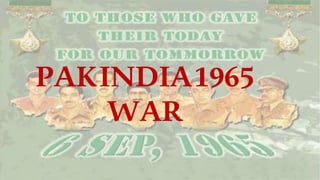
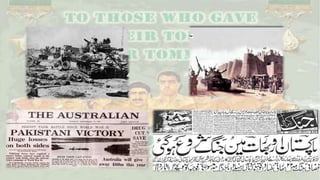
PAKINDIA1965
WAR
Causes :-
1. Kashmir Issue
The state of Jammu and Kashmir was one of a number
of Indian states that recognized British paramountcy. Prior to
the withdrawal of the British from India, the state came under
pressure from both India and Pakistan to join them. The
Maharaja of Kashmir, Hari Singh wanted to remain
independent and tried to delay the issue. However at the time
of British withdrawal the state was invaded by a concentrated
force of Pro-Pakistan Tribes from North West Frontier Province
(NWFP) and regular Pakistani soldiers. This forced him to
accede Kashmir to India, who promptly rushed into Kashmir
and thus started the war. A UN cease-fire was arranged for the
December 31, 1948. And India agreed to resolve Kashmir issue
according UN terms. But in 1964 India forgetting all its
promises about Kashmir, claimed that Kashmir was never the
part of Pakistan and never will be.
This forced Pakistan to take severe actions, like launching
Gebralter Operation, which ultimately led to full scale war.
To be cont.
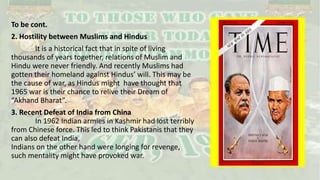
2. Hostility between Muslims and Hindus
It is a historical fact that in spite of living
thousands of years together, relations of Muslim and
Hindu were never friendly. And recently Muslims had
gotten their homeland against Hindus’ will. This may be
the cause of war, as Hindus might have thought that
1965 war is their chance to relive their Dream of
“Akhand Bharat”.
3. Recent Defeat of India from China
In 1962 Indian armies in Kashmir had lost terribly
from Chinese force. This led to think Pakistanis that they
can also defeat India,
Indians on the other hand were longing for revenge,
such mentality might have provoked war.
The War :-
On August 15, 1965, Indian forces crossed the
ceasefire line and launched an attack on Pakistan
administered Kashmir , marking an official
beginning to the war. Most of the war was fought
on land by each country's infantry and armored
units, with substantial backing from their air forces.
Initially, the Indian Army met with considerable
success in the northern sector (Kashmir). After
launching a prolonged artillery barrage against
Pakistan, India was able to capture three important
mountain positions. However, by the end of the
month both sides were on even footing, as Pakistan
had made progress in areas such as Tithwal, Uri,
and Punch
To be cont.
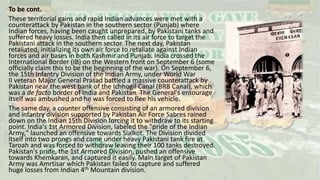
These territorial gains and rapid Indian advances were met with a
counterattack by Pakistan in the southern sector (Punjab) where
Indian forces, having been caught unprepared, by Pakistani tanks and
suffered heavy losses. India then called in its air force to target the
Pakistani attack in the southern sector. The next day, Pakistan
retaliated, initializing its own air force to retaliate against Indian
forces and air bases in both Kashmir and Punjab. India crossed the
International Border (IB) on the Western front on September 6 (some
officially claim this to be the beginning of the war). On September 6,
the 15th Infantry Division of the Indian Army, under World War
II veteran Major General Prasad battled a massive counterattack by
Pakistan near the west bank of the Ichhogil Canal (BRB Canal), which
was a de facto border of India and Pakistan. The General's entourage
itself was ambushed and he was forced to flee his vehicle.
The same day, a counter offensive consisting of an armored division
and infantry division supported by Pakistan Air Force Sabres rained
down on the Indian 15th Division forcing it to withdraw to its starting
point. India's 1st Armored Division, labeled the "pride of the Indian
Army," launched an offensive towards Sialkot. The Division divided
itself into two prongs and came under heavy Pakistani tank fire at
Taroah and was forced to withdraw leaving their 100 tanks destroyed.
Pakistan's pride, the 1st Armored Division, pushed an offensive
towards Khemkaran, and captured it easily. Main target of Pakistan
Army was Amrtisar which Pakistan failed to capture and suffered
huge losses from Indian 4th Mountain division.
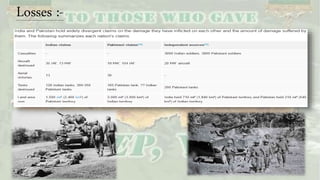
Losses :-
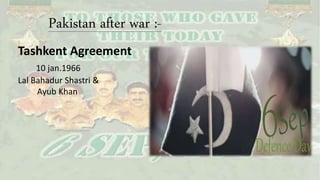
Pakistan after war :-
Tashkent Agreement
10 jan.1966
Lal Bahadur Shastri &
Ayub Khan
To be cont.
ReactionofPublic
The point of view of public was that Pakistan was going to win the war. News of
the Tashkent Declaration shocked the people who were expecting something
quite different. Public becomes more doubted by the action of Ayub Khan that
refused to comment and went into seclusion instead of taking the people into
confidence over the reasons for signing the agreement. Demonstrations and
rioting erupted at various places throughout the country. In order to dispel the
anger and misgiving of the people, Ayub Khan decided to lay the matter before
the people by addressing the nation on January 14.
Despite the fact that Ayub Khan was able to satisfy the misgiving of the people,
there is no doubt that the Tashkent Declaration greatly damaged the image of
Ayub Khan.
To be cont.
Politicalsituation
After this war Pakistan went into political crises .Z.A Bhutto (Foreign minister In
Ayub Khan’s cabinet) was against Tashkent agreement. He left cabinet and protest
against govt. He launched his own party PPP.
Due to these matters Pakistan remained politically unstable for a long time.
At last the result was that we defeated in 1971 war and we have to loose East
Pakistan.
India after war :-
The war had created a tense state of affairs in its aftermath. India's decision to declare
ceasefire with Pakistan caused some outrage among the Indian populace, who
believed they had the upper hand. Both India and Pakistan increased their defense
spending and the Cold War politics had taken roots in the subcontinent. The Indian
Military, which was already undergoing rapid expansions, made improvements in
command and control to address some shortcomings. Partly as a result of the
inefficient information gathering, India established the Research and Analysis Wing for
external espionage and intelligence. India viewed the American policy during the war
as biased, since Pakistan was U.S’ ally but U.S’ didn't come to aid. India slowly started
aligning with the Soviet Union both politically and militarily. The Indian premier, Shastri
was hailed as a hero in New Delhi.

Pak india 1965 war

  • 1.
  • 3.
    Causes :- 1. KashmirIssue The state of Jammu and Kashmir was one of a number of Indian states that recognized British paramountcy. Prior to the withdrawal of the British from India, the state came under pressure from both India and Pakistan to join them. The Maharaja of Kashmir, Hari Singh wanted to remain independent and tried to delay the issue. However at the time of British withdrawal the state was invaded by a concentrated force of Pro-Pakistan Tribes from North West Frontier Province (NWFP) and regular Pakistani soldiers. This forced him to accede Kashmir to India, who promptly rushed into Kashmir and thus started the war. A UN cease-fire was arranged for the December 31, 1948. And India agreed to resolve Kashmir issue according UN terms. But in 1964 India forgetting all its promises about Kashmir, claimed that Kashmir was never the part of Pakistan and never will be. This forced Pakistan to take severe actions, like launching Gebralter Operation, which ultimately led to full scale war.
  • 4.
    To be cont. 2.Hostility between Muslims and Hindus It is a historical fact that in spite of living thousands of years together, relations of Muslim and Hindu were never friendly. And recently Muslims had gotten their homeland against Hindus’ will. This may be the cause of war, as Hindus might have thought that 1965 war is their chance to relive their Dream of “Akhand Bharat”. 3. Recent Defeat of India from China In 1962 Indian armies in Kashmir had lost terribly from Chinese force. This led to think Pakistanis that they can also defeat India, Indians on the other hand were longing for revenge, such mentality might have provoked war.
  • 5.
    The War :- OnAugust 15, 1965, Indian forces crossed the ceasefire line and launched an attack on Pakistan administered Kashmir , marking an official beginning to the war. Most of the war was fought on land by each country's infantry and armored units, with substantial backing from their air forces. Initially, the Indian Army met with considerable success in the northern sector (Kashmir). After launching a prolonged artillery barrage against Pakistan, India was able to capture three important mountain positions. However, by the end of the month both sides were on even footing, as Pakistan had made progress in areas such as Tithwal, Uri, and Punch
  • 6.
    To be cont. Theseterritorial gains and rapid Indian advances were met with a counterattack by Pakistan in the southern sector (Punjab) where Indian forces, having been caught unprepared, by Pakistani tanks and suffered heavy losses. India then called in its air force to target the Pakistani attack in the southern sector. The next day, Pakistan retaliated, initializing its own air force to retaliate against Indian forces and air bases in both Kashmir and Punjab. India crossed the International Border (IB) on the Western front on September 6 (some officially claim this to be the beginning of the war). On September 6, the 15th Infantry Division of the Indian Army, under World War II veteran Major General Prasad battled a massive counterattack by Pakistan near the west bank of the Ichhogil Canal (BRB Canal), which was a de facto border of India and Pakistan. The General's entourage itself was ambushed and he was forced to flee his vehicle. The same day, a counter offensive consisting of an armored division and infantry division supported by Pakistan Air Force Sabres rained down on the Indian 15th Division forcing it to withdraw to its starting point. India's 1st Armored Division, labeled the "pride of the Indian Army," launched an offensive towards Sialkot. The Division divided itself into two prongs and came under heavy Pakistani tank fire at Taroah and was forced to withdraw leaving their 100 tanks destroyed. Pakistan's pride, the 1st Armored Division, pushed an offensive towards Khemkaran, and captured it easily. Main target of Pakistan Army was Amrtisar which Pakistan failed to capture and suffered huge losses from Indian 4th Mountain division.
  • 7.
  • 8.
    Pakistan after war:- Tashkent Agreement 10 jan.1966 Lal Bahadur Shastri & Ayub Khan
  • 9.
    To be cont. ReactionofPublic Thepoint of view of public was that Pakistan was going to win the war. News of the Tashkent Declaration shocked the people who were expecting something quite different. Public becomes more doubted by the action of Ayub Khan that refused to comment and went into seclusion instead of taking the people into confidence over the reasons for signing the agreement. Demonstrations and rioting erupted at various places throughout the country. In order to dispel the anger and misgiving of the people, Ayub Khan decided to lay the matter before the people by addressing the nation on January 14. Despite the fact that Ayub Khan was able to satisfy the misgiving of the people, there is no doubt that the Tashkent Declaration greatly damaged the image of Ayub Khan.
  • 10.
    To be cont. Politicalsituation Afterthis war Pakistan went into political crises .Z.A Bhutto (Foreign minister In Ayub Khan’s cabinet) was against Tashkent agreement. He left cabinet and protest against govt. He launched his own party PPP. Due to these matters Pakistan remained politically unstable for a long time. At last the result was that we defeated in 1971 war and we have to loose East Pakistan.
  • 11.
    India after war:- The war had created a tense state of affairs in its aftermath. India's decision to declare ceasefire with Pakistan caused some outrage among the Indian populace, who believed they had the upper hand. Both India and Pakistan increased their defense spending and the Cold War politics had taken roots in the subcontinent. The Indian Military, which was already undergoing rapid expansions, made improvements in command and control to address some shortcomings. Partly as a result of the inefficient information gathering, India established the Research and Analysis Wing for external espionage and intelligence. India viewed the American policy during the war as biased, since Pakistan was U.S’ ally but U.S’ didn't come to aid. India slowly started aligning with the Soviet Union both politically and militarily. The Indian premier, Shastri was hailed as a hero in New Delhi.