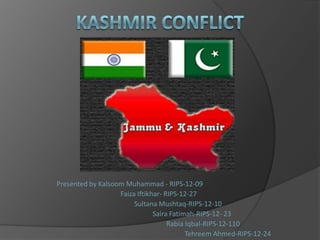
Presented by Kalsoom Muhammad - RIPS-12-09
Faiza Iftikhar- RIPS-12-27
Sultana Mushtaq-RIPS-12-10
Saira Fatimah-RIPS-12- 23
Rabia Iqbal-RIPS-12-110
Tehreem Ahmed-RIPS-12-24
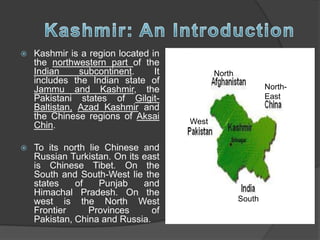
 Kashmir is a region located in
the northwestern part of the
Indian subcontinent. It
includes the Indian state of
Jammu and Kashmir, the
Pakistani states of Gilgit-
Baltistan, Azad Kashmir and
the Chinese regions of Aksai
Chin.
 To its north lie Chinese and
Russian Turkistan. On its east
is Chinese Tibet. On the
South and South-West lie the
states of Punjab and
Himachal Pradesh. On the
west is the North West
Frontier Provinces of
Pakistan, China and Russia.
West
North-
East
South
North
 The Indian Independence Act, 1935 aimed at
dividing United India into The Union of India
and The Dominion of Pakistan which later
became Independent Pakistan in 1947.
According to this act the different states had
the option of choosing whether they wanted to
be a part of India or Pakistan.
 Kashmir ruled by a Hindu named Maharaja
Hari Singh.
 October 1947 a Muslim revolution of freedom
took place. The Maharaja had no choice but
to sign an “Instrument of Accession” to Indian
government providing them control over the
Kashmir region.
 This was not accepted by Pakistani tribes and
the Muslim revolution and decided to move
forward into the region and then the Maharaja
of Kashmir faced military powers. Maharaja
requested India to assist, but India refused to
help until Kashmir was officially a part of
India. After signing necessary documents
India started to progress into Kashmir with
military aid leading to the war of 1947
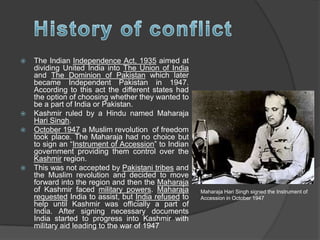
Maharaja Hari Singh signed the Instrument of
Accession in October 1947
 In 1947, the Maharaja of Jammu and Kashmir
Hari Singh, opposed either to join Pakistan or
India. He signed an agreement with Pakistan
on August 16, 1947 and tried to sign a similar
agreement with India too. But at the time of
independace public uprising between Hindus,
Muslims and Sikhs rose up.
 On October 22, 1947, the Pathan-armed
tribes of the Northwest Frontier Province
(NWFP) invaded Kashmir. Hari Singh was
alerted about the invasion. He wanted India’s
military support but India refused to help until
Kashmir was officially a part of India. India
agreed to the accession after consulting
Sheikh Abdullah, the leader of the National
Conference (NC). Hari Singh signed the
accord on October 27 and on the same day
Indian armed forces entered Kashmir to drive
back the invaders.
 This annoyed Pakistani Governor-General
Mohammed Ali Jinnah. On October 27th, he
ordered Lt. General Sir Douglas Gracey, chief
of the Pakistan army, to send Pakistani troops
into Kashmir but he withdraw his orders. In
November, Jinnah transferred military supplies
to the invaders.
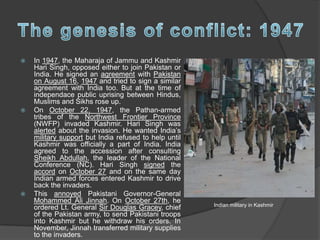
Indian military in Kashmir
 In 1948 Jinnah sent Pakistani regular troops
to Kashmir.
 On January 1, 1948, India’s Prime Minister
Jawaharlal Nehru followed the advice of
British Governor General Lord Mountbatten,
made a criticism with the UN Security Council
calling for a peaceful agreement on disputes
between India and Pakistan. In the complaint
India promised to hold a “plebiscite or
referendum under international auspices,” as
soon as the invaders would be expelled.
 On January 20 and on April 21, 1948 the
Security Council established a three-member
and five member UN commission
respectively on India and Pakistan (UNCIP)
to send them to Kashmir to investigate the
situation.
 On July 7, 1948, following Minister Sir
Mohammed Zafrullah Khan’s had his troops
in Kashmir.
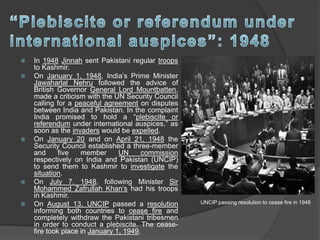
 On August 13, UNCIP passed a resolution
informing both countries to cease fire and
completely withdraw the Pakistani tribesmen
in order to conduct a plebiscite. The cease-
fire took place in January 1, 1949.
UNCIP passing resolution to cease fire in 1948
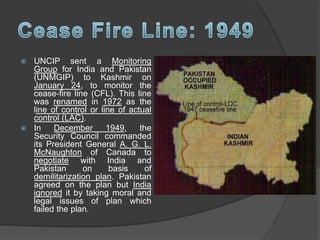
 UNCIP sent a Monitoring
Group for India and Pakistan
(UNMGIP) to Kashmir on
January 24, to monitor the
cease-fire line (CFL). This line
was renamed in 1972 as the
line of control or line of actual
control (LAC).
 In December 1949, the
Security Council commanded
its President General A. G. L.
McNaughton of Canada to
negotiate with India and
Pakistan on basis of
demilitarization plan. Pakistan
agreed on the plan but India
ignored it by taking moral and
legal issues of plan which
failed the plan.
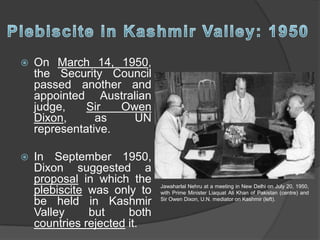
 On March 14, 1950,
the Security Council
passed another and
appointed Australian
judge, Sir Owen
Dixon, as UN
representative.
 In September 1950,
Dixon suggested a
proposal in which the
plebiscite was only to
be held in Kashmir
Valley but both
countries rejected it.
Jawaharlal Nehru at a meeting in New Delhi on July 20, 1950,
with Prime Minister Liaquat Ali Khan of Pakistan (centre) and
Sir Owen Dixon, U.N. mediator on Kashmir (left).
 In April 1951, the US Council appointed
Dr. Frank Graham, as UN
representative. Between December
1951 and February 1953, Graham tried
to convince both countries to accept his
demilitarization proposals which
mentioned the reduction of the military
of both countries in Kashmir and Azad
Kashmir before conducting plebiscite but
it failed.
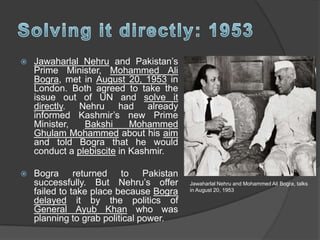
 Jawaharlal Nehru and Pakistan’s
Prime Minister, Mohammed Ali
Bogra, met in August 20, 1953 in
London. Both agreed to take the
issue out of UN and solve it
directly. Nehru had already
informed Kashmir’s new Prime
Minister, Bakshi Mohammed
Ghulam Mohammed about his aim
and told Bogra that he would
conduct a plebiscite in Kashmir.
 Bogra returned to Pakistan
successfully. But Nehru’s offer
failed to take place because Bogra
delayed it by the politics of
General Ayub Khan who was
planning to grab political power.
Jawaharlal Nehru and Mohammed Ali Bogra, talks
in August 20, 1953
 On 30 October 1956, India adopts a
constitution for Kashmir declaring it a part
of the Indian Union. India's Home Minister,
Pandit Govind Ballabh Pant, during his visit
to Srinagar, declared that the State of
Jammu and Kashmir is an integral part of
India and there can be no question of a
plebiscite to determine its status and
forcefully incorporated Kashmir into it and
renamed it as Jammu Kashmir.
 In February 1957, the Council authorized its
president Gunnar Jarring to supervise India
and Pakistan on the proposals of
demilitarization and plebiscite. Jarring did not
have any success and in April referred it to the
Council to hold by negotiation, which Pakistan
accepted but India rejected.
 In September Pakistan Prime Minister General
Ayub Khan Noon’s said that his country was
ready to withdraw its troops from Kashmir. The
Security Council sent Frank Graham who
again tried to make an agreement between the
two countries but India again rejected it.
Graham Report: 1958
 In March 1958, Graham submitted a report
to the Security Council (CSC) suggesting
to settle the dispute but as usual India
rejected it. From the mid-1950s onward,
the Soviet Union frees India by its frequent
rejection in the UN. Since then, the issue
died in the Security Council until it was
again raised in 1963 and 1965. The Indo-
Pak borders remained mostly quiet during
the period 1949-65. In 1965, India and
Pakistan fought another war.
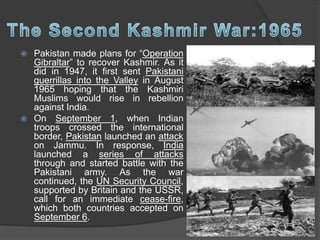
 Pakistan made plans for “Operation
Gibraltar” to recover Kashmir. As it
did in 1947, it first sent Pakistani
guerrillas into the Valley in August
1965 hoping that the Kashmiri
Muslims would rise in rebellion
against India.
 On September 1, when Indian
troops crossed the international
border, Pakistan launched an attack
on Jammu. In response, India
launched a series of attacks
through and started battle with the
Pakistani army. As the war
continued, the UN Security Council,
supported by Britain and the USSR,
call for an immediate cease-fire,
which both countries accepted on
September 6.
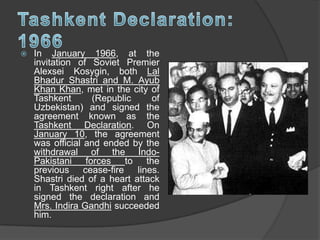
 In January 1966, at the
invitation of Soviet Premier
Alexsei Kosygin, both Lal
Bhadur Shastri and M. Ayub
Khan Khan, met in the city of
Tashkent (Republic of
Uzbekistan) and signed the
agreement known as the
Tashkent Declaration. On
January 10, the agreement
was official and ended by the
withdrawal of the Indo-
Pakistani forces to the
previous cease-fire lines.
Shastri died of a heart attack
in Tashkent right after he
signed the declaration and
Mrs. Indira Gandhi succeeded
him.
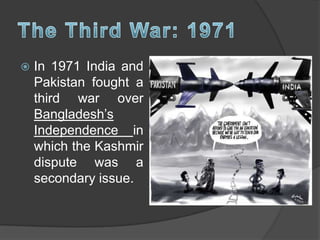
 In 1971 India and
Pakistan fought a
third war over
Bangladesh’s
Independence in
which the Kashmir
dispute was a
secondary issue.
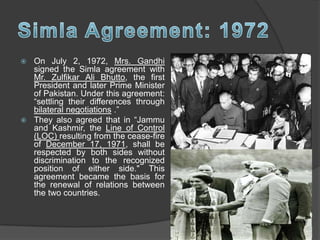
 On July 2, 1972, Mrs. Gandhi
signed the Simla agreement with
Mr. Zulfikar Ali Bhutto, the first
President and later Prime Minister
of Pakistan. Under this agreement:
“settling their differences through
bilateral negotiations .”
 They also agreed that in “Jammu
and Kashmir, the Line of Control
(LOC) resulting from the cease-fire
of December 17, 1971, shall be
respected by both sides without
discrimination to the recognized
position of either side." This
agreement became the basis for
the renewal of relations between
the two countries.
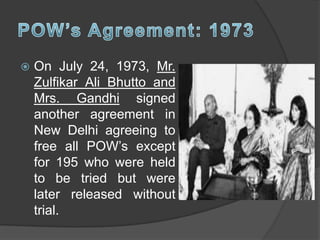
 On July 24, 1973, Mr.
Zulfikar Ali Bhutto and
Mrs. Gandhi signed
another agreement in
New Delhi agreeing to
free all POW’s except
for 195 who were held
to be tried but were
later released without
trial.
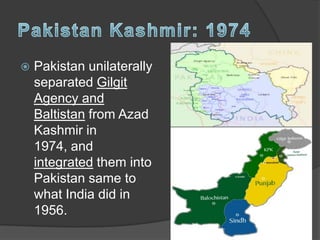
 Pakistan unilaterally
separated Gilgit
Agency and
Baltistan from Azad
Kashmir in
1974, and
integrated them into
Pakistan same to
what India did in
1956.
 In 1968, following the end of the third Indo-
Pakistani war, India released Sheikh Abdullah,
leader of National conference and his colleague,
Mirza Afzal Beg, from jail. Abdullah accepted
Kashmir’s accession to India as final. As seen in
March 10, 1972, in an interview with The Times
(London), he said, “our dispute with the
government of India is not accession but it is the
quantum of autonomy” for Kashmir. In June 1972,
the state government headed by Mir Passim put
the ban on Abdullah’s entry into Kashmir as he
demanded for a plebiscite.
 In 1974, Sheikh Abdullah and Mirza Afzal
Beg joined India in a series of negotiations.
The negotiations between Mrs. Gandhi’s
special representative G. Parthasarathi and
Mirza Beg resulted in a six-point accord
called the Kashmir Accord.
 The accord was signed by Abdullah on
February 12, 1975. Abdullah agreed to
Kashmir’s status as a part of India allowing
enjoying special conditions. On February
25, 1975, Abdullah became the Chief
Minister of the state. In July 1975, his party,
the National Conference finally came into
existence again. He governed the state
until he died on September 21, 1982.
 Sheikh Abdullah’s son, Dr. Farooq
Abdullah, succeeded him. But Dr.
Farooq joined by the influential Maulvi
Farooq of the Awami Action Committee
demanded autonomy.
 During the 1983 legislative elections
despite Mrs. Gandhi’s anger and her
management of the elections, Dr.
Farooq Abdullah won the election.
 Upset by Dr. Farooq’s demand for autonomy,
Mrs. Gandhi dismissed Abdullah’s
government in 1984 and replaced it with
Ghulam Mohammad Shah as its Chief
Minister.
 As public violence increased under
Ghulam Mohammad Shah’s
leadership, in the Valley and Jammu, he
was dismissed in 1986. In the same
year Dr. Farooq Abdullah signed a deal
with Mr. Rajiv Gandhi, the new Prime
Minister. In June 1986, National
Conference and Congress were united.
 The union of two parties won a victory in
the March 1987 elections but it did not
help Abdullah to keep power for long.
The election of 1987 resulted in
Abdullah’s defeat following the Muslim
uprising in 1989.
 Pakistan was ready to support the secessionist
groups with funds, weapons and training, as it
continued to make claims over Kashmir. Three
principal umbrella groups were involved in the
uprising. One group, composed of Muslim
fundamentalists. The second umbrella group was
tied to the Jammu and Kashmir Liberation Front
(JKLF) who demanded an independent Kashmir.
The third group was the Jammu and Kashmir
Peoples’ League. These groups demanded that a
plebiscite as promised by India and guaranteed by
the UN Resolutions of 1948-49 be conducted so
that the Kashmiris could exercise their right of self-
determination.
 India, however, rejected their demands
based on the argument that in 1956 the
Kashmir constituent assembly acceded
to India. It further argued that the
plebiscite was outdated and that based
on the July 1972 Simla agreement
Pakistan was forced to resolve the
Kashmir dispute bilaterally with India
and not under the guidance of any
international organization.
 The action of Indian Government dismissed Abdullah’s
government in August 1990. Under the July 1990 Jammu
and Kashmir Disturbed Areas Act and Armed Forces
Special Powers Act (AFSP; the security forces forcefully
committed a series of human right abuses. The abuses
included the following:
 Staged tease “encounters” for the deaths of victims, who
died in police custody,
 Cruel treatment of prisoners and suspects with beatings,
burnings with cigarettes, suspension by the
feet and electric shocks,
 Random arrest and detention of the suspects for more
than 12 months,
 Searching and arresting suspects without a warrant.
 By early 1996, the central government decided to deal with the
insurgency (rebellion). It restored state government under
Abdullah who had won in the September elections, although the
All-Party Hurriyat (Freedom) Conference (APHC) boycotted the
elections. In February 1996, the central government released from
jail the four Pakistani separatist leaders, Imran Rahi of the Hiz-Ul-
Mujahideen, Bilal Lodhi of the Al-Barq, Babbar Badr of the Muslim
Janbaz Force (MJF), and Ghulam Mohiuddin of the Muslim
Mujahideen and started talks with them. They agreed to talks with
the government with no conditions and without Pakistan’s
involvement. On February 10, another Pakistani Master Ahsan
Dar, the founder of the Hiz-Ul-Mujahideen, who was in jail, joined
them by supported the four Pakistani. The leader of the Peoples
League, Shabir Ahmad Shah, also joined the conference, saying
that the problem could not be solved without the including
Pakistan in the talks. The constant insurgency increased conflict
between India and Pakistan and increased the chance of nuclear
encounter.
 In the midst of the Kashmir Muslim insurgency,
tensions between India and Pakistan became so
intense that in May 1990, the Pakistani military
headed by General Mirza Aslam Beg was willing to
use nuclear weapons to “take out New Delhi.”
Prime Minister Benazeer Bhutto, took a hostile
stand towards India. Despite these hostile relations,
India and Pakistan held several talks at foreign
secretary levels between 1990 and January 1994,
but without any results. Pakistan insisted that India
stop its counter-insurgency operations, while India
insisted that that the talks should focus on
Pakistan’s cross border aid to the Muslim militants.
 After Benazeer’s second
discharge, Nawaz Sharif took office as
Prime Minister in February 1997. Indo-
Pak relations temporarily soften. Several
meetings were held. At meetings they
formed eight joint “working groups” that
would look at the Kashmir issue, for the
first time since 1972.
 These relations changed after the parliament elections of
March 1998 when Indian government that took a hard stand
against Pakistan. The Home Minister, L. K. Advani, of the
new government threatened to go after the terrorists even
into the Pakistan-occupied Kashmir. Indo-Pakistani conflicts
increased in May 1998.
 On July 29, when Vajpayee and Sharif met at the tenth
summit of the SAARC held in Columbo, Sri Lanka, the
encounter failed. Sharif insisted to resolve the “core issue” of
Kashmir. India’s foreign secretary, K. Raghunath, responded
by saying Pakistan’s focus on the issue of Kashmir as
“neurotic”. In contrast, when they met on September 23, at
UN General Assembly session, in New York, they agreed to
try to resolve the Kashmir issue “peacefully”. This agreement
was not taken up by the Pakistani military including General
Musharraf.
The Threat of War and the Bush
Administration’s Role in Ending It:
2001
 On December 13, 2001 the Indian
parliament building was attacked by the
Pakistan-based terrorist. Tensions
between India and Pakistan got intense.
Both countries started moving military
along the Line Of Control (LOC).
 On January 12, 2002, Gn. Pervaiz Musharraf
promised not to use his country as a base for
terrorism in Kashmir. India adopted it and the
situation was calm. But Gn. Musharraf released 500
militants and went against his promise.
 In May 14, the Indian government send 100,000
troops to close the LOC. Musharraf responded by
sending half million troops to the borders and on May
27. These tensions made the two countries come
closer to the war. It was this threat that made British
Foreign Secretary, Jack Straw; U.S. Deputy of
Secretay of State, Richard Armitage; and Defense
Secretary, Donald Rumsfeld, to visit both Pakistan
and India in May and June 2002 and they succeeded
in resolving tensions.
 During the SAARC summit meeting,
held January 4-6, 2004, Vajpayee met
Gn. Musharraf on January 5. They
discussed an agreement that had been
put together by Indian and Pakistani
officials. As Musharraf said in December
2004, he wanted to compromise on the
conflict by negotiations. Therefore, the
leaders gave their approval on the
agreement.
 In order to settle the dispute that remained forgotten till the
present Pakistani and Indian politics, the International
Community must enter and take on some new steps. Since
1947, the Kashmir conflict has threatened to initiate a nuclear
war between India and Pakistan. These countries have
already fought three wars over the region; still the United
Nations have failed to settle the situation. In January 2008,
leaders of Pakistan and India suggested that they can lastly
complete a long-term resolution with international support.
United States has been working to facilitate peace talks
between Pakistan and India to resolve the Kashmir Conflict.
In July 15, 2009, Pakistani Prime Minister Yousaf Raza Gilani
and Indian Prime Minister Manmohan Singh had agreed to
discuss resolution of the dispute. All what these two countries
should unite is to begin the upholding or supporting of conflict
resolution. All that is left is action.
References
 http://geography.howstuffworks.com/middle-east/geography-of-
kashmir.htm
http://en.wikipedia.org/wiki/Kashmir
 http://www.kashmiri-cc.ca/kashmir.htm
 http://hinduism.about.com/od/history/a/Kashmir-Paradise-Lost.htm
 http://sas1500.wordpress.com/2012/10/25/the-territorial-dispute-
within-the-kashmir-region/The Territorial Dispute within the
Kashmir Region
 http://www.legislation.gov.uk/ukpga/Geo6/10-11/30
 http://www.jammu-kashmir.com/documents/harisingh47.html
 http://www.britannica.com/EBchecked/topic/312908/Kashmir/214223/T
he-Kashmir-problem#ref673547
 http://www.time.com/time/magazine/article/0,9171,793895,00.html
 http://www.washingtonpost.com/wpdyn/content/article/2008/08/27/AR2
008082703195.html?nav=rss_world
Kashmir conflict

Kashmir conflict

  • 1.
    Presented by KalsoomMuhammad - RIPS-12-09 Faiza Iftikhar- RIPS-12-27 Sultana Mushtaq-RIPS-12-10 Saira Fatimah-RIPS-12- 23 Rabia Iqbal-RIPS-12-110 Tehreem Ahmed-RIPS-12-24
  • 2.
     Kashmir isa region located in the northwestern part of the Indian subcontinent. It includes the Indian state of Jammu and Kashmir, the Pakistani states of Gilgit- Baltistan, Azad Kashmir and the Chinese regions of Aksai Chin.  To its north lie Chinese and Russian Turkistan. On its east is Chinese Tibet. On the South and South-West lie the states of Punjab and Himachal Pradesh. On the west is the North West Frontier Provinces of Pakistan, China and Russia. West North- East South North
  • 3.
     The IndianIndependence Act, 1935 aimed at dividing United India into The Union of India and The Dominion of Pakistan which later became Independent Pakistan in 1947. According to this act the different states had the option of choosing whether they wanted to be a part of India or Pakistan.  Kashmir ruled by a Hindu named Maharaja Hari Singh.  October 1947 a Muslim revolution of freedom took place. The Maharaja had no choice but to sign an “Instrument of Accession” to Indian government providing them control over the Kashmir region.  This was not accepted by Pakistani tribes and the Muslim revolution and decided to move forward into the region and then the Maharaja of Kashmir faced military powers. Maharaja requested India to assist, but India refused to help until Kashmir was officially a part of India. After signing necessary documents India started to progress into Kashmir with military aid leading to the war of 1947 Maharaja Hari Singh signed the Instrument of Accession in October 1947
  • 4.
     In 1947,the Maharaja of Jammu and Kashmir Hari Singh, opposed either to join Pakistan or India. He signed an agreement with Pakistan on August 16, 1947 and tried to sign a similar agreement with India too. But at the time of independace public uprising between Hindus, Muslims and Sikhs rose up.  On October 22, 1947, the Pathan-armed tribes of the Northwest Frontier Province (NWFP) invaded Kashmir. Hari Singh was alerted about the invasion. He wanted India’s military support but India refused to help until Kashmir was officially a part of India. India agreed to the accession after consulting Sheikh Abdullah, the leader of the National Conference (NC). Hari Singh signed the accord on October 27 and on the same day Indian armed forces entered Kashmir to drive back the invaders.  This annoyed Pakistani Governor-General Mohammed Ali Jinnah. On October 27th, he ordered Lt. General Sir Douglas Gracey, chief of the Pakistan army, to send Pakistani troops into Kashmir but he withdraw his orders. In November, Jinnah transferred military supplies to the invaders. Indian military in Kashmir
  • 5.
     In 1948Jinnah sent Pakistani regular troops to Kashmir.  On January 1, 1948, India’s Prime Minister Jawaharlal Nehru followed the advice of British Governor General Lord Mountbatten, made a criticism with the UN Security Council calling for a peaceful agreement on disputes between India and Pakistan. In the complaint India promised to hold a “plebiscite or referendum under international auspices,” as soon as the invaders would be expelled.  On January 20 and on April 21, 1948 the Security Council established a three-member and five member UN commission respectively on India and Pakistan (UNCIP) to send them to Kashmir to investigate the situation.  On July 7, 1948, following Minister Sir Mohammed Zafrullah Khan’s had his troops in Kashmir.  On August 13, UNCIP passed a resolution informing both countries to cease fire and completely withdraw the Pakistani tribesmen in order to conduct a plebiscite. The cease- fire took place in January 1, 1949. UNCIP passing resolution to cease fire in 1948
  • 6.
     UNCIP senta Monitoring Group for India and Pakistan (UNMGIP) to Kashmir on January 24, to monitor the cease-fire line (CFL). This line was renamed in 1972 as the line of control or line of actual control (LAC).  In December 1949, the Security Council commanded its President General A. G. L. McNaughton of Canada to negotiate with India and Pakistan on basis of demilitarization plan. Pakistan agreed on the plan but India ignored it by taking moral and legal issues of plan which failed the plan.
  • 7.
     On March14, 1950, the Security Council passed another and appointed Australian judge, Sir Owen Dixon, as UN representative.  In September 1950, Dixon suggested a proposal in which the plebiscite was only to be held in Kashmir Valley but both countries rejected it. Jawaharlal Nehru at a meeting in New Delhi on July 20, 1950, with Prime Minister Liaquat Ali Khan of Pakistan (centre) and Sir Owen Dixon, U.N. mediator on Kashmir (left).
  • 8.
     In April1951, the US Council appointed Dr. Frank Graham, as UN representative. Between December 1951 and February 1953, Graham tried to convince both countries to accept his demilitarization proposals which mentioned the reduction of the military of both countries in Kashmir and Azad Kashmir before conducting plebiscite but it failed.
  • 9.
     Jawaharlal Nehruand Pakistan’s Prime Minister, Mohammed Ali Bogra, met in August 20, 1953 in London. Both agreed to take the issue out of UN and solve it directly. Nehru had already informed Kashmir’s new Prime Minister, Bakshi Mohammed Ghulam Mohammed about his aim and told Bogra that he would conduct a plebiscite in Kashmir.  Bogra returned to Pakistan successfully. But Nehru’s offer failed to take place because Bogra delayed it by the politics of General Ayub Khan who was planning to grab political power. Jawaharlal Nehru and Mohammed Ali Bogra, talks in August 20, 1953
  • 10.
     On 30October 1956, India adopts a constitution for Kashmir declaring it a part of the Indian Union. India's Home Minister, Pandit Govind Ballabh Pant, during his visit to Srinagar, declared that the State of Jammu and Kashmir is an integral part of India and there can be no question of a plebiscite to determine its status and forcefully incorporated Kashmir into it and renamed it as Jammu Kashmir.
  • 11.
     In February1957, the Council authorized its president Gunnar Jarring to supervise India and Pakistan on the proposals of demilitarization and plebiscite. Jarring did not have any success and in April referred it to the Council to hold by negotiation, which Pakistan accepted but India rejected.  In September Pakistan Prime Minister General Ayub Khan Noon’s said that his country was ready to withdraw its troops from Kashmir. The Security Council sent Frank Graham who again tried to make an agreement between the two countries but India again rejected it.
  • 12.
    Graham Report: 1958 In March 1958, Graham submitted a report to the Security Council (CSC) suggesting to settle the dispute but as usual India rejected it. From the mid-1950s onward, the Soviet Union frees India by its frequent rejection in the UN. Since then, the issue died in the Security Council until it was again raised in 1963 and 1965. The Indo- Pak borders remained mostly quiet during the period 1949-65. In 1965, India and Pakistan fought another war.
  • 13.
     Pakistan madeplans for “Operation Gibraltar” to recover Kashmir. As it did in 1947, it first sent Pakistani guerrillas into the Valley in August 1965 hoping that the Kashmiri Muslims would rise in rebellion against India.  On September 1, when Indian troops crossed the international border, Pakistan launched an attack on Jammu. In response, India launched a series of attacks through and started battle with the Pakistani army. As the war continued, the UN Security Council, supported by Britain and the USSR, call for an immediate cease-fire, which both countries accepted on September 6.
  • 14.
     In January1966, at the invitation of Soviet Premier Alexsei Kosygin, both Lal Bhadur Shastri and M. Ayub Khan Khan, met in the city of Tashkent (Republic of Uzbekistan) and signed the agreement known as the Tashkent Declaration. On January 10, the agreement was official and ended by the withdrawal of the Indo- Pakistani forces to the previous cease-fire lines. Shastri died of a heart attack in Tashkent right after he signed the declaration and Mrs. Indira Gandhi succeeded him.
  • 15.
     In 1971India and Pakistan fought a third war over Bangladesh’s Independence in which the Kashmir dispute was a secondary issue.
  • 16.
     On July2, 1972, Mrs. Gandhi signed the Simla agreement with Mr. Zulfikar Ali Bhutto, the first President and later Prime Minister of Pakistan. Under this agreement: “settling their differences through bilateral negotiations .”  They also agreed that in “Jammu and Kashmir, the Line of Control (LOC) resulting from the cease-fire of December 17, 1971, shall be respected by both sides without discrimination to the recognized position of either side." This agreement became the basis for the renewal of relations between the two countries.
  • 17.
     On July24, 1973, Mr. Zulfikar Ali Bhutto and Mrs. Gandhi signed another agreement in New Delhi agreeing to free all POW’s except for 195 who were held to be tried but were later released without trial.
  • 18.
     Pakistan unilaterally separatedGilgit Agency and Baltistan from Azad Kashmir in 1974, and integrated them into Pakistan same to what India did in 1956.
  • 19.
     In 1968,following the end of the third Indo- Pakistani war, India released Sheikh Abdullah, leader of National conference and his colleague, Mirza Afzal Beg, from jail. Abdullah accepted Kashmir’s accession to India as final. As seen in March 10, 1972, in an interview with The Times (London), he said, “our dispute with the government of India is not accession but it is the quantum of autonomy” for Kashmir. In June 1972, the state government headed by Mir Passim put the ban on Abdullah’s entry into Kashmir as he demanded for a plebiscite.
  • 20.
     In 1974,Sheikh Abdullah and Mirza Afzal Beg joined India in a series of negotiations. The negotiations between Mrs. Gandhi’s special representative G. Parthasarathi and Mirza Beg resulted in a six-point accord called the Kashmir Accord.
  • 21.
     The accordwas signed by Abdullah on February 12, 1975. Abdullah agreed to Kashmir’s status as a part of India allowing enjoying special conditions. On February 25, 1975, Abdullah became the Chief Minister of the state. In July 1975, his party, the National Conference finally came into existence again. He governed the state until he died on September 21, 1982.
  • 22.
     Sheikh Abdullah’sson, Dr. Farooq Abdullah, succeeded him. But Dr. Farooq joined by the influential Maulvi Farooq of the Awami Action Committee demanded autonomy.
  • 23.
     During the1983 legislative elections despite Mrs. Gandhi’s anger and her management of the elections, Dr. Farooq Abdullah won the election.
  • 24.
     Upset byDr. Farooq’s demand for autonomy, Mrs. Gandhi dismissed Abdullah’s government in 1984 and replaced it with Ghulam Mohammad Shah as its Chief Minister.
  • 25.
     As publicviolence increased under Ghulam Mohammad Shah’s leadership, in the Valley and Jammu, he was dismissed in 1986. In the same year Dr. Farooq Abdullah signed a deal with Mr. Rajiv Gandhi, the new Prime Minister. In June 1986, National Conference and Congress were united.
  • 26.
     The unionof two parties won a victory in the March 1987 elections but it did not help Abdullah to keep power for long. The election of 1987 resulted in Abdullah’s defeat following the Muslim uprising in 1989.
  • 27.
     Pakistan wasready to support the secessionist groups with funds, weapons and training, as it continued to make claims over Kashmir. Three principal umbrella groups were involved in the uprising. One group, composed of Muslim fundamentalists. The second umbrella group was tied to the Jammu and Kashmir Liberation Front (JKLF) who demanded an independent Kashmir. The third group was the Jammu and Kashmir Peoples’ League. These groups demanded that a plebiscite as promised by India and guaranteed by the UN Resolutions of 1948-49 be conducted so that the Kashmiris could exercise their right of self- determination.
  • 28.
     India, however,rejected their demands based on the argument that in 1956 the Kashmir constituent assembly acceded to India. It further argued that the plebiscite was outdated and that based on the July 1972 Simla agreement Pakistan was forced to resolve the Kashmir dispute bilaterally with India and not under the guidance of any international organization.
  • 29.
     The actionof Indian Government dismissed Abdullah’s government in August 1990. Under the July 1990 Jammu and Kashmir Disturbed Areas Act and Armed Forces Special Powers Act (AFSP; the security forces forcefully committed a series of human right abuses. The abuses included the following:  Staged tease “encounters” for the deaths of victims, who died in police custody,  Cruel treatment of prisoners and suspects with beatings, burnings with cigarettes, suspension by the feet and electric shocks,  Random arrest and detention of the suspects for more than 12 months,  Searching and arresting suspects without a warrant.
  • 30.
     By early1996, the central government decided to deal with the insurgency (rebellion). It restored state government under Abdullah who had won in the September elections, although the All-Party Hurriyat (Freedom) Conference (APHC) boycotted the elections. In February 1996, the central government released from jail the four Pakistani separatist leaders, Imran Rahi of the Hiz-Ul- Mujahideen, Bilal Lodhi of the Al-Barq, Babbar Badr of the Muslim Janbaz Force (MJF), and Ghulam Mohiuddin of the Muslim Mujahideen and started talks with them. They agreed to talks with the government with no conditions and without Pakistan’s involvement. On February 10, another Pakistani Master Ahsan Dar, the founder of the Hiz-Ul-Mujahideen, who was in jail, joined them by supported the four Pakistani. The leader of the Peoples League, Shabir Ahmad Shah, also joined the conference, saying that the problem could not be solved without the including Pakistan in the talks. The constant insurgency increased conflict between India and Pakistan and increased the chance of nuclear encounter.
  • 31.
     In themidst of the Kashmir Muslim insurgency, tensions between India and Pakistan became so intense that in May 1990, the Pakistani military headed by General Mirza Aslam Beg was willing to use nuclear weapons to “take out New Delhi.” Prime Minister Benazeer Bhutto, took a hostile stand towards India. Despite these hostile relations, India and Pakistan held several talks at foreign secretary levels between 1990 and January 1994, but without any results. Pakistan insisted that India stop its counter-insurgency operations, while India insisted that that the talks should focus on Pakistan’s cross border aid to the Muslim militants.
  • 32.
     After Benazeer’ssecond discharge, Nawaz Sharif took office as Prime Minister in February 1997. Indo- Pak relations temporarily soften. Several meetings were held. At meetings they formed eight joint “working groups” that would look at the Kashmir issue, for the first time since 1972.
  • 33.
     These relationschanged after the parliament elections of March 1998 when Indian government that took a hard stand against Pakistan. The Home Minister, L. K. Advani, of the new government threatened to go after the terrorists even into the Pakistan-occupied Kashmir. Indo-Pakistani conflicts increased in May 1998.  On July 29, when Vajpayee and Sharif met at the tenth summit of the SAARC held in Columbo, Sri Lanka, the encounter failed. Sharif insisted to resolve the “core issue” of Kashmir. India’s foreign secretary, K. Raghunath, responded by saying Pakistan’s focus on the issue of Kashmir as “neurotic”. In contrast, when they met on September 23, at UN General Assembly session, in New York, they agreed to try to resolve the Kashmir issue “peacefully”. This agreement was not taken up by the Pakistani military including General Musharraf.
  • 34.
    The Threat ofWar and the Bush Administration’s Role in Ending It: 2001  On December 13, 2001 the Indian parliament building was attacked by the Pakistan-based terrorist. Tensions between India and Pakistan got intense. Both countries started moving military along the Line Of Control (LOC).
  • 35.
     On January12, 2002, Gn. Pervaiz Musharraf promised not to use his country as a base for terrorism in Kashmir. India adopted it and the situation was calm. But Gn. Musharraf released 500 militants and went against his promise.  In May 14, the Indian government send 100,000 troops to close the LOC. Musharraf responded by sending half million troops to the borders and on May 27. These tensions made the two countries come closer to the war. It was this threat that made British Foreign Secretary, Jack Straw; U.S. Deputy of Secretay of State, Richard Armitage; and Defense Secretary, Donald Rumsfeld, to visit both Pakistan and India in May and June 2002 and they succeeded in resolving tensions.
  • 36.
     During theSAARC summit meeting, held January 4-6, 2004, Vajpayee met Gn. Musharraf on January 5. They discussed an agreement that had been put together by Indian and Pakistani officials. As Musharraf said in December 2004, he wanted to compromise on the conflict by negotiations. Therefore, the leaders gave their approval on the agreement.
  • 37.
     In orderto settle the dispute that remained forgotten till the present Pakistani and Indian politics, the International Community must enter and take on some new steps. Since 1947, the Kashmir conflict has threatened to initiate a nuclear war between India and Pakistan. These countries have already fought three wars over the region; still the United Nations have failed to settle the situation. In January 2008, leaders of Pakistan and India suggested that they can lastly complete a long-term resolution with international support. United States has been working to facilitate peace talks between Pakistan and India to resolve the Kashmir Conflict. In July 15, 2009, Pakistani Prime Minister Yousaf Raza Gilani and Indian Prime Minister Manmohan Singh had agreed to discuss resolution of the dispute. All what these two countries should unite is to begin the upholding or supporting of conflict resolution. All that is left is action.
  • 38.
    References  http://geography.howstuffworks.com/middle-east/geography-of- kashmir.htm http://en.wikipedia.org/wiki/Kashmir  http://www.kashmiri-cc.ca/kashmir.htm http://hinduism.about.com/od/history/a/Kashmir-Paradise-Lost.htm  http://sas1500.wordpress.com/2012/10/25/the-territorial-dispute- within-the-kashmir-region/The Territorial Dispute within the Kashmir Region  http://www.legislation.gov.uk/ukpga/Geo6/10-11/30  http://www.jammu-kashmir.com/documents/harisingh47.html  http://www.britannica.com/EBchecked/topic/312908/Kashmir/214223/T he-Kashmir-problem#ref673547  http://www.time.com/time/magazine/article/0,9171,793895,00.html  http://www.washingtonpost.com/wpdyn/content/article/2008/08/27/AR2 008082703195.html?nav=rss_world