PREPARED BY:
ANUM CHAUDHARY
Pakistan Foreign Policy
Non-Alignment Era
Foreign Policy
• Every nation adopts an attitude and mode of
action towards other states which suits its
peculiar circumstances and interests.
What is Foreign Policy?
“The foreign policy is establishment
and development of relations with
other countries in order to protect the
national interests by taking appropriate
steps at international level.”
Description of Foreign Policy
• "The foreign policy of a country is in a
sense a projection of its internal policies
i.e. social, political and economic."
BY: F.M. Muhammad Ayub Khan
• Foreign policy dictates how a country will
act with respect to other countries
politically, socially, economically, and
militarily, and to a somewhat lesser
extent, how it behaves towards non-
state actors.
PAKISTAN 'S FOREIGN POLICY
Pakistan 's foreign policy is guided by its history,
geographical location and the aspiration of its
people. It is also responsive to regional and
international imperatives. Given the persistent
challenges, Pakistan has opted for a proactive
foreign policy. While there are elements of
continuity in the foreign policy, as they should
be, there is also a change of emphasis and
nuance. The essence of Pakistan's Foreign
Policy are:-
• Develop friendly relations with all countries
particularly the Muslim world, major powers and
immediate neighbors.
• Safeguard vital security and geo-strategic interests
of Pakistan.
• Resolve the core issue of Jammu and Kashmir in
accordance with the resolutions of the UN Security
Council and wishes of the Kashmiri people.
• Promote the image of Pakistan as a strong,
dynamic, progressive, moderate and democratic
Islamic country.
• Augment economic and commercial interests
abroad.
• Protect the interests of Pakistan 's expatriate
community abroad.
Quaid’s Vision on foreign policy of
Pakistan
• Our foreign policy is one of friendliness and goodwill
towards all the nations of the world.
• We do not cherish aggressive designs against any
country or nation.
• We believe in the principle of honesty and fair play in
national and international dealings and are prepared
to make our utmost contribution to the promotion of
peace and prosperity among the nations of the world.
• Pakistan will never be found lacking in extending its
material and moral support to the oppressed and
suppressed peoples of the world, and in upholding the
principles of the United Nations Charter."
Principles Of Pak F.P - In vision of
Quaid
1. Peaceful Co-existence
2. Non-Alignment
3. Unite Nations Charter
4. Bilateralism
5. Support to Right of
Self-Determination
6. Unity of Islamic
World
7. De- Weaponisation
8. Establishment of
Peace
9. Good Relations with
Neighbours
10.International and
Regional
Cooperation
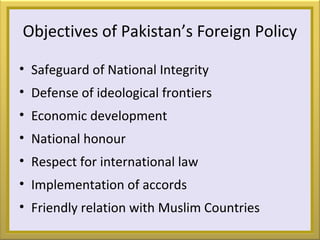
Objectives of Pakistan’s Foreign Policy
• Safeguard of National Integrity
• Defense of ideological frontiers
• Economic development
• National honour
• Respect for international law
• Implementation of accords
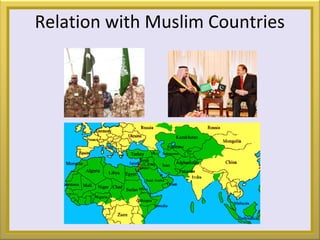
• Friendly relation with Muslim Countries
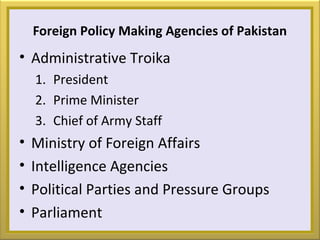
Foreign Policy Making Agencies of Pakistan
• Administrative Troika
1. President
2. Prime Minister
3. Chief of Army Staff
• Ministry of Foreign Affairs
• Intelligence Agencies
• Political Parties and Pressure Groups
• Parliament
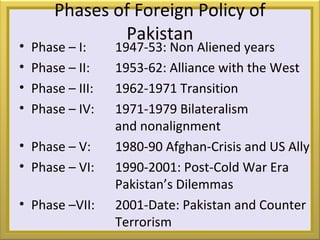
Phases of Foreign Policy of
Pakistan
• Phase – I: 1947-53: Non Aliened years
• Phase – II: 1953-62: Alliance with the West
• Phase – III: 1962-1971 Transition
• Phase – IV: 1971-1979 Bilateralism
and nonalignment
• Phase – V: 1980-90 Afghan-Crisis and US Ally
• Phase – VI: 1990-2001: Post-Cold War Era
Pakistan’s Dilemmas
• Phase –VII: 2001-Date: Pakistan and Counter
Terrorism
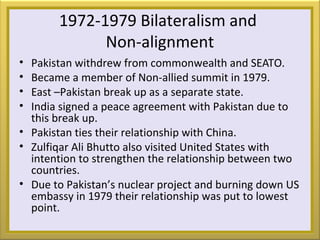
1972-1979 Bilateralism and
Non-alignment
• Pakistan withdrew from commonwealth and SEATO.
• Became a member of Non-allied summit in 1979.
• East –Pakistan break up as a separate state.
• India signed a peace agreement with Pakistan due to
this break up.
• Pakistan ties their relationship with China.
• Zulfiqar Ali Bhutto also visited United States with
intention to strengthen the relationship between two
countries.
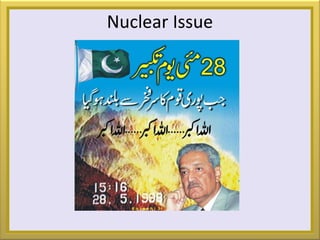
• Due to Pakistan’s nuclear project and burning down US
embassy in 1979 their relationship was put to lowest
point.
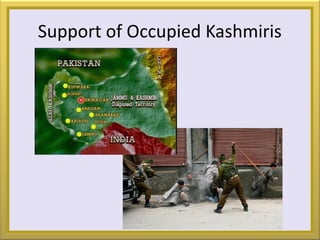
Kashmir Issue
• India and Pakistan have fought at least three
wars over Kashmir
• Indo-Pakistani Wars of 1947, 1965, 1999
• Pakistan Believes that the international
Community, in particular the United Nations and
the major powers , have an important role to
play in persuading India to stop it repression
against the Kashmiris and respect human rights.
• More than 65,000 Kashmiris have been martyred
and over 90,000 are missing.
Support of Occupied Kashmiris
Relation with Muslim Countries
Nuclear Issue
Elements Affecting Foreign Policy
• The political organization found in a country also
greatly influences the foreign policy. For example
under authoritarian systems quick foreign policy
decisions are taken.
• The press also plays a vital role in foreign policy
formulation process.
• The nature of political accountability prevailing in a
system also greatly influence the foreign policy of the
state.
• The leadership also plays a vital role in the shaping of a
country’s foreign policy.
• The great power structure prevailing in the world
politics also greatly influence the policy of a country.
Determinants of Pakistan’s Foreign
Policy
 Administrative Troika
1. President
2. Prime Minister
3. Chief of Army Staff
 Ministry of Foreign Affairs
 Intelligence Agencies
 Political Parties and Pressure Groups
 Parliament
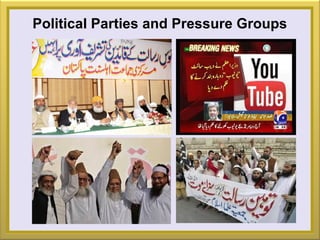
Political Parties and Pressure Groups
Pakistan’s Relations with other
countries
Pakistan has good foreign relations with China, Iran,
Saudi Arabia and other countries of the Persian Gulf.
Pakistan has complicated and inconsistent relations
with the United States.
Relations between Pakistan and India have not been
great historically, but they are moving in the right
direction of late.
Relations between Pakistan and Russia have improved
over the past year or so. This has been a major
success in our foreign policy.
Thank You

Pakistan Foreign Policy Non-Alignment Era

  • 1.
    PREPARED BY: ANUM CHAUDHARY PakistanForeign Policy Non-Alignment Era
  • 2.
    Foreign Policy • Everynation adopts an attitude and mode of action towards other states which suits its peculiar circumstances and interests.
  • 3.
    What is ForeignPolicy? “The foreign policy is establishment and development of relations with other countries in order to protect the national interests by taking appropriate steps at international level.”
  • 4.
    Description of ForeignPolicy • "The foreign policy of a country is in a sense a projection of its internal policies i.e. social, political and economic." BY: F.M. Muhammad Ayub Khan • Foreign policy dictates how a country will act with respect to other countries politically, socially, economically, and militarily, and to a somewhat lesser extent, how it behaves towards non- state actors.
  • 5.
    PAKISTAN 'S FOREIGNPOLICY Pakistan 's foreign policy is guided by its history, geographical location and the aspiration of its people. It is also responsive to regional and international imperatives. Given the persistent challenges, Pakistan has opted for a proactive foreign policy. While there are elements of continuity in the foreign policy, as they should be, there is also a change of emphasis and nuance. The essence of Pakistan's Foreign Policy are:-
  • 6.
    • Develop friendlyrelations with all countries particularly the Muslim world, major powers and immediate neighbors. • Safeguard vital security and geo-strategic interests of Pakistan. • Resolve the core issue of Jammu and Kashmir in accordance with the resolutions of the UN Security Council and wishes of the Kashmiri people. • Promote the image of Pakistan as a strong, dynamic, progressive, moderate and democratic Islamic country. • Augment economic and commercial interests abroad. • Protect the interests of Pakistan 's expatriate community abroad.
  • 7.
    Quaid’s Vision onforeign policy of Pakistan • Our foreign policy is one of friendliness and goodwill towards all the nations of the world. • We do not cherish aggressive designs against any country or nation. • We believe in the principle of honesty and fair play in national and international dealings and are prepared to make our utmost contribution to the promotion of peace and prosperity among the nations of the world. • Pakistan will never be found lacking in extending its material and moral support to the oppressed and suppressed peoples of the world, and in upholding the principles of the United Nations Charter."
  • 8.
    Principles Of PakF.P - In vision of Quaid 1. Peaceful Co-existence 2. Non-Alignment 3. Unite Nations Charter 4. Bilateralism 5. Support to Right of Self-Determination 6. Unity of Islamic World 7. De- Weaponisation 8. Establishment of Peace 9. Good Relations with Neighbours 10.International and Regional Cooperation
  • 9.
    Objectives of Pakistan’sForeign Policy • Safeguard of National Integrity • Defense of ideological frontiers • Economic development • National honour • Respect for international law • Implementation of accords • Friendly relation with Muslim Countries
  • 10.
    Foreign Policy MakingAgencies of Pakistan • Administrative Troika 1. President 2. Prime Minister 3. Chief of Army Staff • Ministry of Foreign Affairs • Intelligence Agencies • Political Parties and Pressure Groups • Parliament
  • 11.
    Phases of ForeignPolicy of Pakistan • Phase – I: 1947-53: Non Aliened years • Phase – II: 1953-62: Alliance with the West • Phase – III: 1962-1971 Transition • Phase – IV: 1971-1979 Bilateralism and nonalignment • Phase – V: 1980-90 Afghan-Crisis and US Ally • Phase – VI: 1990-2001: Post-Cold War Era Pakistan’s Dilemmas • Phase –VII: 2001-Date: Pakistan and Counter Terrorism
  • 12.
    1972-1979 Bilateralism and Non-alignment •Pakistan withdrew from commonwealth and SEATO. • Became a member of Non-allied summit in 1979. • East –Pakistan break up as a separate state. • India signed a peace agreement with Pakistan due to this break up. • Pakistan ties their relationship with China. • Zulfiqar Ali Bhutto also visited United States with intention to strengthen the relationship between two countries. • Due to Pakistan’s nuclear project and burning down US embassy in 1979 their relationship was put to lowest point.
  • 13.
    Kashmir Issue • Indiaand Pakistan have fought at least three wars over Kashmir • Indo-Pakistani Wars of 1947, 1965, 1999 • Pakistan Believes that the international Community, in particular the United Nations and the major powers , have an important role to play in persuading India to stop it repression against the Kashmiris and respect human rights. • More than 65,000 Kashmiris have been martyred and over 90,000 are missing.
  • 14.
  • 15.
  • 16.
  • 18.
    Elements Affecting ForeignPolicy • The political organization found in a country also greatly influences the foreign policy. For example under authoritarian systems quick foreign policy decisions are taken. • The press also plays a vital role in foreign policy formulation process. • The nature of political accountability prevailing in a system also greatly influence the foreign policy of the state. • The leadership also plays a vital role in the shaping of a country’s foreign policy. • The great power structure prevailing in the world politics also greatly influence the policy of a country.
  • 19.
    Determinants of Pakistan’sForeign Policy  Administrative Troika 1. President 2. Prime Minister 3. Chief of Army Staff  Ministry of Foreign Affairs  Intelligence Agencies  Political Parties and Pressure Groups  Parliament
  • 20.
    Political Parties andPressure Groups
  • 21.
    Pakistan’s Relations withother countries Pakistan has good foreign relations with China, Iran, Saudi Arabia and other countries of the Persian Gulf. Pakistan has complicated and inconsistent relations with the United States. Relations between Pakistan and India have not been great historically, but they are moving in the right direction of late. Relations between Pakistan and Russia have improved over the past year or so. This has been a major success in our foreign policy.
  • 22.