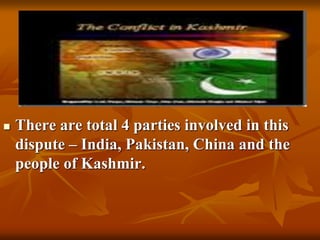
 There are total 4 parties involved in this
dispute – India, Pakistan, China and the
people of Kashmir.
India occupied kashmir
• Indian occupied Kashmir can be divided into
• three parts :
• Jammu (which consist of Hindu population;
• the Kashmiri pundits)
• The Kashmir valley (which consist of 90%
• Muslim population)
• The Leh Ladakh belt which consist of the
• Buddhist monks or people following
• Buddhism
• www.gkquizzitive.wordpress.com
Capital of jammu and kashmir Capital of azad kashmir
Partition and dispute
 Before Independence from British in 1947 from
1820, Kashmir was ruled by the Maharaja of
Kashmir who was Hindu although the majority of
the population were Muslim.
The Problem
• The Kashmir area was
predominantly Muslim.
• The ruler of Kashmir fled to
India and agreed to place
Kashmir under Indian rule if
India would protect Kashmir
from invasion.
• If there had been a vote in
Kashmir, the majority
probably would have voted
to become part of Pakistan
for religious reasons.
PROPAGANDA
Lord mount batten Red cliff
HARI SINGH
Mahraja Hari singh
• The princely state of Kashmir had a Hindu
• King (Maharaja Hari Singh) and 78% Muslim
• population
• Lord Mountbatten gave the king an option of
• either joining India or Pakistan before 15th
• August 1947
• The king was unsure so asked for more time
• He however asked both India and Pakistan to
• sign a standstill agreement
• Pakistan accepted but India refused
• www.gkquizzitive.wordpress.com
• The people in the state protested against
the king’s indecisiveness
• Some of them wanted accession with
Pakistan
• A reaction to the protest the king asked
his troops to open fire on the people
War
• Three major wars between
India and Pakistan have
been fought over the
Kashmir territory
– 1947-1948
– 1965
– 1971
• A fourth war almost took
place when Pakistan
invaded and attempted to
capture Kargil.
The Importance of Kashmir to India and Pakistan
• The geography is mostly
rural, with large
mountains, deserts, and
valleys.
• The region could have
natural resources such
as oil, gold, or silver
that has not yet been
discovered.
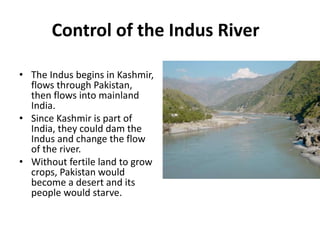
Control of the Indus River
• The Indus begins in Kashmir,
flows through Pakistan,
then flows into mainland
India.
• Since Kashmir is part of
India, they could dam the
Indus and change the flow
of the river.
• Without fertile land to grow
crops, Pakistan would
become a desert and its
people would starve.
FRANK MASSERVY
• A large number of Muslim population was
• killed in the violence
• A reaction to these killings the Pathan
• tribesmen from the North West frontier
• province invaded Kashmir
• They defeated the king’s troops and
reached the capital Srinagar
• www.gkquizzitive.wordpress.com
• The king fled to Jammu and asked India
for help against the onslaught
• India agreed only on the condition of
• accession
• Hence the king on 26th Oct 1947 signed
the accession agreement with India
• India airlifted her troops to Kashmir
• The Pakistan army was stunned and
wanted to fight back
• However when India observe that they will
lose the war then after the death of Quiad-
e-Azam they move toward security council
• www.gkquizzitive.wordpress.com
Security council
• Security council : India blamed Pakistan of
• aggression
• While Pakistan blamed India for the forced
• accession of Kashmir to India
• When the talks were still on India send her
• troops to drive away the tribesman from the
• occupied land
• Pakistan also retaliated and a full on war
• ensured
• The UN security council intervened and urged
• the two countries to declare a cease fire
• www.gkquizzitive.wordpress.com
• On August 13th 1948 urged for a cease fire
• agreement between the two countries
• Withdrawal of troops
• A cease fire line demarcates And a
plebiscite in Kashmir under the UN
supervision
• Both the countries accepted this proposal
• www.gkquizzitive.wordpress.com
Tashkent agreement
• The war of 1965 was perhaps one of the most
• intense wars the two neighbours ever fought.
• Pakistan attacked India in operation code named
• Gibraltar on August 5, 1965.
• The war was at a point of stalemate when the UN
• Security Council unanimously passed a resolution
• on September 20 that called for a ceasefire.
• New Delhi and Islamabad accepted the ceasefire,
• and the war ended on September 23.
• Tashkent Declaration was signed on January 10,
• 1966
• www.gkquizzitive.wordpress.com
Tashkent agreement
 Indian Prime Minister, Lal Bhadur Shastri, and
Pakistani President, M Ayub Khan, signed the Tashkent
agreement on January 10, 1966.
A meeting was held in Tashkent in
the USSR (now in Uzbekistan) beginning
on January 4, 1966 to try to create a more
permanent settlement.
Indian and Pakistani forces would pull back
totheir pre-conflict positions
The nations would not interfere in each
other's internal affairs
 Economic and diplomatic relations would
berestored
 The two leaders would work towards
building good relations between the two
countries.
 www.gkquizzitive.wordpress.com
• The 1971 Indo-Pak war initially started as
a civil war in East Pakistan .
• The revolt began in 1970,due to ganeral
elections
Simla Agreement
 In 1971 a third war, resulting in
the formation of Bangladesh was
broken out and India declared
war on December 3, 1971. When
Indians entered 50 km into the
area of Pakistan, a ceasefire was
reached.
 In 1972 Indira Gandhi, the Indian
prime minister, and Zulfikar Ali
Bhutto signed the Simla
Agreement, which repeated the
promises made in Tashkent.
18 May 1974
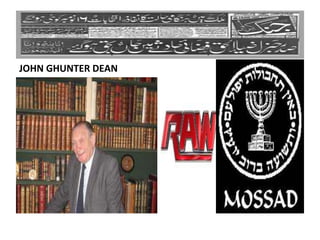
JOHN GHUNTER DEAN
Nuclear Tests
 India and Pakistan both tested nuclear devices in 1998,
and then in 1999 test-fired missiles. Than the Indian
Prime Minister, Atal Behari Vajpayee, visited Lahore by
bus in 1999.
Kargil War & Cross-border
troubles
 But, again the cross-LOC firing in Kargil began
during the mid-1998.
 India argued that the infiltrators were trained and
armed by Pakistan, and based in "Azad Kashmir"
with the full knowledge of the Pakistani government.
Pakistan said that they were freedom fighters (!)
from Kashmir and that it was giving only moral
support.
War and Terrorism
• Both India and Pakistan are convinced that they
are right and that they will prevail
• In the past 60 years, Pakistan and India have
fought three wars over ownership of Kashmir.
India won all three.
• Today, the fight continues with acts of terrorism.
• The people of Kashmir are probably wondering
why the UN and U.S. won't help them
Why doesn't the U.S. lend a helping hand
with the Kashmir conflict?
• The U.S. wants to be
allies with both Pakistan
and India.
• Pakistan shares a border
with Afghanistan so need
Pakistan’s help with war
on terrorism.
• We do a great deal of
trade with India that is
mutually advantageous.
Our Position
• We believe that Kashmir must become an
independent state
• The United Nations must take a proactive role in
securing Kashmiri sovereignty
Conclusion
• Greater understanding of this conflict---history and
developments
• The necessity of resolving this conflict, as well as
potential solutions
• The important role that the UN has in mediating the
situation

Kashmir issue

  • 2.
     There aretotal 4 parties involved in this dispute – India, Pakistan, China and the people of Kashmir.
  • 6.
    India occupied kashmir •Indian occupied Kashmir can be divided into • three parts : • Jammu (which consist of Hindu population; • the Kashmiri pundits) • The Kashmir valley (which consist of 90% • Muslim population) • The Leh Ladakh belt which consist of the • Buddhist monks or people following • Buddhism • www.gkquizzitive.wordpress.com
  • 7.
    Capital of jammuand kashmir Capital of azad kashmir
  • 8.
    Partition and dispute Before Independence from British in 1947 from 1820, Kashmir was ruled by the Maharaja of Kashmir who was Hindu although the majority of the population were Muslim.
  • 9.
    The Problem • TheKashmir area was predominantly Muslim. • The ruler of Kashmir fled to India and agreed to place Kashmir under Indian rule if India would protect Kashmir from invasion. • If there had been a vote in Kashmir, the majority probably would have voted to become part of Pakistan for religious reasons.
  • 13.
  • 16.
  • 17.
    Mahraja Hari singh •The princely state of Kashmir had a Hindu • King (Maharaja Hari Singh) and 78% Muslim • population • Lord Mountbatten gave the king an option of • either joining India or Pakistan before 15th • August 1947 • The king was unsure so asked for more time • He however asked both India and Pakistan to • sign a standstill agreement • Pakistan accepted but India refused • www.gkquizzitive.wordpress.com
  • 18.
    • The peoplein the state protested against the king’s indecisiveness • Some of them wanted accession with Pakistan • A reaction to the protest the king asked his troops to open fire on the people
  • 20.
    War • Three majorwars between India and Pakistan have been fought over the Kashmir territory – 1947-1948 – 1965 – 1971 • A fourth war almost took place when Pakistan invaded and attempted to capture Kargil.
  • 22.
    The Importance ofKashmir to India and Pakistan • The geography is mostly rural, with large mountains, deserts, and valleys. • The region could have natural resources such as oil, gold, or silver that has not yet been discovered.
  • 23.
    Control of theIndus River • The Indus begins in Kashmir, flows through Pakistan, then flows into mainland India. • Since Kashmir is part of India, they could dam the Indus and change the flow of the river. • Without fertile land to grow crops, Pakistan would become a desert and its people would starve.
  • 24.
  • 25.
    • A largenumber of Muslim population was • killed in the violence • A reaction to these killings the Pathan • tribesmen from the North West frontier • province invaded Kashmir • They defeated the king’s troops and reached the capital Srinagar • www.gkquizzitive.wordpress.com
  • 26.
    • The kingfled to Jammu and asked India for help against the onslaught • India agreed only on the condition of • accession • Hence the king on 26th Oct 1947 signed the accession agreement with India
  • 28.
    • India airliftedher troops to Kashmir • The Pakistan army was stunned and wanted to fight back • However when India observe that they will lose the war then after the death of Quiad- e-Azam they move toward security council • www.gkquizzitive.wordpress.com
  • 30.
    Security council • Securitycouncil : India blamed Pakistan of • aggression • While Pakistan blamed India for the forced • accession of Kashmir to India • When the talks were still on India send her • troops to drive away the tribesman from the • occupied land • Pakistan also retaliated and a full on war • ensured • The UN security council intervened and urged • the two countries to declare a cease fire • www.gkquizzitive.wordpress.com
  • 31.
    • On August13th 1948 urged for a cease fire • agreement between the two countries • Withdrawal of troops • A cease fire line demarcates And a plebiscite in Kashmir under the UN supervision • Both the countries accepted this proposal • www.gkquizzitive.wordpress.com
  • 34.
    Tashkent agreement • Thewar of 1965 was perhaps one of the most • intense wars the two neighbours ever fought. • Pakistan attacked India in operation code named • Gibraltar on August 5, 1965. • The war was at a point of stalemate when the UN • Security Council unanimously passed a resolution • on September 20 that called for a ceasefire. • New Delhi and Islamabad accepted the ceasefire, • and the war ended on September 23. • Tashkent Declaration was signed on January 10, • 1966 • www.gkquizzitive.wordpress.com
  • 35.
    Tashkent agreement  IndianPrime Minister, Lal Bhadur Shastri, and Pakistani President, M Ayub Khan, signed the Tashkent agreement on January 10, 1966.
  • 36.
    A meeting washeld in Tashkent in the USSR (now in Uzbekistan) beginning on January 4, 1966 to try to create a more permanent settlement. Indian and Pakistani forces would pull back totheir pre-conflict positions The nations would not interfere in each other's internal affairs
  • 37.
     Economic anddiplomatic relations would berestored  The two leaders would work towards building good relations between the two countries.  www.gkquizzitive.wordpress.com
  • 40.
    • The 1971Indo-Pak war initially started as a civil war in East Pakistan . • The revolt began in 1970,due to ganeral elections
  • 42.
    Simla Agreement  In1971 a third war, resulting in the formation of Bangladesh was broken out and India declared war on December 3, 1971. When Indians entered 50 km into the area of Pakistan, a ceasefire was reached.  In 1972 Indira Gandhi, the Indian prime minister, and Zulfikar Ali Bhutto signed the Simla Agreement, which repeated the promises made in Tashkent.
  • 43.
  • 46.
  • 47.
    Nuclear Tests  Indiaand Pakistan both tested nuclear devices in 1998, and then in 1999 test-fired missiles. Than the Indian Prime Minister, Atal Behari Vajpayee, visited Lahore by bus in 1999.
  • 49.
    Kargil War &Cross-border troubles  But, again the cross-LOC firing in Kargil began during the mid-1998.  India argued that the infiltrators were trained and armed by Pakistan, and based in "Azad Kashmir" with the full knowledge of the Pakistani government. Pakistan said that they were freedom fighters (!) from Kashmir and that it was giving only moral support.
  • 58.
    War and Terrorism •Both India and Pakistan are convinced that they are right and that they will prevail • In the past 60 years, Pakistan and India have fought three wars over ownership of Kashmir. India won all three. • Today, the fight continues with acts of terrorism. • The people of Kashmir are probably wondering why the UN and U.S. won't help them
  • 59.
    Why doesn't theU.S. lend a helping hand with the Kashmir conflict? • The U.S. wants to be allies with both Pakistan and India. • Pakistan shares a border with Afghanistan so need Pakistan’s help with war on terrorism. • We do a great deal of trade with India that is mutually advantageous.
  • 60.
    Our Position • Webelieve that Kashmir must become an independent state • The United Nations must take a proactive role in securing Kashmiri sovereignty
  • 61.
    Conclusion • Greater understandingof this conflict---history and developments • The necessity of resolving this conflict, as well as potential solutions • The important role that the UN has in mediating the situation