PAINTS AND ITS TYPE
Specification and
Estimation
(MATERIAL)
PAINTS
 PAINT IS ANY LIQUID OR MASTIC COMPOSITION THAT
AFTER APPLICATION TO A SUBSTRATE IN THIN LAYER ,
CONVERTS TO A SOLID FILM
• IT IS A SIMPLY PIGMENT SUSPENDED WITH A LIQUID
• IT IS USED TO DECORATE, PROTECT AND PROLONG THE LIFE
OF NATURAL AND SYNTHETIC MATERIALS AND ACTS AS A
BARRIER AGAINST ENVIRONMENTAL CONDITIONS
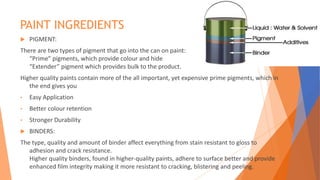
PAINT INGREDIENTS
 PIGMENT:
There are two types of pigment that go into the can on paint:
“Prime” pigments, which provide colour and hide
“Extender” pigment which provides bulk to the product.
Higher quality paints contain more of the all important, yet expensive prime pigments, which in
the end gives you
• Easy Application
• Better colour retention
• Stronger Durability
 BINDERS:
The type, quality and amount of binder affect everything from stain resistant to gloss to
adhesion and crack resistance.
Higher quality binders, found in higher-quality paints, adhere to surface better and provide
enhanced film integrity making it more resistant to cracking, blistering and peeling.
Variety of binders used today.
Latex paint contain either 100% acrylic, styrene acrylic or vinyl binders, while oil
paints typically contain linseed oil, soya oil or modified oils called alkyds.
 LIQUIDS/SOLVENTS:
The liquids provide no added performance benefits. Its simply the “carrier” that
allows to get paint from can to surface.
Higher quality paints have greater ratio of solids (pigments and binder) to liquids,
while cheaper are water downed with liquid.
 ADDITIVES:
These ingredients gives paint a specific benefit that it might not have otherwise have.
Additives such as rheology modifiers ( provides better hide and durability) and
mildewcides (keeps mildew in check) are common additives found in higher ends
paints.
Others include dispersing agents (keeps the pigment evenly distributed) and
preservatives.
PROPERTIES
 EASE OF APPLICATIONGOOD FLOW OUT OF APPLICATION MARKS
 FORMING A CONTINUOUS PROTECTIVE FILM
 HIGH OPACITY
 QUICK DRYING
 CORROSION, WATER AND HEAT RESISTANCE
 COLOUR STABILITY
 ABRASION AND SCRATCH RESISTANCE
 DURABILITY
 FLEXIBILITY
 EASILY CLEANED
SPECIFICATIONS OF CEMENT BASED PAINT
 IT CONSISTS OF PORTLAND CEMENT AND OTHER INGREDIENTS LIKE LIME,
PIGMENTS, HYDROSCOPIC SALTS, WATER REPELLANTS, FUNGICIDES ETC.
 COMPOSITION
PORTLAND CEMENT 65%
HYDRATED LIME 25%
AND OTHER INGREDIENTS IN SUITABLE PROPORTIONS
 THE MATERIAL SHALL BE FREE FROM ORGANIC BINDERS
 THE MATERIAL SHALL BE IN THE POWDER FORM, FREE FROM LUMPS
WHEN MIXED WITH WATER
 DURABILITY: When prepared and tested for normal outdoor exposure a
general breakdown of the film prepared from the registered sample shall
not occur in less than 18 months
 PACKING: THE DRY MATERIAL SHALL BE PACKED IN POLYTHENE BAGS IN
SUITABLE METAL/ PLASTICC CONTAINERS
 MARKING: EACH CONTAINER SHALL BE MARKED WITH
 NAME OF THE MATERIAL
 INDICATION OF THE SOURCE OF MANUFACTURE
 MASS OF THE MATERIAL
 MONTH AND YEAR OF MANUFACTURE
CHARACTER REQUIREMENT
• DRYING TIME AND RECOATING PROPERTIES NOT MORE THAN 24
HOURS
• FINISH SMOOTH AND MALT
• COLOUR CLOSE MATCH TO THE
SPECIFIED IS CODE
COLOUR
TERMINOLOGY
For the purpose of this standard the definitions given in IS 1303 and the following
shall apply.
 Volatile Organic Compounds (VOC) — The volatile matter content minus the
water content in plastic emulsion paint.
 Matt Finish — having gloss values from O to 10, when viewed at 60°.
 Egg Shell/Satin Finish — having gloss values from 11 to 25, when viewed at
60°.
 Semi-glossy Finish — having gloss values from 26 to 70, when viewed at 60°.
 Glossy Finish — having gloss values 71 and above, when viewed at 60°.
TYPES
 Plastic emulsion paint shall be of two types:
 a) Type 1 For interior use, and b) Type 2 For exterior use.
CLASS
 There shall be following four classes of products:
 a) Matt finish, b) Egg shell/satin finish, c) Semi-glossy finish, and d) Glossy
finish.
SPECIFICATIONS OF PLASTIC EMULSION
PAINT
 COMPOSTION
THE MATERIAL SHALL CONSISTS OF PIGMENTS AND IF REQUIRED SUITABLE
EXTENDERS IN APPROPRIATE PROPORTION IN A MEDIUM CONSISTING OF
ANY STABLE SYNTHETIC POLYMER EMULSION IN WATER WITH OTHER
SUITABLE INGREDIENTS AS MAY BE NECESSARY TO PRODUCE A MATERIAL
SO AS TO SATISFY THE REQUIREMENTS
 CONDITIONS IN THE CONTAINER
THE MATERIAL SHALL BE FREE FROM ODOUR OF PUTREFACTION. IT SHALL BE
FREE FROM LUMPS, SKINS AND THE CONDITIONS OF THE MATERIAL SHALL
BE SUCH THAT SETTLING, IF ANY, MAYBE EASILY INCORPORATED ON
STIRRING.
 THRONING
WHEN SUITABLY THINNED WITH WATER, THE MATERIAL SHALL MIX READILY
WITH MINIMUM AMOUNT OF FOAMING TO A SMOOTH AND
HOMOGENEOUS STATE. THE FOAMING, IF ANY, SHALL DISSIPATE RAPIDLY.
 APPLICATION PROPERTIES
THE MATERIAL AFTER RECOMMENDED THINNING SHALL BE SUITABLE FOR APPLICATION
BY BRUSH, SPRAY OR ROLLER. THE RESULTING FILM SHALL NOT SHOW PIGMENT
FLOCCULATION, COARSENESS OR OTHER UNDESIRABLE CHARACTERISTICS.
 RECOATING PROPERTIES
WHEN THREE SUCCESSIVE COATS OF THE MATERIAL, AFTER SUITABLE THINNING WITH
WATER, ARE APPLIED ON A DRY ASBESTOS CEMENT SHEET (SEE IS 20%) AT AN
INTERVAL OF 4 H FOR CLASSES A AND B MATERIAL AND 8 H FOR CLASSES C AND D
MATERIAL BETWEEN COATS, THERE SHALL BE NO LIFTING OF THE UNDERLYING COATS.
THE PAINT SHALL NOT EXHIBIT COLOUR SEPARATION, SAGGING, PITTING, FLAKING OR
CRACKING.
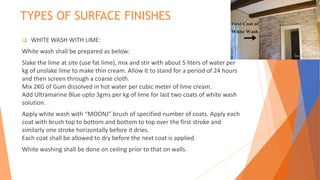
TYPES OF SURFACE FINISHES
 WHITE WASH WITH LIME:
White wash shall be prepared as below:
Slake the lime at site (use fat lime), mix and stir with about 5 liters of water per
kg of unslake lime to make thin cream. Allow it to stand for a period of 24 hours
and then screen through a coarse cloth.
Mix 2KG of Gum dissolved in hot water per cubic meter of lime cream.
Add Ultramarine Blue upto 3gms per kg of lime for last two coats of white wash
solution.
Apply white wash with “MOONJ” brush of specified number of coats. Apply each
coat with brush top to bottom and bottom to top over the first stroke and
similarly one stroke horizontally before it dries.
Each coat shall be allowed to dry before the next coat is applied.
White washing shall be done on ceiling prior to that on walls.
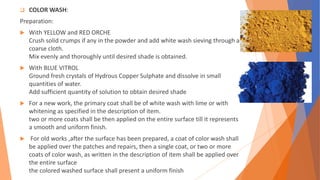
 COLOR WASH:
Preparation:
 With YELLOW and RED ORCHE
Crush solid crumps if any in the powder and add white wash sieving through a
coarse cloth.
Mix evenly and thoroughly until desired shade is obtained.
 With BLUE VITROL
Ground fresh crystals of Hydrous Copper Sulphate and dissolve in small
quantities of water.
Add sufficient quantity of solution to obtain desired shade
 For a new work, the primary coat shall be of white wash with lime or with
whitening as specified in the description of item.
two or more coats shall be then applied on the entire surface till it represents
a smooth and uniform finish.
 For old works ,after the surface has been prepared, a coat of color wash shall
be applied over the patches and repairs, then a single coat, or two or more
coats of color wash, as written in the description of item shall be applied over
the entire surface
the colored washed surface shall present a uniform finish
 HIRAMCHI: (RED ORCHE) WASH
Mix Himarchi, cement, surkhi (100 mesh) and water in the proportion of
3:2:5:125 by volume. Dry mix the powder and add water. Apply mixture by
brush.
 CEMENT SLURRY WASH:
Mix cement with water to form slurry to the consistency of ready mixed oil
paint and apply with brushes to form a smooth bedded opaque surface.
 DRY DISTEMPER:
Apply priming coat of white in case of new work.
Prep. Of distemper
Add 0.6 litre of water per 10N of Distemper. Allow to stand for 30 mins.
Apply prepared distemper minimum 2 coats, with proper distemper
brushes.
 OIL BOUND DISTEMPER:
Dilute distemper in water as recommended by the manufacturer. After
primer coat has dried up apply min two coats with brushes in horizontal and
vertical strokes
 WATER PROOF CEMENT PAINT:
Portland cement paints are made readily by adding paint powder in water
and stirring to obtain a thick paint which shall be diluted to brush able
consistency.
Generally equal volume of paint powder and water make a satisfactory paint.
Apply cement paint with relatively short stiff hog or fiber bristle. Waster
proof cement paint is not to be used on surfaces already treated with white
wash, colour wash, distemper dry or all bound.
Curing is to be done by sprinkling water two or three times a day.
 WHITE WASHING WITH CHALK WASHING
To 25 N of whiting add 2.5 N of Glue and add enough water to cover the
mixture. Leave it to cool till it becomes jelly.
In case of Hessaian ceiling. On no account lime shall be used.
THE FINISHED DRY SURFACE SHALL NOT BE POWDERY AND SHALL NOT
READILY COME OFF ON THE HAND WHEN RUBBED
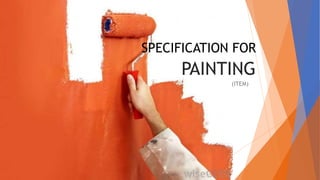
PAINTING
(ITEM)
SPECIFICATION FOR
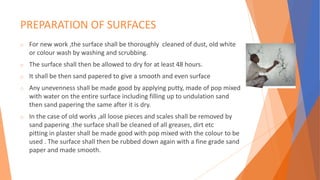
PREPARATION OF SURFACES
o For new work ,the surface shall be thoroughly cleaned of dust, old white
or colour wash by washing and scrubbing.
o The surface shall then be allowed to dry for at least 48 hours.
o It shall be then sand papered to give a smooth and even surface
o Any unevenness shall be made good by applying putty, made of pop mixed
with water on the entire surface including filling up to undulation sand
then sand papering the same after it is dry.
o In the case of old works ,all loose pieces and scales shall be removed by
sand papering .the surface shall be cleaned of all greases, dirt etc
pitting in plaster shall be made good with pop mixed with the colour to be
used . The surface shall then be rubbed down again with a fine grade sand
paper and made smooth.
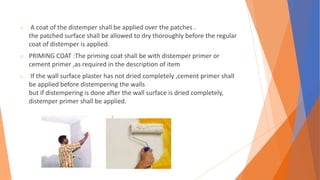
o A coat of the distemper shall be applied over the patches .
the patched surface shall be allowed to dry thoroughly before the regular
coat of distemper is applied.
o PRIMING COAT :The priming coat shall be with distemper primer or
cement primer ,as required in the description of item
o If the wall surface plaster has not dried completely ,cement primer shall
be applied before distempering the walls
but if distempering is done after the wall surface is dried completely,
distemper primer shall be applied.
THE VARIOUS REQUIREMENTS FOR SURFACE
FINISHING ARE:
 CLEARCOLLE.
This is prepared from glue and boiling water in proportion of 1kg of glue
to every 15 litres of water
 LIME.
Lime used for white washing shall b class C (fat lime)
 WATER
 GUM.
Best quality to be used
INTERIOR PAINTS-INTRODUCTION
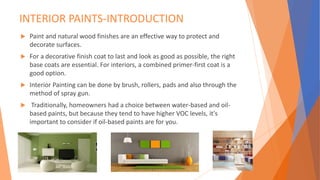
 Paint and natural wood finishes are an effective way to protect and
decorate surfaces.
 For a decorative finish coat to last and look as good as possible, the right
base coats are essential. For interiors, a combined primer-first coat is a
good option.
 Interior Painting can be done by brush, rollers, pads and also through the
method of spray gun.
 Traditionally, homeowners had a choice between water-based and oil-
based paints, but because they tend to have higher VOC levels, it's
important to consider if oil-based paints are for you.
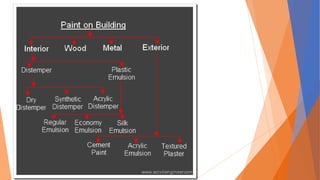
TYPES OF INTERIOR PAINTS
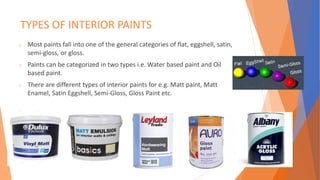
o Most paints fall into one of the general categories of flat, eggshell, satin,
semi-gloss, or gloss.
o Paints can be categorized in two types i.e. Water based paint and Oil
based paint.
o There are different types of interior paints for e.g. Matt paint, Matt
Enamel, Satin Eggshell, Semi-Gloss, Gloss Paint etc.
ADVANTAGES OF WATER-BASED PAINTS
• low VOCs
• easy cleanup with water
• quick drying
• an elastic, flexible finish resistant to cracking
• stable color over time, without yellowing
ADVANTAGES OF OIL-BASED PAINTS
• attractive gloss
• good "leveling" (brush strokes fill themselves in to create a smooth finish)
• hard, durable finish.
Oil Based Paints are popular for glossy woodwork, doors, and furniture, as
well as demanding surfaces such as floors.
Be cautious when switching to a water-based paint if the surface has
previously been coated with an oil-based product, as the new paint may not
stick. In this situation, washing the surface and then roughening it all over
with a medium to smooth grit sandpaper—making it clean, dry, and dull in
order to prevent peeling of the new coat.
FOR PLASTERING SKIM PLASTER,LINED
WALLS
 When applying over a porous surface, mix wall and ceiling primer and
undercoat with upto 20% water to make a diluted coat. This will seal the
surface and promote adhesion.
 Dilution rate will depend on the porosity of the surface. A rear patch is
required to determine the correct dilution rate.
 Finish with a full coat of wall and ceiling and undercoat to enhance the top
coat color.
FOR GLOSSY OR OIL BASED SURFACE
 Sand down and then clean with a detergent.
 Apply one full coat of wall and ceiling primer and undercoat to promote
adhesion and enhance the top coat colour.
 For plaster surface which are porous, chalky or slightly degraded but
otherwise structurally sound, apply one coat of farrow and ball masonry
and plaster stabilizing primer.
APPLICATION METHODS OF PAINTS
 Although latex- and oil-based paints can be applied with rollers or pads as well as brushes,
cleaning them after using oil paints is difficult and will require lots of white spirit or
thinner.
 Primer
Use a brush, roller or pad.
 First Coat
Use a brush, roller or pad.
 Flat
Use a brush, roller, pad or sprayer.
 When using more than one tin of the same colour check if the batch numbers are the
same.
 Stir paint thoroughly before use.
 Apply two coats using a brush or roller. On application of the final coat lay
off the paint in a single direction.
 Estate emulsion modern emulsions, dead flat, full gloss and estate
eggshell as eggshell are dry in two hours and can be recoated in four
hours.
 Clean brushes and rollers with warm soapy water.

Paints

  • 1.
    PAINTS AND ITSTYPE Specification and Estimation (MATERIAL)
  • 2.
    PAINTS  PAINT ISANY LIQUID OR MASTIC COMPOSITION THAT AFTER APPLICATION TO A SUBSTRATE IN THIN LAYER , CONVERTS TO A SOLID FILM • IT IS A SIMPLY PIGMENT SUSPENDED WITH A LIQUID • IT IS USED TO DECORATE, PROTECT AND PROLONG THE LIFE OF NATURAL AND SYNTHETIC MATERIALS AND ACTS AS A BARRIER AGAINST ENVIRONMENTAL CONDITIONS
  • 3.
    PAINT INGREDIENTS  PIGMENT: Thereare two types of pigment that go into the can on paint: “Prime” pigments, which provide colour and hide “Extender” pigment which provides bulk to the product. Higher quality paints contain more of the all important, yet expensive prime pigments, which in the end gives you • Easy Application • Better colour retention • Stronger Durability  BINDERS: The type, quality and amount of binder affect everything from stain resistant to gloss to adhesion and crack resistance. Higher quality binders, found in higher-quality paints, adhere to surface better and provide enhanced film integrity making it more resistant to cracking, blistering and peeling.
  • 4.
    Variety of bindersused today. Latex paint contain either 100% acrylic, styrene acrylic or vinyl binders, while oil paints typically contain linseed oil, soya oil or modified oils called alkyds.  LIQUIDS/SOLVENTS: The liquids provide no added performance benefits. Its simply the “carrier” that allows to get paint from can to surface. Higher quality paints have greater ratio of solids (pigments and binder) to liquids, while cheaper are water downed with liquid.  ADDITIVES: These ingredients gives paint a specific benefit that it might not have otherwise have. Additives such as rheology modifiers ( provides better hide and durability) and mildewcides (keeps mildew in check) are common additives found in higher ends paints. Others include dispersing agents (keeps the pigment evenly distributed) and preservatives.
  • 5.
    PROPERTIES  EASE OFAPPLICATIONGOOD FLOW OUT OF APPLICATION MARKS  FORMING A CONTINUOUS PROTECTIVE FILM  HIGH OPACITY  QUICK DRYING  CORROSION, WATER AND HEAT RESISTANCE  COLOUR STABILITY  ABRASION AND SCRATCH RESISTANCE  DURABILITY  FLEXIBILITY  EASILY CLEANED
  • 7.
    SPECIFICATIONS OF CEMENTBASED PAINT  IT CONSISTS OF PORTLAND CEMENT AND OTHER INGREDIENTS LIKE LIME, PIGMENTS, HYDROSCOPIC SALTS, WATER REPELLANTS, FUNGICIDES ETC.  COMPOSITION PORTLAND CEMENT 65% HYDRATED LIME 25% AND OTHER INGREDIENTS IN SUITABLE PROPORTIONS  THE MATERIAL SHALL BE FREE FROM ORGANIC BINDERS  THE MATERIAL SHALL BE IN THE POWDER FORM, FREE FROM LUMPS WHEN MIXED WITH WATER  DURABILITY: When prepared and tested for normal outdoor exposure a general breakdown of the film prepared from the registered sample shall not occur in less than 18 months
  • 8.
     PACKING: THEDRY MATERIAL SHALL BE PACKED IN POLYTHENE BAGS IN SUITABLE METAL/ PLASTICC CONTAINERS  MARKING: EACH CONTAINER SHALL BE MARKED WITH  NAME OF THE MATERIAL  INDICATION OF THE SOURCE OF MANUFACTURE  MASS OF THE MATERIAL  MONTH AND YEAR OF MANUFACTURE CHARACTER REQUIREMENT • DRYING TIME AND RECOATING PROPERTIES NOT MORE THAN 24 HOURS • FINISH SMOOTH AND MALT • COLOUR CLOSE MATCH TO THE SPECIFIED IS CODE COLOUR
  • 9.
    TERMINOLOGY For the purposeof this standard the definitions given in IS 1303 and the following shall apply.  Volatile Organic Compounds (VOC) — The volatile matter content minus the water content in plastic emulsion paint.  Matt Finish — having gloss values from O to 10, when viewed at 60°.  Egg Shell/Satin Finish — having gloss values from 11 to 25, when viewed at 60°.  Semi-glossy Finish — having gloss values from 26 to 70, when viewed at 60°.  Glossy Finish — having gloss values 71 and above, when viewed at 60°. TYPES  Plastic emulsion paint shall be of two types:  a) Type 1 For interior use, and b) Type 2 For exterior use. CLASS  There shall be following four classes of products:  a) Matt finish, b) Egg shell/satin finish, c) Semi-glossy finish, and d) Glossy finish.
  • 10.
    SPECIFICATIONS OF PLASTICEMULSION PAINT  COMPOSTION THE MATERIAL SHALL CONSISTS OF PIGMENTS AND IF REQUIRED SUITABLE EXTENDERS IN APPROPRIATE PROPORTION IN A MEDIUM CONSISTING OF ANY STABLE SYNTHETIC POLYMER EMULSION IN WATER WITH OTHER SUITABLE INGREDIENTS AS MAY BE NECESSARY TO PRODUCE A MATERIAL SO AS TO SATISFY THE REQUIREMENTS  CONDITIONS IN THE CONTAINER THE MATERIAL SHALL BE FREE FROM ODOUR OF PUTREFACTION. IT SHALL BE FREE FROM LUMPS, SKINS AND THE CONDITIONS OF THE MATERIAL SHALL BE SUCH THAT SETTLING, IF ANY, MAYBE EASILY INCORPORATED ON STIRRING.  THRONING WHEN SUITABLY THINNED WITH WATER, THE MATERIAL SHALL MIX READILY WITH MINIMUM AMOUNT OF FOAMING TO A SMOOTH AND HOMOGENEOUS STATE. THE FOAMING, IF ANY, SHALL DISSIPATE RAPIDLY.
  • 11.
     APPLICATION PROPERTIES THEMATERIAL AFTER RECOMMENDED THINNING SHALL BE SUITABLE FOR APPLICATION BY BRUSH, SPRAY OR ROLLER. THE RESULTING FILM SHALL NOT SHOW PIGMENT FLOCCULATION, COARSENESS OR OTHER UNDESIRABLE CHARACTERISTICS.  RECOATING PROPERTIES WHEN THREE SUCCESSIVE COATS OF THE MATERIAL, AFTER SUITABLE THINNING WITH WATER, ARE APPLIED ON A DRY ASBESTOS CEMENT SHEET (SEE IS 20%) AT AN INTERVAL OF 4 H FOR CLASSES A AND B MATERIAL AND 8 H FOR CLASSES C AND D MATERIAL BETWEEN COATS, THERE SHALL BE NO LIFTING OF THE UNDERLYING COATS. THE PAINT SHALL NOT EXHIBIT COLOUR SEPARATION, SAGGING, PITTING, FLAKING OR CRACKING.
  • 12.
    TYPES OF SURFACEFINISHES  WHITE WASH WITH LIME: White wash shall be prepared as below: Slake the lime at site (use fat lime), mix and stir with about 5 liters of water per kg of unslake lime to make thin cream. Allow it to stand for a period of 24 hours and then screen through a coarse cloth. Mix 2KG of Gum dissolved in hot water per cubic meter of lime cream. Add Ultramarine Blue upto 3gms per kg of lime for last two coats of white wash solution. Apply white wash with “MOONJ” brush of specified number of coats. Apply each coat with brush top to bottom and bottom to top over the first stroke and similarly one stroke horizontally before it dries. Each coat shall be allowed to dry before the next coat is applied. White washing shall be done on ceiling prior to that on walls.
  • 13.
     COLOR WASH: Preparation: With YELLOW and RED ORCHE Crush solid crumps if any in the powder and add white wash sieving through a coarse cloth. Mix evenly and thoroughly until desired shade is obtained.  With BLUE VITROL Ground fresh crystals of Hydrous Copper Sulphate and dissolve in small quantities of water. Add sufficient quantity of solution to obtain desired shade  For a new work, the primary coat shall be of white wash with lime or with whitening as specified in the description of item. two or more coats shall be then applied on the entire surface till it represents a smooth and uniform finish.  For old works ,after the surface has been prepared, a coat of color wash shall be applied over the patches and repairs, then a single coat, or two or more coats of color wash, as written in the description of item shall be applied over the entire surface the colored washed surface shall present a uniform finish
  • 14.
     HIRAMCHI: (REDORCHE) WASH Mix Himarchi, cement, surkhi (100 mesh) and water in the proportion of 3:2:5:125 by volume. Dry mix the powder and add water. Apply mixture by brush.  CEMENT SLURRY WASH: Mix cement with water to form slurry to the consistency of ready mixed oil paint and apply with brushes to form a smooth bedded opaque surface.  DRY DISTEMPER: Apply priming coat of white in case of new work. Prep. Of distemper Add 0.6 litre of water per 10N of Distemper. Allow to stand for 30 mins. Apply prepared distemper minimum 2 coats, with proper distemper brushes.
  • 15.
     OIL BOUNDDISTEMPER: Dilute distemper in water as recommended by the manufacturer. After primer coat has dried up apply min two coats with brushes in horizontal and vertical strokes  WATER PROOF CEMENT PAINT: Portland cement paints are made readily by adding paint powder in water and stirring to obtain a thick paint which shall be diluted to brush able consistency. Generally equal volume of paint powder and water make a satisfactory paint. Apply cement paint with relatively short stiff hog or fiber bristle. Waster proof cement paint is not to be used on surfaces already treated with white wash, colour wash, distemper dry or all bound. Curing is to be done by sprinkling water two or three times a day.
  • 16.
     WHITE WASHINGWITH CHALK WASHING To 25 N of whiting add 2.5 N of Glue and add enough water to cover the mixture. Leave it to cool till it becomes jelly. In case of Hessaian ceiling. On no account lime shall be used. THE FINISHED DRY SURFACE SHALL NOT BE POWDERY AND SHALL NOT READILY COME OFF ON THE HAND WHEN RUBBED
  • 18.
  • 19.
    PREPARATION OF SURFACES oFor new work ,the surface shall be thoroughly cleaned of dust, old white or colour wash by washing and scrubbing. o The surface shall then be allowed to dry for at least 48 hours. o It shall be then sand papered to give a smooth and even surface o Any unevenness shall be made good by applying putty, made of pop mixed with water on the entire surface including filling up to undulation sand then sand papering the same after it is dry. o In the case of old works ,all loose pieces and scales shall be removed by sand papering .the surface shall be cleaned of all greases, dirt etc pitting in plaster shall be made good with pop mixed with the colour to be used . The surface shall then be rubbed down again with a fine grade sand paper and made smooth.
  • 20.
    o A coatof the distemper shall be applied over the patches . the patched surface shall be allowed to dry thoroughly before the regular coat of distemper is applied. o PRIMING COAT :The priming coat shall be with distemper primer or cement primer ,as required in the description of item o If the wall surface plaster has not dried completely ,cement primer shall be applied before distempering the walls but if distempering is done after the wall surface is dried completely, distemper primer shall be applied.
  • 21.
    THE VARIOUS REQUIREMENTSFOR SURFACE FINISHING ARE:  CLEARCOLLE. This is prepared from glue and boiling water in proportion of 1kg of glue to every 15 litres of water  LIME. Lime used for white washing shall b class C (fat lime)  WATER  GUM. Best quality to be used
  • 22.
    INTERIOR PAINTS-INTRODUCTION  Paintand natural wood finishes are an effective way to protect and decorate surfaces.  For a decorative finish coat to last and look as good as possible, the right base coats are essential. For interiors, a combined primer-first coat is a good option.  Interior Painting can be done by brush, rollers, pads and also through the method of spray gun.  Traditionally, homeowners had a choice between water-based and oil- based paints, but because they tend to have higher VOC levels, it's important to consider if oil-based paints are for you.
  • 23.
    TYPES OF INTERIORPAINTS o Most paints fall into one of the general categories of flat, eggshell, satin, semi-gloss, or gloss. o Paints can be categorized in two types i.e. Water based paint and Oil based paint. o There are different types of interior paints for e.g. Matt paint, Matt Enamel, Satin Eggshell, Semi-Gloss, Gloss Paint etc.
  • 24.
    ADVANTAGES OF WATER-BASEDPAINTS • low VOCs • easy cleanup with water • quick drying • an elastic, flexible finish resistant to cracking • stable color over time, without yellowing ADVANTAGES OF OIL-BASED PAINTS • attractive gloss • good "leveling" (brush strokes fill themselves in to create a smooth finish) • hard, durable finish. Oil Based Paints are popular for glossy woodwork, doors, and furniture, as well as demanding surfaces such as floors. Be cautious when switching to a water-based paint if the surface has previously been coated with an oil-based product, as the new paint may not stick. In this situation, washing the surface and then roughening it all over with a medium to smooth grit sandpaper—making it clean, dry, and dull in order to prevent peeling of the new coat.
  • 25.
    FOR PLASTERING SKIMPLASTER,LINED WALLS  When applying over a porous surface, mix wall and ceiling primer and undercoat with upto 20% water to make a diluted coat. This will seal the surface and promote adhesion.  Dilution rate will depend on the porosity of the surface. A rear patch is required to determine the correct dilution rate.  Finish with a full coat of wall and ceiling and undercoat to enhance the top coat color.
  • 26.
    FOR GLOSSY OROIL BASED SURFACE  Sand down and then clean with a detergent.  Apply one full coat of wall and ceiling primer and undercoat to promote adhesion and enhance the top coat colour.  For plaster surface which are porous, chalky or slightly degraded but otherwise structurally sound, apply one coat of farrow and ball masonry and plaster stabilizing primer.
  • 27.
    APPLICATION METHODS OFPAINTS  Although latex- and oil-based paints can be applied with rollers or pads as well as brushes, cleaning them after using oil paints is difficult and will require lots of white spirit or thinner.  Primer Use a brush, roller or pad.  First Coat Use a brush, roller or pad.  Flat Use a brush, roller, pad or sprayer.  When using more than one tin of the same colour check if the batch numbers are the same.
  • 28.
     Stir paintthoroughly before use.  Apply two coats using a brush or roller. On application of the final coat lay off the paint in a single direction.  Estate emulsion modern emulsions, dead flat, full gloss and estate eggshell as eggshell are dry in two hours and can be recoated in four hours.  Clean brushes and rollers with warm soapy water.