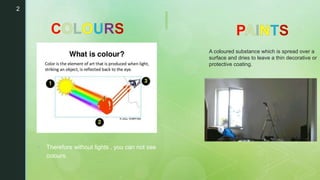
 Therefore without lights , you can not see
colours.
2
A coloured substance which is spread over a
surface and dries to leave a thin decorative or
protective coating.
3
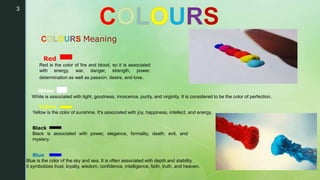
Red
Red is the color of fire and blood, so it is associated
with energy, war, danger, strength, power,
determination as well as passion, desire, and love.
Meaning
Yellow
Yellow is the color of sunshine. It's associated with joy, happiness, intellect, and energy.
White
White is associated with light, goodness, innocence, purity, and virginity. It is considered to be the color of perfection.
Black
Black is associated with power, elegance, formality, death, evil, and
mystery.
Blue
Blue is the color of the sky and sea. It is often associated with depth and stability.
It symbolizes trust, loyalty, wisdom, confidence, intelligence, faith, truth, and heaven.
4
5
•
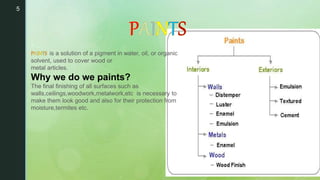
is a solution of a pigment in water, oil, or organic
solvent, used to cover wood or
metal articles.
Why we do we paints?
The final finishing of all surfaces such as
walls,ceilings,woodwork,metalwork,etc is necessary to
make them look good and also for their protection from
moisture,termites etc.
6 •
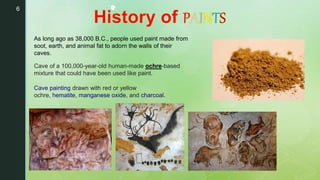
Cave of a 100,000-year-old human-made ochre-based
mixture that could have been used like paint.
Cave painting drawn with red or yellow
ochre, hematite, manganese oxide, and charcoal.
As long ago as 38,000 B.C., people used paint made from
soot, earth, and animal fat to adorn the walls of their
caves.
7 •
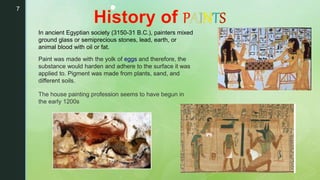
Paint was made with the yolk of eggs and therefore, the
substance would harden and adhere to the surface it was
applied to. Pigment was made from plants, sand, and
different soils.
The house painting profession seems to have begun in
the early 1200s
In ancient Egyptian society (3150-31 B.C.), painters mixed
ground glass or semiprecious stones, lead, earth, or
animal blood with oil or fat.
8
•
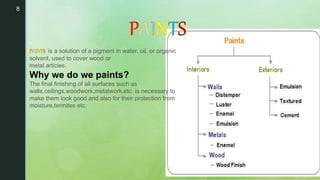
is a solution of a pigment in water, oil, or organic
solvent, used to cover wood or
metal articles.
Why we do we paints?
The final finishing of all surfaces such as
walls,ceilings,woodwork,metalwork,etc is necessary to
make them look good and also for their protection from
moisture,termites etc.
9
CLASSIFICATION OF
ON THE BASIS OF BASE USED
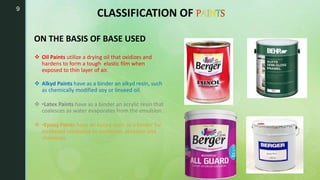
 Oil Paints utilize a drying oil that oxidizes and
hardens to form a tough elastic film when
exposed to thin layer of air.
 Alkyd Paints have as a binder an alkyd resin, such
as chemically modified soy or linseed oil.
 •Latex Paints have as a binder an acrylic resin that
coalesces as water evaporates from the emulsion.
 •Epoxy Paints have an epoxy resin as a binder for
increased resistance to corrosion, abrasion and
chemicals
10
ON THE BASIS OF PROPERTIES
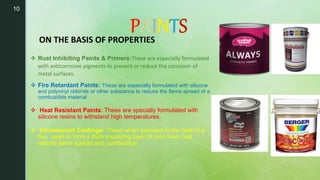
 Rust Inhibiting Paints & Primers:These are especially formulated
with anticorrosive pigments to prevent or reduce the corrosion of
metal surfaces.
 Fire Retardant Paints: These are especially formulated with silicone
and polyvinyl chloride or other substance to reduce the flame spread of a
combustible material
 Heat Resistant Paints: These are specially formulated with
silicone resins to withstand high temperatures.
 Intumescent Coatings: These when exposed to the heat of a
fire, swell to form a thick insulating layer of inert foam that
retards flame spread and combustion.
11
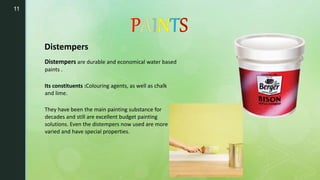
Distempers
Distempers are durable and economical water based
paints .
Its constituents :Colouring agents, as well as chalk
and lime.
They have been the main painting substance for
decades and still are excellent budget painting
solutions. Even the distempers now used are more
varied and have special properties.
12
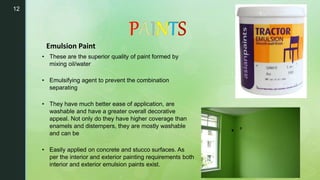
• These are the superior quality of paint formed by
mixing oil/water
• Emulsifying agent to prevent the combination
separating
• They have much better ease of application, are
washable and have a greater overall decorative
appeal. Not only do they have higher coverage than
enamels and distempers, they are mostly washable
and can be
• Easily applied on concrete and stucco surfaces. As
per the interior and exterior painting requirements both
interior and exterior emulsion paints exist.
Emulsion Paint
13
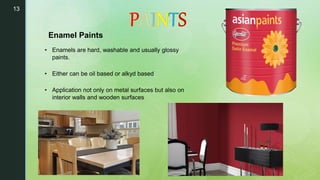
• Enamels are hard, washable and usually glossy
paints.
• Either can be oil based or alkyd based
• Application not only on metal surfaces but also on
interior walls and wooden surfaces
Enamel Paints
14
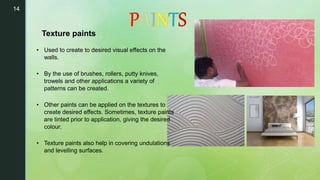
• Used to create to desired visual effects on the
walls.
• By the use of brushes, rollers, putty knives,
trowels and other applications a variety of
patterns can be created.
• Other paints can be applied on the textures to
create desired effects. Sometimes, texture paints
are tinted prior to application, giving the desired
colour.
• Texture paints also help in covering undulations
and levelling surfaces.
Texture paints
15
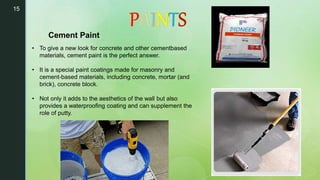
• To give a new look for concrete and other cementbased
materials, cement paint is the perfect answer.
• It is a special paint coatings made for masonry and
cement-based materials, including concrete, mortar (and
brick), concrete block.
• Not only it adds to the aesthetics of the wall but also
provides a waterproofing coating and can supplement the
role of putty.
Cement Paint
16
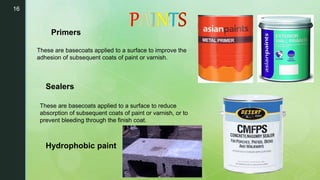
These are basecoats applied to a surface to improve the
adhesion of subsequent coats of paint or varnish.
Primers
Sealers
These are basecoats applied to a surface to reduce
absorption of subsequent coats of paint or varnish, or to
prevent bleeding through the finish coat.
Hydrophobic paint
17
PROCESS OF PAINTING
Surface Preparation
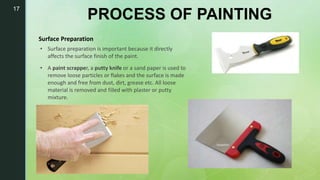
• Surface preparation is important because it directly
affects the surface finish of the paint.
• A paint scrapper, a putty knife or a sand paper is used to
remove loose particles or flakes and the surface is made
enough and free from dust, dirt, grease etc. All loose
material is removed and filled with plaster or putty
mixture.
18
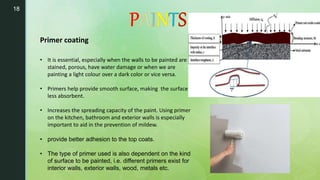
• It is essential, especially when the walls to be painted are
stained, porous, have water damage or when we are
painting a light colour over a dark color or vice versa.
• Primers help provide smooth surface, making the surface
less absorbent.
• Increases the spreading capacity of the paint. Using primer
on the kitchen, bathroom and exterior walls is especially
important to aid in the prevention of mildew.
• provide better adhesion to the top coats.
• The type of primer used is also dependent on the kind
of surface to be painted, i.e. different primers exist for
interior walls, exterior walls, wood, metals etc.
Primer coating
19
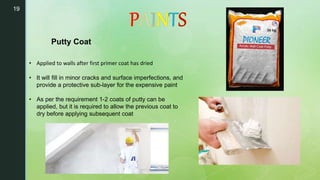
Putty Coat
• Applied to walls after first primer coat has dried
• It will fill in minor cracks and surface imperfections, and
provide a protective sub-layer for the expensive paint
• As per the requirement 1-2 coats of putty can be
applied, but it is required to allow the previous coat to
dry before applying subsequent coat
20
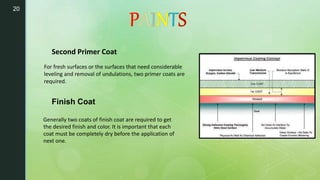
Finish Coat
For fresh surfaces or the surfaces that need considerable
leveling and removal of undulations, two primer coats are
required.
Second Primer Coat
Generally two coats of finish coat are required to get
the desired finish and color. It is important that each
coat must be completely dry before the application of
next one.
21
 Brush
 Roller
 Spray
Methods of painting
22
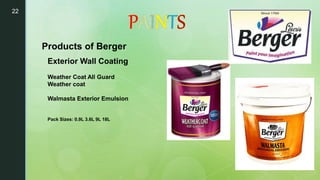
Products of Berger
Weather Coat All Guard
Weather coat
Walmasta Exterior Emulsion
Pack Sizes: 0.9L 3.6L 9L 18L
Exterior Wall Coating
23
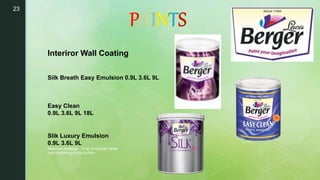
Interiror Wall Coating
Silk Breath Easy Emulsion 0.9L 3.6L 9L
Easy Clean
0.9L 3.6L 9L 18L
Slik Luxury Emulsion
0.9L 3.6L 9L
Maximum coverage - 13 to 15 sqm/per kg/per
coat depending on the surface
24
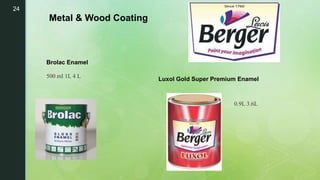
Metal & Wood Coating
Brolac Enamel
500 ml 1L 4 L Luxol Gold Super Premium Enamel
0.9L 3.6L
25
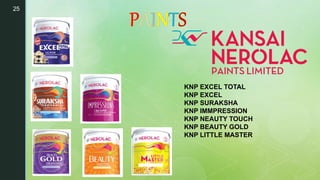
KNP EXCEL TOTAL
KNP EXCEL
KNP SURAKSHA
KNP IMMPRESSION
KNP NEAUTY TOUCH
KNP BEAUTY GOLD
KNP LITTLE MASTER
26
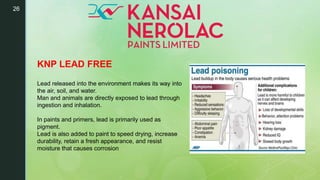
Lead released into the environment makes its way into
the air, soil, and water.
Man and animals are directly exposed to lead through
ingestion and inhalation.
In paints and primers, lead is primarily used as
pigment.
Lead is also added to paint to speed drying, increase
durability, retain a fresh appearance, and resist
moisture that causes corrosion
KNP LEAD FREE
27
Any Queries?
Group Members
Bibek Shrestha

Colors and paints

  • 2.
     Therefore withoutlights , you can not see colours. 2 A coloured substance which is spread over a surface and dries to leave a thin decorative or protective coating.
  • 3.
    3 Red Red is thecolor of fire and blood, so it is associated with energy, war, danger, strength, power, determination as well as passion, desire, and love. Meaning Yellow Yellow is the color of sunshine. It's associated with joy, happiness, intellect, and energy. White White is associated with light, goodness, innocence, purity, and virginity. It is considered to be the color of perfection. Black Black is associated with power, elegance, formality, death, evil, and mystery. Blue Blue is the color of the sky and sea. It is often associated with depth and stability. It symbolizes trust, loyalty, wisdom, confidence, intelligence, faith, truth, and heaven.
  • 4.
  • 5.
    5 • is a solutionof a pigment in water, oil, or organic solvent, used to cover wood or metal articles. Why we do we paints? The final finishing of all surfaces such as walls,ceilings,woodwork,metalwork,etc is necessary to make them look good and also for their protection from moisture,termites etc.
  • 6.
    6 • Cave ofa 100,000-year-old human-made ochre-based mixture that could have been used like paint. Cave painting drawn with red or yellow ochre, hematite, manganese oxide, and charcoal. As long ago as 38,000 B.C., people used paint made from soot, earth, and animal fat to adorn the walls of their caves.
  • 7.
    7 • Paint wasmade with the yolk of eggs and therefore, the substance would harden and adhere to the surface it was applied to. Pigment was made from plants, sand, and different soils. The house painting profession seems to have begun in the early 1200s In ancient Egyptian society (3150-31 B.C.), painters mixed ground glass or semiprecious stones, lead, earth, or animal blood with oil or fat.
  • 8.
    8 • is a solutionof a pigment in water, oil, or organic solvent, used to cover wood or metal articles. Why we do we paints? The final finishing of all surfaces such as walls,ceilings,woodwork,metalwork,etc is necessary to make them look good and also for their protection from moisture,termites etc.
  • 9.
    9 CLASSIFICATION OF ON THEBASIS OF BASE USED  Oil Paints utilize a drying oil that oxidizes and hardens to form a tough elastic film when exposed to thin layer of air.  Alkyd Paints have as a binder an alkyd resin, such as chemically modified soy or linseed oil.  •Latex Paints have as a binder an acrylic resin that coalesces as water evaporates from the emulsion.  •Epoxy Paints have an epoxy resin as a binder for increased resistance to corrosion, abrasion and chemicals
  • 10.
    10 ON THE BASISOF PROPERTIES  Rust Inhibiting Paints & Primers:These are especially formulated with anticorrosive pigments to prevent or reduce the corrosion of metal surfaces.  Fire Retardant Paints: These are especially formulated with silicone and polyvinyl chloride or other substance to reduce the flame spread of a combustible material  Heat Resistant Paints: These are specially formulated with silicone resins to withstand high temperatures.  Intumescent Coatings: These when exposed to the heat of a fire, swell to form a thick insulating layer of inert foam that retards flame spread and combustion.
  • 11.
    11 Distempers Distempers are durableand economical water based paints . Its constituents :Colouring agents, as well as chalk and lime. They have been the main painting substance for decades and still are excellent budget painting solutions. Even the distempers now used are more varied and have special properties.
  • 12.
    12 • These arethe superior quality of paint formed by mixing oil/water • Emulsifying agent to prevent the combination separating • They have much better ease of application, are washable and have a greater overall decorative appeal. Not only do they have higher coverage than enamels and distempers, they are mostly washable and can be • Easily applied on concrete and stucco surfaces. As per the interior and exterior painting requirements both interior and exterior emulsion paints exist. Emulsion Paint
  • 13.
    13 • Enamels arehard, washable and usually glossy paints. • Either can be oil based or alkyd based • Application not only on metal surfaces but also on interior walls and wooden surfaces Enamel Paints
  • 14.
    14 • Used tocreate to desired visual effects on the walls. • By the use of brushes, rollers, putty knives, trowels and other applications a variety of patterns can be created. • Other paints can be applied on the textures to create desired effects. Sometimes, texture paints are tinted prior to application, giving the desired colour. • Texture paints also help in covering undulations and levelling surfaces. Texture paints
  • 15.
    15 • To givea new look for concrete and other cementbased materials, cement paint is the perfect answer. • It is a special paint coatings made for masonry and cement-based materials, including concrete, mortar (and brick), concrete block. • Not only it adds to the aesthetics of the wall but also provides a waterproofing coating and can supplement the role of putty. Cement Paint
  • 16.
    16 These are basecoatsapplied to a surface to improve the adhesion of subsequent coats of paint or varnish. Primers Sealers These are basecoats applied to a surface to reduce absorption of subsequent coats of paint or varnish, or to prevent bleeding through the finish coat. Hydrophobic paint
  • 17.
    17 PROCESS OF PAINTING SurfacePreparation • Surface preparation is important because it directly affects the surface finish of the paint. • A paint scrapper, a putty knife or a sand paper is used to remove loose particles or flakes and the surface is made enough and free from dust, dirt, grease etc. All loose material is removed and filled with plaster or putty mixture.
  • 18.
    18 • It isessential, especially when the walls to be painted are stained, porous, have water damage or when we are painting a light colour over a dark color or vice versa. • Primers help provide smooth surface, making the surface less absorbent. • Increases the spreading capacity of the paint. Using primer on the kitchen, bathroom and exterior walls is especially important to aid in the prevention of mildew. • provide better adhesion to the top coats. • The type of primer used is also dependent on the kind of surface to be painted, i.e. different primers exist for interior walls, exterior walls, wood, metals etc. Primer coating
  • 19.
    19 Putty Coat • Appliedto walls after first primer coat has dried • It will fill in minor cracks and surface imperfections, and provide a protective sub-layer for the expensive paint • As per the requirement 1-2 coats of putty can be applied, but it is required to allow the previous coat to dry before applying subsequent coat
  • 20.
    20 Finish Coat For freshsurfaces or the surfaces that need considerable leveling and removal of undulations, two primer coats are required. Second Primer Coat Generally two coats of finish coat are required to get the desired finish and color. It is important that each coat must be completely dry before the application of next one.
  • 21.
    21  Brush  Roller Spray Methods of painting
  • 22.
    22 Products of Berger WeatherCoat All Guard Weather coat Walmasta Exterior Emulsion Pack Sizes: 0.9L 3.6L 9L 18L Exterior Wall Coating
  • 23.
    23 Interiror Wall Coating SilkBreath Easy Emulsion 0.9L 3.6L 9L Easy Clean 0.9L 3.6L 9L 18L Slik Luxury Emulsion 0.9L 3.6L 9L Maximum coverage - 13 to 15 sqm/per kg/per coat depending on the surface
  • 24.
    24 Metal & WoodCoating Brolac Enamel 500 ml 1L 4 L Luxol Gold Super Premium Enamel 0.9L 3.6L
  • 25.
    25 KNP EXCEL TOTAL KNPEXCEL KNP SURAKSHA KNP IMMPRESSION KNP NEAUTY TOUCH KNP BEAUTY GOLD KNP LITTLE MASTER
  • 26.
    26 Lead released intothe environment makes its way into the air, soil, and water. Man and animals are directly exposed to lead through ingestion and inhalation. In paints and primers, lead is primarily used as pigment. Lead is also added to paint to speed drying, increase durability, retain a fresh appearance, and resist moisture that causes corrosion KNP LEAD FREE
  • 27.