BUILDING
CONSTRUCTION
AND
MATERIALS
TOPIC: FLOOR TILES AND PAINTS
GROUP MEMBERS:-
 Ameesha Chaudhary
 Apoorv Sharma
 Bhavna Chauhan
 Divyansh Jain
 Ishan Khanna
 Jugnu Nishad
 Monya Gaur
 Muskan Singh
 Naman Kumar
INDEX
PAINT
INTRODUCTION
What is Paint Made Of:-
1. Pigment - to provide colour, hiding and control gloss.
2. Resin – the binder to hold the pigment particles together and provide
adhesion to the surface painted.
3. Solvent – to act as a carrier for the pigments and resin –the solvent
may be organic Or Inorganic (such as Mineral,Chemicals or water).
4. Additives – to enhance certain properties such as ease of brushing,
mould resistance, scuff resistance, drying and sag resistance.
We apply paint for:-
 Decoration
 Protection
 Identification
 Sanitation
 DISTEMPER
 EMULSION
 LIME WASH
DISTEMPER
 These are paints used for the treatment of
masonry walls. In distempers water instead
of oil is used as a carrier. These are also
known as water paints. It is made by mixing
whiting and glue boiled in water. In market a
number of distempers are available. All
prepared distempers are mixed with water
only before being used. As the distemper is
affected by weather and comes off, if
washed, so it’s use is restricted only at
interior works.
 It forms a cheap, durable and easy finish for
interiors.These should be applied in dry weather
after the surface has been cleaned and dried.
There are some points which should be kept in
mind while applying distempers:-
 The surface should be completely dry.
 There should be no patches of efflorescence, also
surface should be smooth, if not then the surface
should be made smooth with sand paper.
 Old surface should be cleaned properly.
 These may be applied in two or more coats also.
On drying of primary coat (1st), prepared distemper
solution in water is applied on the surface with
brush.
TYPES OF DISTEMPERS
There are two types of distemper –
 Oil Bound Distemper
 Dry Distemper
Dry Distemper is a water based wall paint and its
main constituents are chalk lime, glue and water.
Distemper is normally brush applied and gives a better
look than the traditional whitewash. It is available in
powder form and has to mixed in glue and water. Three
or coats have to be applied to give a smooth finish. You
can create a nice rustic or earthy look with Dry
Distemper. Cost – Rs 4-5 / sq ft including labour. This
paint is non – washable.
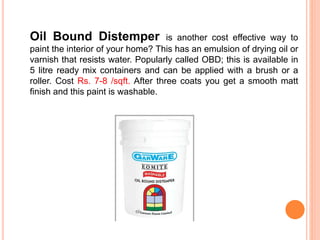
Oil Bound Distemper is another cost effective way to
paint the interior of your home? This has an emulsion of drying oil or
varnish that resists water. Popularly called OBD; this is available in
5 litre ready mix containers and can be applied with a brush or a
roller. Cost Rs. 7-8 /sqft. After three coats you get a smooth matt
finish and this paint is washable.
EMULSION PAINT
 These are the superior quality of paint formed by
mixing oil/water and an emulsifying agent to prevent
the combination separating. They have much better
ease of application, are washable and have a
greater overall decorative appeal. Not only do they
have higher coverage than enamels and distempers,
they are mostly washable and can be easily applied
on concrete and stucco surfaces. As per the interior
and exterior painting requirements both interior and
exterior emulsion paints exist.
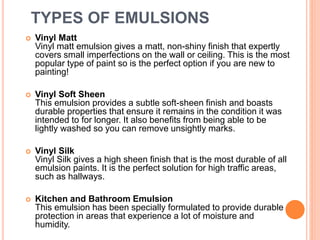
TYPES OF EMULSIONS
 Vinyl Matt
Vinyl matt emulsion gives a matt, non-shiny finish that expertly
covers small imperfections on the wall or ceiling. This is the most
popular type of paint so is the perfect option if you are new to
painting!
 Vinyl Soft Sheen
This emulsion provides a subtle soft-sheen finish and boasts
durable properties that ensure it remains in the condition it was
intended to for longer. It also benefits from being able to be
lightly washed so you can remove unsightly marks.
 Vinyl Silk
Vinyl Silk gives a high sheen finish that is the most durable of all
emulsion paints. It is the perfect solution for high traffic areas,
such as hallways.
 Kitchen and Bathroom Emulsion
This emulsion has been specially formulated to provide durable
protection in areas that experience a lot of moisture and
humidity.
 Acrylic resin in this paint sticks to the surface and
holds the other ingredients in place after drying. A
paint contains Pigments, (which give the colour
and protection from UV light to it), Solvents (which
either dissolve some portion or improve the flow of
paint) and finally various Additives (like anti
skinning agent, anti-settling agents and surface
active agents.)
 Usually in Emulsion paints water is available at
around 50 to 60% by volume. The oily portions and
the solids in the form of pigments are the
remaining. But it is to be remembered that the
pigments have a higher density than water and
hence water in terms of ratio by weight is lesser.
WHITE WASH WITH LIME:
Limewash is a very traditional finish, used to decorate and
protect porous stone and lime-rendered surfaces. Like
Distemper, Limewash is a breathable finish making it
suitable for old and damp-problematic walls. Unlike paint,
lime wash penetrates the surface and the colour is built up
by applying successive coats.
 Environmentally-friendly
 Water-based
 Recommended for exterior use only on lime render and
porous stone
 Gloss level - 3% (very matt)
 Covers approx. 6 square metres per litre (one coat)
 Available in a wide choice of colours
 Available in 5L tins
 Limewash is made to order, please allow 7-10 days for
delivery.
POWDER COATING
Powder Coating is a type of dry coating, which is
applied as a free-flowing, dry powder. The main
difference between liquid paint and a powder coating
is that the powder coating does not require any
solvent to keep the binder and filler parts in a liquid
suspension form. The coating is typically applied
electrostatically and is then cured under heat to allow
it to flow and form a "skin." It is usually used to create
a hard finish.
FAILURE OF PAINT
The main reasons of paint failure after application on
surface are the applicator and improper treatment of
surface. Application Defects can be attributed to:
 Dilution: This usually occurs when the dilution of the
paint is not done as per manufacturers
recommendation. There can be a case of over dilution
and under dilution, as well as dilution with the incorrect
diluent.
 Contamination: Foreign contaminants added without
the manufacturers consent which results in various film
defects.

Building construction

  • 1.
  • 2.
    TOPIC: FLOOR TILESAND PAINTS GROUP MEMBERS:-  Ameesha Chaudhary  Apoorv Sharma  Bhavna Chauhan  Divyansh Jain  Ishan Khanna  Jugnu Nishad  Monya Gaur  Muskan Singh  Naman Kumar
  • 3.
  • 4.
  • 5.
    INTRODUCTION What is PaintMade Of:- 1. Pigment - to provide colour, hiding and control gloss. 2. Resin – the binder to hold the pigment particles together and provide adhesion to the surface painted. 3. Solvent – to act as a carrier for the pigments and resin –the solvent may be organic Or Inorganic (such as Mineral,Chemicals or water). 4. Additives – to enhance certain properties such as ease of brushing, mould resistance, scuff resistance, drying and sag resistance. We apply paint for:-  Decoration  Protection  Identification  Sanitation
  • 6.
  • 7.
    DISTEMPER  These arepaints used for the treatment of masonry walls. In distempers water instead of oil is used as a carrier. These are also known as water paints. It is made by mixing whiting and glue boiled in water. In market a number of distempers are available. All prepared distempers are mixed with water only before being used. As the distemper is affected by weather and comes off, if washed, so it’s use is restricted only at interior works.
  • 8.
     It formsa cheap, durable and easy finish for interiors.These should be applied in dry weather after the surface has been cleaned and dried. There are some points which should be kept in mind while applying distempers:-  The surface should be completely dry.  There should be no patches of efflorescence, also surface should be smooth, if not then the surface should be made smooth with sand paper.  Old surface should be cleaned properly.  These may be applied in two or more coats also. On drying of primary coat (1st), prepared distemper solution in water is applied on the surface with brush.
  • 9.
    TYPES OF DISTEMPERS Thereare two types of distemper –  Oil Bound Distemper  Dry Distemper
  • 10.
    Dry Distemper isa water based wall paint and its main constituents are chalk lime, glue and water. Distemper is normally brush applied and gives a better look than the traditional whitewash. It is available in powder form and has to mixed in glue and water. Three or coats have to be applied to give a smooth finish. You can create a nice rustic or earthy look with Dry Distemper. Cost – Rs 4-5 / sq ft including labour. This paint is non – washable.
  • 11.
    Oil Bound Distemperis another cost effective way to paint the interior of your home? This has an emulsion of drying oil or varnish that resists water. Popularly called OBD; this is available in 5 litre ready mix containers and can be applied with a brush or a roller. Cost Rs. 7-8 /sqft. After three coats you get a smooth matt finish and this paint is washable.
  • 12.
    EMULSION PAINT  Theseare the superior quality of paint formed by mixing oil/water and an emulsifying agent to prevent the combination separating. They have much better ease of application, are washable and have a greater overall decorative appeal. Not only do they have higher coverage than enamels and distempers, they are mostly washable and can be easily applied on concrete and stucco surfaces. As per the interior and exterior painting requirements both interior and exterior emulsion paints exist.
  • 13.
    TYPES OF EMULSIONS Vinyl Matt Vinyl matt emulsion gives a matt, non-shiny finish that expertly covers small imperfections on the wall or ceiling. This is the most popular type of paint so is the perfect option if you are new to painting!  Vinyl Soft Sheen This emulsion provides a subtle soft-sheen finish and boasts durable properties that ensure it remains in the condition it was intended to for longer. It also benefits from being able to be lightly washed so you can remove unsightly marks.  Vinyl Silk Vinyl Silk gives a high sheen finish that is the most durable of all emulsion paints. It is the perfect solution for high traffic areas, such as hallways.  Kitchen and Bathroom Emulsion This emulsion has been specially formulated to provide durable protection in areas that experience a lot of moisture and humidity.
  • 14.
     Acrylic resinin this paint sticks to the surface and holds the other ingredients in place after drying. A paint contains Pigments, (which give the colour and protection from UV light to it), Solvents (which either dissolve some portion or improve the flow of paint) and finally various Additives (like anti skinning agent, anti-settling agents and surface active agents.)  Usually in Emulsion paints water is available at around 50 to 60% by volume. The oily portions and the solids in the form of pigments are the remaining. But it is to be remembered that the pigments have a higher density than water and hence water in terms of ratio by weight is lesser.
  • 15.
    WHITE WASH WITHLIME: Limewash is a very traditional finish, used to decorate and protect porous stone and lime-rendered surfaces. Like Distemper, Limewash is a breathable finish making it suitable for old and damp-problematic walls. Unlike paint, lime wash penetrates the surface and the colour is built up by applying successive coats.  Environmentally-friendly  Water-based  Recommended for exterior use only on lime render and porous stone  Gloss level - 3% (very matt)  Covers approx. 6 square metres per litre (one coat)  Available in a wide choice of colours  Available in 5L tins  Limewash is made to order, please allow 7-10 days for delivery.
  • 16.
    POWDER COATING Powder Coatingis a type of dry coating, which is applied as a free-flowing, dry powder. The main difference between liquid paint and a powder coating is that the powder coating does not require any solvent to keep the binder and filler parts in a liquid suspension form. The coating is typically applied electrostatically and is then cured under heat to allow it to flow and form a "skin." It is usually used to create a hard finish.
  • 17.
    FAILURE OF PAINT Themain reasons of paint failure after application on surface are the applicator and improper treatment of surface. Application Defects can be attributed to:  Dilution: This usually occurs when the dilution of the paint is not done as per manufacturers recommendation. There can be a case of over dilution and under dilution, as well as dilution with the incorrect diluent.  Contamination: Foreign contaminants added without the manufacturers consent which results in various film defects.