Pain management
Dhuha F Shamsaldeen
315-316
Objectives
1.Explain how the pain of labor and birth differs from other types of
pain.
2.Describe sources of labor pain.
3.List factors influencing the woman’s experience of labor pain.
4.Discuss principles of labor pain management.
5.Compare nonpharmacologic interventions to manage labor pain.
6.Explain various relaxation techniques that help a woman cope with
labor.
7.Differentiate analgesia from anesthesia.
8.Describe advantages and disadvantages of opioid administration.
9.Compare methods of regional anesthesia.
10.Explain major complications associated with epidural and spinal
anesthesia.
11.Discuss reasons general anesthesia is risky for a pregnant woman
and her fetus.
What is labor ?
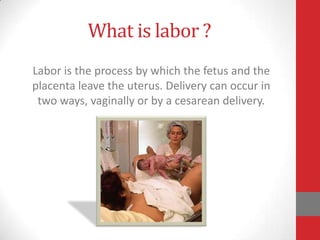
Labor is the process by which the fetus and the
placenta leave the uterus. Delivery can occur in
two ways, vaginally or by a cesarean delivery.
Signs of labor ?
• Some women experience very distinct signs of labor, while
others do not. No one knows what causes labor to start or
when it will start, but several hormonal and physical changes
may indicate the beginning of labor:
Lightening
Passing of the mucus plug
Contractions
Water breaking
Effacement and dilation of the cervix
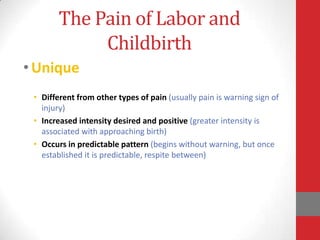
The Pain of Labor and
Childbirth
•Unique
• Different from other types of pain (usually pain is warning sign of
injury)
• Increased intensity desired and positive (greater intensity is
associated with approaching birth)
• Occurs in predictable pattern (begins without warning, but once
established it is predictable, respite between)
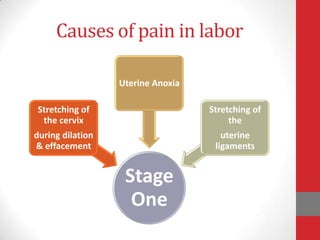
Causes of pain in labor
Stage
One
Stretching of
the cervix
during dilation
& effacement
Uterine Anoxia
Stretching of
the
uterine
ligaments
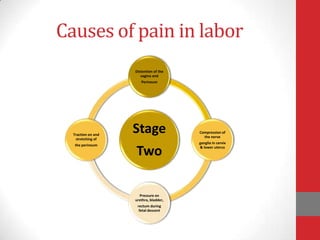
Causes of pain in labor
Stage
Two
Distention of the
vagina and
Perineum
Compression of
the nerve
ganglia in cervix
& lower uterus
Pressure on
urethra, bladder,
rectum during
fetal descent
Traction on and
stretching of
the perineum
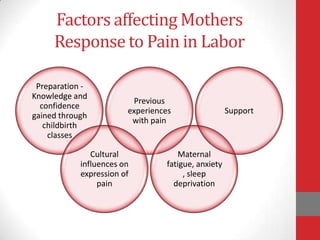
Factors affecting Mothers
Response to Pain in Labor
Preparation -
Knowledge and
confidence
gained through
childbirth
classes
Cultural
influences on
expression of
pain
Previous
experiences
with pain
Maternal
fatigue, anxiety
, sleep
deprivation
Support
The goal of pain management
pain management prior to delivery may
help ease your anxiety in the moment of
labor.
Pain Management Principles and
Techniques
• Principles of pain relief during labor
• Women are more satisfied when they have control
over the pain experience
• Caregivers commonly underrate the severity of pain
• Women who are prepared for labor usually report a
more satisfying experience than do women who are
not prepared
Pain Management Principles and
Techniques (cont.)
• Non-Pharmacologic Pain Interventions
• Continuous labor support-doula
• Acupressure and acupuncture
• Relaxation techniques-helps to facilitate labor process
• Patterned breathing
• Attention focusing (imagery)
• Movement and positioning
• Touch and massage
• Water therapy
Breathing pattern
Movement and positioning
Touch and massage
Water therapy
Pain Management Principles and
Techniques (cont.)
• Advantages and disadvantages of non-pharmacologic
interventions
• Advantages
• Noninvasive
• Address emotional and spiritual aspects of birth
• Promote women’s sense of control over pain
• Disadvantages
• Many of the interventions require special training and/or practice
before birth
• These methods are not effective for every woman
Pharmacological Interventions
• Analgesia and sedation
• The use of medication to reduce the sensation of pain
• Sedatives given to promote sedation and relaxation
• Opioids given to promote analgesia during labor
• Anesthesia
• The use of medication to partially or totally block all
sensation to an area of the body
• Local, regional, general
Analgesics and
anesthetics
commonly used in
labor and birth
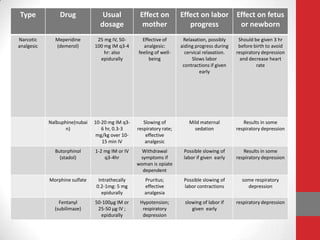
Type Drug Usual
dosage
Effect on
mother
Effect on labor
progress
Effect on fetus
or newborn
Narcotic
analgesic
Meperidine
(demerol)
25 mg IV, 50-
100 mg IM q3-4
hr: also
epidurally
Effective of
analgesic:
feeling of well-
being
Relaxation, possibly
aiding progress during
cervical relaxation.
Slows labor
contractions if given
early
Should be given 3 hr
before birth to avoid
respiratory depression
and decrease heart
rate
Nalbuphine(nubai
n)
10-20 mg IM q3-
6 hr, 0.3-3
mg/kg over 10-
15 min IV
Slowing of
respiratory rate;
effective
analgesic
Mild maternal
sedation
Results in some
respiratory depression
Butorphinol
(stadol)
1-2 mg IM or IV
q3-4hr
Withdrawal
symptoms if
woman is opiate
dependent
Possible slowing of
labor if given early
Results in some
respiratory depression
Morphine sulfate Intrathecally
0.2-1mg: 5 mg
epidurally
Pruritus;
effective
analgesia
Possible slowing of
labor contractions
some respiratory
depression
Fentanyl
(subilimaze)
50-100µg IM or
25-50 µg IV ;
epidurally
Hypotension;
respiratory
depression
slowing of labor if
given early
respiratory depression
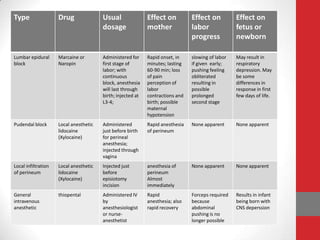
Type Drug Usual
dosage
Effect on
mother
Effect on
labor
progress
Effect on
fetus or
newborn
Lumbar epidural
block
Marcaine or
Naropin
Administered for
first stage of
labor; with
continuous
block, anesthesia
will last through
birth; injected at
L3-4;
Rapid onset, in
minutes; lasting
60-90 min; loss
of pain
perception of
labor
contractions and
birth; possible
maternal
hypotension
slowing of labor
if given early;
pushing feeling
obliterated
resulting in
possible
prolonged
second stage
May result in
respiratory
depression. May
be some
differences in
response in first
few days of life.
Pudendal block Local anesthetic
lidocaine
(Xylocaine)
Administered
just before birth
for perineal
anesthesia;
injected through
vagina
Rapid anesthesia
of perineum
None apparent None apparent
Local infiltration
of perineum
Local anesthetic
lidocaine
(Xylocaine)
Injected just
before
episiotomy
incision
anesthesia of
perineum
Almost
immediately
None apparent None apparent
General
intravenous
anesthetic
thiopental Administered IV
by
anesthesiologist
or nurse-
anesthetist
Rapid
anesthesia; also
rapid recovery
Forceps required
because
abdominal
pushing is no
longer possible
Results in infant
being born with
CNS deperssion
Pharmacological Interventions
(cont.)
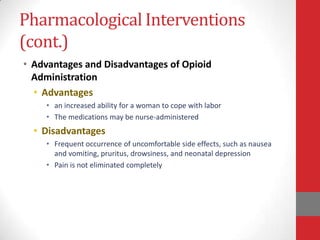
• Advantages and Disadvantages of Opioid
Administration
• Advantages
• an increased ability for a woman to cope with labor
• The medications may be nurse-administered
• Disadvantages
• Frequent occurrence of uncomfortable side effects, such as nausea
and vomiting, pruritus, drowsiness, and neonatal depression
• Pain is not eliminated completely
Pharmacological Interventions
(cont.)
• Types of anesthesia
• Local anesthesia
• Used to numb the perineum just before birth to allow for episiotomy
and repair
• Regional anesthesia
• Involves blocking a group of sensory nerves that supply a particular
organ or area of the body
• General anesthesia
• Not used frequently in obstetrics because of the risks involved
Pharmacological Interventions
(cont.)
• Types of regional anesthesia
• Pudendal block-pain relief for the birth
• Paracervical block-pain relief during labor
• Epidural anesthesia-pain relief during labor
• Intrathecal anesthesia-provides pain relief until the
epirdural begins to work
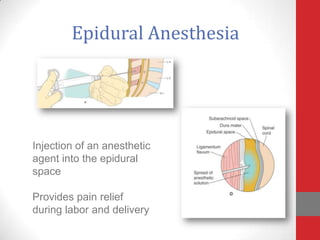
Epidural Anesthesia
Injection of an anesthetic
agent into the epidural
space
Provides pain relief
during labor and delivery
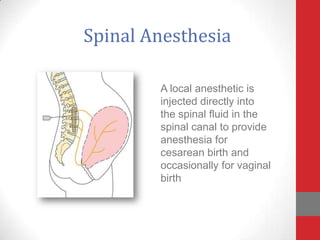
Spinal Anesthesia
A local anesthetic is
injected directly into
the spinal fluid in the
spinal canal to provide
anesthesia for
cesarean birth and
occasionally for vaginal
birth
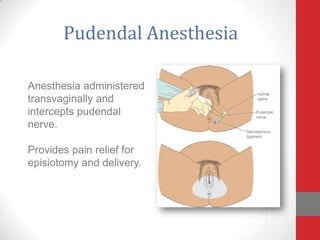
Pudendal Anesthesia
Anesthesia administered
transvaginally and
intercepts pudendal
nerve.
Provides pain relief for
episiotomy and delivery.
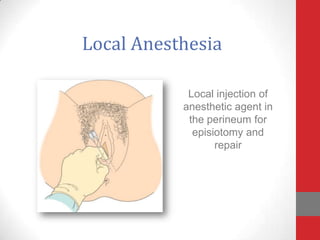
Local Anesthesia
Local injection of
anesthetic agent in
the perineum for
episiotomy and
repair
Pharmacological Interventions
(cont.)
• Complications Associated With Epidural and Spinal
Anesthesia
• Hypotension
• Maternal fever
• Shivering
• Pruritus
• Inadvertent injection into the blood stream
• Spinal headache
• Fetal distress
Pharmacological Interventions
(cont.)
• Life-Threatening Complications Occurring With
General Anesthesia
• Failed intubation-due to physiological changes: trachea and
thorax
• Aspiration-often premedicated
• Malignant hyperthermia-(rare) inherited condition that causes
sustained muscle contractions in the presence of certain
anesthetic agents
Refrencess
• http://www.webmd.com/baby/guide/pregnancy-pain-relief
• http://www.webmd.com/baby/labor-signs
• Pilitteri, A.(2010) Maternal and Child Health
Nursing, Philadelphia. J.B Lippincott Co. (6th edition) Pp 395-
414 ch16

Pain management during labor

  • 1.
    Pain management Dhuha FShamsaldeen 315-316
  • 2.
    Objectives 1.Explain how thepain of labor and birth differs from other types of pain. 2.Describe sources of labor pain. 3.List factors influencing the woman’s experience of labor pain. 4.Discuss principles of labor pain management. 5.Compare nonpharmacologic interventions to manage labor pain. 6.Explain various relaxation techniques that help a woman cope with labor. 7.Differentiate analgesia from anesthesia. 8.Describe advantages and disadvantages of opioid administration. 9.Compare methods of regional anesthesia. 10.Explain major complications associated with epidural and spinal anesthesia. 11.Discuss reasons general anesthesia is risky for a pregnant woman and her fetus.
  • 3.
    What is labor? Labor is the process by which the fetus and the placenta leave the uterus. Delivery can occur in two ways, vaginally or by a cesarean delivery.
  • 4.
    Signs of labor? • Some women experience very distinct signs of labor, while others do not. No one knows what causes labor to start or when it will start, but several hormonal and physical changes may indicate the beginning of labor: Lightening Passing of the mucus plug Contractions Water breaking Effacement and dilation of the cervix
  • 5.
    The Pain ofLabor and Childbirth •Unique • Different from other types of pain (usually pain is warning sign of injury) • Increased intensity desired and positive (greater intensity is associated with approaching birth) • Occurs in predictable pattern (begins without warning, but once established it is predictable, respite between)
  • 6.
    Causes of painin labor Stage One Stretching of the cervix during dilation & effacement Uterine Anoxia Stretching of the uterine ligaments
  • 7.
    Causes of painin labor Stage Two Distention of the vagina and Perineum Compression of the nerve ganglia in cervix & lower uterus Pressure on urethra, bladder, rectum during fetal descent Traction on and stretching of the perineum
  • 8.
    Factors affecting Mothers Responseto Pain in Labor Preparation - Knowledge and confidence gained through childbirth classes Cultural influences on expression of pain Previous experiences with pain Maternal fatigue, anxiety , sleep deprivation Support
  • 9.
    The goal ofpain management pain management prior to delivery may help ease your anxiety in the moment of labor.
  • 10.
    Pain Management Principlesand Techniques • Principles of pain relief during labor • Women are more satisfied when they have control over the pain experience • Caregivers commonly underrate the severity of pain • Women who are prepared for labor usually report a more satisfying experience than do women who are not prepared
  • 11.
    Pain Management Principlesand Techniques (cont.) • Non-Pharmacologic Pain Interventions • Continuous labor support-doula • Acupressure and acupuncture • Relaxation techniques-helps to facilitate labor process • Patterned breathing • Attention focusing (imagery) • Movement and positioning • Touch and massage • Water therapy
  • 12.
  • 13.
  • 14.
  • 15.
  • 16.
    Pain Management Principlesand Techniques (cont.) • Advantages and disadvantages of non-pharmacologic interventions • Advantages • Noninvasive • Address emotional and spiritual aspects of birth • Promote women’s sense of control over pain • Disadvantages • Many of the interventions require special training and/or practice before birth • These methods are not effective for every woman
  • 17.
    Pharmacological Interventions • Analgesiaand sedation • The use of medication to reduce the sensation of pain • Sedatives given to promote sedation and relaxation • Opioids given to promote analgesia during labor • Anesthesia • The use of medication to partially or totally block all sensation to an area of the body • Local, regional, general
  • 18.
  • 19.
    Type Drug Usual dosage Effecton mother Effect on labor progress Effect on fetus or newborn Narcotic analgesic Meperidine (demerol) 25 mg IV, 50- 100 mg IM q3-4 hr: also epidurally Effective of analgesic: feeling of well- being Relaxation, possibly aiding progress during cervical relaxation. Slows labor contractions if given early Should be given 3 hr before birth to avoid respiratory depression and decrease heart rate Nalbuphine(nubai n) 10-20 mg IM q3- 6 hr, 0.3-3 mg/kg over 10- 15 min IV Slowing of respiratory rate; effective analgesic Mild maternal sedation Results in some respiratory depression Butorphinol (stadol) 1-2 mg IM or IV q3-4hr Withdrawal symptoms if woman is opiate dependent Possible slowing of labor if given early Results in some respiratory depression Morphine sulfate Intrathecally 0.2-1mg: 5 mg epidurally Pruritus; effective analgesia Possible slowing of labor contractions some respiratory depression Fentanyl (subilimaze) 50-100µg IM or 25-50 µg IV ; epidurally Hypotension; respiratory depression slowing of labor if given early respiratory depression
  • 20.
    Type Drug Usual dosage Effecton mother Effect on labor progress Effect on fetus or newborn Lumbar epidural block Marcaine or Naropin Administered for first stage of labor; with continuous block, anesthesia will last through birth; injected at L3-4; Rapid onset, in minutes; lasting 60-90 min; loss of pain perception of labor contractions and birth; possible maternal hypotension slowing of labor if given early; pushing feeling obliterated resulting in possible prolonged second stage May result in respiratory depression. May be some differences in response in first few days of life. Pudendal block Local anesthetic lidocaine (Xylocaine) Administered just before birth for perineal anesthesia; injected through vagina Rapid anesthesia of perineum None apparent None apparent Local infiltration of perineum Local anesthetic lidocaine (Xylocaine) Injected just before episiotomy incision anesthesia of perineum Almost immediately None apparent None apparent General intravenous anesthetic thiopental Administered IV by anesthesiologist or nurse- anesthetist Rapid anesthesia; also rapid recovery Forceps required because abdominal pushing is no longer possible Results in infant being born with CNS deperssion
  • 21.
    Pharmacological Interventions (cont.) • Advantagesand Disadvantages of Opioid Administration • Advantages • an increased ability for a woman to cope with labor • The medications may be nurse-administered • Disadvantages • Frequent occurrence of uncomfortable side effects, such as nausea and vomiting, pruritus, drowsiness, and neonatal depression • Pain is not eliminated completely
  • 22.
    Pharmacological Interventions (cont.) • Typesof anesthesia • Local anesthesia • Used to numb the perineum just before birth to allow for episiotomy and repair • Regional anesthesia • Involves blocking a group of sensory nerves that supply a particular organ or area of the body • General anesthesia • Not used frequently in obstetrics because of the risks involved
  • 23.
    Pharmacological Interventions (cont.) • Typesof regional anesthesia • Pudendal block-pain relief for the birth • Paracervical block-pain relief during labor • Epidural anesthesia-pain relief during labor • Intrathecal anesthesia-provides pain relief until the epirdural begins to work
  • 24.
    Epidural Anesthesia Injection ofan anesthetic agent into the epidural space Provides pain relief during labor and delivery
  • 25.
    Spinal Anesthesia A localanesthetic is injected directly into the spinal fluid in the spinal canal to provide anesthesia for cesarean birth and occasionally for vaginal birth
  • 26.
    Pudendal Anesthesia Anesthesia administered transvaginallyand intercepts pudendal nerve. Provides pain relief for episiotomy and delivery.
  • 27.
    Local Anesthesia Local injectionof anesthetic agent in the perineum for episiotomy and repair
  • 28.
    Pharmacological Interventions (cont.) • ComplicationsAssociated With Epidural and Spinal Anesthesia • Hypotension • Maternal fever • Shivering • Pruritus • Inadvertent injection into the blood stream • Spinal headache • Fetal distress
  • 29.
    Pharmacological Interventions (cont.) • Life-ThreateningComplications Occurring With General Anesthesia • Failed intubation-due to physiological changes: trachea and thorax • Aspiration-often premedicated • Malignant hyperthermia-(rare) inherited condition that causes sustained muscle contractions in the presence of certain anesthetic agents
  • 30.
    Refrencess • http://www.webmd.com/baby/guide/pregnancy-pain-relief • http://www.webmd.com/baby/labor-signs •Pilitteri, A.(2010) Maternal and Child Health Nursing, Philadelphia. J.B Lippincott Co. (6th edition) Pp 395- 414 ch16