Epidural Labour Analgesia (pain relief of child birth) Dr Ashok Jadon, MD DNB MNAMS Aesculap IPM Fellowship Senior Consultant & HOD Anaesthesia Tata Motors Hospital, Jamshedpur, India
Scope Introduction & Need for labour analgesia Pain Pathways Methods Epidural analgesia Walking epidural Our 3 yrs Experience
Introduction & Need for labour analgesia Pain undesirable experience Labour pain Intense Non-essential for progress of labour Undesirable side effects  on mother & Baby
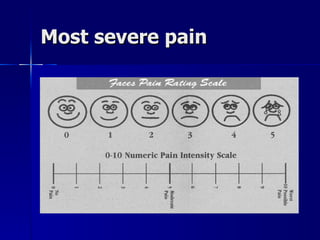
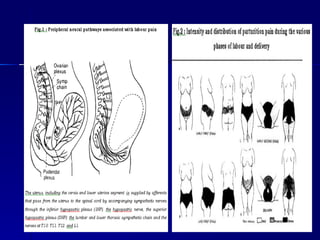
Most severe pain
 
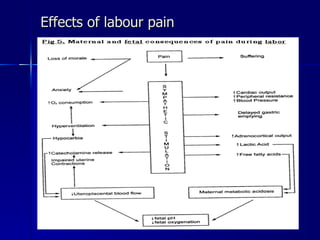
Effects of labour pain
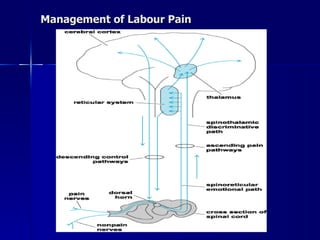
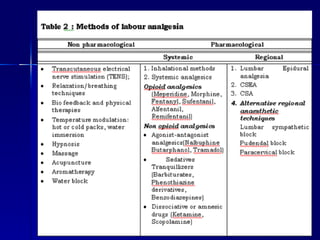
Management of Labour Pain
 
 
Simplicity  Safety  Preservation of fetal homeostasis Gold Standard ; Epidural analgesia
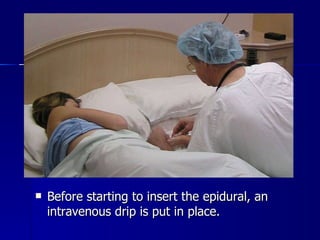
Before starting to insert the epidural, an intravenous drip is put in place.
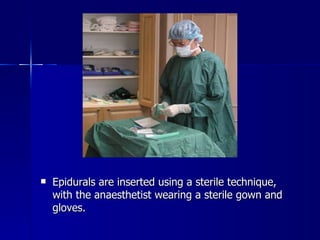
Epidurals are inserted using a sterile technique, with the anaesthetist wearing a sterile gown and gloves.
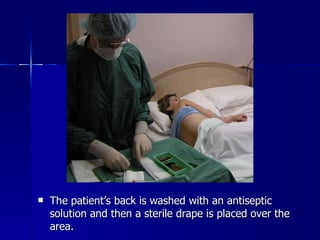
The patient’s back is washed with an antiseptic solution and then a sterile drape is placed over the area.
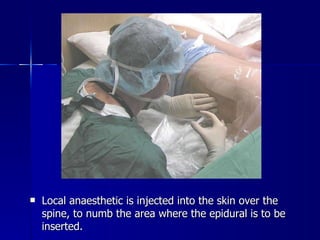
Local anaesthetic is injected into the skin over the spine, to numb the area where the epidural is to be inserted.
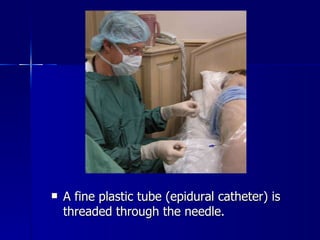
A fine plastic tube (epidural catheter) is threaded through the needle.
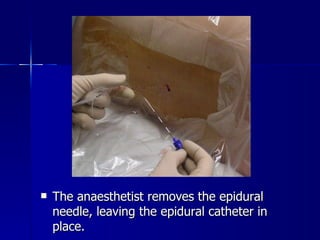
The anaesthetist removes the epidural needle, leaving the epidural catheter in place.
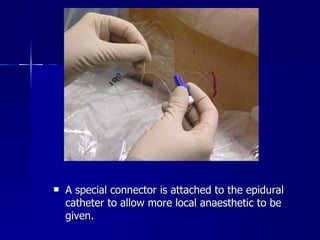
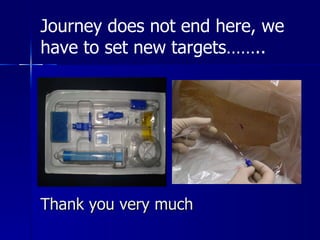
A special connector is attached to the epidural catheter to allow more local anaesthetic to be given.
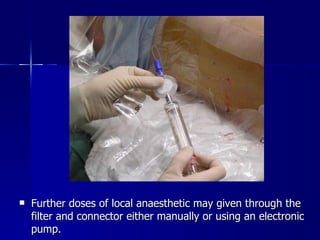
Further doses of local anaesthetic may given through the filter and connector either manually or using an electronic pump.
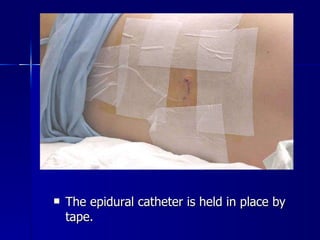
The epidural catheter is held in place by tape.
 
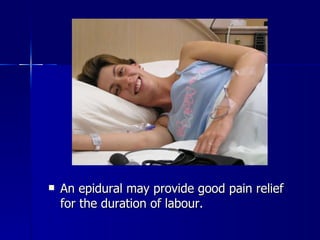
An epidural may provide good pain relief for the duration of labour.
Thanks to Heidi and John for permission to use their photos.
 
COMPLICATIONS  TOTAL SPINAL BLOCKADE  Dural puncture with inadvertent subarachnoid injection HYPOTENSION  Normal preg women hypotension can be prevented by rapid infusion of 500-1000ml of crystalloid solution
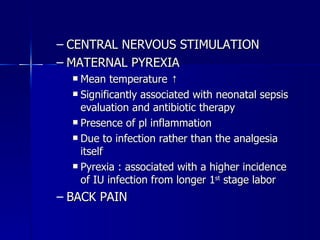
CENTRAL NERVOUS STIMULATION  MATERNAL PYREXIA  Mean temperature ↑  Significantly associated with neonatal sepsis evaluation and antibiotic therapy  Presence of pl inflammation  Due to infection rather than the analgesia itself  Pyrexia : associated with a higher incidence of IU infection from longer 1 st  stage labor  BACK PAIN
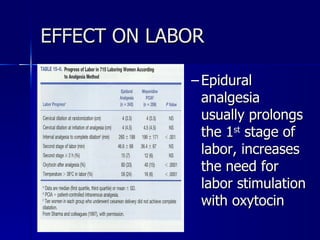
EFFECT ON LABOR Epidural analgesia usually prolongs the 1 st  stage of labor, increases the need for labor stimulation with oxytocin
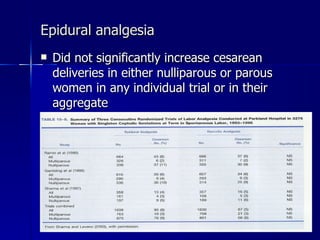
Epidural analgesia Did not significantly increase cesarean deliveries in either nulliparous or parous women in any individual trial or in their aggregate
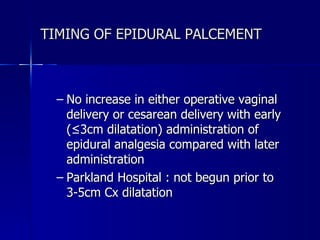
TIMING OF EPIDURAL PALCEMENT No increase in either operative vaginal delivery or cesarean delivery with early (≤3cm dilatation) administration of epidural analgesia compared with later administration  Parkland Hospital : not begun prior to 3-5cm Cx dilatation
SAFETY  1968-1985, 26000 women : no maternal deaths  CONTRAINDICATIONS  actual or anticipated serious maternal hemorrhage, infection at or near the sites for puncture, suspicion of neurological disease
SEVERE PREECLAMPSIA-ECLAMPSIA Ideal labor analgesia for women with severe preeclampsia : controversial  Past two to three decades, most obstetrical anesthesiologists : favor epidural blockade for labor and delivery in women with severe pre-ecalmpsia  1995, Wallace and colleagues : GA and RA are equally acceptable for cesarean delivery in women with severe pre-ecalmpsia
INTRAVENOUS FLUID PRELOADING Most authorities recommend prehydration, usually with 500~1000ml of crystalloid solution  Aggressive volume replacement in severe preeclampsia women increases their risk for pul edema, especially in the first 72 hrs postpartum  No instances of pul edema in 738 women in whom crystalloid preload was limited to 500ml
EPIDURAL OPIATE ANALGESIA Injection of opiates into the epidural space to relieve pain from labor become popular -> rapid onset of pain relief, decrease in shevering, less dense motor blockade  Side effect : pruritus(80%), urinary retention(55%), N/V(45%), headaches(10%)
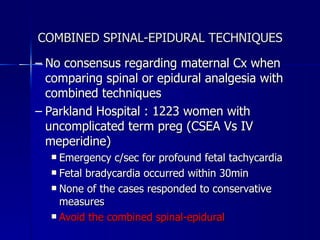
COMBINED SPINAL-EPIDURAL TECHNIQUES No consensus regarding maternal Cx when comparing spinal or epidural analgesia with combined techniques Parkland Hospital : 1223 women with uncomplicated term preg (CSEA Vs IV meperidine) Emergency c/sec for profound fetal tachycardia Fetal bradycardia occurred within 30min  None of the cases responded to conservative measures  Avoid the combined spinal-epidural
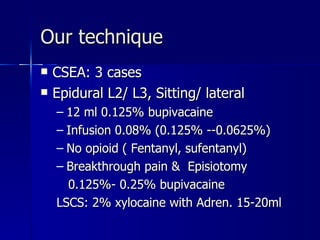
Our technique CSEA: 3 cases Epidural L2/ L3, Sitting/ lateral 12 ml 0.125% bupivacaine Infusion 0.08% (0.125% --0.0625%) No opioid ( Fentanyl, sufentanyl) Breakthrough pain &  Episiotomy  0.125%- 0.25% bupivacaine LSCS: 2% xylocaine with Adren. 15-20ml
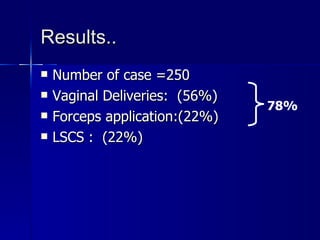
Results.. Number of case =250 Vaginal Deliveries:  (56%) Forceps application:(22%) LSCS :  (22%) 78%
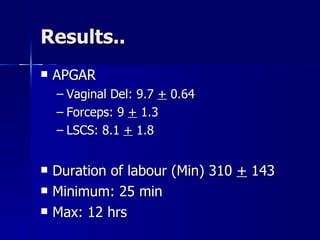
Results.. APGAR  Vaginal Del: 9.7  +  0.64 Forceps: 9  +  1.3 LSCS: 8.1  +  1.8 Duration of labour (Min) 310  +  143 Minimum: 25 min Max: 12 hrs
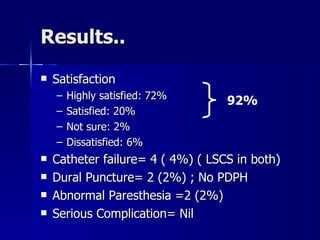
Results.. Satisfaction Highly satisfied: 72% Satisfied: 20% Not sure: 2% Dissatisfied: 6%  Catheter failure= 4 ( 4%) ( LSCS in both) Dural Puncture= 2 (2%) ; No PDPH Abnormal Paresthesia =2 (2%) Serious Complication= Nil 92%
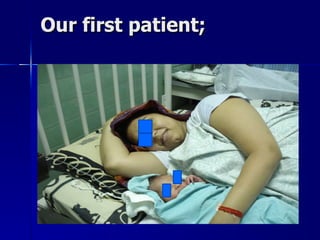
Our first patient;
Journey does not end here, we have to set new targets……..   Thank you very much

Epidural labour pain relief

  • 1.
    Epidural Labour Analgesia(pain relief of child birth) Dr Ashok Jadon, MD DNB MNAMS Aesculap IPM Fellowship Senior Consultant & HOD Anaesthesia Tata Motors Hospital, Jamshedpur, India
  • 2.
    Scope Introduction &Need for labour analgesia Pain Pathways Methods Epidural analgesia Walking epidural Our 3 yrs Experience
  • 3.
    Introduction & Needfor labour analgesia Pain undesirable experience Labour pain Intense Non-essential for progress of labour Undesirable side effects on mother & Baby
  • 4.
  • 5.
  • 6.
  • 7.
  • 8.
  • 9.
  • 10.
    Simplicity Safety Preservation of fetal homeostasis Gold Standard ; Epidural analgesia
  • 11.
    Before starting toinsert the epidural, an intravenous drip is put in place.
  • 12.
    Epidurals are insertedusing a sterile technique, with the anaesthetist wearing a sterile gown and gloves.
  • 13.
    The patient’s backis washed with an antiseptic solution and then a sterile drape is placed over the area.
  • 14.
    Local anaesthetic isinjected into the skin over the spine, to numb the area where the epidural is to be inserted.
  • 15.
    A fine plastictube (epidural catheter) is threaded through the needle.
  • 16.
    The anaesthetist removesthe epidural needle, leaving the epidural catheter in place.
  • 17.
    A special connectoris attached to the epidural catheter to allow more local anaesthetic to be given.
  • 18.
    Further doses oflocal anaesthetic may given through the filter and connector either manually or using an electronic pump.
  • 19.
    The epidural catheteris held in place by tape.
  • 20.
  • 21.
    An epidural mayprovide good pain relief for the duration of labour.
  • 22.
    Thanks to Heidiand John for permission to use their photos.
  • 23.
  • 24.
    COMPLICATIONS TOTALSPINAL BLOCKADE Dural puncture with inadvertent subarachnoid injection HYPOTENSION Normal preg women hypotension can be prevented by rapid infusion of 500-1000ml of crystalloid solution
  • 25.
    CENTRAL NERVOUS STIMULATION MATERNAL PYREXIA Mean temperature ↑ Significantly associated with neonatal sepsis evaluation and antibiotic therapy Presence of pl inflammation Due to infection rather than the analgesia itself Pyrexia : associated with a higher incidence of IU infection from longer 1 st stage labor BACK PAIN
  • 26.
    EFFECT ON LABOREpidural analgesia usually prolongs the 1 st stage of labor, increases the need for labor stimulation with oxytocin
  • 27.
    Epidural analgesia Didnot significantly increase cesarean deliveries in either nulliparous or parous women in any individual trial or in their aggregate
  • 28.
    TIMING OF EPIDURALPALCEMENT No increase in either operative vaginal delivery or cesarean delivery with early (≤3cm dilatation) administration of epidural analgesia compared with later administration Parkland Hospital : not begun prior to 3-5cm Cx dilatation
  • 29.
    SAFETY 1968-1985,26000 women : no maternal deaths CONTRAINDICATIONS actual or anticipated serious maternal hemorrhage, infection at or near the sites for puncture, suspicion of neurological disease
  • 30.
    SEVERE PREECLAMPSIA-ECLAMPSIA Ideallabor analgesia for women with severe preeclampsia : controversial Past two to three decades, most obstetrical anesthesiologists : favor epidural blockade for labor and delivery in women with severe pre-ecalmpsia 1995, Wallace and colleagues : GA and RA are equally acceptable for cesarean delivery in women with severe pre-ecalmpsia
  • 31.
    INTRAVENOUS FLUID PRELOADINGMost authorities recommend prehydration, usually with 500~1000ml of crystalloid solution Aggressive volume replacement in severe preeclampsia women increases their risk for pul edema, especially in the first 72 hrs postpartum No instances of pul edema in 738 women in whom crystalloid preload was limited to 500ml
  • 32.
    EPIDURAL OPIATE ANALGESIAInjection of opiates into the epidural space to relieve pain from labor become popular -> rapid onset of pain relief, decrease in shevering, less dense motor blockade Side effect : pruritus(80%), urinary retention(55%), N/V(45%), headaches(10%)
  • 33.
    COMBINED SPINAL-EPIDURAL TECHNIQUESNo consensus regarding maternal Cx when comparing spinal or epidural analgesia with combined techniques Parkland Hospital : 1223 women with uncomplicated term preg (CSEA Vs IV meperidine) Emergency c/sec for profound fetal tachycardia Fetal bradycardia occurred within 30min None of the cases responded to conservative measures Avoid the combined spinal-epidural
  • 34.
    Our technique CSEA:3 cases Epidural L2/ L3, Sitting/ lateral 12 ml 0.125% bupivacaine Infusion 0.08% (0.125% --0.0625%) No opioid ( Fentanyl, sufentanyl) Breakthrough pain & Episiotomy 0.125%- 0.25% bupivacaine LSCS: 2% xylocaine with Adren. 15-20ml
  • 35.
    Results.. Number ofcase =250 Vaginal Deliveries: (56%) Forceps application:(22%) LSCS : (22%) 78%
  • 36.
    Results.. APGAR Vaginal Del: 9.7 + 0.64 Forceps: 9 + 1.3 LSCS: 8.1 + 1.8 Duration of labour (Min) 310 + 143 Minimum: 25 min Max: 12 hrs
  • 37.
    Results.. Satisfaction Highlysatisfied: 72% Satisfied: 20% Not sure: 2% Dissatisfied: 6% Catheter failure= 4 ( 4%) ( LSCS in both) Dural Puncture= 2 (2%) ; No PDPH Abnormal Paresthesia =2 (2%) Serious Complication= Nil 92%
  • 38.
  • 39.
    Journey does notend here, we have to set new targets…….. Thank you very much