MANAGEMENT OF LABOR
PAIN
By Dr. Aliza
Resident Anesthesiology
SIHS
ETIOLOGY OF PAIN DURING LABOR
• Physical Pain:
Contraction Of Myometrium
Stretching Of Cervix and Perineum
• Emotional Factors
Fear Of Unknown
Anxiety
Previous Unpleasant Experience
NONPHARMACOLOGICAL ANALGESIC
TECHNIQUES
• Psychological Analgesic techniques (Bradley, Dick-Read, Lamaze and LeBoyer)
• Hypnosis
• Transcutaneous Electrical Nerve Stimulation
• Biofeedback
• Acupuncture
PARENTERAL AGENTS
Systemic Opioids In Labor
• Advantages:
Easy Administration
Inexpensive
Avoids Complications Of Regional Blocks
Does Not Require Highly Skilled Personnel
SYSTEMIC OPIOIDS - DISADVANTAGES
• Cross the Placenta
• Maternal Respiratory Depression and Sedation
• Nausea,Vomiting, Gastric Stasis
• Loss Of Beat-to-Beat Variability of FHR
• Neurobehavioral Depression of Neonate
• Low Apgar Scores
• Respiratory Acidosis
OPIOIDS
• Meperidine:
10 to 25mg IV or 25 to 50mg IM
• Fentanyl:
25 to 100mcg/hr
• Remifentanil PCA:
40mcg bolus with 2 minutes lockout
• Butorphanol: 1 to 2mg
• Nalbuphine: 10 to 20mg
NSAIDS
• Not recommended
• Suppress Uterine Contractions
• Promote Early Closure of Ductus Arteriosus
Various Agents:
• Promethazine (25 to 50mg IM)
• Hydroxyzine (50-100mg IM)
• Midazolam (up to 2mg in combination)
• Ketamine (10 to 15mg IV)
INHALATIONAL ANALGESIA:
• Entonox
Easy to Administer
Satisfactory Analgesia
Minimal Neonatal Depression
INHALATIONAL ANALGESIA:
• Isoflurane
• Enflurane
• Desflurane
Limited use due to
a. Drowsiness
b. High Cost
c. Unpleasant Smell
d. Accidental Overdose
REGIONAL BLOCKS
Pudendal Nerve Block:
Technique:
A special needle (koback) is used and placed transvaginally underneath ischial spine on each side.The
needle is advanced 1-1.5cm through sacrospinous ligament and 10ml of 1% lidocaine or 2%
chloroprocaine is injected following negative needle aspiration.
Complications:
• Intravascular Injection
• Retroperitoneal Hematoma
• Retropsoas Or Subgluteal Abscess
PARACERVICAL PLEXUS BLOCKS
No Longer Used Due To Possibility Of:
• Fetal Bradycardia
• Uterine Arterial Vasoconstriction
• Uteroplacental Insufficiency
• Local Anesthetic Insufficiency
REGIONAL TECHNIQUES
• Epidural Analgesia
• Spinal Analgesia
• Combined Spinal and Epidural Analgesia
• Continuous Epidural Analgesia
• Continuous Spinal Analgesia
CHOICE OF DRUGS
• Local anesthetics were administered to block both the visceral and somatic pain of
labor
• Intrathecal opioids effectively relieve pain of first stage of labor although they should
be combined with LA to relieve pain of first and second stages of labor
• Addition of opioid to LA shortens latency
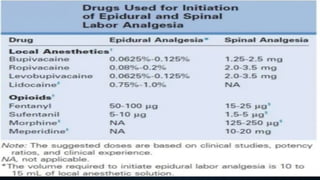
• Contemporary epidural labor analgesia practice most often incorporates low doses
of long acting local anesthetic combined with lipid soluble opioid
LOCAL ANESTHETICS
Bupivacaine
• Most commonly used for labor neuraxial analgesia
• Highly protein bound, limits trans-placental transfer
Ropivacaine
Levo bupivacaine
Lidocaine
2-chlorprocaine
OPIOIDS
• In clinical practice, epidural fentanyl and sufentanil are usually administered with a
local anesthetic for initiation of analgesia
• Addition of opioid to LA for neuraxial labor analgesia decreases latency, prolongs
the duration of analgesia, decreases epidural LA requirement, decreases motor
blockade and improves quality of analgesia
ADVANTAGES OF LOWER DOSE OF LOCAL
ANESTHETICS:
• Decreased risk for local anesthetic systemic toxicity
• Decreased risk for high or total spinal anesthesia
• Decreased intensity of motor blockade
EPIDURAL TEST DOSE
• Purpose is to help identify unintentional cannulation of a vein or subarachnoid space
• Epidural test dose: Placement of an epidural catheter and administration of a
standard dose of lidocaine 45mg/ epinephrine 15mcg
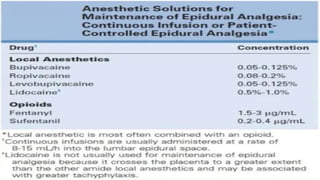
MAINTENANCE OF ANALGESIA
• Combination of a low dose, long-acting amide local anesthetic and a lipid soluble
opioid
• This approach improves safety and leads to less motor blockade and greater patient
satisfaction.
ADMINISTRATION TECHNIQUES
1. Intermittent Bolus
• Analgesia re-established with bolus injection of 8 to 12 ml of LA/Opioid solution.
• Pain relief is constantly interrupted by regression of analgesia
• The spread and quality of analgesia may change with the repeated lumbar epidural
injections.

2. Continuous Infusion
• Prolonged infusion might lead to significant motor blockade.Therefore, dose requires
titration.
• Strict monitoring is required as migration of catheter into subarachnoid, subdural or
intravenous spaces are likely to go unnoticed.
SIDE EFFECTS OF NEURAXIAL ANALGESIA
1. Hypotension
2. Pruritis
3. Nausea and vomiting
4. Fever
5. Shivering
6. Urinary retention
7. Delayed Gastric Emptying
COMPLICATIONS OF NEURAXIAL
ANALGESIA
1. Inadequate Analgesia
2. Unintentional Dural puncture
3. Respiratory Depression
4. Intravascular Injections of LA
5. Extensive Motor Blockade
6. Prolonged Blockade
7. Sensory change
8. Back Pain
9. Pelvic Floor injury
INADEQUATE ANALGESIA
• Successful Location of the epidural space is not always possible and satisfactory analgesia does not
always occur, even when the epidural space has been identified correctly. Factors such as patient age
and weight, the specific technique, the type of epidural catheter, and the skill of anesthesia provider are
associated with the rate of failure of neuraxial analgesia.
• The risk for failed anesthesia and the potential need to place a second epidural catheter should be
discussed with the patient during preanesthetic evaluation, before placement of the first epidural
catheter.
• Three types mainly:
1. Extent of block is inadequate.
2. Asymmetric block
3. Breakthrough pain
UNINTENTIONAL DURAL PUNCTURE
• Rate of unintentional Dural puncture with an epidural needle or catheter was 1.5%
• Options:
1. Remove the needle and place an epidural catheter at another interspace;
2. If CSE analgesia was planned, the intrathecal dose may be injected through the epidural
needle before it is removed and re-sited at a different interspace.
3. The anesthesia provider may place a catheter in the subarachnoid space and administer
continuous spinal analgesia for labor and delivery.
HIGH AND TOTAL SPINAL ANAESTHESIA
• May occur after unintentional and unrecognized injection of local anesthetic (via a
needle or catheter) into either the subarachnoid or subdural space.
• Alternatively, the epidural catheter may migrate into the subarachnoid or subdural
space during the course of labor and deliver.
• High spinal blockade may result from overdose of local anesthetic in epidural space.
CONTRAINDICATIONS
• Patient refusal or inability to cooperate.
• Increased intracranial pressure secondary to a mass lesion
• Skin or soft tissue infection at the site of needle placement
• Frank coagulopathy
• Uncorrected maternal hypovolemia (e.g. haemorrhage)
BENEFITS OF EPIDURAL ANALGESIA
• Epidural analgesia may facilitate an atraumatic vaginal breech delivery, the vaginal
delivery of twin infants, and vaginal delivery of preterm infant.
• By providing effective pain relief, epidural analgesia facilitates the control of blood
pressure in pre-eclamptic women.
• Epidural Analgesia also blunts the hemodynamic effects of uterine contractions and
the associated pain response
• Prevents hypoventilation hyperventilation syndrome.
ADMINISTRATION OF EPIDURAL ANALGESIA
FOR LABOR: TECHNIQUE
1. Informed consent is obtained and obstetrician is consulted.
2. Monitoring includes the following:
• Blood pressure every 1 to 2 minutes for 15 minutes after giving bolus of local anesthetic
• Continuous maternal heart rate monitoring during and after administration of the block.
• Continuous fetal heart rate monitoring during and after the procedure and continual
verbal communication.
ADMINISTRATION OF EPIDURAL ANALGESIA
FOR LABOR: TECHNIQUE
3. The patient is hydrated with 500 ml. of Ringer’s lactate solution.
4. The patient assumes a lateral decubitus or sitting position.
5. The epidural space is identified with a loss-of-resistance technique.
6. The epidural catheter is advanced 3 to 5 cm into the epidural space.
7. A test dose of 3 mL of 1.5% lidocaine with 1:200,000 epinephrine is injected after
careful aspiration and after a uterine contraction (to minimize the chance of
confusing tachycardia that results from the pain with tachycardia as a result of
intravenous injection of the test dose.)
ADMINISTRATION OF EPIDURAL ANALGESIA
FOR LABOR: TECHNIQUE
8. If the test done is negative, one or two 5-mL doses of 0.25% bupivacaine are injected to
achieve a cephalad sensory level of approximately T10.
9. After 15 to 20 minutes, the block is assessed by means of loss of sensation to cold or
pinprick.
10. The patient is cared for in the lateral or semi lateral position to avoid aortocaval
compression.
11. Subsequently, maternal blood pressure is measured every 5 to 15 minutes.The fetal heart
rate is monitored continuously.
12. The level of analgesia and the intensity of motor block are assessed every 1 to 2 hours.
SADDLE BLOCK
• Advantageous in the patient with a preterm fetus or vaginal breech presentation. In
these cases, dense perineal relaxation may facilitate an atraumatic vaginal delivery.
• A saddle block also provides excellent anesthesia for an outlet/low forceps delivery.
• The block is administered with the patient in the sitting position to promote caudal
spread of the hyperbaric local anesthetic.
• We administer the local anesthetic immediately after a uterine contraction to
decrease the likelihood of an unexpected high block.
CONTINUOUS SPINAL ANALGESIA
• Placed through 18- or 19-gauge needle.Very small (e.g. 28- to 32-gauge) catheters.
• Were developed for insertion through small (e.g. 22- to 26-gauge) spinal needles.
• Unfortunately, several cases of cauda equina syndrome (associated with the use of
spinal micro catheters during surgery in non-pregnant patients) prompted the Food
and Drug Administration to remove these micro catheters from the market.
SPINAL ANALGESIA FOR LABOR: SINGLE
SHOT TECHNIQUE
• A single-shot subarachnoid injection of local anesthetic is not suitable for the first
stage labor.
• A single-shot injection has finite duration and multiple injections result in an
increased risk of post dural puncture headache (PDPH).
COMBINED SPINAL AND EPIDURAL
ANALGESIA
• Benefits patients with severe pain early in labor
• Or for immediate analgesia prior to delivery
• Typical Intrathecal doses for CSE are
1. Fentanyl: 10-12.5mcg
2. Sufentanil: 5mcg
3. Bupivacaine 2.5mg
4. Rupivacaine 3-4mg
GENERAL ANESTHESIA
• Avoided due to risk of aspiration
• Used only in a true emergency during vaginal delivery
 Indications:
a. Fetal distress during second stage
b. Tetanic uterine contractions
c. Breech extraction
d. Version and extraction
e. Manual removal of a retained Placenta
f. Replacement of an inverted uterus
managing labour pains - anaesthesia.pptx

managing labour pains - anaesthesia.pptx

  • 1.
    MANAGEMENT OF LABOR PAIN ByDr. Aliza Resident Anesthesiology SIHS
  • 2.
    ETIOLOGY OF PAINDURING LABOR • Physical Pain: Contraction Of Myometrium Stretching Of Cervix and Perineum • Emotional Factors Fear Of Unknown Anxiety Previous Unpleasant Experience
  • 3.
    NONPHARMACOLOGICAL ANALGESIC TECHNIQUES • PsychologicalAnalgesic techniques (Bradley, Dick-Read, Lamaze and LeBoyer) • Hypnosis • Transcutaneous Electrical Nerve Stimulation • Biofeedback • Acupuncture
  • 4.
    PARENTERAL AGENTS Systemic OpioidsIn Labor • Advantages: Easy Administration Inexpensive Avoids Complications Of Regional Blocks Does Not Require Highly Skilled Personnel
  • 5.
    SYSTEMIC OPIOIDS -DISADVANTAGES • Cross the Placenta • Maternal Respiratory Depression and Sedation • Nausea,Vomiting, Gastric Stasis • Loss Of Beat-to-Beat Variability of FHR • Neurobehavioral Depression of Neonate • Low Apgar Scores • Respiratory Acidosis
  • 6.
    OPIOIDS • Meperidine: 10 to25mg IV or 25 to 50mg IM • Fentanyl: 25 to 100mcg/hr • Remifentanil PCA: 40mcg bolus with 2 minutes lockout • Butorphanol: 1 to 2mg • Nalbuphine: 10 to 20mg
  • 7.
    NSAIDS • Not recommended •Suppress Uterine Contractions • Promote Early Closure of Ductus Arteriosus Various Agents: • Promethazine (25 to 50mg IM) • Hydroxyzine (50-100mg IM) • Midazolam (up to 2mg in combination) • Ketamine (10 to 15mg IV)
  • 8.
    INHALATIONAL ANALGESIA: • Entonox Easyto Administer Satisfactory Analgesia Minimal Neonatal Depression
  • 9.
    INHALATIONAL ANALGESIA: • Isoflurane •Enflurane • Desflurane Limited use due to a. Drowsiness b. High Cost c. Unpleasant Smell d. Accidental Overdose
  • 10.
    REGIONAL BLOCKS Pudendal NerveBlock: Technique: A special needle (koback) is used and placed transvaginally underneath ischial spine on each side.The needle is advanced 1-1.5cm through sacrospinous ligament and 10ml of 1% lidocaine or 2% chloroprocaine is injected following negative needle aspiration. Complications: • Intravascular Injection • Retroperitoneal Hematoma • Retropsoas Or Subgluteal Abscess
  • 11.
    PARACERVICAL PLEXUS BLOCKS NoLonger Used Due To Possibility Of: • Fetal Bradycardia • Uterine Arterial Vasoconstriction • Uteroplacental Insufficiency • Local Anesthetic Insufficiency
  • 12.
    REGIONAL TECHNIQUES • EpiduralAnalgesia • Spinal Analgesia • Combined Spinal and Epidural Analgesia • Continuous Epidural Analgesia • Continuous Spinal Analgesia
  • 13.
    CHOICE OF DRUGS •Local anesthetics were administered to block both the visceral and somatic pain of labor • Intrathecal opioids effectively relieve pain of first stage of labor although they should be combined with LA to relieve pain of first and second stages of labor • Addition of opioid to LA shortens latency • Contemporary epidural labor analgesia practice most often incorporates low doses of long acting local anesthetic combined with lipid soluble opioid
  • 14.
    LOCAL ANESTHETICS Bupivacaine • Mostcommonly used for labor neuraxial analgesia • Highly protein bound, limits trans-placental transfer Ropivacaine Levo bupivacaine Lidocaine 2-chlorprocaine
  • 15.
    OPIOIDS • In clinicalpractice, epidural fentanyl and sufentanil are usually administered with a local anesthetic for initiation of analgesia • Addition of opioid to LA for neuraxial labor analgesia decreases latency, prolongs the duration of analgesia, decreases epidural LA requirement, decreases motor blockade and improves quality of analgesia
  • 16.
    ADVANTAGES OF LOWERDOSE OF LOCAL ANESTHETICS: • Decreased risk for local anesthetic systemic toxicity • Decreased risk for high or total spinal anesthesia • Decreased intensity of motor blockade
  • 18.
    EPIDURAL TEST DOSE •Purpose is to help identify unintentional cannulation of a vein or subarachnoid space • Epidural test dose: Placement of an epidural catheter and administration of a standard dose of lidocaine 45mg/ epinephrine 15mcg
  • 19.
    MAINTENANCE OF ANALGESIA •Combination of a low dose, long-acting amide local anesthetic and a lipid soluble opioid • This approach improves safety and leads to less motor blockade and greater patient satisfaction.
  • 21.
    ADMINISTRATION TECHNIQUES 1. IntermittentBolus • Analgesia re-established with bolus injection of 8 to 12 ml of LA/Opioid solution. • Pain relief is constantly interrupted by regression of analgesia • The spread and quality of analgesia may change with the repeated lumbar epidural injections. 2. Continuous Infusion • Prolonged infusion might lead to significant motor blockade.Therefore, dose requires titration. • Strict monitoring is required as migration of catheter into subarachnoid, subdural or intravenous spaces are likely to go unnoticed.
  • 22.
    SIDE EFFECTS OFNEURAXIAL ANALGESIA 1. Hypotension 2. Pruritis 3. Nausea and vomiting 4. Fever 5. Shivering 6. Urinary retention 7. Delayed Gastric Emptying
  • 23.
    COMPLICATIONS OF NEURAXIAL ANALGESIA 1.Inadequate Analgesia 2. Unintentional Dural puncture 3. Respiratory Depression 4. Intravascular Injections of LA 5. Extensive Motor Blockade 6. Prolonged Blockade 7. Sensory change 8. Back Pain 9. Pelvic Floor injury
  • 24.
    INADEQUATE ANALGESIA • SuccessfulLocation of the epidural space is not always possible and satisfactory analgesia does not always occur, even when the epidural space has been identified correctly. Factors such as patient age and weight, the specific technique, the type of epidural catheter, and the skill of anesthesia provider are associated with the rate of failure of neuraxial analgesia. • The risk for failed anesthesia and the potential need to place a second epidural catheter should be discussed with the patient during preanesthetic evaluation, before placement of the first epidural catheter. • Three types mainly: 1. Extent of block is inadequate. 2. Asymmetric block 3. Breakthrough pain
  • 25.
    UNINTENTIONAL DURAL PUNCTURE •Rate of unintentional Dural puncture with an epidural needle or catheter was 1.5% • Options: 1. Remove the needle and place an epidural catheter at another interspace; 2. If CSE analgesia was planned, the intrathecal dose may be injected through the epidural needle before it is removed and re-sited at a different interspace. 3. The anesthesia provider may place a catheter in the subarachnoid space and administer continuous spinal analgesia for labor and delivery.
  • 26.
    HIGH AND TOTALSPINAL ANAESTHESIA • May occur after unintentional and unrecognized injection of local anesthetic (via a needle or catheter) into either the subarachnoid or subdural space. • Alternatively, the epidural catheter may migrate into the subarachnoid or subdural space during the course of labor and deliver. • High spinal blockade may result from overdose of local anesthetic in epidural space.
  • 27.
    CONTRAINDICATIONS • Patient refusalor inability to cooperate. • Increased intracranial pressure secondary to a mass lesion • Skin or soft tissue infection at the site of needle placement • Frank coagulopathy • Uncorrected maternal hypovolemia (e.g. haemorrhage)
  • 28.
    BENEFITS OF EPIDURALANALGESIA • Epidural analgesia may facilitate an atraumatic vaginal breech delivery, the vaginal delivery of twin infants, and vaginal delivery of preterm infant. • By providing effective pain relief, epidural analgesia facilitates the control of blood pressure in pre-eclamptic women. • Epidural Analgesia also blunts the hemodynamic effects of uterine contractions and the associated pain response • Prevents hypoventilation hyperventilation syndrome.
  • 29.
    ADMINISTRATION OF EPIDURALANALGESIA FOR LABOR: TECHNIQUE 1. Informed consent is obtained and obstetrician is consulted. 2. Monitoring includes the following: • Blood pressure every 1 to 2 minutes for 15 minutes after giving bolus of local anesthetic • Continuous maternal heart rate monitoring during and after administration of the block. • Continuous fetal heart rate monitoring during and after the procedure and continual verbal communication.
  • 30.
    ADMINISTRATION OF EPIDURALANALGESIA FOR LABOR: TECHNIQUE 3. The patient is hydrated with 500 ml. of Ringer’s lactate solution. 4. The patient assumes a lateral decubitus or sitting position. 5. The epidural space is identified with a loss-of-resistance technique. 6. The epidural catheter is advanced 3 to 5 cm into the epidural space. 7. A test dose of 3 mL of 1.5% lidocaine with 1:200,000 epinephrine is injected after careful aspiration and after a uterine contraction (to minimize the chance of confusing tachycardia that results from the pain with tachycardia as a result of intravenous injection of the test dose.)
  • 31.
    ADMINISTRATION OF EPIDURALANALGESIA FOR LABOR: TECHNIQUE 8. If the test done is negative, one or two 5-mL doses of 0.25% bupivacaine are injected to achieve a cephalad sensory level of approximately T10. 9. After 15 to 20 minutes, the block is assessed by means of loss of sensation to cold or pinprick. 10. The patient is cared for in the lateral or semi lateral position to avoid aortocaval compression. 11. Subsequently, maternal blood pressure is measured every 5 to 15 minutes.The fetal heart rate is monitored continuously. 12. The level of analgesia and the intensity of motor block are assessed every 1 to 2 hours.
  • 32.
    SADDLE BLOCK • Advantageousin the patient with a preterm fetus or vaginal breech presentation. In these cases, dense perineal relaxation may facilitate an atraumatic vaginal delivery. • A saddle block also provides excellent anesthesia for an outlet/low forceps delivery. • The block is administered with the patient in the sitting position to promote caudal spread of the hyperbaric local anesthetic. • We administer the local anesthetic immediately after a uterine contraction to decrease the likelihood of an unexpected high block.
  • 33.
    CONTINUOUS SPINAL ANALGESIA •Placed through 18- or 19-gauge needle.Very small (e.g. 28- to 32-gauge) catheters. • Were developed for insertion through small (e.g. 22- to 26-gauge) spinal needles. • Unfortunately, several cases of cauda equina syndrome (associated with the use of spinal micro catheters during surgery in non-pregnant patients) prompted the Food and Drug Administration to remove these micro catheters from the market.
  • 34.
    SPINAL ANALGESIA FORLABOR: SINGLE SHOT TECHNIQUE • A single-shot subarachnoid injection of local anesthetic is not suitable for the first stage labor. • A single-shot injection has finite duration and multiple injections result in an increased risk of post dural puncture headache (PDPH).
  • 35.
    COMBINED SPINAL ANDEPIDURAL ANALGESIA • Benefits patients with severe pain early in labor • Or for immediate analgesia prior to delivery • Typical Intrathecal doses for CSE are 1. Fentanyl: 10-12.5mcg 2. Sufentanil: 5mcg 3. Bupivacaine 2.5mg 4. Rupivacaine 3-4mg
  • 36.
    GENERAL ANESTHESIA • Avoideddue to risk of aspiration • Used only in a true emergency during vaginal delivery  Indications: a. Fetal distress during second stage b. Tetanic uterine contractions c. Breech extraction d. Version and extraction e. Manual removal of a retained Placenta f. Replacement of an inverted uterus