Prepared by/ Dr. Islam EzzEldin Osman
Assistant lecturer of Anesthesia
Ain shams University
2017
As noted by the ASA and the ACOG
“There is no other circumstance where it is
considered acceptable for a person to
experience severe pain, amenable to safe
intervention, while under a physician’s care.”
“ In the absence of a medical contraindication,
maternal request is a sufficient medical
indication for pain relief during labor.”
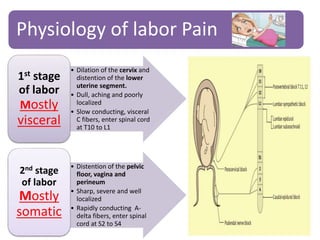
Physiology of labor Pain
• Dilation of the cervix and
distention of the lower
uterine segment.
• Dull, aching and poorly
localized
• Slow conducting, visceral
C fibers, enter spinal cord
at T10 to L1
1st stage
of labor
Mostly
visceral
• Distention of the pelvic
floor, vagina and
perineum
• Sharp, severe and well
localized
• Rapidly conducting A-
delta fibers, enter spinal
cord at S2 to S4
2nd stage
of labor
Mostly
somatic
The ideal labor analgesic technique
is safe for both the mother and the infant
does not interfere with the progress of labor and delivery
provides flexibility in response to changing conditions
provides consistent pain relief
has a long enough duration of action
minimizes undesirable side effects (e.g., motor block)
minimizes ongoing demands on the anesthesia provider’s time
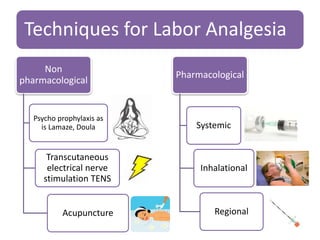
Techniques for Labor Analgesia
Non
pharmacological
Psycho prophylaxis as
is Lamaze, Doula
Transcutaneous
electrical nerve
stimulation TENS
Acupuncture
Pharmacological
Systemic
Inhalational
Regional
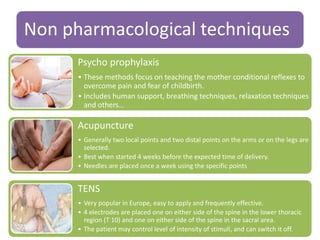
Non pharmacological techniques
Psycho prophylaxis
• These methods focus on teaching the mother conditional reflexes to
overcome pain and fear of childbirth.
• Includes human support, breathing techniques, relaxation techniques
and others…
Acupuncture
• Generally two local points and two distal points on the arms or on the legs are
selected.
• Best when started 4 weeks before the expected time of delivery.
• Needles are placed once a week using the specific points
TENS
• Very popular in Europe, easy to apply and frequently effective.
• 4 electrodes are placed one on either side of the spine in the lower thoracic
region (T 10) and one on either side of the spine in the sacral area.
• The patient may control level of intensity of stimuli, and can switch it off.
Pharmacological Techniques
Systemic opioids
Inhalational
Regional
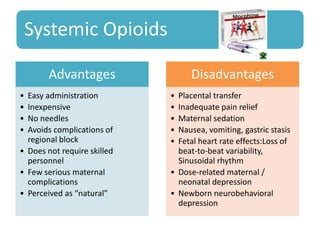
Systemic Opioids
Advantages
• Easy administration
• Inexpensive
• No needles
• Avoids complications of
regional block
• Does not require skilled
personnel
• Few serious maternal
complications
• Perceived as “natural”
Disadvantages
• Placental transfer
• Inadequate pain relief
• Maternal sedation
• Nausea, vomiting, gastric stasis
• Fetal heart rate effects:Loss of
beat-to-beat variability,
Sinusoidal rhythm
• Dose-related maternal /
neonatal depression
• Newborn neurobehavioral
depression
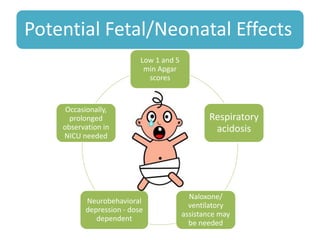
Potential Fetal/Neonatal Effects
Low 1 and 5
min Apgar
scores
Respiratory
acidosis
Naloxone/
ventilatory
assistance may
be needed
Neurobehavioral
depression - dose
dependent
Occasionally,
prolonged
observation in
NICU needed
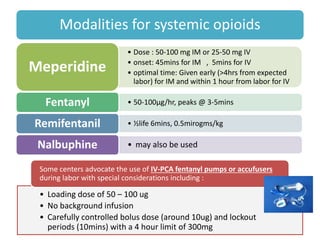
Modalities for systemic opioids
• Dose : 50-100 mg IM or 25-50 mg IV
• onset: 45mins for IM , 5mins for IV
• optimal time: Given early (>4hrs from expected
labor) for IM and within 1 hour from labor for IV
Meperidine
• 50-100µg/hr, peaks @ 3-5minsFentanyl
• ½life 6mins, 0.5mirogms/kgRemifentanil
• may also be usedNalbuphine
• Loading dose of 50 – 100 ug
• No background infusion
• Carefully controlled bolus dose (around 10ug) and lockout
periods (10mins) with a 4 hour limit of 300mg
Some centers advocate the use of IV-PCA fentanyl pumps or accufusers
during labor with special considerations including :
Dexmedetomidine
Recently , intravenous infusion of
Dexmedetomidine is being used in combination
with remifentanil infusion for labor analgesia.
• Opioid sparing effect
• Adequate level of sedation
• Minimal haemodynamic side effects.
• Very low incidence of nausea and vomiting
Advantages
Inhalational Analgesia
Entonox
(50% N20/50% O2)
Advantages:
• Easy to administer (no
needles or PDPH)
• “Satisfactory”
analgesia variable
• Minimal neonatal
depression
Disadvantages:
• Decreased uterine
contractility (except N2O)
• Rapid induction of
anesthesia in pregnancy
• Risk of unconsciousness and
aspiration
• Difficulties with scavenging
in labor rooms
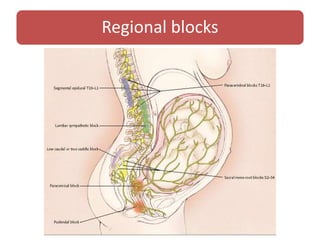
Regional blocks
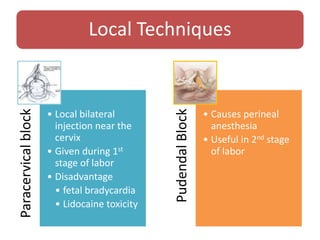
Local TechniquesParacervicalblock
• Local bilateral
injection near the
cervix
• Given during 1st
stage of labor
• Disadvantage
• fetal bradycardia
• Lidocaine toxicity
PudendalBlock
• Causes perineal
anesthesia
• Useful in 2nd stage
of labor
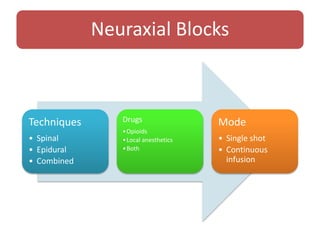
Neuraxial Blocks
Techniques
• Spinal
• Epidural
• Combined
Drugs
•Opioids
•Local anesthetics
•Both
Mode
• Single shot
• Continuous
infusion
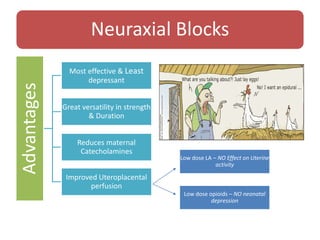
Neuraxial BlocksAdvantages
Most effective & Least
depressant
Great versatility in strength
& Duration
Reduces maternal
Catecholamines
Improved Uteroplacental
perfusion
Low dose LA – NO Effect on Uterine
activity
Low dose opioids – NO neonatal
depression
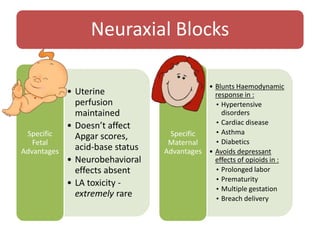
Neuraxial Blocks
• Uterine
perfusion
maintained
• Doesn’t affect
Apgar scores,
acid-base status
• Neurobehavioral
effects absent
• LA toxicity -
extremely rare
Specific
Fetal
Advantages
• Blunts Haemodynamic
response in :
• Hypertensive
disorders
• Cardiac disease
• Asthma
• Diabetics
• Avoids depressant
effects of opioids in :
• Prolonged labor
• Prematurity
• Multiple gestation
• Breach delivery
Specific
Maternal
Advantages
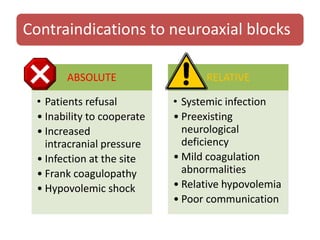
Contraindications to neuroaxial blocks
ABSOLUTE
• Patients refusal
• Inability to cooperate
• Increased
intracranial pressure
• Infection at the site
• Frank coagulopathy
• Hypovolemic shock
RELATIVE
• Systemic infection
• Preexisting
neurological
deficiency
• Mild coagulation
abnormalities
• Relative hypovolemia
• Poor communication
Spinal Anelgesia
Involves intrathecal injection of opiods, Local anesthetics
or more commonly a mixture of both.
Has the benefit of having the most rapid onset of
analgesia.
The most commonly used modality for labor, the “saddle
block” provides profound perineal analgesia with minimal
hemodynamic side effects.
Choice Of Local Anesthetic
Rapid onset with
minimal motor
block
Minimal risk of
maternal
toxicity
Negligible effects
on uterine activity
and uteroplacental
perfusion
Limited
uteroplacental
transfer
Long duration of
action
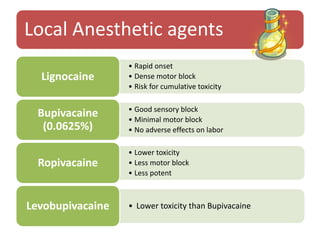
Local Anesthetic agents
• Rapid onset
• Dense motor block
• Risk for cumulative toxicity
Lignocaine
• Good sensory block
• Minimal motor block
• No adverse effects on labor
Bupivacaine
(0.0625%)
• Lower toxicity
• Less motor block
• Less potent
Ropivacaine
• Lower toxicity than BupivacaineLevobupivacaine
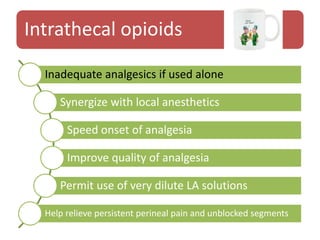
Intrathecal opioids
Inadequate analgesics if used alone
Synergize with local anesthetics
Speed onset of analgesia
Improve quality of analgesia
Permit use of very dilute LA solutions
Help relieve persistent perineal pain and unblocked segments
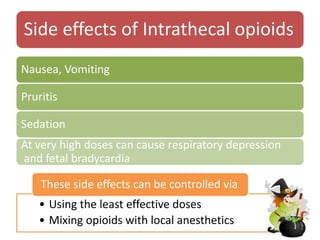
Side effects of Intrathecal opioids
Nausea, Vomiting
Pruritis
Sedation
At very high doses can cause respiratory depression
and fetal bradycardia
• Using the least effective doses
• Mixing opioids with local anesthetics
These side effects can be controlled via
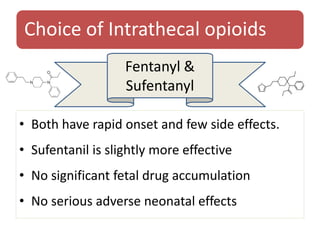
Choice of Intrathecal opioids
• Both have rapid onset and few side effects.
• Sufentanil is slightly more effective
• No significant fetal drug accumulation
• No serious adverse neonatal effects
Fentanyl &
Sufentanyl
Continuous Spinal Analgesia
Used by some centers in Europe,
however it is restricted by FDA
regulations in the US.
Uses 28 or 32-G catheters for 22
or 26-G spinal needles.
Risks include development of
cauda Equina Syndrome,
hypotension and nerve injury.
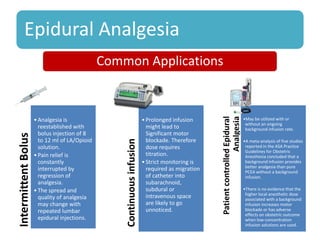
Epidural AnalgesiaIntermittentBolus
•Analgesia is
reestablished with
bolus injection of 8
to 12 ml of LA/Opioid
solution.
•Pain relief is
constantly
interrupted by
regression of
analgesia.
•The spread and
quality of analgesia
may change with
repeated lumbar
epidural injections.
Continuousinfusion
•Prolonged infusion
might lead to
Significant motor
blockade. Therefore
dose requires
titration.
•Strict monitoring is
required as migration
of catheter into
subarachnoid,
subdural or
intravenous space
are likely to go
unnoticed.
PatientcontrolledEpidural
Analgesia
•May be utilized with or
without an ongoing
background infusion rate.
•A meta-analysis of five studies
reported in the ASA Practice
Guidelines for Obstetric
Anesthesia concluded that a
background infusion provides
better analgesia than pure
PCEA without a background
infusion.
•There is no evidence that the
higher local anesthetic dose
associated with a background
infusion increases motor
blockade or has adverse
effects on obstetric outcome
when low-concentration
infusion solutions are used.
Common Applications
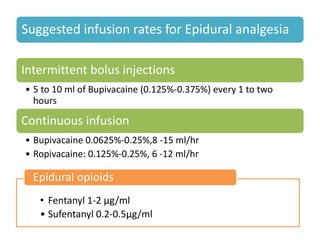
Suggested infusion rates for Epidural analgesia
Intermittent bolus injections
• 5 to 10 ml of Bupivacaine (0.125%-0.375%) every 1 to two
hours
Continuous infusion
• Bupivacaine 0.0625%-0.25%,8 -15 ml/hr
• Ropivacaine: 0.125%-0.25%, 6 -12 ml/hr
• Fentanyl 1-2 µg/ml
• Sufentanyl 0.2-0.5µg/ml
Epidural opioids
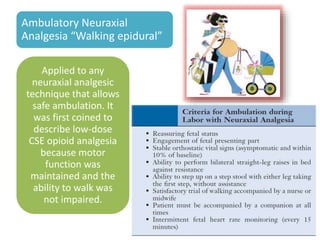
Ambulatory Neuraxial
Analgesia “Walking epidural”
Applied to any
neuraxial analgesic
technique that allows
safe ambulation. It
was first coined to
describe low-dose
CSE opioid analgesia
because motor
function was
maintained and the
ability to walk was
not impaired.
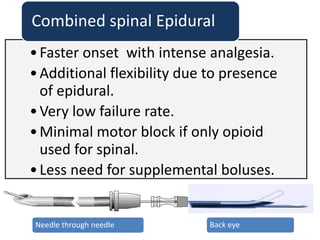
•Faster onset with intense analgesia.
•Additional flexibility due to presence
of epidural.
•Very low failure rate.
•Minimal motor block if only opioid
used for spinal.
•Less need for supplemental boluses.
Combined spinal Epidural
Needle through needle Back eye
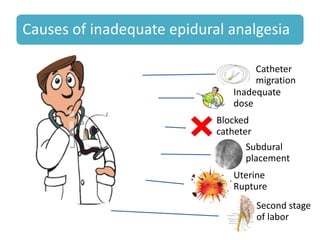
Causes of inadequate epidural analgesia
Catheter
migration
Inadequate
dose
Blocked
catheter
Subdural
placement
Uterine
Rupture
Second stage
of labor
Complications of Epidural analgesia
Hypotension
Inadequate analgesia
Extensive motor blockade
Respiratory depression
Faulty placement
Back pain
How to avoid epidural disasters
• Maintain constant verbal contact.
• Nurse in lateral position as much as possible.
• Assure continuous maternal and fetal monitoring throughout
placing and handling epidural infusions.
• Always aspirate before each injection.
• Treat every injection as a test dose.
• Always observe for passive return through the catheter.
• Do not inject more than 4 ml of LA at a time.
• If in doubts, repeat test dose. Still in doubts? Replace it
• After all, be mentally prepare to treat :
1. Convulsions
2. Total spinal
3. Cardiovascular collapse and arrest
Labor analgesia

Labor analgesia

  • 1.
    Prepared by/ Dr.Islam EzzEldin Osman Assistant lecturer of Anesthesia Ain shams University 2017
  • 2.
    As noted bythe ASA and the ACOG “There is no other circumstance where it is considered acceptable for a person to experience severe pain, amenable to safe intervention, while under a physician’s care.” “ In the absence of a medical contraindication, maternal request is a sufficient medical indication for pain relief during labor.”
  • 3.
    Physiology of laborPain • Dilation of the cervix and distention of the lower uterine segment. • Dull, aching and poorly localized • Slow conducting, visceral C fibers, enter spinal cord at T10 to L1 1st stage of labor Mostly visceral • Distention of the pelvic floor, vagina and perineum • Sharp, severe and well localized • Rapidly conducting A- delta fibers, enter spinal cord at S2 to S4 2nd stage of labor Mostly somatic
  • 4.
    The ideal laboranalgesic technique is safe for both the mother and the infant does not interfere with the progress of labor and delivery provides flexibility in response to changing conditions provides consistent pain relief has a long enough duration of action minimizes undesirable side effects (e.g., motor block) minimizes ongoing demands on the anesthesia provider’s time
  • 5.
    Techniques for LaborAnalgesia Non pharmacological Psycho prophylaxis as is Lamaze, Doula Transcutaneous electrical nerve stimulation TENS Acupuncture Pharmacological Systemic Inhalational Regional
  • 6.
    Non pharmacological techniques Psychoprophylaxis • These methods focus on teaching the mother conditional reflexes to overcome pain and fear of childbirth. • Includes human support, breathing techniques, relaxation techniques and others… Acupuncture • Generally two local points and two distal points on the arms or on the legs are selected. • Best when started 4 weeks before the expected time of delivery. • Needles are placed once a week using the specific points TENS • Very popular in Europe, easy to apply and frequently effective. • 4 electrodes are placed one on either side of the spine in the lower thoracic region (T 10) and one on either side of the spine in the sacral area. • The patient may control level of intensity of stimuli, and can switch it off.
  • 7.
  • 8.
    Systemic Opioids Advantages • Easyadministration • Inexpensive • No needles • Avoids complications of regional block • Does not require skilled personnel • Few serious maternal complications • Perceived as “natural” Disadvantages • Placental transfer • Inadequate pain relief • Maternal sedation • Nausea, vomiting, gastric stasis • Fetal heart rate effects:Loss of beat-to-beat variability, Sinusoidal rhythm • Dose-related maternal / neonatal depression • Newborn neurobehavioral depression
  • 9.
    Potential Fetal/Neonatal Effects Low1 and 5 min Apgar scores Respiratory acidosis Naloxone/ ventilatory assistance may be needed Neurobehavioral depression - dose dependent Occasionally, prolonged observation in NICU needed
  • 10.
    Modalities for systemicopioids • Dose : 50-100 mg IM or 25-50 mg IV • onset: 45mins for IM , 5mins for IV • optimal time: Given early (>4hrs from expected labor) for IM and within 1 hour from labor for IV Meperidine • 50-100µg/hr, peaks @ 3-5minsFentanyl • ½life 6mins, 0.5mirogms/kgRemifentanil • may also be usedNalbuphine • Loading dose of 50 – 100 ug • No background infusion • Carefully controlled bolus dose (around 10ug) and lockout periods (10mins) with a 4 hour limit of 300mg Some centers advocate the use of IV-PCA fentanyl pumps or accufusers during labor with special considerations including :
  • 11.
    Dexmedetomidine Recently , intravenousinfusion of Dexmedetomidine is being used in combination with remifentanil infusion for labor analgesia. • Opioid sparing effect • Adequate level of sedation • Minimal haemodynamic side effects. • Very low incidence of nausea and vomiting Advantages
  • 12.
    Inhalational Analgesia Entonox (50% N20/50%O2) Advantages: • Easy to administer (no needles or PDPH) • “Satisfactory” analgesia variable • Minimal neonatal depression Disadvantages: • Decreased uterine contractility (except N2O) • Rapid induction of anesthesia in pregnancy • Risk of unconsciousness and aspiration • Difficulties with scavenging in labor rooms
  • 13.
  • 14.
    Local TechniquesParacervicalblock • Localbilateral injection near the cervix • Given during 1st stage of labor • Disadvantage • fetal bradycardia • Lidocaine toxicity PudendalBlock • Causes perineal anesthesia • Useful in 2nd stage of labor
  • 15.
    Neuraxial Blocks Techniques • Spinal •Epidural • Combined Drugs •Opioids •Local anesthetics •Both Mode • Single shot • Continuous infusion
  • 16.
    Neuraxial BlocksAdvantages Most effective& Least depressant Great versatility in strength & Duration Reduces maternal Catecholamines Improved Uteroplacental perfusion Low dose LA – NO Effect on Uterine activity Low dose opioids – NO neonatal depression
  • 17.
    Neuraxial Blocks • Uterine perfusion maintained •Doesn’t affect Apgar scores, acid-base status • Neurobehavioral effects absent • LA toxicity - extremely rare Specific Fetal Advantages • Blunts Haemodynamic response in : • Hypertensive disorders • Cardiac disease • Asthma • Diabetics • Avoids depressant effects of opioids in : • Prolonged labor • Prematurity • Multiple gestation • Breach delivery Specific Maternal Advantages
  • 18.
    Contraindications to neuroaxialblocks ABSOLUTE • Patients refusal • Inability to cooperate • Increased intracranial pressure • Infection at the site • Frank coagulopathy • Hypovolemic shock RELATIVE • Systemic infection • Preexisting neurological deficiency • Mild coagulation abnormalities • Relative hypovolemia • Poor communication
  • 19.
    Spinal Anelgesia Involves intrathecalinjection of opiods, Local anesthetics or more commonly a mixture of both. Has the benefit of having the most rapid onset of analgesia. The most commonly used modality for labor, the “saddle block” provides profound perineal analgesia with minimal hemodynamic side effects.
  • 20.
    Choice Of LocalAnesthetic Rapid onset with minimal motor block Minimal risk of maternal toxicity Negligible effects on uterine activity and uteroplacental perfusion Limited uteroplacental transfer Long duration of action
  • 21.
    Local Anesthetic agents •Rapid onset • Dense motor block • Risk for cumulative toxicity Lignocaine • Good sensory block • Minimal motor block • No adverse effects on labor Bupivacaine (0.0625%) • Lower toxicity • Less motor block • Less potent Ropivacaine • Lower toxicity than BupivacaineLevobupivacaine
  • 22.
    Intrathecal opioids Inadequate analgesicsif used alone Synergize with local anesthetics Speed onset of analgesia Improve quality of analgesia Permit use of very dilute LA solutions Help relieve persistent perineal pain and unblocked segments
  • 23.
    Side effects ofIntrathecal opioids Nausea, Vomiting Pruritis Sedation At very high doses can cause respiratory depression and fetal bradycardia • Using the least effective doses • Mixing opioids with local anesthetics These side effects can be controlled via
  • 24.
    Choice of Intrathecalopioids • Both have rapid onset and few side effects. • Sufentanil is slightly more effective • No significant fetal drug accumulation • No serious adverse neonatal effects Fentanyl & Sufentanyl
  • 25.
    Continuous Spinal Analgesia Usedby some centers in Europe, however it is restricted by FDA regulations in the US. Uses 28 or 32-G catheters for 22 or 26-G spinal needles. Risks include development of cauda Equina Syndrome, hypotension and nerve injury.
  • 26.
    Epidural AnalgesiaIntermittentBolus •Analgesia is reestablishedwith bolus injection of 8 to 12 ml of LA/Opioid solution. •Pain relief is constantly interrupted by regression of analgesia. •The spread and quality of analgesia may change with repeated lumbar epidural injections. Continuousinfusion •Prolonged infusion might lead to Significant motor blockade. Therefore dose requires titration. •Strict monitoring is required as migration of catheter into subarachnoid, subdural or intravenous space are likely to go unnoticed. PatientcontrolledEpidural Analgesia •May be utilized with or without an ongoing background infusion rate. •A meta-analysis of five studies reported in the ASA Practice Guidelines for Obstetric Anesthesia concluded that a background infusion provides better analgesia than pure PCEA without a background infusion. •There is no evidence that the higher local anesthetic dose associated with a background infusion increases motor blockade or has adverse effects on obstetric outcome when low-concentration infusion solutions are used. Common Applications
  • 27.
    Suggested infusion ratesfor Epidural analgesia Intermittent bolus injections • 5 to 10 ml of Bupivacaine (0.125%-0.375%) every 1 to two hours Continuous infusion • Bupivacaine 0.0625%-0.25%,8 -15 ml/hr • Ropivacaine: 0.125%-0.25%, 6 -12 ml/hr • Fentanyl 1-2 µg/ml • Sufentanyl 0.2-0.5µg/ml Epidural opioids
  • 28.
    Ambulatory Neuraxial Analgesia “Walkingepidural” Applied to any neuraxial analgesic technique that allows safe ambulation. It was first coined to describe low-dose CSE opioid analgesia because motor function was maintained and the ability to walk was not impaired.
  • 29.
    •Faster onset withintense analgesia. •Additional flexibility due to presence of epidural. •Very low failure rate. •Minimal motor block if only opioid used for spinal. •Less need for supplemental boluses. Combined spinal Epidural Needle through needle Back eye
  • 30.
    Causes of inadequateepidural analgesia Catheter migration Inadequate dose Blocked catheter Subdural placement Uterine Rupture Second stage of labor
  • 31.
    Complications of Epiduralanalgesia Hypotension Inadequate analgesia Extensive motor blockade Respiratory depression Faulty placement Back pain
  • 32.
    How to avoidepidural disasters • Maintain constant verbal contact. • Nurse in lateral position as much as possible. • Assure continuous maternal and fetal monitoring throughout placing and handling epidural infusions. • Always aspirate before each injection. • Treat every injection as a test dose. • Always observe for passive return through the catheter. • Do not inject more than 4 ml of LA at a time. • If in doubts, repeat test dose. Still in doubts? Replace it • After all, be mentally prepare to treat : 1. Convulsions 2. Total spinal 3. Cardiovascular collapse and arrest

Editor's Notes

  • #22  Lignocaine: Rapid onset, Dense motor block, Risk of cumulative toxicity, UV/MV ratio – 0.6 Bupivacaine( 0.0625%): Good sensory, Minimal motor block, 2hrs, No adverse effects on labor, UV/MV – 0.3 Ropivacaine: Lower toxicity, ?Less motor block, Less potent Levobupivacaine: Lower toxicity
  • #23 Inadequate analgesics if used alone Synergize with local anesthetics Speed onset of analgesia Improve quality of analgesia Permit use of very dilute LA solutions Help relieve persistent perineal pain and unblocked segments
  • #28 Opioid: Fentanyl 1-2 µg/ml, Sufentanyl 0.2-0.5µg/ml Continuous infusion Bupivacaine 0.0625%-0.25%,8 -15 ml/hr Ropivacaine: 0.125%-0.25%, 6 -12 ml/hr Intermittent bolus injections Bupivacaine: 0.125%-0.375%, 5-10 ml, duration:1-2 hr
  • #31 Inadequate dose Patency of catheter Subdural placement Second stage of labor Catheter migration Uterine rupture