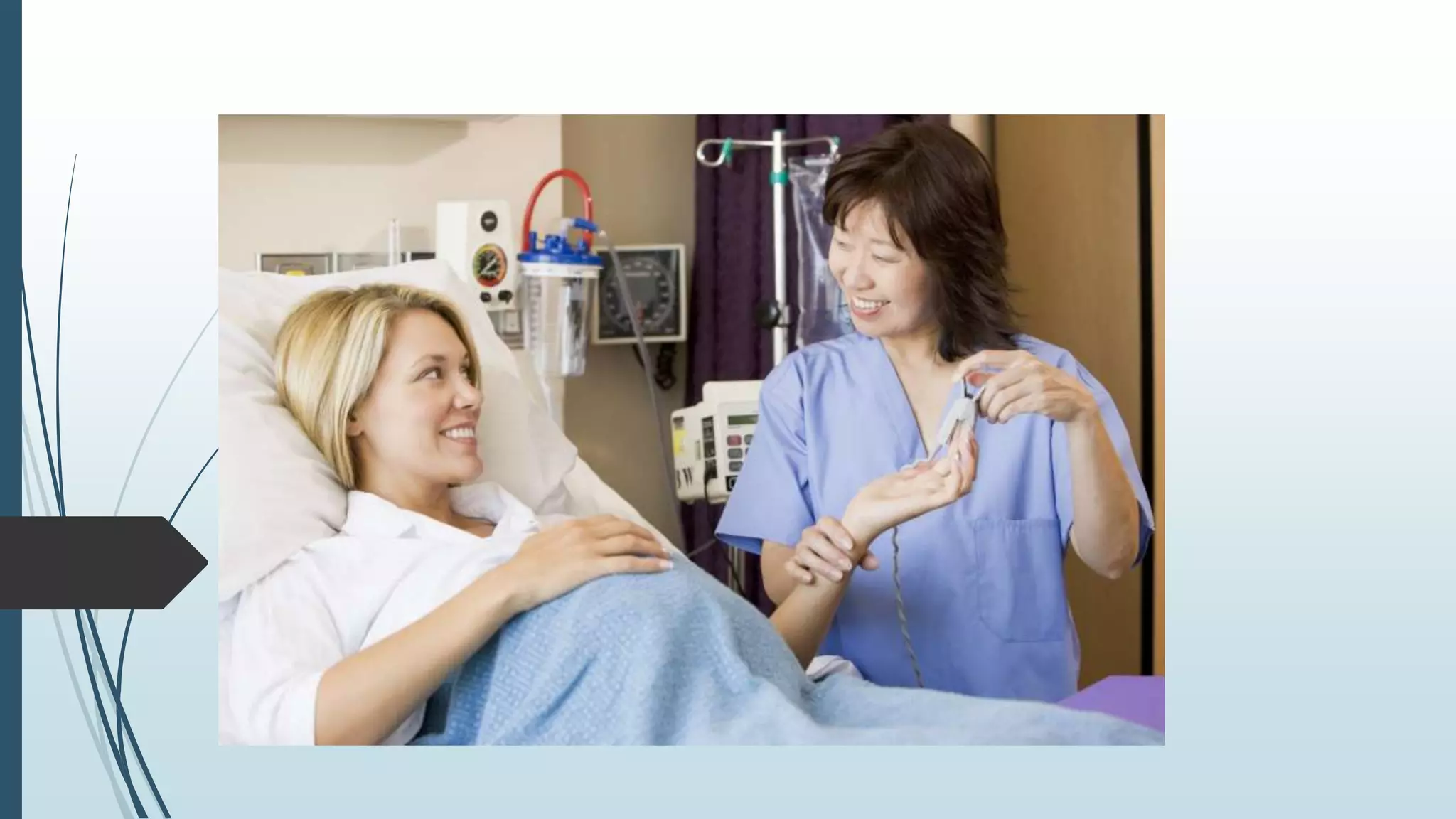
COMFORT AND SUPPORT IN
LABOUR
DEFINITION OF LABOUR:
Series of events that take place in the genital organs in an effort to expel the viable products of conception (foetus,
placenta and the membranes) out of womb through the vagina into the outer world is called labour.
COMFORT IN LABOUR:
Concerns about the discomfort and pain that accompany labour and birth can dominate a pregnant women's or
couple's thoughts about childbirth, particularly as the baby's due date approaches. Providing information during
prenatal visits about the numerous methods of comfort promotion and pain control available to women can
help ally some of the fears.
SUPPORT IN LABOUR:
It is addressed to the processes of supporting the women and providing her with complete protection in labour.
We can classify the different techniques used in this process in three categories:
 Emotional supports
 Physical supports.
 Instructions/Information.
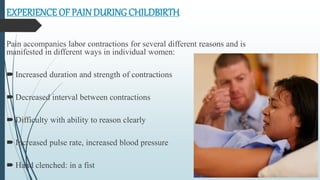
EXPERIENCE OF PAINDURING CHILDBIRTH
Pain accompanies labor contractions for several different reasons and is
manifested in different ways in individual women:
 Increased duration and strength of contractions
 Decreased interval between contractions
 Difficulty with ability to reason clearly
 Increased pulse rate, increased blood pressure
 Hand clenched: in a fist
Etiology of PainDuring Labor andBirth
During contractions, blood vessels constrict,
reducing the blood supply to uterine and cervical
cells, resulting in anoxia to muscle fibers. This
anoxia can cause pain.
stretching of the cervix and perineum.
the pressure of the foetal presenting part on
tissues
culturally and situationally determined.

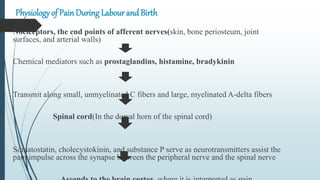
Physiology of Pain During Labour and Birth
Nociceptors, the end points of afferent nerves(skin, bone periosteum, joint
surfaces, and arterial walls)
Chemical mediators such as prostaglandins, histamine, bradykinin
Transmit along small, unmyelinated C fibers and large, myelinated A-delta fibers
Spinal cord(In the dorsal horn of the spinal cord)
Somatostatin, cholecystokinin, and substance P serve as neurotransmitters assist the
pain impulse across the synapse between the peripheral nerve and the spinal nerve
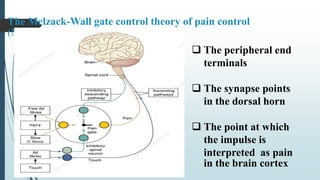
The Melzack-Wall gate control theory of pain control
(Melzack & Wall, 1965),
 The peripheral end
terminals
 The synapse points
in the dorsal horn
 The point at which
the impulse is
interpreted as pain
in the brain cortex
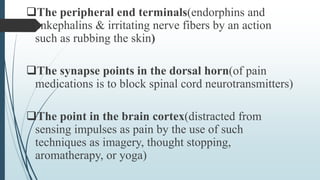
The peripheral end terminals(endorphins and
enkephalins & irritating nerve fibers by an action
such as rubbing the skin)
The synapse points in the dorsal horn(of pain
medications is to block spinal cord neurotransmitters)
The point in the brain cortex(distracted from
sensing impulses as pain by the use of such
techniques as imagery, thought stopping,
aromatherapy, or yoga)
Physiology of labor pain 1st stage of labor-
Dilatation of the cervix and distension of lower uterine
segment.
Dull, aching and poorly localized.
Slow conducting, visceral C fibers, enter spinal cord at level
of T10-L1.
Physiology of labor pain 2nd stage of labor-
Distension of the pelvic floor, vagina and perineum.
Sharp, severe and well localized .
Rapidly conducting A-delta fibers, enter the spinal cord at S2
to S4.
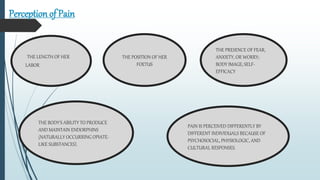
Perception of Pain
THE LENGTH OF HER
LABOR
THE POSITION OF HER
FOETUS
THE PRESENCE OF FEAR,
ANXIETY, OR WORRY;
BODY IMAGE; SELF-
EFFICACY
PAIN IS PERCEIVED DIFFERENTLY BY
DIFFERENT INDIVIDUALS BECAUSE OF
PSYCHOSOCIAL, PHYSIOLOGIC, AND
CULTURAL RESPONSES.
THE BODY'S ABILITY TO PRODUCE
AND MAINTAIN ENDORPHINS
(NATURALLY OCCURRING OPIATE-
LIKE SUBSTANCES).
Pharmacologicmanagement of painrelief during
labour
Pharmacological Interventions
Analgesia and sedation
The use of medication to reduce the sensation of pain
Sedatives given to promote sedation and relaxation
Opioids given to promote analgesia during labor
Anesthesia
The use of medication to partially or totally block all
sensation to an area of the body
Local, regional, general
Preparation for Medication Administration
Opioids are usually administered as intramuscularly (IM) or intravenous (IV) injection, they may also be administered
with a pump (patient control analgesia).
COMMONLY USED OPIOIDS
 To be safe, remember the criteria that a drug must
"Never give any drug unless you know it is safe for your individual client" to "Never give a drug during labor unless
you know it is safe for both of your clients: the mother and the fetus.
 Prepare a woman for the type of agent prescribed.
Narcotic Analgesics
Potent analgesic effect, but all drugs in this
category cause fetal CNS
Narcotic analgesics commonly used include
 Meperidine bydrochloride (Demerol)
Nalbuphine (Nubain)
Fentanyl (Sublimaze)
Butorphanol tarrate (Stadol).
Meperidine
Sedative and Antispasmodic
Given either IM orIV
Crosses the placenta
Cause respiratory
depression in a fetus.
It may be puzzling to see a
sleepy baby delivered to a
woman who was given
meperidine 2 hours before
birth and an alert baby
delivered to a woman who had
received meperidine within 1
hour of birth
The dose is 25 to
100 mg
Act about 30 minutes
after intramuscular (IM)
injection and about 5
minutes after
intravenous (V)
administration.
Its duration of
action is 2 to 3
hours,
• Nalbuphine hydrochloride(nubain) and
butorphanol tartrate(Stadol
• These are both synthetic
narcotic analgesics.
• The action of these agents in
comparable to that of
meperdine.
• Like meperidine, they may also
leave a degree of respiratory
depression in the newborn.
• FENTANYL:
• Fentanyl has rapid onset of action
(within 2-3 minutes after IV
administration) with short duration of
action, making it useful for labour
analgesia.
• It is a highly lipid soluble synthetic
opioid, with analgesic potency 100
times that of morphine and 800 times
that of pethidine.
• It can be administered in IV boluses of
25-50 micro mg (given slowly over 1-2
Naloxone Hydrochloride (Marcan) Action: Naloxone
hydrochloride is a narcotic antagonist that counteracts the
effect of narcotic analgesics. It is used to counteract newborn
respiratory depression when a mother has received a narcotic
analgesic during labor
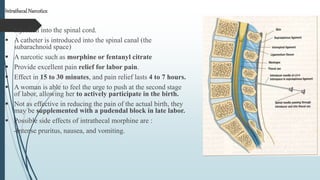
IntrathecalNarcotics:
 Injection into the spinal cord.
 A catheter is introduced into the spinal canal (the
subarachnoid space)
 A narcotic such as morphine or fentanyl citrate
 Provide excellent pain relief for labor pain.
 Effect in 15 to 30 minutes, and pain relief lasts 4 to 7 hours.
 A woman is able to feel the urge to push at the second stage
of labor, allowing her to actively participate in the birth.
 Not as effective in reducing the pain of the actual birth, they
may be supplemented with a pudendal block in late labor.
 Possible side effects of intrathecal morphine are :
-Intense pruritus, nausea, and vomiting.
.
INHALATION ANALGESIA (ENTONOX):
-Nitrous oxide, administered as a blend of 50% nitrous oxide and 50% oxygen.
-The laboring women uses a handled face mask to self-administer the anesthetic gas.
-Entonox gas takes 50 seconds to take effect, the women is instructed on correctly timing
each inhalation.
-She should start with onset of contraction so that the analgesia is effective at the peak of
the contraction.
-It is safe when the women becomes too drowsy, she will automatically drop the mask.
It does not cause neonatal respiratory depression or affect uterine contractility.
►NEURALANALGESIA:
-Best pain relief in labour and is widely used.
-A local anesthetic with or without opioids is injected into epidural or
intrathecal space close to the spinal nerves that transmit pain from the uterus to the spinal
column.
-Neuraxial analgesia may be epidural, spinal or combined epidural and spinal analgesia.
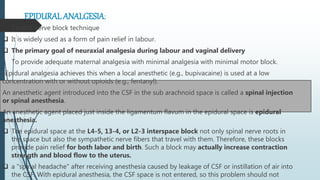
EPIDURAL ANALGESIA:
 Central nerve block technique
 It is widely used as a form of pain relief in labour.
 The primary goal of neuraxial analgesia during labour and vaginal delivery
To provide adequate maternal analgesia with minimal analgesia with minimal motor block.
-Epidural analgesia achieves this when a local anesthetic (e.g., bupivacaine) is used at a low
concentration with or without opioids (e.g., fentanyl).
An anesthetic agent introduced into the CSF in the sub arachnoid space is called a spinal injection
or spinal anesthesia.
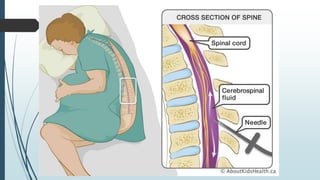
An anesthetic agent placed just inside the ligamentum flavum in the epidural space is epidural
anesthesia.
 The epidural space at the L4-5, 13-4, or L2-3 interspace block not only spinal nerve roots in
the space but also the sympathetic nerve fibers that travel with them. Therefore, these blocks
provide pain relief for both labor and birth. Such a block may actually increase contraction
strength and blood flow to the uterus.
 a "spinal headache" after receiving anesthesia caused by leakage of CSF or instillation of air into
the CSF. With epidural anesthesia, the CSF space is not entered, so this problem should not
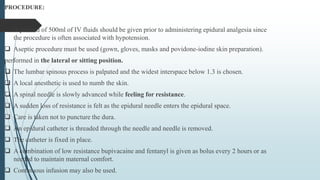
PROCEDURE:
 A preload of 500ml of IV fluids should be given prior to administering epidural analgesia since
the procedure is often associated with hypotension.
 Aseptic procedure must be used (gown, gloves, masks and povidone-iodine skin preparation).
performed in the lateral or sitting position.
 The lumbar spinous process is palpated and the widest interspace below 1.3 is chosen.
 A local anesthetic is used to numb the skin.
 A spinal needle is slowly advanced while feeling for resistance.
 A sudden loss of resistance is felt as the epidural needle enters the epidural space.
 Care is taken not to puncture the dura.
 An epidural catheter is threaded through the needle and needle is removed.
 The catheter is fixed in place.
 A combination of low resistance bupivacaine and fentanyl is given as bolus every 2 hours or as
needed to maintain maternal comfort.
 Continuous infusion may also be used.
Contraindications of epidural analgesia DRUGS USED FOR EPIDURALANALGESIA
> LOCALANAESTHETIC:
Bupivacaine is the most commonly used.
> OPIOID: Fentanyl. Epidural analgesia starts
taking effect in 5 to 10 minutes after injection. The
maximal effect may not be achieved for 15-20
minutes.
COMPLICATIONS FOR EPIDURAL
ANALGESIA:
Hypotension
Nausea and vomiting
 Coagulopathy
 Thrombocytopenia
 Raised intracranial pressure
 Skin or soft tissue injection
at the site of the epidural
placement.
 Anticoagulant therapy
(within 6-12 hours after the
last dose).
PRECAUTIONS:
 Blood pressure should be recorded prior
to administration. check every 5 to 15
minutes interval.
 Continuous fetal heart rate monitoring
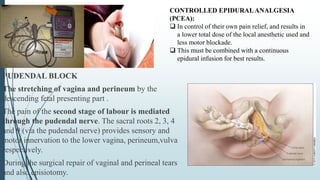
PUDENDAL BLOCK
The stretching of vagina and perineum by the
descending fetal presenting part .
The pain of the second stage of labour is mediated
through the pudendal nerve. The sacral roots 2, 3, 4
and 9 (via the pudendal nerve) provides sensory and
motor innervation to the lower vagina, perineum,vulva
respectively.
During the surgical repair of vaginal and perineal tears
and also episiotomy.
CONTROLLED EPIDURALANALGESIA
(PCEA):
 In control of their own pain relief, and results in
a lower total dose of the local anesthetic used and
less motor blockade.
 This must be combined with a continuous
epidural infusion for best results.

INDICATION OF PUDENDAL BLOCK ARE
AS FOLLOWS:
Outlet forceps delivery
Assisted breech delivery
Repair of episiotomy and perineal lacerations.
COMPLICATIONS OF PUDENDAL BLOCK
 Hematoma formation from perforation of a blood
vessel during needle insertion.
 Infection at the site of injection.
 Ischial region paresthesia and sacral neuropathy
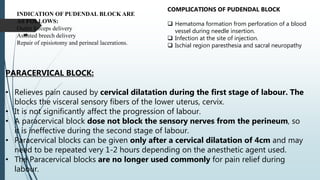
PARACERVICAL BLOCK:
• Relieves pain caused by cervical dilatation during the first stage of labour. The
blocks the visceral sensory fibers of the lower uterus, cervix.
• It is not significantly affect the progression of labour.
• A paracervical block dose not block the sensory nerves from the perineum, so
it is ineffective during the second stage of labour.
• Paracervical blocks can be given only after a cervical dilatation of 4cm and may
need to be repeated very 1-2 hours depending on the anesthetic agent used.
• The Paracervical blocks are no longer used commonly for pain relief during
labour.
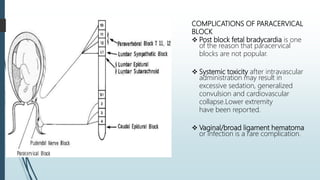
COMPLICATIONS OF PARACERVICAL
BLOCK
 Post block fetal bradycardia is one
of the reason that paracervical
blocks are not popular.
 Systemic toxicity after intravascular
administration may result in
excessive sedation, generalized
convulsion and cardiovascular
collapse.Lower extremity
have been reported.
 Vaginal/broad ligament hematoma
or infection is a rare complication.
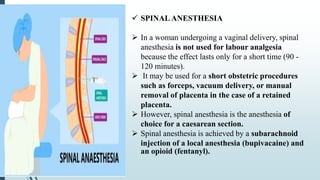
 SPINALANESTHESIA
 In a woman undergoing a vaginal delivery, spinal
anesthesia is not used for labour analgesia
because the effect lasts only for a short time (90 -
120 minutes).
 It may be used for a short obstetric procedures
such as forceps, vacuum delivery, or manual
removal of placenta in the case of a retained
placenta.
 However, spinal anesthesia is the anesthesia of
choice for a caesarean section.
 Spinal anesthesia is achieved by a subarachnoid
injection of a local anesthesia (bupivacaine) and
an opioid (fentanyl).
COMPLICATIONS:
Hypotension
Nausea and vomiting
High spinal (cephalad ptrogresion of
the level of anesthesia)
Pruritus
Post Dural puncture headache
ADVANTAGES OF SPINAL
ANESTHESIA:
Short procedure time
Rapid onset of the block -within 5
minutes.
High success rate.
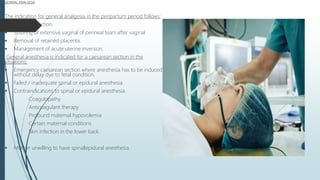
GENERAL ANALGESIA
The indication for general analgesia in the peripartum period follows:
 Cesarean section.
 Suturing of extensive vaginal of perineal tears after vaginal
 Removal of retained placenta.
 Management of acute uterine inversion.
General anesthesia is indicated for a caesarean section in the
situations:
 Emergency caesarean section where anesthesia has to be induced
without delay dye to fetal condition.
 Failed / inadequate spinal or epidural anesthesia
 Contraindications to spinal or epidural anesthesia.
Coagulopathy
Anticoagulant therapy
Profound maternal hypovolemia
Certain maternal conditions
Skin infection in the lower back.
 Mother unwilling to have spinallepidural anesthesia.
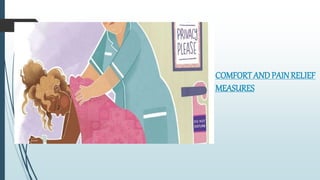
COMFORTANDPAINRELIEF
MEASURES
 COMFORT AND PAIN RELIEF MEASURES
 The pattern of interventions has swung from a philosophy of no intervention (none given because pain
labor was a woman's lot), to a philosophy that drug intervention was required (too much given), to a
modern approach of empowering women and their partners with information so that they can choose
how to best relieve pain during labor, within the limits of medical safety.
 Nurses play a key role in educating women and their support persons about the numerous comfort and
pain relief strategies available and making sure couples understand the choices available to them along
with the benefits and risks.
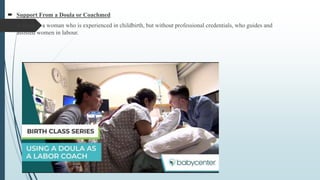
 Support From a Doula or Coachmed
 A doula is a woman who is experienced in childbirth, but without professional credentials, who guides and
assisted women in labour.
Complementary and alternative therapies
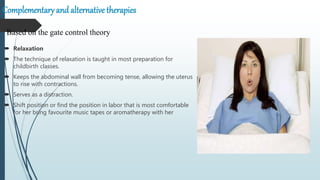
 Relaxation
 The technique of relaxation is taught in most preparation for
childbirth classes.
 Keeps the abdominal wall from becoming tense, allowing the uterus
to rise with contractions.
 Serves as a distraction.
 Shift position or find the position in labor that is most comfortable
for her bring favourite music tapes or aromatherapy with her
Based on the gate control theory
Focusing and Imagery
PRAYER
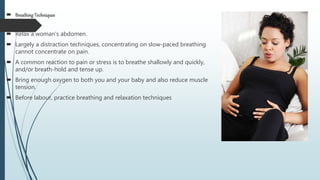
 Breathing Techniques
 Relax a woman's abdomen.
 Largely a distraction techniques, concentrating on slow-paced breathing
cannot concentrate on pain.
 A common reaction to pain or stress is to breathe shallowly and quickly,
and/or breath-hold and tense up.
 Bring enough oxygen to both you and your baby and also reduce muscle
tension.
 Before labour, practice breathing and relaxation techniques
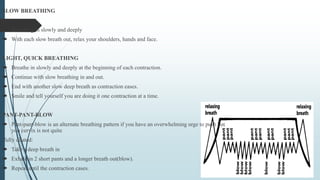
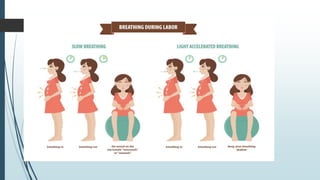
SLOW BREATHING
 Breathing in slowly and deeply
 With each slow breath out, relax your shoulders, hands and face.
LIGHT, QUICK BREATHING
 Breathe in slowly and deeply at the beginning of each contraction.
 Continue with slow breathing in and out.
 End with another slow deep breath as contraction eases.
 Smile and tell yourself you are doing it one contraction at a time.
PANT-PANT-BLOW
 Pant-pant-blow is an alternate breathing pattern if you have an overwhelming urge to push but
you cervix is not quite
fully dilated:
 Take a deep breath in
 Exhale in 2 short pants and a longer breath out(blow).
 Repeat until the contraction cases.
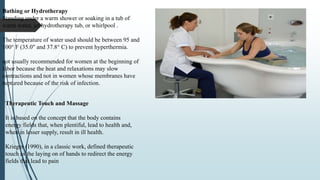
Bathing or Hydrotherapy
Standing under a warm shower or soaking in a tub of
warm water, jet hydrotherapy tub, or whirlpool .
The temperature of water used should be between 95 and
100° F (35.0" and 37.8° C) to prevent hyperthermia.
not usually recommended for women at the beginning of
labor because the heat and relaxations may slow
contractions and not in women whose membranes have
ruptured because of the risk of infection.
Therapeutic Touch and Massage
It is based on the concept that the body contains
energy fields that, when plentiful, lead to health and,
when in lesser supply, result in ill health.
Krieger (1990), in a classic work, defined therapeutic
touch as the laying on of hands to redirect the energy
fields that lead to pain
Herbal Preparations
Examples include raspberry
leaves, fennel, and life root.
Blue cohosh (squaw root), an
herb that induces uterine
contractions, is not
recommended because of the
risk of acute toxic effects
(e.g., cerebrovascular
accident) to the mother or
fetus.
Aromatherapy and Essential Oils
 use of aromatic oils to complement emotional
and physical well-being.
 Their use is based on the principle that the
sense of smell plays a significant role in overall
health.
 When an essential oil is inhaled, its molecules
are transported via the olfactory system to the
limbic system in the brain. The brain responds
to particular aromas with emotional responses.
 When applied externally, they are absorbed by
the skin and then carried throughout the body.
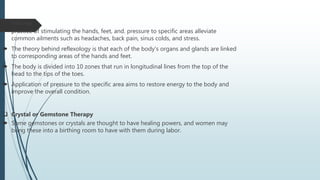
 Reflexology
 practice of stimulating the hands, feet, and. pressure to specific areas alleviate
common ailments such as headaches, back pain, sinus colds, and stress.
 The theory behind reflexology is that each of the body's organs and glands are linked
to corresponding areas of the hands and feet.
 The body is divided into 10 zones that run in longitudinal lines from the top of the
head to the tips of the toes.
 Application of pressure to the specific area aims to restore energy to the body and
improve the overall condition.
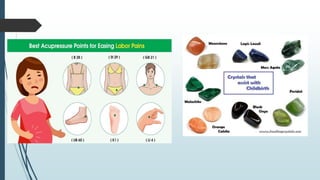
 Crystal or Gemstone Therapy
 Some gemstones or crystals are thought to have healing powers, and women may
bring these into a birthing room to have with them during labor.
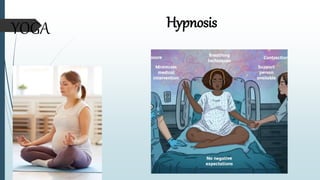
YOGA Hypnosis
Biofeedback
Biofeedback is based on the belief that people have control and can regulate internal events such as heart rate
and pain responses. Women who are interested in using biofeedback for pain relief in labor must attend several
sessions during pregnancy to condition themselves to regulate their pain response. During these sessions, a
biofeedback apparatus is used to measure muscle tone or the woman's ability to relax.
TranscutaneousElectrical Nerve Stimulation
Relieves pain by counter irritation on nociceptors .
With two pairs of electrodes attached to a woman's back to
coincide with the T10-L1 nerve pathways, low-intensity
electrical stimulation is given continuously or is applied by
the woman herself as a contraction begins.
This stimulation blocks the afferent fibers, preventing pain
from traveling to the spinal cord synapses from the uterus.
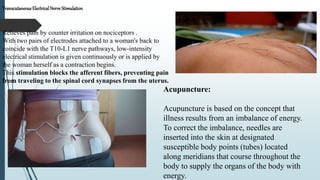
Acupuncture:
Acupuncture is based on the concept that
illness results from an imbalance of energy.
To correct the imbalance, needles are
inserted into the skin at designated
susceptible body points (tubes) located
along meridians that course throughout the
body to supply the organs of the body with
energy.
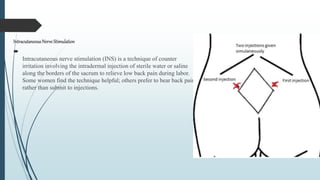
IntracutaneousNerve Stimulation

Intracutaneous nerve stimulation (INS) is a technique of counter
irritation involving the intradermal injection of sterile water or saline
along the borders of the sacrum to relieve low back pain during labor.
Some women find the technique helpful; others prefer to bear back pain
rather than submit to injections.
NURSING CARE TO PROMOTE THE COMFORT OF A WOMAN DURING LABOR
 Anxiety related to fear of pain from labor contractions
 Ineffective coping related to combination of uterine contractions and anxiety
 Pain related to labor contractions
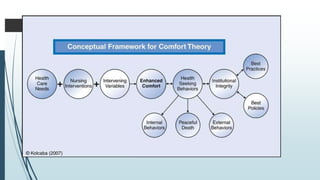
Kolcaba’s Theory of Comfort was first developed in the 1990s. It is a middle-range theory for health practice, education, and
research. This theory has the potential to place comfort in the forefront of healthcare. According to the model, comfort is an
immediate desirable outcome of nursing care.
•The Theory of Comfort was developed when Katharine Kolcaba conducted a concept analysis of comfort that examined
literature from several disciplines, including nursing, medicine, psychology, psychiatry, ergonomics, and English. After the
three forms of comfort and four contexts of holistic human experience were introduced, a taxonomic structure was created to
guide for the assessment, measurement, and evaluation of patient comfort.
•According to Kolcaba, comfort is the product of holistic nursing art.
Kolcaba described comfort existing in three forms: relief, ease, and transcendence.
•If specific comfort needs of a patient are met, the patient experiences comfort in the sense of relief. For example, a patient
who receives pain medication in post-operative care is receiving relief comfort.
•Ease addresses comfort in a state of contentment. For example, the patient’s anxieties are calmed.
•Transcendence is described as a state of comfort in which patients are able to rise above their challenges.
•The four contexts in which patient comfort can occur are: physical, psychospiritual, environmental, and sociocultural.
Kolcaba’s Theory of Comfort
Comfort in labor andmidwifery art
 Purpose: To examine the phenomenon of comfort in the context of childbirth. Enhancement of
comfort for laboring women is a valued outcome of nursing and midwifery care. Interventions that
increase comfort during labor support a woman's effort to participate more fully in the birth thereby
keeping her more aware of her body, emotions, and experience.
 Organizing construct: The concept of comfort is analyzed and defined in the context of laboring
women. Comfort studied from a feminist perspective is suggested.
 Sources: A literature review of nursing, midwifery, and medical texts from the 1920s to 1998 provides
information about labor, pain in labor, and goals of providers caring for laboring women. Research
articles focusing on comfort are identified as they relate to the concept of comfort in labor. Writings of
contemporary feminist authors provided the ideas for designing the study of comfort from a feminist
perspective.
 Methods: To develop a theory of comfort during labor, early nursing and midwifery texts were
searched to identify goals of care. The meaning of comfort was analyzed from the early 1920s to the
present by concept analysis. Validation of findings was sought from publications on comfort research.
 Findings: Comfort can exist in spite of great pain and nurses and midwives may be able to assist
laboring women to achieve a level of comfort during labor. Intervening to promote the comfort of
laboring women can empower these women during birthing.
 Conclusions: For clinicians caring for birthing women, particularly midwives, promotion of comfort is a
high priority. Increasing comfort can redefine the meaning of pain in childbirth. Increasing comfort
create a decreased need for medical interventions and lower costs
THANK YOU

COMFORT AND SUPPORT IN LABOUR.pptx

  • 2.
  • 3.
    DEFINITION OF LABOUR: Seriesof events that take place in the genital organs in an effort to expel the viable products of conception (foetus, placenta and the membranes) out of womb through the vagina into the outer world is called labour. COMFORT IN LABOUR: Concerns about the discomfort and pain that accompany labour and birth can dominate a pregnant women's or couple's thoughts about childbirth, particularly as the baby's due date approaches. Providing information during prenatal visits about the numerous methods of comfort promotion and pain control available to women can help ally some of the fears.
  • 4.
    SUPPORT IN LABOUR: Itis addressed to the processes of supporting the women and providing her with complete protection in labour. We can classify the different techniques used in this process in three categories:  Emotional supports  Physical supports.  Instructions/Information.
  • 5.
    EXPERIENCE OF PAINDURINGCHILDBIRTH Pain accompanies labor contractions for several different reasons and is manifested in different ways in individual women:  Increased duration and strength of contractions  Decreased interval between contractions  Difficulty with ability to reason clearly  Increased pulse rate, increased blood pressure  Hand clenched: in a fist
  • 6.
    Etiology of PainDuringLabor andBirth During contractions, blood vessels constrict, reducing the blood supply to uterine and cervical cells, resulting in anoxia to muscle fibers. This anoxia can cause pain. stretching of the cervix and perineum. the pressure of the foetal presenting part on tissues culturally and situationally determined.
  • 7.
    Physiology of PainDuring Labour and Birth Nociceptors, the end points of afferent nerves(skin, bone periosteum, joint surfaces, and arterial walls) Chemical mediators such as prostaglandins, histamine, bradykinin Transmit along small, unmyelinated C fibers and large, myelinated A-delta fibers Spinal cord(In the dorsal horn of the spinal cord) Somatostatin, cholecystokinin, and substance P serve as neurotransmitters assist the pain impulse across the synapse between the peripheral nerve and the spinal nerve
  • 8.
    The Melzack-Wall gatecontrol theory of pain control (Melzack & Wall, 1965),  The peripheral end terminals  The synapse points in the dorsal horn  The point at which the impulse is interpreted as pain in the brain cortex
  • 9.
    The peripheral endterminals(endorphins and enkephalins & irritating nerve fibers by an action such as rubbing the skin) The synapse points in the dorsal horn(of pain medications is to block spinal cord neurotransmitters) The point in the brain cortex(distracted from sensing impulses as pain by the use of such techniques as imagery, thought stopping, aromatherapy, or yoga)
  • 10.
    Physiology of laborpain 1st stage of labor- Dilatation of the cervix and distension of lower uterine segment. Dull, aching and poorly localized. Slow conducting, visceral C fibers, enter spinal cord at level of T10-L1. Physiology of labor pain 2nd stage of labor- Distension of the pelvic floor, vagina and perineum. Sharp, severe and well localized . Rapidly conducting A-delta fibers, enter the spinal cord at S2 to S4.
  • 11.
    Perception of Pain THELENGTH OF HER LABOR THE POSITION OF HER FOETUS THE PRESENCE OF FEAR, ANXIETY, OR WORRY; BODY IMAGE; SELF- EFFICACY PAIN IS PERCEIVED DIFFERENTLY BY DIFFERENT INDIVIDUALS BECAUSE OF PSYCHOSOCIAL, PHYSIOLOGIC, AND CULTURAL RESPONSES. THE BODY'S ABILITY TO PRODUCE AND MAINTAIN ENDORPHINS (NATURALLY OCCURRING OPIATE- LIKE SUBSTANCES).
  • 12.
  • 13.
    Pharmacological Interventions Analgesia andsedation The use of medication to reduce the sensation of pain Sedatives given to promote sedation and relaxation Opioids given to promote analgesia during labor Anesthesia The use of medication to partially or totally block all sensation to an area of the body Local, regional, general
  • 14.
    Preparation for MedicationAdministration Opioids are usually administered as intramuscularly (IM) or intravenous (IV) injection, they may also be administered with a pump (patient control analgesia). COMMONLY USED OPIOIDS  To be safe, remember the criteria that a drug must "Never give any drug unless you know it is safe for your individual client" to "Never give a drug during labor unless you know it is safe for both of your clients: the mother and the fetus.  Prepare a woman for the type of agent prescribed.
  • 15.
    Narcotic Analgesics Potent analgesiceffect, but all drugs in this category cause fetal CNS Narcotic analgesics commonly used include  Meperidine bydrochloride (Demerol) Nalbuphine (Nubain) Fentanyl (Sublimaze) Butorphanol tarrate (Stadol).
  • 16.
    Meperidine Sedative and Antispasmodic Giveneither IM orIV Crosses the placenta Cause respiratory depression in a fetus. It may be puzzling to see a sleepy baby delivered to a woman who was given meperidine 2 hours before birth and an alert baby delivered to a woman who had received meperidine within 1 hour of birth The dose is 25 to 100 mg Act about 30 minutes after intramuscular (IM) injection and about 5 minutes after intravenous (V) administration. Its duration of action is 2 to 3 hours,
  • 17.
    • Nalbuphine hydrochloride(nubain)and butorphanol tartrate(Stadol • These are both synthetic narcotic analgesics. • The action of these agents in comparable to that of meperdine. • Like meperidine, they may also leave a degree of respiratory depression in the newborn. • FENTANYL: • Fentanyl has rapid onset of action (within 2-3 minutes after IV administration) with short duration of action, making it useful for labour analgesia. • It is a highly lipid soluble synthetic opioid, with analgesic potency 100 times that of morphine and 800 times that of pethidine. • It can be administered in IV boluses of 25-50 micro mg (given slowly over 1-2
  • 18.
    Naloxone Hydrochloride (Marcan)Action: Naloxone hydrochloride is a narcotic antagonist that counteracts the effect of narcotic analgesics. It is used to counteract newborn respiratory depression when a mother has received a narcotic analgesic during labor
  • 19.
    IntrathecalNarcotics:  Injection intothe spinal cord.  A catheter is introduced into the spinal canal (the subarachnoid space)  A narcotic such as morphine or fentanyl citrate  Provide excellent pain relief for labor pain.  Effect in 15 to 30 minutes, and pain relief lasts 4 to 7 hours.  A woman is able to feel the urge to push at the second stage of labor, allowing her to actively participate in the birth.  Not as effective in reducing the pain of the actual birth, they may be supplemented with a pudendal block in late labor.  Possible side effects of intrathecal morphine are : -Intense pruritus, nausea, and vomiting. .
  • 20.
    INHALATION ANALGESIA (ENTONOX): -Nitrousoxide, administered as a blend of 50% nitrous oxide and 50% oxygen. -The laboring women uses a handled face mask to self-administer the anesthetic gas. -Entonox gas takes 50 seconds to take effect, the women is instructed on correctly timing each inhalation. -She should start with onset of contraction so that the analgesia is effective at the peak of the contraction. -It is safe when the women becomes too drowsy, she will automatically drop the mask. It does not cause neonatal respiratory depression or affect uterine contractility. ►NEURALANALGESIA: -Best pain relief in labour and is widely used. -A local anesthetic with or without opioids is injected into epidural or intrathecal space close to the spinal nerves that transmit pain from the uterus to the spinal column. -Neuraxial analgesia may be epidural, spinal or combined epidural and spinal analgesia.
  • 21.
    EPIDURAL ANALGESIA:  Centralnerve block technique  It is widely used as a form of pain relief in labour.  The primary goal of neuraxial analgesia during labour and vaginal delivery To provide adequate maternal analgesia with minimal analgesia with minimal motor block. -Epidural analgesia achieves this when a local anesthetic (e.g., bupivacaine) is used at a low concentration with or without opioids (e.g., fentanyl). An anesthetic agent introduced into the CSF in the sub arachnoid space is called a spinal injection or spinal anesthesia. An anesthetic agent placed just inside the ligamentum flavum in the epidural space is epidural anesthesia.  The epidural space at the L4-5, 13-4, or L2-3 interspace block not only spinal nerve roots in the space but also the sympathetic nerve fibers that travel with them. Therefore, these blocks provide pain relief for both labor and birth. Such a block may actually increase contraction strength and blood flow to the uterus.  a "spinal headache" after receiving anesthesia caused by leakage of CSF or instillation of air into the CSF. With epidural anesthesia, the CSF space is not entered, so this problem should not
  • 23.
    PROCEDURE:  A preloadof 500ml of IV fluids should be given prior to administering epidural analgesia since the procedure is often associated with hypotension.  Aseptic procedure must be used (gown, gloves, masks and povidone-iodine skin preparation). performed in the lateral or sitting position.  The lumbar spinous process is palpated and the widest interspace below 1.3 is chosen.  A local anesthetic is used to numb the skin.  A spinal needle is slowly advanced while feeling for resistance.  A sudden loss of resistance is felt as the epidural needle enters the epidural space.  Care is taken not to puncture the dura.  An epidural catheter is threaded through the needle and needle is removed.  The catheter is fixed in place.  A combination of low resistance bupivacaine and fentanyl is given as bolus every 2 hours or as needed to maintain maternal comfort.  Continuous infusion may also be used.
  • 24.
    Contraindications of epiduralanalgesia DRUGS USED FOR EPIDURALANALGESIA > LOCALANAESTHETIC: Bupivacaine is the most commonly used. > OPIOID: Fentanyl. Epidural analgesia starts taking effect in 5 to 10 minutes after injection. The maximal effect may not be achieved for 15-20 minutes. COMPLICATIONS FOR EPIDURAL ANALGESIA: Hypotension Nausea and vomiting  Coagulopathy  Thrombocytopenia  Raised intracranial pressure  Skin or soft tissue injection at the site of the epidural placement.  Anticoagulant therapy (within 6-12 hours after the last dose). PRECAUTIONS:  Blood pressure should be recorded prior to administration. check every 5 to 15 minutes interval.  Continuous fetal heart rate monitoring
  • 25.
    PUDENDAL BLOCK The stretchingof vagina and perineum by the descending fetal presenting part . The pain of the second stage of labour is mediated through the pudendal nerve. The sacral roots 2, 3, 4 and 9 (via the pudendal nerve) provides sensory and motor innervation to the lower vagina, perineum,vulva respectively. During the surgical repair of vaginal and perineal tears and also episiotomy. CONTROLLED EPIDURALANALGESIA (PCEA):  In control of their own pain relief, and results in a lower total dose of the local anesthetic used and less motor blockade.  This must be combined with a continuous epidural infusion for best results.
  • 26.
     INDICATION OF PUDENDALBLOCK ARE AS FOLLOWS: Outlet forceps delivery Assisted breech delivery Repair of episiotomy and perineal lacerations. COMPLICATIONS OF PUDENDAL BLOCK  Hematoma formation from perforation of a blood vessel during needle insertion.  Infection at the site of injection.  Ischial region paresthesia and sacral neuropathy PARACERVICAL BLOCK: • Relieves pain caused by cervical dilatation during the first stage of labour. The blocks the visceral sensory fibers of the lower uterus, cervix. • It is not significantly affect the progression of labour. • A paracervical block dose not block the sensory nerves from the perineum, so it is ineffective during the second stage of labour. • Paracervical blocks can be given only after a cervical dilatation of 4cm and may need to be repeated very 1-2 hours depending on the anesthetic agent used. • The Paracervical blocks are no longer used commonly for pain relief during labour.
  • 27.
    COMPLICATIONS OF PARACERVICAL BLOCK Post block fetal bradycardia is one of the reason that paracervical blocks are not popular.  Systemic toxicity after intravascular administration may result in excessive sedation, generalized convulsion and cardiovascular collapse.Lower extremity have been reported.  Vaginal/broad ligament hematoma or infection is a rare complication.
  • 28.
     SPINALANESTHESIA  Ina woman undergoing a vaginal delivery, spinal anesthesia is not used for labour analgesia because the effect lasts only for a short time (90 - 120 minutes).  It may be used for a short obstetric procedures such as forceps, vacuum delivery, or manual removal of placenta in the case of a retained placenta.  However, spinal anesthesia is the anesthesia of choice for a caesarean section.  Spinal anesthesia is achieved by a subarachnoid injection of a local anesthesia (bupivacaine) and an opioid (fentanyl).
  • 29.
    COMPLICATIONS: Hypotension Nausea and vomiting Highspinal (cephalad ptrogresion of the level of anesthesia) Pruritus Post Dural puncture headache ADVANTAGES OF SPINAL ANESTHESIA: Short procedure time Rapid onset of the block -within 5 minutes. High success rate.
  • 30.
    GENERAL ANALGESIA The indicationfor general analgesia in the peripartum period follows:  Cesarean section.  Suturing of extensive vaginal of perineal tears after vaginal  Removal of retained placenta.  Management of acute uterine inversion. General anesthesia is indicated for a caesarean section in the situations:  Emergency caesarean section where anesthesia has to be induced without delay dye to fetal condition.  Failed / inadequate spinal or epidural anesthesia  Contraindications to spinal or epidural anesthesia. Coagulopathy Anticoagulant therapy Profound maternal hypovolemia Certain maternal conditions Skin infection in the lower back.  Mother unwilling to have spinallepidural anesthesia.
  • 31.
  • 32.
     COMFORT ANDPAIN RELIEF MEASURES  The pattern of interventions has swung from a philosophy of no intervention (none given because pain labor was a woman's lot), to a philosophy that drug intervention was required (too much given), to a modern approach of empowering women and their partners with information so that they can choose how to best relieve pain during labor, within the limits of medical safety.  Nurses play a key role in educating women and their support persons about the numerous comfort and pain relief strategies available and making sure couples understand the choices available to them along with the benefits and risks.
  • 33.
     Support Froma Doula or Coachmed  A doula is a woman who is experienced in childbirth, but without professional credentials, who guides and assisted women in labour.
  • 34.
    Complementary and alternativetherapies  Relaxation  The technique of relaxation is taught in most preparation for childbirth classes.  Keeps the abdominal wall from becoming tense, allowing the uterus to rise with contractions.  Serves as a distraction.  Shift position or find the position in labor that is most comfortable for her bring favourite music tapes or aromatherapy with her Based on the gate control theory
  • 35.
  • 36.
     Breathing Techniques Relax a woman's abdomen.  Largely a distraction techniques, concentrating on slow-paced breathing cannot concentrate on pain.  A common reaction to pain or stress is to breathe shallowly and quickly, and/or breath-hold and tense up.  Bring enough oxygen to both you and your baby and also reduce muscle tension.  Before labour, practice breathing and relaxation techniques
  • 37.
    SLOW BREATHING  Breathingin slowly and deeply  With each slow breath out, relax your shoulders, hands and face. LIGHT, QUICK BREATHING  Breathe in slowly and deeply at the beginning of each contraction.  Continue with slow breathing in and out.  End with another slow deep breath as contraction eases.  Smile and tell yourself you are doing it one contraction at a time. PANT-PANT-BLOW  Pant-pant-blow is an alternate breathing pattern if you have an overwhelming urge to push but you cervix is not quite fully dilated:  Take a deep breath in  Exhale in 2 short pants and a longer breath out(blow).  Repeat until the contraction cases.
  • 39.
    Bathing or Hydrotherapy Standingunder a warm shower or soaking in a tub of warm water, jet hydrotherapy tub, or whirlpool . The temperature of water used should be between 95 and 100° F (35.0" and 37.8° C) to prevent hyperthermia. not usually recommended for women at the beginning of labor because the heat and relaxations may slow contractions and not in women whose membranes have ruptured because of the risk of infection. Therapeutic Touch and Massage It is based on the concept that the body contains energy fields that, when plentiful, lead to health and, when in lesser supply, result in ill health. Krieger (1990), in a classic work, defined therapeutic touch as the laying on of hands to redirect the energy fields that lead to pain
  • 40.
    Herbal Preparations Examples includeraspberry leaves, fennel, and life root. Blue cohosh (squaw root), an herb that induces uterine contractions, is not recommended because of the risk of acute toxic effects (e.g., cerebrovascular accident) to the mother or fetus. Aromatherapy and Essential Oils  use of aromatic oils to complement emotional and physical well-being.  Their use is based on the principle that the sense of smell plays a significant role in overall health.  When an essential oil is inhaled, its molecules are transported via the olfactory system to the limbic system in the brain. The brain responds to particular aromas with emotional responses.  When applied externally, they are absorbed by the skin and then carried throughout the body.
  • 41.
     Reflexology  practiceof stimulating the hands, feet, and. pressure to specific areas alleviate common ailments such as headaches, back pain, sinus colds, and stress.  The theory behind reflexology is that each of the body's organs and glands are linked to corresponding areas of the hands and feet.  The body is divided into 10 zones that run in longitudinal lines from the top of the head to the tips of the toes.  Application of pressure to the specific area aims to restore energy to the body and improve the overall condition.  Crystal or Gemstone Therapy  Some gemstones or crystals are thought to have healing powers, and women may bring these into a birthing room to have with them during labor.
  • 43.
  • 44.
    Biofeedback Biofeedback is basedon the belief that people have control and can regulate internal events such as heart rate and pain responses. Women who are interested in using biofeedback for pain relief in labor must attend several sessions during pregnancy to condition themselves to regulate their pain response. During these sessions, a biofeedback apparatus is used to measure muscle tone or the woman's ability to relax.
  • 45.
    TranscutaneousElectrical Nerve Stimulation Relievespain by counter irritation on nociceptors . With two pairs of electrodes attached to a woman's back to coincide with the T10-L1 nerve pathways, low-intensity electrical stimulation is given continuously or is applied by the woman herself as a contraction begins. This stimulation blocks the afferent fibers, preventing pain from traveling to the spinal cord synapses from the uterus. Acupuncture: Acupuncture is based on the concept that illness results from an imbalance of energy. To correct the imbalance, needles are inserted into the skin at designated susceptible body points (tubes) located along meridians that course throughout the body to supply the organs of the body with energy.
  • 46.
    IntracutaneousNerve Stimulation  Intracutaneous nervestimulation (INS) is a technique of counter irritation involving the intradermal injection of sterile water or saline along the borders of the sacrum to relieve low back pain during labor. Some women find the technique helpful; others prefer to bear back pain rather than submit to injections.
  • 47.
    NURSING CARE TOPROMOTE THE COMFORT OF A WOMAN DURING LABOR  Anxiety related to fear of pain from labor contractions  Ineffective coping related to combination of uterine contractions and anxiety  Pain related to labor contractions
  • 48.
    Kolcaba’s Theory ofComfort was first developed in the 1990s. It is a middle-range theory for health practice, education, and research. This theory has the potential to place comfort in the forefront of healthcare. According to the model, comfort is an immediate desirable outcome of nursing care. •The Theory of Comfort was developed when Katharine Kolcaba conducted a concept analysis of comfort that examined literature from several disciplines, including nursing, medicine, psychology, psychiatry, ergonomics, and English. After the three forms of comfort and four contexts of holistic human experience were introduced, a taxonomic structure was created to guide for the assessment, measurement, and evaluation of patient comfort. •According to Kolcaba, comfort is the product of holistic nursing art. Kolcaba described comfort existing in three forms: relief, ease, and transcendence. •If specific comfort needs of a patient are met, the patient experiences comfort in the sense of relief. For example, a patient who receives pain medication in post-operative care is receiving relief comfort. •Ease addresses comfort in a state of contentment. For example, the patient’s anxieties are calmed. •Transcendence is described as a state of comfort in which patients are able to rise above their challenges. •The four contexts in which patient comfort can occur are: physical, psychospiritual, environmental, and sociocultural. Kolcaba’s Theory of Comfort
  • 50.
    Comfort in laborandmidwifery art  Purpose: To examine the phenomenon of comfort in the context of childbirth. Enhancement of comfort for laboring women is a valued outcome of nursing and midwifery care. Interventions that increase comfort during labor support a woman's effort to participate more fully in the birth thereby keeping her more aware of her body, emotions, and experience.  Organizing construct: The concept of comfort is analyzed and defined in the context of laboring women. Comfort studied from a feminist perspective is suggested.  Sources: A literature review of nursing, midwifery, and medical texts from the 1920s to 1998 provides information about labor, pain in labor, and goals of providers caring for laboring women. Research articles focusing on comfort are identified as they relate to the concept of comfort in labor. Writings of contemporary feminist authors provided the ideas for designing the study of comfort from a feminist perspective.  Methods: To develop a theory of comfort during labor, early nursing and midwifery texts were searched to identify goals of care. The meaning of comfort was analyzed from the early 1920s to the present by concept analysis. Validation of findings was sought from publications on comfort research.  Findings: Comfort can exist in spite of great pain and nurses and midwives may be able to assist laboring women to achieve a level of comfort during labor. Intervening to promote the comfort of laboring women can empower these women during birthing.  Conclusions: For clinicians caring for birthing women, particularly midwives, promotion of comfort is a high priority. Increasing comfort can redefine the meaning of pain in childbirth. Increasing comfort create a decreased need for medical interventions and lower costs
  • 51.