Labour Pain
management
Introduction
• Women in labour experience varying degrees of pain
• They exhibit an equally varying range of responses to
it.
• An individual’s reaction to the pain of labour may be
influenced by;
– Circumstances of her labour
– Environment
– Cultural background
– Parity
– Preparation towards labour
– Support available
– Their Pain threshold (previous pain episodes)
Uncontrolled labour pain
• It is paramount to manage acute labour pain
to avoid progression to chronic pain
• Prevalence rates of chronic pain after
cesarean section are between 6% -18% and
after vaginal delivery they are between 4% -
10%
• Predictors for chronic pain after cesarean
section and vaginal delivery are;
– Previous chronic pain
– General anesthesia
– Higher post delivery pain
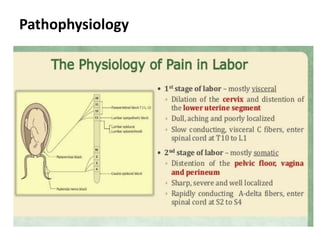
Pathophysiology
Mechanisms of labour pain
• During the first stage:
• Stretching and dilation of the lower
uterine segment and cervix.
• Visceral afferent neurons accompany
sympathetics through the paracervical
region, hypogastric plexus, and lumbar
sympathetic chain on to the dorsal horn of
the spinal cord at the level
Mechanisms of labour pain
• During the second stage of labour:
• Somatic afferent neurons arising in the
cervix, vagina, and perineum convey
signals via the pudendal nerve, entering
the spinal cord at S2-4
Benefits of Labour Analgesia
• Prevents pain-induced activation of the
sympathetic nervous
• Prevention of increased peripheral vascular resistance
and its associated decrease in uteroplacental blood flow.
• Prevention of pain-induced hyperventilation with the
consequence decreased unloading of oxygen to the
foetus.
• Prevention of compensatory hypoventilation between
contractions and associated maternal and foetal
hypoxaemia.
• Prevention of delayed gastric and bladder emptying.
Assessment of labour pain
• Regular and ongoing
• Description of pain
• Site, aggravating/relieving factors
• Response to analgesics
• Scoring of pain
– Numeric rating scale
– Visual analogue scale
Management of Labour Pain
• Inhalation Agents
• Nitrous oxide
• co-administered with oxygen typically in 50:50
mixture (Entonox) using a blender or premixed
cylinder and via a mask or mouthpiece
• rapid onset and offset
• minimal metabolism.
• physiologic effects: slight reduction in tidal volume
with some compensation through increased
respiratory rate.
• little-to- no effect on cardiovascular or uterine
functions.
• common side effects: nausea and vomiting
Management of Labour Pain
• Parenteral Opioids
• easily cross the placenta
• risk to neonatal respiratory depression
• can be administered IM or IV
• IV dosing delivered by intermittent boluses from
healthcare providers or Patient Controlled Analgesia
(PCA).
• Fentanyl one of the most ideally suited: rapid onset,
short duration, and lack of active metabolites.
• Remifentanil also suitable- (Requires infusion pump)
• Other opioids used; morphine, pethidine and tramadol
Dosages
Drug Usual dose Onset IV/IM Duration Caution
Morphine 2-5 mg IV/
5-10 mg IM/SC
5 min 3-4 hours Infrequent used during labor due to
greater respiratory depression
in neonate than pethidine
Fentanyl 50-100 mcg IV/
100mcg IM
2-3 min IV10 min
IM 60m
Short acting, potent respiratory depressant, used
as continuous infusion
Max 600 mcg [6 hrs] and/or PCA;
Cumulative effect
with large doses over
time.
Pethidine 50-100mg IM every 3-4
hours
25 -50mg IVevery 60-90
minutes+ Promethazine
25mg IM every 3-4hours
Within 10 minutes
for IM
IM Onset 30-45
minutes
IV onset 5minutes
Maternal sedation
Newborn respiratory depression (max 3-5hours
after dose least if given within 1 hour)
Associated low apgar scores
Tramadol 100mg IM/IV in active
phase of labour
Within 15min 4Hours Minimal maternal side effects(nausea,vomiting,
drowsiness).
Management of Labour Pain
• Regional
• Epidural analgesia
• Most effective means of relieving pain during labour.
• Local anaesthetics, opioids or a combination
• Few absolute contraindications
• Patient refusal
• Allergy to injectate
• Intracranial lesions with associated increased intracranial
pressure
• Local infection at the site of needle insertion
• Coagulopathy
• Recent anticoagulant administration
• Uncorrected maternal hypovolemia
• Unskilled staffing or not available to monitor
Management of Labour Pain
• Regional
• Combined spinal-epidural analgesia
• significantly faster onset to effective analgesia, faster onset to
sacral analgesia, and decreased incidence of failed epidural
analgesia
• Paracervical Block
• can be used during the first stage of labour to relieve pain
associated with cervical dilation
• involves injection of local anaesthetic lateral to the cervix.
• Pudendal block:
• injection of local anaesthetic into the bilateral vaginal wall
• partially relieve pain associated with the second stage of
labour.
Management of Labour Pain
• Nonpharmacologic
• Transcutaneous electrical nerve stimulation
• Breathing techniques
• Acupuncture
• Hypnosis
• Biofeedback
• Hydrotherapy
• Counseling
Perineal infiltration
• Used for episiotomy/perineal tear repair
• Lignocaine 10-20mls 2% solution infiltrated into the
site of anticipated episiotomy and prior to repair of
episiotomy or perineal tear.
• Not recommended for patients on epidural or
combined epidural.
Paracervical block
• Given prior to Manual Vacuum Aspiration
• Performed with the patient on modified lithotomy
position.
• The needle is introduced into the left or right lateral
vaginal fornix at the 4 o’clock or the 8 o’clock
positions.
• Infiltrate 5-10 ml of bupivacaine 0.125 – 0.25%
without epinephrine on each side.
Points to note/ precautions
• Follow basic principles of pain assessment
• Timing for analgesia; avoid opioids if delivery is
anticipated within 4 hours.
• Expertise to manage side effects and complications
• Safety of opioids in different stages of labour
• Neuraxial analgesia is the gold standard for labour
analgesia (epidural, spinal, combined spinal-
epidural)
• Monitoring is key
References
• http://www.cochrane.org/CD007238/PREG_early-
versus-late-initiation-of-epidural-analgesia-for-
labour
• http://www.genderbias.net/docs/resources/full_tex
t/dilemmas/epidural_versus_non_epidural_in_labo
ur.pdf
• file:///C:/Users/User/Downloads/practice-
guidelines-for-obstetric-anesthesia.pdf
• DC Dutta's Textbook of Obstetrics
• https://www.aafp.org/afp/2012/0301/p447.html
• https://www.slideshare.net/rahul_chikki/labour-
analgesia-47423507
Reference
• https://www.ncbi.nlm.nih.gov/pubmed/20446346
• https://www.nwh.org/patient-guides-and-
forms/maternity-guide/maternity-chapter-
3/chapter-three-labor-and-delivery
• https://obgyn.onlinelibrary.wiley.com/doi/full/10.
1111/1471-0528.13249

15. Labour pain Edt 7th.ppt

  • 1.
  • 2.
    Introduction • Women inlabour experience varying degrees of pain • They exhibit an equally varying range of responses to it. • An individual’s reaction to the pain of labour may be influenced by; – Circumstances of her labour – Environment – Cultural background – Parity – Preparation towards labour – Support available – Their Pain threshold (previous pain episodes)
  • 3.
    Uncontrolled labour pain •It is paramount to manage acute labour pain to avoid progression to chronic pain • Prevalence rates of chronic pain after cesarean section are between 6% -18% and after vaginal delivery they are between 4% - 10% • Predictors for chronic pain after cesarean section and vaginal delivery are; – Previous chronic pain – General anesthesia – Higher post delivery pain
  • 4.
  • 5.
    Mechanisms of labourpain • During the first stage: • Stretching and dilation of the lower uterine segment and cervix. • Visceral afferent neurons accompany sympathetics through the paracervical region, hypogastric plexus, and lumbar sympathetic chain on to the dorsal horn of the spinal cord at the level
  • 6.
    Mechanisms of labourpain • During the second stage of labour: • Somatic afferent neurons arising in the cervix, vagina, and perineum convey signals via the pudendal nerve, entering the spinal cord at S2-4
  • 7.
    Benefits of LabourAnalgesia • Prevents pain-induced activation of the sympathetic nervous • Prevention of increased peripheral vascular resistance and its associated decrease in uteroplacental blood flow. • Prevention of pain-induced hyperventilation with the consequence decreased unloading of oxygen to the foetus. • Prevention of compensatory hypoventilation between contractions and associated maternal and foetal hypoxaemia. • Prevention of delayed gastric and bladder emptying.
  • 8.
    Assessment of labourpain • Regular and ongoing • Description of pain • Site, aggravating/relieving factors • Response to analgesics • Scoring of pain – Numeric rating scale – Visual analogue scale
  • 9.
    Management of LabourPain • Inhalation Agents • Nitrous oxide • co-administered with oxygen typically in 50:50 mixture (Entonox) using a blender or premixed cylinder and via a mask or mouthpiece • rapid onset and offset • minimal metabolism. • physiologic effects: slight reduction in tidal volume with some compensation through increased respiratory rate. • little-to- no effect on cardiovascular or uterine functions. • common side effects: nausea and vomiting
  • 10.
    Management of LabourPain • Parenteral Opioids • easily cross the placenta • risk to neonatal respiratory depression • can be administered IM or IV • IV dosing delivered by intermittent boluses from healthcare providers or Patient Controlled Analgesia (PCA). • Fentanyl one of the most ideally suited: rapid onset, short duration, and lack of active metabolites. • Remifentanil also suitable- (Requires infusion pump) • Other opioids used; morphine, pethidine and tramadol
  • 11.
    Dosages Drug Usual doseOnset IV/IM Duration Caution Morphine 2-5 mg IV/ 5-10 mg IM/SC 5 min 3-4 hours Infrequent used during labor due to greater respiratory depression in neonate than pethidine Fentanyl 50-100 mcg IV/ 100mcg IM 2-3 min IV10 min IM 60m Short acting, potent respiratory depressant, used as continuous infusion Max 600 mcg [6 hrs] and/or PCA; Cumulative effect with large doses over time. Pethidine 50-100mg IM every 3-4 hours 25 -50mg IVevery 60-90 minutes+ Promethazine 25mg IM every 3-4hours Within 10 minutes for IM IM Onset 30-45 minutes IV onset 5minutes Maternal sedation Newborn respiratory depression (max 3-5hours after dose least if given within 1 hour) Associated low apgar scores Tramadol 100mg IM/IV in active phase of labour Within 15min 4Hours Minimal maternal side effects(nausea,vomiting, drowsiness).
  • 12.
    Management of LabourPain • Regional • Epidural analgesia • Most effective means of relieving pain during labour. • Local anaesthetics, opioids or a combination • Few absolute contraindications • Patient refusal • Allergy to injectate • Intracranial lesions with associated increased intracranial pressure • Local infection at the site of needle insertion • Coagulopathy • Recent anticoagulant administration • Uncorrected maternal hypovolemia • Unskilled staffing or not available to monitor
  • 13.
    Management of LabourPain • Regional • Combined spinal-epidural analgesia • significantly faster onset to effective analgesia, faster onset to sacral analgesia, and decreased incidence of failed epidural analgesia • Paracervical Block • can be used during the first stage of labour to relieve pain associated with cervical dilation • involves injection of local anaesthetic lateral to the cervix. • Pudendal block: • injection of local anaesthetic into the bilateral vaginal wall • partially relieve pain associated with the second stage of labour.
  • 14.
    Management of LabourPain • Nonpharmacologic • Transcutaneous electrical nerve stimulation • Breathing techniques • Acupuncture • Hypnosis • Biofeedback • Hydrotherapy • Counseling
  • 15.
    Perineal infiltration • Usedfor episiotomy/perineal tear repair • Lignocaine 10-20mls 2% solution infiltrated into the site of anticipated episiotomy and prior to repair of episiotomy or perineal tear. • Not recommended for patients on epidural or combined epidural.
  • 16.
    Paracervical block • Givenprior to Manual Vacuum Aspiration • Performed with the patient on modified lithotomy position. • The needle is introduced into the left or right lateral vaginal fornix at the 4 o’clock or the 8 o’clock positions. • Infiltrate 5-10 ml of bupivacaine 0.125 – 0.25% without epinephrine on each side.
  • 17.
    Points to note/precautions • Follow basic principles of pain assessment • Timing for analgesia; avoid opioids if delivery is anticipated within 4 hours. • Expertise to manage side effects and complications • Safety of opioids in different stages of labour • Neuraxial analgesia is the gold standard for labour analgesia (epidural, spinal, combined spinal- epidural) • Monitoring is key
  • 18.
    References • http://www.cochrane.org/CD007238/PREG_early- versus-late-initiation-of-epidural-analgesia-for- labour • http://www.genderbias.net/docs/resources/full_tex t/dilemmas/epidural_versus_non_epidural_in_labo ur.pdf •file:///C:/Users/User/Downloads/practice- guidelines-for-obstetric-anesthesia.pdf • DC Dutta's Textbook of Obstetrics • https://www.aafp.org/afp/2012/0301/p447.html • https://www.slideshare.net/rahul_chikki/labour- analgesia-47423507
  • 19.