POSTNATAL CARE FOR MOTHERS
Presented by-
Rohit Tongariya
Principal
Anmtc, katihar
Learning Objectives
At the end of the session, the learner will be able to-
1.Describe postnatal care.
2.Describe activities under each postpartum visit.
Introduction-
• The first 42 days after birth is the post- natal period and is crucial for the
mother and the new born.
• First 48 hours, followed by the first one week are the most crucial period as-
most of the fatal and near-fatal maternal and neonatal complications occur
during this period.
• Evidence has shown that more than 60% of maternal deaths take place during
the post-partum period.
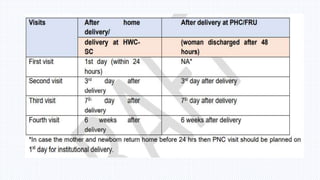
Number and timing of post-partum visits
Every pregnant woman and her newborn should be examined either
by CHO or MPWs as per the following schedule.
In case woman is unable to come to HWC, than MPW should visit the
mother for completing these examinations.
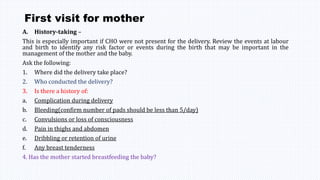
First visit for mother
A. History-taking –
This is especially important if CHO were not present for the delivery. Review the events at labour
and birth to identify any risk factor or events during the birth that may be important in the
management of the mother and the baby.
Ask the following:
1. Where did the delivery take place?
2. Who conducted the delivery?
3. Is there a history of:
a. Complication during delivery
b. Bleeding(confirm number of pads should be less than 5/day)
c. Convulsions or loss of consciousness
d. Pain in thighs and abdomen
e. Dribbling or retention of urine
f. Any breast tenderness
4. Has the mother started breastfeeding the baby?
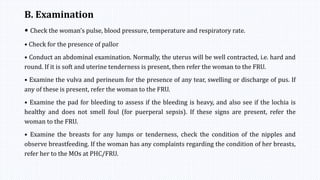
B. Examination
• Check the woman’s pulse, blood pressure, temperature and respiratory rate.
• Check for the presence of pallor
• Conduct an abdominal examination. Normally, the uterus will be well contracted, i.e. hard and
round. If it is soft and uterine tenderness is present, then refer the woman to the FRU.
• Examine the vulva and perineum for the presence of any tear, swelling or discharge of pus. If
any of these is present, refer the woman to the FRU.
• Examine the pad for bleeding to assess if the bleeding is heavy, and also see if the lochia is
healthy and does not smell foul (for puerperal sepsis). If these signs are present, refer the
woman to the FRU.
• Examine the breasts for any lumps or tenderness, check the condition of the nipples and
observe breastfeeding. If the woman has any complaints regarding the condition of her breasts,
refer her to the MOs at PHC/FRU.
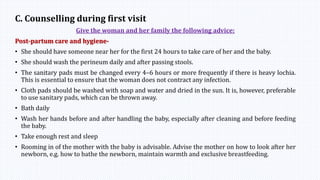
C. Counselling during first visit
Give the woman and her family the following advice:
Post-partum care and hygiene-
• She should have someone near her for the first 24 hours to take care of her and the baby.
• She should wash the perineum daily and after passing stools.
• The sanitary pads must be changed every 4–6 hours or more frequently if there is heavy lochia.
This is essential to ensure that the woman does not contract any infection.
• Cloth pads should be washed with soap and water and dried in the sun. It is, however, preferable
to use sanitary pads, which can be thrown away.
• Bath daily
• Wash her hands before and after handling the baby, especially after cleaning and before feeding
the baby.
• Take enough rest and sleep
• Rooming in of the mother with the baby is advisable. Advise the mother on how to look after her
newborn, e.g. how to bathe the newborn, maintain warmth and exclusive breastfeeding.
Nutrition
 She should increase her intake of food and fluids.
 Advise her to refrain from observing taboos that exist in the community against nutritionally
healthy foods (e.g. the taboo against eating solid food for six days).Talk to the woman’s
family members, such as her husband and mother-in-law, to encourage them to ensure that
she eats enough and avoids heavy physical work.
 Advice on regularly intake of IFA and Calcium tablets.
Contraception –
 Advise the couple regarding the return of fertility.
 Advise the couple on birth spacing or limiting the size of the family.
 Advice the couple to abstain from sexual intercourse for about 6 week’s post-partum, or till
the perineal wounds heal.
Breastfeeding
• Ask the mother whether breastfeeding was initiated within one hour of the birth.
• If breastfeeding is still not initiated, ask reason for not initiating the breastfeeding
and then assist her in breastfeeding the baby immediately.
• Observe breastfeeding and check if there is good attachment and effective suckling.
• Advise her to feed the baby colostrum.
• She should breastfeed frequently, i.e. at least 6–8 times during the day and 2–3 times
during the night.
• She should not give water or any other liquid to the baby.
• Emphasize that breast milk is enough in quantity to satisfy the baby’s hunger and
that the baby does not even require water while on breastfeeds.
• She should breastfeed from both breasts during a feed. The baby should finish
emptying one breast to get the rich hind milk before starting on the second breast.
Registration of birth-
• Explain the importance of getting the birth of the baby registered with the
local panchayat.
• This is a legal document.
• The child will require the birth certificate for many purposes in the future, e.g.
school admission
Second and third visits for mother
A. History Taking –
1. Is there continued bleeding P/V? This, i.e. post-partum bleeding occurring
24 hours or more after delivery, is known as ‘delayed’ PPH. Refer to the
PHC/CHC/DH
2. Is there foul-smelling vaginal discharge? This could be indicative of
puerperal sepsis
3. Has there been any fever?
4. Are there a history of swelling (engorgement) and/or tenderness of the
breast/issues in breast feeding
5. Is there any pain or problem while passing urine (dribbling or leaking)? Is
there fatigue and is she ‘not feeling well’?
6. Does she feel unhappy or cry easily? This indicates post-partum
depression, and usually occurs 4–7 days after delivery. Assure her that
everything will be fine and refer her to the MO only if the problem persists.
7. Are there any other complaints?
B. Examination
• This is similar to the examination conducted during the first
visit.
• During 2nd and 3rd PNC visit for women who have undergone
c-section, an examination of post-caesarean section surgical site
for any signs of surgical site infection like fever, purulent (pus)
discharge in, or coming from the wound (including evidence of
an abscess) or any reopening of the surgical wound or painful,
spreading erythema surrounding the surgical site should be
noted and managed/referred accordingly.
C. Management/counselling-
Diet and rest-
• Inform the mother that during lactation, she needs to eat more than her normal
prepregnancy diet. This is because she needs to regain her strength during the
period of exclusive breastfeeding and also for her baby to derive its full nutritional
requirements from breast milk.
• She should be advised to take foods rich in calories, proteins, iron, vitamins and
other micro-nutrients (milk and milk products, such as curd and cottage cheese;
green leafy vegetables and other seasonal vegetables; pulses; eggs; meat, including
fish and poultry; groundnuts; ragi; jaggery; fruits, such as mango, guava, orange,
sweet lime and watermelon).
• The mother needs sufficient rest during the post-partum period; to be able to
regain her strength.
• Advise her to refrain from doing any heavy work during the post-partum
period, and to focus solely on looking after herself and her baby. Her family
members should also be advised to ensure this.
Contraception-
• Inform the mother that whenever her periods begin again and/or she stops
exclusive breastfeeding, she can conceive even after a single act of
unprotected sex.
• Check if the couple is using any contraceptive method and inform the couple
about the various choices of contraceptive methods available and help them
choose the method most suitable to them.
Post natal care

Post natal care

  • 1.
    POSTNATAL CARE FORMOTHERS Presented by- Rohit Tongariya Principal Anmtc, katihar
  • 2.
    Learning Objectives At theend of the session, the learner will be able to- 1.Describe postnatal care. 2.Describe activities under each postpartum visit.
  • 3.
    Introduction- • The first42 days after birth is the post- natal period and is crucial for the mother and the new born. • First 48 hours, followed by the first one week are the most crucial period as- most of the fatal and near-fatal maternal and neonatal complications occur during this period. • Evidence has shown that more than 60% of maternal deaths take place during the post-partum period.
  • 4.
    Number and timingof post-partum visits Every pregnant woman and her newborn should be examined either by CHO or MPWs as per the following schedule. In case woman is unable to come to HWC, than MPW should visit the mother for completing these examinations.
  • 6.
    First visit formother A. History-taking – This is especially important if CHO were not present for the delivery. Review the events at labour and birth to identify any risk factor or events during the birth that may be important in the management of the mother and the baby. Ask the following: 1. Where did the delivery take place? 2. Who conducted the delivery? 3. Is there a history of: a. Complication during delivery b. Bleeding(confirm number of pads should be less than 5/day) c. Convulsions or loss of consciousness d. Pain in thighs and abdomen e. Dribbling or retention of urine f. Any breast tenderness 4. Has the mother started breastfeeding the baby?
  • 7.
    B. Examination • Checkthe woman’s pulse, blood pressure, temperature and respiratory rate. • Check for the presence of pallor • Conduct an abdominal examination. Normally, the uterus will be well contracted, i.e. hard and round. If it is soft and uterine tenderness is present, then refer the woman to the FRU. • Examine the vulva and perineum for the presence of any tear, swelling or discharge of pus. If any of these is present, refer the woman to the FRU. • Examine the pad for bleeding to assess if the bleeding is heavy, and also see if the lochia is healthy and does not smell foul (for puerperal sepsis). If these signs are present, refer the woman to the FRU. • Examine the breasts for any lumps or tenderness, check the condition of the nipples and observe breastfeeding. If the woman has any complaints regarding the condition of her breasts, refer her to the MOs at PHC/FRU.
  • 8.
    C. Counselling duringfirst visit Give the woman and her family the following advice: Post-partum care and hygiene- • She should have someone near her for the first 24 hours to take care of her and the baby. • She should wash the perineum daily and after passing stools. • The sanitary pads must be changed every 4–6 hours or more frequently if there is heavy lochia. This is essential to ensure that the woman does not contract any infection. • Cloth pads should be washed with soap and water and dried in the sun. It is, however, preferable to use sanitary pads, which can be thrown away. • Bath daily • Wash her hands before and after handling the baby, especially after cleaning and before feeding the baby. • Take enough rest and sleep • Rooming in of the mother with the baby is advisable. Advise the mother on how to look after her newborn, e.g. how to bathe the newborn, maintain warmth and exclusive breastfeeding.
  • 9.
    Nutrition  She shouldincrease her intake of food and fluids.  Advise her to refrain from observing taboos that exist in the community against nutritionally healthy foods (e.g. the taboo against eating solid food for six days).Talk to the woman’s family members, such as her husband and mother-in-law, to encourage them to ensure that she eats enough and avoids heavy physical work.  Advice on regularly intake of IFA and Calcium tablets. Contraception –  Advise the couple regarding the return of fertility.  Advise the couple on birth spacing or limiting the size of the family.  Advice the couple to abstain from sexual intercourse for about 6 week’s post-partum, or till the perineal wounds heal.
  • 10.
    Breastfeeding • Ask themother whether breastfeeding was initiated within one hour of the birth. • If breastfeeding is still not initiated, ask reason for not initiating the breastfeeding and then assist her in breastfeeding the baby immediately. • Observe breastfeeding and check if there is good attachment and effective suckling. • Advise her to feed the baby colostrum. • She should breastfeed frequently, i.e. at least 6–8 times during the day and 2–3 times during the night. • She should not give water or any other liquid to the baby. • Emphasize that breast milk is enough in quantity to satisfy the baby’s hunger and that the baby does not even require water while on breastfeeds. • She should breastfeed from both breasts during a feed. The baby should finish emptying one breast to get the rich hind milk before starting on the second breast.
  • 11.
    Registration of birth- •Explain the importance of getting the birth of the baby registered with the local panchayat. • This is a legal document. • The child will require the birth certificate for many purposes in the future, e.g. school admission
  • 12.
    Second and thirdvisits for mother A. History Taking – 1. Is there continued bleeding P/V? This, i.e. post-partum bleeding occurring 24 hours or more after delivery, is known as ‘delayed’ PPH. Refer to the PHC/CHC/DH 2. Is there foul-smelling vaginal discharge? This could be indicative of puerperal sepsis 3. Has there been any fever? 4. Are there a history of swelling (engorgement) and/or tenderness of the breast/issues in breast feeding 5. Is there any pain or problem while passing urine (dribbling or leaking)? Is there fatigue and is she ‘not feeling well’? 6. Does she feel unhappy or cry easily? This indicates post-partum depression, and usually occurs 4–7 days after delivery. Assure her that everything will be fine and refer her to the MO only if the problem persists. 7. Are there any other complaints?
  • 13.
    B. Examination • Thisis similar to the examination conducted during the first visit. • During 2nd and 3rd PNC visit for women who have undergone c-section, an examination of post-caesarean section surgical site for any signs of surgical site infection like fever, purulent (pus) discharge in, or coming from the wound (including evidence of an abscess) or any reopening of the surgical wound or painful, spreading erythema surrounding the surgical site should be noted and managed/referred accordingly.
  • 14.
    C. Management/counselling- Diet andrest- • Inform the mother that during lactation, she needs to eat more than her normal prepregnancy diet. This is because she needs to regain her strength during the period of exclusive breastfeeding and also for her baby to derive its full nutritional requirements from breast milk. • She should be advised to take foods rich in calories, proteins, iron, vitamins and other micro-nutrients (milk and milk products, such as curd and cottage cheese; green leafy vegetables and other seasonal vegetables; pulses; eggs; meat, including fish and poultry; groundnuts; ragi; jaggery; fruits, such as mango, guava, orange, sweet lime and watermelon).
  • 15.
    • The motherneeds sufficient rest during the post-partum period; to be able to regain her strength. • Advise her to refrain from doing any heavy work during the post-partum period, and to focus solely on looking after herself and her baby. Her family members should also be advised to ensure this.
  • 16.
    Contraception- • Inform themother that whenever her periods begin again and/or she stops exclusive breastfeeding, she can conceive even after a single act of unprotected sex. • Check if the couple is using any contraceptive method and inform the couple about the various choices of contraceptive methods available and help them choose the method most suitable to them.