Principles of Labor
Analgesia
Prepared By Dr Patrick ISHIMWE
TABLE OF CONTENTS
o Introduction to Pain, Labour Pain and Analgesia
o Neuroanatomy and Neurophysiology of Pain
o Non-Pharmacological Methods
o Pharmacological Analgesia
o Regional Analgesia Techniques
o Safety, Monitoring, and Future Directions
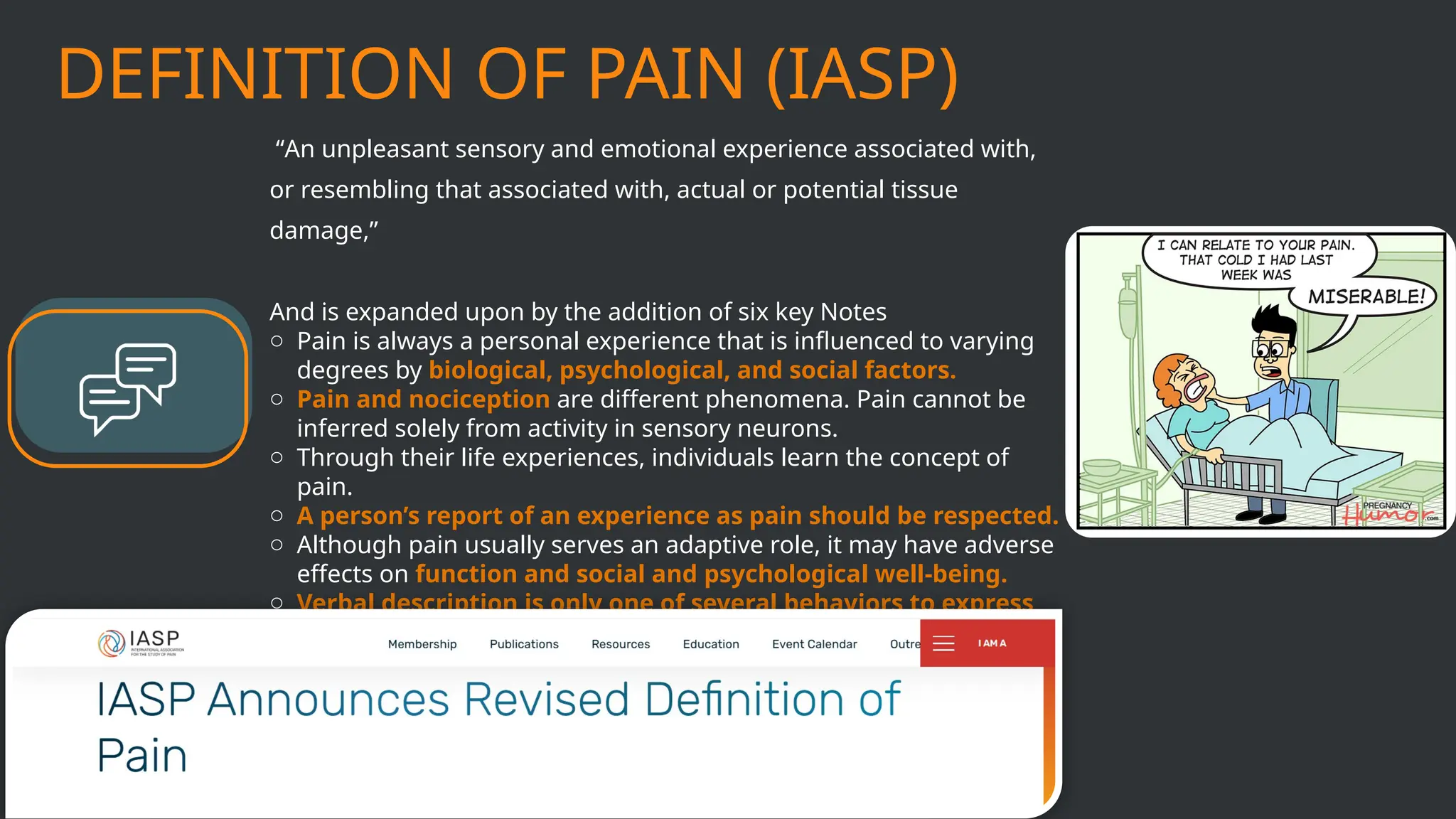
DEFINITION OF PAIN (IASP)
“An unpleasant sensory and emotional experience associated with,
or resembling that associated with, actual or potential tissue
damage,”
And is expanded upon by the addition of six key Notes
o Pain is always a personal experience that is influenced to varying
degrees by biological, psychological, and social factors.
o Pain and nociception are different phenomena. Pain cannot be
inferred solely from activity in sensory neurons.
o Through their life experiences, individuals learn the concept of
pain.
o A person’s report of an experience as pain should be respected.
o Although pain usually serves an adaptive role, it may have adverse
effects on function and social and psychological well-being.
o Verbal description is only one of several behaviors to express
pain; inability to communicate does not negate the possibility that
a human or a nonhuman animal experiences pain.
LABOR PAIN IN HISTORY
ANCIENT TIMES (EGYPT,
GREECE, ROME,…Africa)
MIDDLE AGES (5th
- 19th
Centuries)
PRESENT & FUTURE (20th
Cent- Future)
Labour pain seen as
natural, unavoidable, or
punishment (e.g., biblical
references).
Labour pain linked with
spirituality and sin.
Elaborate on what you
want to discuss.
INTRODUCTION TO LABOR ANALGESIA
oLabour pain is severe and has both
visceral(Uterine contraction, cervical dilatation)
(T10–L1) and somatic (Perineal stretching) (S2–
S4) components.
oPain leads to catecholamine release, uterine
vasoconstriction, and fetal hypoxia.
oHyperventilation causes hypocapnia and
worsens oxygen delivery.
oEffective analgesia reduces maternal stress and
fetal acidosis.
oGoals: relieve maternal suffering and improve
maternal–fetal safety.
oLabour analgesia options: non-
WELCOME TO PRESENTATION
o 60 % Of Primigravida
reports pain as severe and
Excruciating.
o Labor Analgesia is given to
those who requested it.
HOME
LOGO SERVICE CONTACT
ABOUT
Neuroanatomy and Neurophysiology
Pain Pathway in First Stage of Labor
During Fist Stage of Labor Pain is
Poorly localized and Diffuse because it
is due to stretching of Lower Uterine
Segment and Usually cervical
Dilatation, then Nociceptors detect
Noxious stimuli , transferred by A-
Delta and C-Fibers to Spinal Cord.
Pain Pathway in the Second Stage of Labor
During second Stage of Labor Pain is
dues to descent of Fetal Head and
subscequent stretching on the pelvic
floor, The Vaginal wall and Perineum,
and it’s mainly Somatic where it is
transmitted through Pudendal Nerve.
Methods of Labor Analgesia
NON PHARMACOLOGICAL METHODS
o Include massage, breathing techniques,
relaxation, TENS, hydrotherapy, acupuncture,
hypnosis, and aromatherapy.
o Evidence base is limited, mostly anecdotal or
small studies.
o Hydrotherapy and relaxation improve
satisfaction and reduce the need for
pharmacological methods.
o Acupuncture reduces instrumental delivery
and caesarean rates.
o Generally useful for mild labour pain or as
adjuncts to pharmacological methods.
PHARMACOLOGICAL: INHALATIONAL AGENTS
o Entonox (50% nitrous oxide + O₂) widely
used; simple and self-administered.
o Rapid Onset, Provides moderate pain relief
but is often inadequate for many women.
o Side effects: nausea, drowsiness, vomiting,
B12 metabolism disruption.
o Occupational exposure is a concern but can
be reduced with scavenging systems.
o Sevoflurane (sub-anaesthetic doses) studied
as an alternative – less nausea than Entonox.
o Concerns: sedation, risk of unconsciousness,
fetal toxicity, and environmental pollution.
PHARMACOLOGICAL: SYSTEMIC OPIOIDS
o Pethidine: common but less effective than
epidural; causes nausea, sedation, and
neonatal respiratory depression.
• Relatively contraindicated late in labour due
to neonatal depression.
o Remifentanil PCA: ultra-short acting opioid
with ~3 min half-life.
• RESPITE trial: halved epidural conversions vs
pethidine, better maternal satisfaction.
• No excess maternal/infant respiratory
depression.
• Suitable when an epidural is contraindicated
(e.g., coagulopathy, fixed cardiac output
states).
NEURAXIAL ANALGESIA: EPIDURAL
o Gold standard for labour pain relief.
o Involves epidural catheter with local anaesthetic ±
opioids.
o Newer agents (levobupivacaine, ropivacaine) are
safer and less cardiotoxic.
o Low-dose local anaesthetic + lipophilic opioid
reduces motor block, facilitates ambulation.
o Meta-analyses: no increased risk of caesarean,
backache, or neonatal compromise.
o Provides flexibility for “top-ups” during operative
deliveries.
COMBINED & CONTINUOUS NEURAXIAL TECHNIQUES
o Combined spinal-epidural (CSE): rapid onset, useful in
advanced labour or severe pain.
o Equally safe as conventional epidural; quicker onset but
maternal satisfaction varies.
o Continuous intrathecal analgesia: microcatheter delivers local
anaesthetic ± opioid.
o Provides titratable, effective analgesia with less drug use.
o Challenges: catheter failure, infection, post-dural puncture
headache.
o Considered for obese patients or high-risk cases (e.g.,
cardiac disease).
o May reduce total drug requirement compared to epidural alone.
o Risk of maternal pruritus, hypotension, and post-dural puncture
headache.
o Increasingly preferred in modern obstetric anaesthesia practice.
MAINTENANCE OF EPIDURAL ANALGESIA
Methods: intermittent boluses, continuous
infusion, PCEA, PIEB.
o Continuous infusion improves consistency but
may cause motor block.
o PCEA (Patient-Controlled Epidural
Analgesia): better satisfaction, lower drug
use, less motor block.
o Genetic factors (e.g., OPRM1 polymorphism)
may influence analgesic response.
o CIPCEA (Computer-Integrated PCEA): adjusts
background infusion automatically, improving
satisfaction.
o PIEB: programmed boluses, better spread,
reduced local anaesthetic use, higher
satisfaction.
ULTRASOUND & SAFETY ADVANCES
o Ultrasound guidance improves epidural
placement in obese or difficult spines.
o Limited benefit in women with easily
palpable landmarks.
o Endorsed by NICE and ASRA for neuraxial
procedures.
o Monitoring: maternal vitals, fetal heart rate,
block level, and side effects.
o Intralipid infusion introduced for
treatment of local anesthetic toxicity.
o Lipid binds toxic local anaesthetics,
protecting cardiac muscle.
o Now part of the resuscitation protocol in
obstetric anaesthesia.
TIMING AND TERMINATION OF EPIDURAL
o Early epidural (<4 cm dilation) does not
increase caesarean rates.
o Provides shorter labour duration and better
pain relief.
o ACOG & ASA: “maternal request is sufficient
indication” for epidural.
o RCoA: anaesthetist should attend within
30 min of request.
o No evidence that discontinuing epidural late
in labour reduces adverse outcomes.
o Stopping early increases inadequate pain
relief in second stage.
OTHER CONSIDERATIONS & CONCLUSION
o Epidural + fentanyl ( 2 µg/mL) does not
≤
reduce breastfeeding success.
o Maternal fever occurs in up to one-third of
cases; the mechanism is likely sterile
inflammation.
o Epidural remains the safest and most effective
method of labour analgesia.
o Contraindications: maternal coagulopathy,
sepsis, raised ICP, refusal.
o Alternatives: remifentanil PCA, inhalational
agents, non-pharmacological measures.
o Future: closed-loop drug delivery systems and
personalized analgesia.
o https://www.iasp-pain.org/publications/iasp-news/
iasp-announces-revised-definition-of-pain/
o https://www.ncbi.nlm.nih.gov/books/NBK542219/
o https://www.aafp.org/pubs/afp/issues/2021/0315/
p355.pdf
ohttps://www.hkmj.org/system/files/hkmj208632.pdf
References

Presentation on Principles of Labor Analgesia.pptx

  • 1.
  • 2.
    TABLE OF CONTENTS oIntroduction to Pain, Labour Pain and Analgesia o Neuroanatomy and Neurophysiology of Pain o Non-Pharmacological Methods o Pharmacological Analgesia o Regional Analgesia Techniques o Safety, Monitoring, and Future Directions
  • 3.
    DEFINITION OF PAIN(IASP) “An unpleasant sensory and emotional experience associated with, or resembling that associated with, actual or potential tissue damage,” And is expanded upon by the addition of six key Notes o Pain is always a personal experience that is influenced to varying degrees by biological, psychological, and social factors. o Pain and nociception are different phenomena. Pain cannot be inferred solely from activity in sensory neurons. o Through their life experiences, individuals learn the concept of pain. o A person’s report of an experience as pain should be respected. o Although pain usually serves an adaptive role, it may have adverse effects on function and social and psychological well-being. o Verbal description is only one of several behaviors to express pain; inability to communicate does not negate the possibility that a human or a nonhuman animal experiences pain.
  • 4.
    LABOR PAIN INHISTORY ANCIENT TIMES (EGYPT, GREECE, ROME,…Africa) MIDDLE AGES (5th - 19th Centuries) PRESENT & FUTURE (20th Cent- Future) Labour pain seen as natural, unavoidable, or punishment (e.g., biblical references). Labour pain linked with spirituality and sin. Elaborate on what you want to discuss.
  • 5.
    INTRODUCTION TO LABORANALGESIA oLabour pain is severe and has both visceral(Uterine contraction, cervical dilatation) (T10–L1) and somatic (Perineal stretching) (S2– S4) components. oPain leads to catecholamine release, uterine vasoconstriction, and fetal hypoxia. oHyperventilation causes hypocapnia and worsens oxygen delivery. oEffective analgesia reduces maternal stress and fetal acidosis. oGoals: relieve maternal suffering and improve maternal–fetal safety. oLabour analgesia options: non-
  • 6.
    WELCOME TO PRESENTATION o60 % Of Primigravida reports pain as severe and Excruciating. o Labor Analgesia is given to those who requested it.
  • 7.
  • 8.
    Pain Pathway inFirst Stage of Labor During Fist Stage of Labor Pain is Poorly localized and Diffuse because it is due to stretching of Lower Uterine Segment and Usually cervical Dilatation, then Nociceptors detect Noxious stimuli , transferred by A- Delta and C-Fibers to Spinal Cord.
  • 9.
    Pain Pathway inthe Second Stage of Labor During second Stage of Labor Pain is dues to descent of Fetal Head and subscequent stretching on the pelvic floor, The Vaginal wall and Perineum, and it’s mainly Somatic where it is transmitted through Pudendal Nerve.
  • 10.
  • 11.
    NON PHARMACOLOGICAL METHODS oInclude massage, breathing techniques, relaxation, TENS, hydrotherapy, acupuncture, hypnosis, and aromatherapy. o Evidence base is limited, mostly anecdotal or small studies. o Hydrotherapy and relaxation improve satisfaction and reduce the need for pharmacological methods. o Acupuncture reduces instrumental delivery and caesarean rates. o Generally useful for mild labour pain or as adjuncts to pharmacological methods.
  • 12.
    PHARMACOLOGICAL: INHALATIONAL AGENTS oEntonox (50% nitrous oxide + O₂) widely used; simple and self-administered. o Rapid Onset, Provides moderate pain relief but is often inadequate for many women. o Side effects: nausea, drowsiness, vomiting, B12 metabolism disruption. o Occupational exposure is a concern but can be reduced with scavenging systems. o Sevoflurane (sub-anaesthetic doses) studied as an alternative – less nausea than Entonox. o Concerns: sedation, risk of unconsciousness, fetal toxicity, and environmental pollution.
  • 13.
    PHARMACOLOGICAL: SYSTEMIC OPIOIDS oPethidine: common but less effective than epidural; causes nausea, sedation, and neonatal respiratory depression. • Relatively contraindicated late in labour due to neonatal depression. o Remifentanil PCA: ultra-short acting opioid with ~3 min half-life. • RESPITE trial: halved epidural conversions vs pethidine, better maternal satisfaction. • No excess maternal/infant respiratory depression. • Suitable when an epidural is contraindicated (e.g., coagulopathy, fixed cardiac output states).
  • 14.
    NEURAXIAL ANALGESIA: EPIDURAL oGold standard for labour pain relief. o Involves epidural catheter with local anaesthetic ± opioids. o Newer agents (levobupivacaine, ropivacaine) are safer and less cardiotoxic. o Low-dose local anaesthetic + lipophilic opioid reduces motor block, facilitates ambulation. o Meta-analyses: no increased risk of caesarean, backache, or neonatal compromise. o Provides flexibility for “top-ups” during operative deliveries.
  • 15.
    COMBINED & CONTINUOUSNEURAXIAL TECHNIQUES o Combined spinal-epidural (CSE): rapid onset, useful in advanced labour or severe pain. o Equally safe as conventional epidural; quicker onset but maternal satisfaction varies. o Continuous intrathecal analgesia: microcatheter delivers local anaesthetic ± opioid. o Provides titratable, effective analgesia with less drug use. o Challenges: catheter failure, infection, post-dural puncture headache. o Considered for obese patients or high-risk cases (e.g., cardiac disease). o May reduce total drug requirement compared to epidural alone. o Risk of maternal pruritus, hypotension, and post-dural puncture headache. o Increasingly preferred in modern obstetric anaesthesia practice.
  • 16.
    MAINTENANCE OF EPIDURALANALGESIA Methods: intermittent boluses, continuous infusion, PCEA, PIEB. o Continuous infusion improves consistency but may cause motor block. o PCEA (Patient-Controlled Epidural Analgesia): better satisfaction, lower drug use, less motor block. o Genetic factors (e.g., OPRM1 polymorphism) may influence analgesic response. o CIPCEA (Computer-Integrated PCEA): adjusts background infusion automatically, improving satisfaction. o PIEB: programmed boluses, better spread, reduced local anaesthetic use, higher satisfaction.
  • 17.
    ULTRASOUND & SAFETYADVANCES o Ultrasound guidance improves epidural placement in obese or difficult spines. o Limited benefit in women with easily palpable landmarks. o Endorsed by NICE and ASRA for neuraxial procedures. o Monitoring: maternal vitals, fetal heart rate, block level, and side effects. o Intralipid infusion introduced for treatment of local anesthetic toxicity. o Lipid binds toxic local anaesthetics, protecting cardiac muscle. o Now part of the resuscitation protocol in obstetric anaesthesia.
  • 18.
    TIMING AND TERMINATIONOF EPIDURAL o Early epidural (<4 cm dilation) does not increase caesarean rates. o Provides shorter labour duration and better pain relief. o ACOG & ASA: “maternal request is sufficient indication” for epidural. o RCoA: anaesthetist should attend within 30 min of request. o No evidence that discontinuing epidural late in labour reduces adverse outcomes. o Stopping early increases inadequate pain relief in second stage.
  • 19.
    OTHER CONSIDERATIONS &CONCLUSION o Epidural + fentanyl ( 2 µg/mL) does not ≤ reduce breastfeeding success. o Maternal fever occurs in up to one-third of cases; the mechanism is likely sterile inflammation. o Epidural remains the safest and most effective method of labour analgesia. o Contraindications: maternal coagulopathy, sepsis, raised ICP, refusal. o Alternatives: remifentanil PCA, inhalational agents, non-pharmacological measures. o Future: closed-loop drug delivery systems and personalized analgesia.
  • 20.
    o https://www.iasp-pain.org/publications/iasp-news/ iasp-announces-revised-definition-of-pain/ o https://www.ncbi.nlm.nih.gov/books/NBK542219/ ohttps://www.aafp.org/pubs/afp/issues/2021/0315/ p355.pdf ohttps://www.hkmj.org/system/files/hkmj208632.pdf References