Dr. Shiraz Munshi MBBS,DNB(fellow) Interventional Pain Specialist Sterling Hospital, HCG Medi-Surge Hospital, Ahmedabad Chronic Back Pain A More Effective Approach
NO ONE should live or die in pain
Precision Diagnosis and Treatment of Back Pain
WHAT DO WE TREAT  Back and Neck Pain Radiculopathy  (pain originating in the neck or back, running down the arm or leg) Prolapsed Intervertebral Disc Spondylolisthesis / lysis Spinal Stenosis Post Laminectomy pain Trigeminal Neuralgia RSD—Reflex Sympathetic Dystrophy ( CRPS 1 or 2 ) Myofascial pain Rib fractures Headaches Shingles/Herpes Zoster Diabetic Neuropathy Pain Vascular (ischemic) Pain Any Chronic Pain Syndrome
The Spinal Column The human spinal column is the center of postural control. It is built to provide stability and at the same time allow flexibility.  These two seemingly incompatible functions of support (inflexibility) and movement (flexibility) are at opposite ends of a spectrum of movement, and this fact is one reason the spine is so vulnerable to injury.
Old School Concepts of Neck & Back Pain A Physical Cause for the Pain Does Not Exist or Cannot Be Diagnosed in 70% of cases Psychosocial Issues Predominate Treatments are Expensive, Risky, and Ineffective
New Concepts of Back & Neck Pain A physical cause for the pain  can  be found and diagnosed in almost 70% of cases If back and neck pain are ignored biopsychosocial issues will predominate Treatment is generally effective and low risk. Cost is substantially less when compared to continued disability and/or surgery.
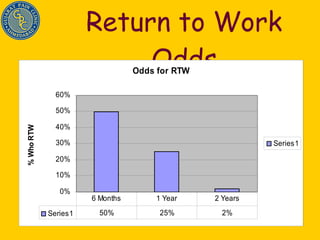
Early Intervention Odds for return to work after: 6 months? 1 year? 2 year?
Return to Work Odds
Proper Treatment of Neck & Back Pain Must Begin With The  Diagnosis Of fundamental importance Often skipped! Difficult without appropriate tools and strategies 70% of problems DO have a diagnosable physical cause
“ It is clear from clinical experience and formal studies that when a patient presents with spinal pain there are no clinical features that permit the source of pain to be diagnosed. Even imaging studies do not provide a diagnosis. The appropriate investigations are the ones that answer the questions ( where does the pain come from )” Bogduk et al
Precision Diagnosis of  Neck & Back Pain Use a combination of: History Physical Exam Radiologic Findings Diagnostic Injections
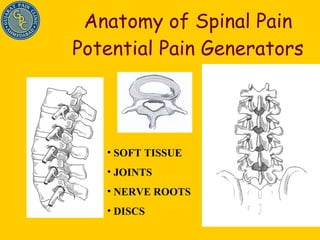
Anatomy of Spinal Pain Potential Pain Generators SOFT TISSUE JOINTS NERVE ROOTS DISCS
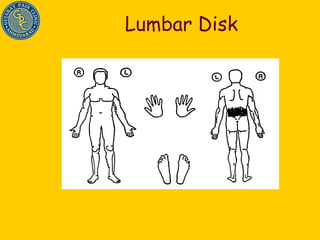
Lumbar Disk
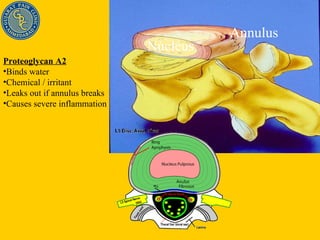
Annulus Nucleus Proteoglycan A2 Binds water Chemical / irritant Leaks out if annulus breaks Causes severe inflammation
 
 
Diagnosis MRI – look for HOT spot – T2 weighted Images Provocation discogram
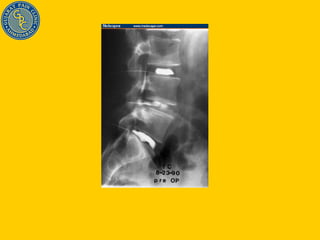
Diskogram
 
 
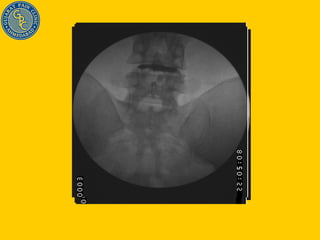
CONTRAST DISTRIBUTION [80] : (AS EVALUATED BY FLUOROSCOPY )     Disk has a complete radio fissure that allows injected fluid to escape.  Can be in any stage of degeneration.   “ Ruptured”  (R)   Degenerated disk with radio fissure leading to the outer edge of the annulus.   “ Fissured” (F)   Degenerated disk with fissures and clefts in the nucleus and inner annulus.   “ Irregular”  (I)   Mature disk with nucleus starting to degenerate into fibrous lumps.   “ Lobular”  (L)   No signs of degeneration, Soft white amorphous nucleus   “ Cotton Ball”  (CB)   Stage of Disk Degeneration (C-arm View)   Discogram Type “ Ruptured” “ Fissured” “ Irregular” “ Lobular” “ Cotton Ball”
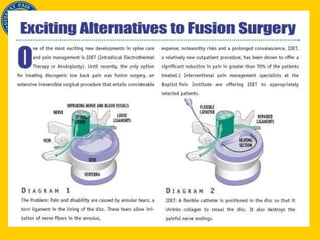
Management Transforaminal selective nerve injection Intradiscal therapy DeKompressor Discectomy OZONE Discectomy IDET Laser Discectomy
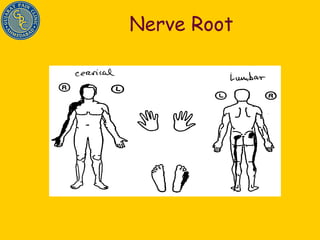
Nerve Root
Clinical Indications   Large disk herniations spinal stenosis tumor invasion of nerve root vertibral fracture post herpatic neuralgia discogenic pain segmental neuralgias prognostic   predicting efficacy of neurolytic or  neurosurgical treatment
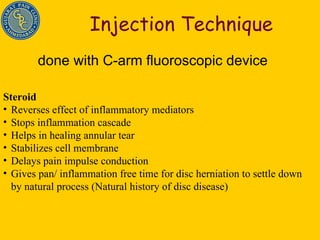
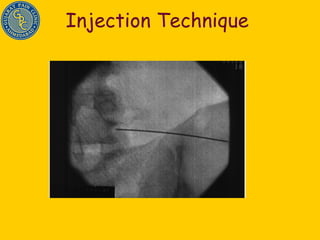
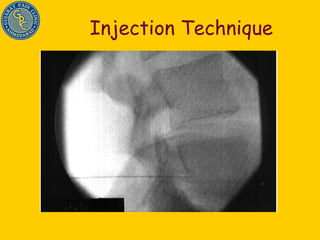
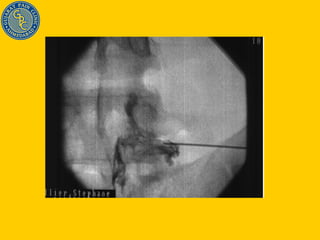
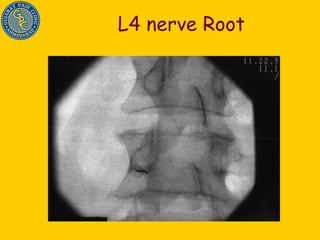
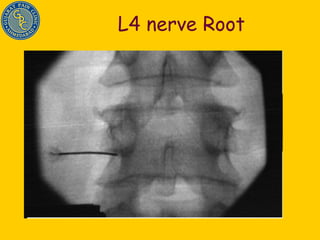
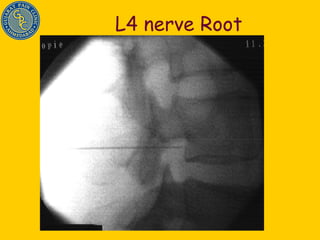
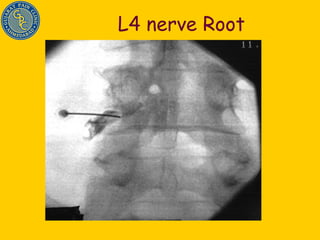
Injection Technique done with C-arm fluoroscopic device Steroid Reverses effect of inflammatory mediators Stops inflammation cascade Helps in healing annular tear Stabilizes cell membrane Delays pain impulse conduction Gives pan/ inflammation free time for disc herniation to settle down by natural process (Natural history of disc disease)
Injection Technique
Injection Technique
 
L4 nerve Root
L4 nerve Root
L4 nerve Root
L4 nerve Root
Management Transforaminal selective nerve injection Intradiscal therapy DeKompressor Discectomy OZONE Discectomy IDET Laser Discectomy
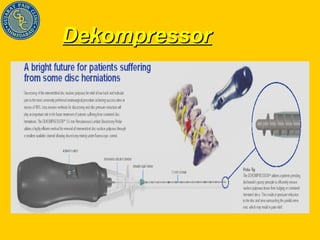
Dekompressor
Management Transforaminal selective nerve injection Intradiscal therapy DeKompressor Discectomy OZONE Discectomy IDET Laser Discectomy` Nucleoplasty
 
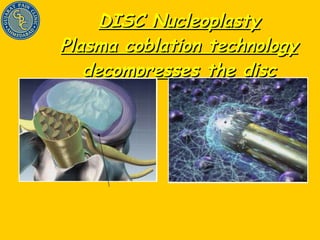
DISC Nucleoplasty Plasma coblation technology decompresses the disc
Failed Back surgery syndrome (Post laminectomy pain syndrome) Adhesions – Racz adhesiolysis Recurrent disc herniation at same or adjacent level – treat similarly as disc prolapse Facet joint pain - Denervation Neuropathic pain – LS block / SCS / Intrathecal pump
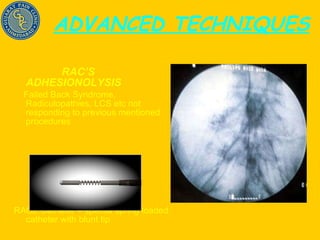
ADVANCED TECHNIQUES RAC’S ADHESIONOLYSIS   Failed Back Syndrome, Radiculopathies, LCS etc not responding to previous mentioned procedures  RACZ Catheter – special spring loaded catheter with blunt tip
Failed Back surgery syndrome (Post laminectomy pain syndrome) Adhesions – Racz adhesiolysis Recurrent disc herniation at same or adjacent level – treat similarly as disc prolapse Facet joint pain - Denervation Neuropathic pain – LS block / SCS / Intrathecal morphine pump Intractable pain – SCS / Intrathecal morphine pump
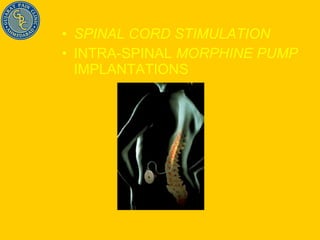
SPINAL CORD STIMULATION   INTRA-SPINAL  MORPHINE PUMP  IMPLANTATIONS
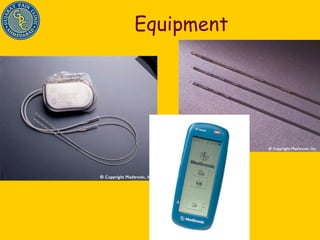
Equipment
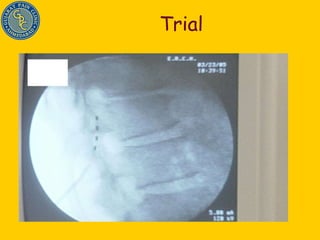
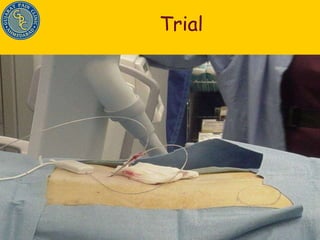
Trial
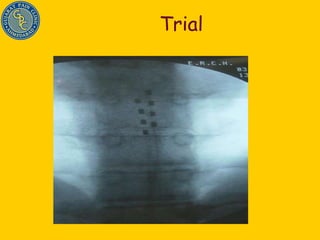
Trial
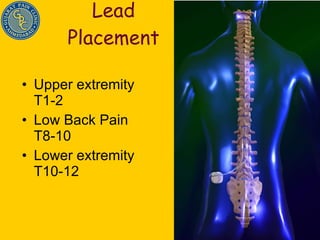
Lead Placement Upper extremity T1-2 Low Back Pain T8-10 Lower extremity T10-12
Trial
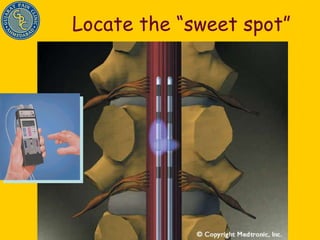
Locate the “sweet spot”
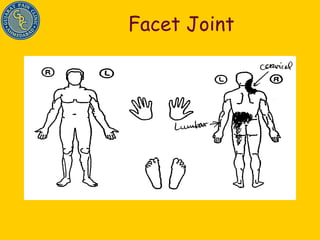
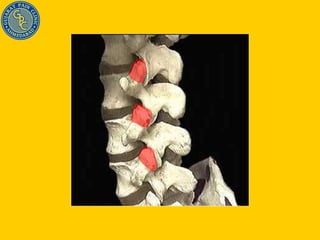
Facet Joint
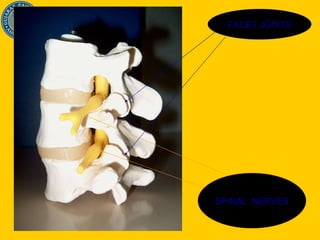
FACET JOINTS SPINAL  NERVES
 
Pathophysiology of Facet Syndrome With  chronic inflammation  these joints can fill with fluid and distend leading to pain This  could also cause compression of nerve  root in the neural foramen Synovial cyst  can also cause pressure on the nerve root as would facet hypertrophy and osteomyelitis
Pathophysiology of Facet Syndrome Intervertebral disk space narrowing can lead to  subluxation  of facet joint Capsular irritation and local inflammation can cause  reflex spasm of paraspinal muscles
Incidence  5-40% of patients with chronic back pain suffer from facet induced pain
Diagnosis History Physical examination Diagnostic block
History Low back pain- unilateral or bilateral Tenderness over facet joints Pain is deep, dull aching, difficult to localize Referred to the buttocks, groin, hip, or posterior and lateral thigh
History Occasionally radiates below the knee but not into the foot Sudden onset of pain usually in association with twisting, bending, or rotatory movement Increased pain on external and lateral bending
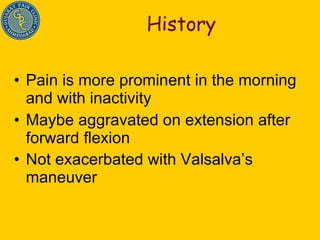
History Pain is more prominent in the morning and with inactivity Maybe aggravated on extension after forward flexion  Not exacerbated with Valsalva’s maneuver
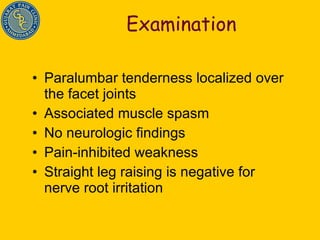
Examination Paralumbar tenderness localized over the facet joints Associated muscle spasm No neurologic findings Pain-inhibited weakness Straight leg raising is negative for nerve root irritation
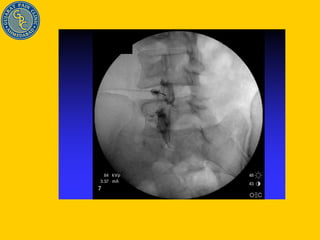
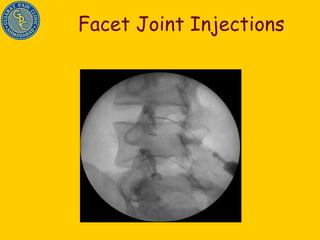
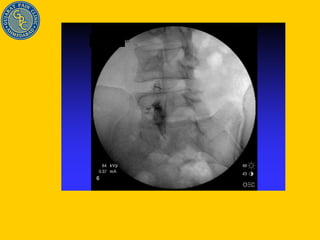
Diagnostic Joint Injection Technique With fluoroscopic guidance  Place the needle in the joint with fluoroscopic guidance
 
 
Facet Joint Injections
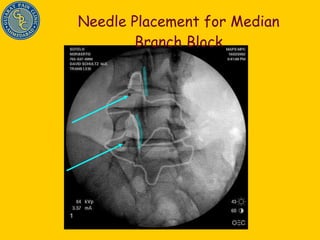
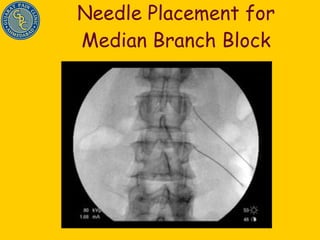
Needle Placement for Median Branch Block
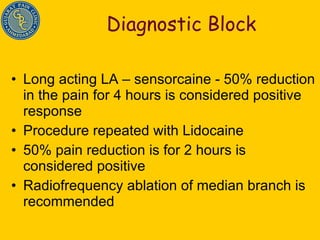
Diagnostic Block Long acting LA – sensorcaine - 50% reduction in the pain for 4 hours is considered positive response Procedure repeated with Lidocaine 50% pain reduction is for 2 hours is considered positive Radiofrequency ablation of median branch is recommended
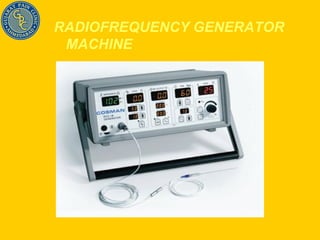
RADIOFREQUENCY GENERATOR MACHINE
Radiofrequency (RF) lesioning   Safe, proven means of treating chronic pain Continuous radiofrequency current is used to heat a small volume of nerve tissue, thereby disrupting pain signals from that specific area This procedure has a selective effect on nerve fibers, reducing pain in target areas, but leaving other sensory capabilities intact.  A procedure developed more than 30 years ago
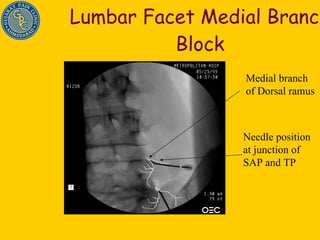
Lumbar Facet Medial Branch Block Needle position at junction of SAP and TP Medial branch of Dorsal ramus
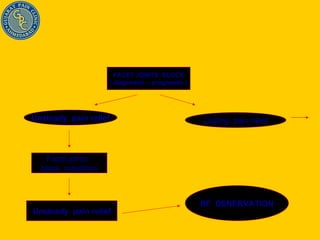
FACET JOINTS  -  RF DENERVATION  PATIENTS  SELECTION  -  FLOW CHART FACET JOINTS  BLOCK ( diagnostic – prognostic ) Unsteady  pain relief Lasting  pain releif Facet joints  block  repetition Unsteady  pain relief RF  DENERVATION
Sacroiliac Joint
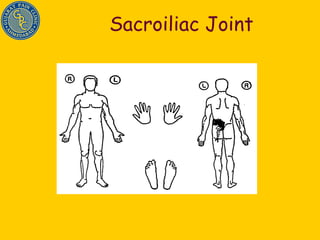
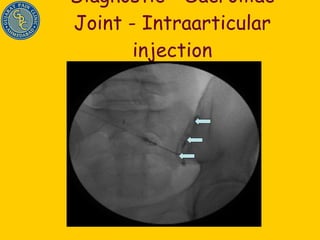
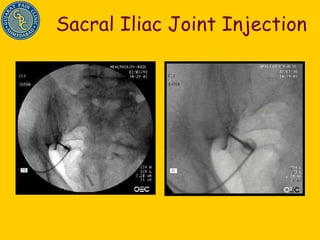
Sacral Iliac Joint Injection History: fall, or high velocity trauma  (MVA) PE :  pain over SI joint, Patrick’s test,  Radiology : not very useful  Diagnosis: Gold Standard is flouroscopic guided injection of SI joint using dye and lidocaine Treatment: SI joint injection with lidocaine and steroid and  physical therapy.  We add hylase also sometimes for better penetration of the drugs
Diagnostic - Sacroiliac Joint - Intraarticular injection
Sacral Iliac Joint Injection
More advanced techniques available
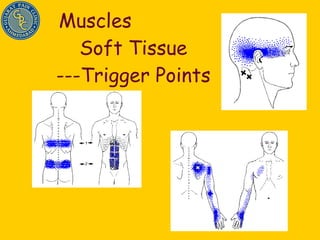
Muscles  Soft Tissue ---Trigger Points
IN SUMMARY…..
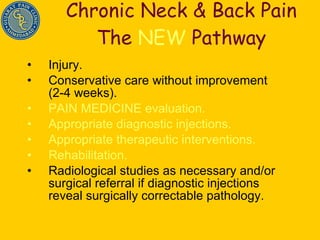
Chronic Neck & Back Pain The  NEW  Pathway Injury. Conservative care without improvement (2-4 weeks). PAIN MEDICINE evaluation. Appropriate diagnostic injections. Appropriate therapeutic interventions. Rehabilitation. Radiological studies as necessary and/or surgical referral if diagnostic injections reveal surgically correctable pathology.
THERAPEUTIC WINDOW OF OPPORTUNITY
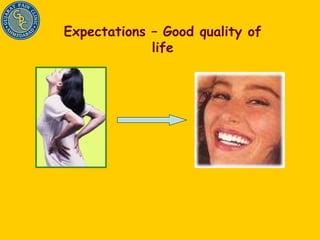
Expectations – Good quality of life
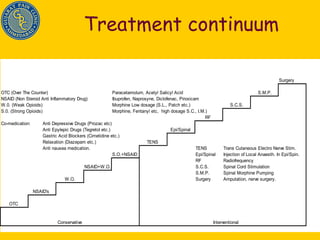
Treatment continuum
 
Thank you for your attention! Are there any questions?
NO ONE should live or die in pain

Back Pain

  • 1.
    Dr. Shiraz MunshiMBBS,DNB(fellow) Interventional Pain Specialist Sterling Hospital, HCG Medi-Surge Hospital, Ahmedabad Chronic Back Pain A More Effective Approach
  • 2.
    NO ONE shouldlive or die in pain
  • 3.
    Precision Diagnosis andTreatment of Back Pain
  • 4.
    WHAT DO WETREAT Back and Neck Pain Radiculopathy (pain originating in the neck or back, running down the arm or leg) Prolapsed Intervertebral Disc Spondylolisthesis / lysis Spinal Stenosis Post Laminectomy pain Trigeminal Neuralgia RSD—Reflex Sympathetic Dystrophy ( CRPS 1 or 2 ) Myofascial pain Rib fractures Headaches Shingles/Herpes Zoster Diabetic Neuropathy Pain Vascular (ischemic) Pain Any Chronic Pain Syndrome
  • 5.
    The Spinal ColumnThe human spinal column is the center of postural control. It is built to provide stability and at the same time allow flexibility. These two seemingly incompatible functions of support (inflexibility) and movement (flexibility) are at opposite ends of a spectrum of movement, and this fact is one reason the spine is so vulnerable to injury.
  • 6.
    Old School Conceptsof Neck & Back Pain A Physical Cause for the Pain Does Not Exist or Cannot Be Diagnosed in 70% of cases Psychosocial Issues Predominate Treatments are Expensive, Risky, and Ineffective
  • 7.
    New Concepts ofBack & Neck Pain A physical cause for the pain can be found and diagnosed in almost 70% of cases If back and neck pain are ignored biopsychosocial issues will predominate Treatment is generally effective and low risk. Cost is substantially less when compared to continued disability and/or surgery.
  • 8.
    Early Intervention Oddsfor return to work after: 6 months? 1 year? 2 year?
  • 9.
  • 10.
    Proper Treatment ofNeck & Back Pain Must Begin With The Diagnosis Of fundamental importance Often skipped! Difficult without appropriate tools and strategies 70% of problems DO have a diagnosable physical cause
  • 11.
    “ It isclear from clinical experience and formal studies that when a patient presents with spinal pain there are no clinical features that permit the source of pain to be diagnosed. Even imaging studies do not provide a diagnosis. The appropriate investigations are the ones that answer the questions ( where does the pain come from )” Bogduk et al
  • 12.
    Precision Diagnosis of Neck & Back Pain Use a combination of: History Physical Exam Radiologic Findings Diagnostic Injections
  • 13.
    Anatomy of SpinalPain Potential Pain Generators SOFT TISSUE JOINTS NERVE ROOTS DISCS
  • 14.
  • 15.
    Annulus Nucleus ProteoglycanA2 Binds water Chemical / irritant Leaks out if annulus breaks Causes severe inflammation
  • 16.
  • 17.
  • 18.
    Diagnosis MRI –look for HOT spot – T2 weighted Images Provocation discogram
  • 19.
  • 20.
  • 21.
  • 22.
    CONTRAST DISTRIBUTION [80]: (AS EVALUATED BY FLUOROSCOPY )     Disk has a complete radio fissure that allows injected fluid to escape. Can be in any stage of degeneration.   “ Ruptured” (R)   Degenerated disk with radio fissure leading to the outer edge of the annulus.   “ Fissured” (F)   Degenerated disk with fissures and clefts in the nucleus and inner annulus.   “ Irregular” (I)   Mature disk with nucleus starting to degenerate into fibrous lumps.   “ Lobular” (L)   No signs of degeneration, Soft white amorphous nucleus   “ Cotton Ball” (CB)   Stage of Disk Degeneration (C-arm View)   Discogram Type “ Ruptured” “ Fissured” “ Irregular” “ Lobular” “ Cotton Ball”
  • 23.
    Management Transforaminal selectivenerve injection Intradiscal therapy DeKompressor Discectomy OZONE Discectomy IDET Laser Discectomy
  • 24.
  • 25.
    Clinical Indications Large disk herniations spinal stenosis tumor invasion of nerve root vertibral fracture post herpatic neuralgia discogenic pain segmental neuralgias prognostic predicting efficacy of neurolytic or neurosurgical treatment
  • 26.
    Injection Technique donewith C-arm fluoroscopic device Steroid Reverses effect of inflammatory mediators Stops inflammation cascade Helps in healing annular tear Stabilizes cell membrane Delays pain impulse conduction Gives pan/ inflammation free time for disc herniation to settle down by natural process (Natural history of disc disease)
  • 27.
  • 28.
  • 29.
  • 30.
  • 31.
  • 32.
  • 33.
  • 34.
    Management Transforaminal selectivenerve injection Intradiscal therapy DeKompressor Discectomy OZONE Discectomy IDET Laser Discectomy
  • 35.
  • 36.
    Management Transforaminal selectivenerve injection Intradiscal therapy DeKompressor Discectomy OZONE Discectomy IDET Laser Discectomy` Nucleoplasty
  • 37.
  • 38.
    DISC Nucleoplasty Plasmacoblation technology decompresses the disc
  • 39.
    Failed Back surgerysyndrome (Post laminectomy pain syndrome) Adhesions – Racz adhesiolysis Recurrent disc herniation at same or adjacent level – treat similarly as disc prolapse Facet joint pain - Denervation Neuropathic pain – LS block / SCS / Intrathecal pump
  • 40.
    ADVANCED TECHNIQUES RAC’SADHESIONOLYSIS Failed Back Syndrome, Radiculopathies, LCS etc not responding to previous mentioned procedures RACZ Catheter – special spring loaded catheter with blunt tip
  • 41.
    Failed Back surgerysyndrome (Post laminectomy pain syndrome) Adhesions – Racz adhesiolysis Recurrent disc herniation at same or adjacent level – treat similarly as disc prolapse Facet joint pain - Denervation Neuropathic pain – LS block / SCS / Intrathecal morphine pump Intractable pain – SCS / Intrathecal morphine pump
  • 42.
    SPINAL CORD STIMULATION INTRA-SPINAL MORPHINE PUMP IMPLANTATIONS
  • 43.
  • 44.
  • 45.
  • 46.
    Lead Placement Upperextremity T1-2 Low Back Pain T8-10 Lower extremity T10-12
  • 47.
  • 48.
  • 49.
  • 50.
  • 51.
  • 52.
    Pathophysiology of FacetSyndrome With chronic inflammation these joints can fill with fluid and distend leading to pain This could also cause compression of nerve root in the neural foramen Synovial cyst can also cause pressure on the nerve root as would facet hypertrophy and osteomyelitis
  • 53.
    Pathophysiology of FacetSyndrome Intervertebral disk space narrowing can lead to subluxation of facet joint Capsular irritation and local inflammation can cause reflex spasm of paraspinal muscles
  • 54.
    Incidence 5-40%of patients with chronic back pain suffer from facet induced pain
  • 55.
    Diagnosis History Physicalexamination Diagnostic block
  • 56.
    History Low backpain- unilateral or bilateral Tenderness over facet joints Pain is deep, dull aching, difficult to localize Referred to the buttocks, groin, hip, or posterior and lateral thigh
  • 57.
    History Occasionally radiatesbelow the knee but not into the foot Sudden onset of pain usually in association with twisting, bending, or rotatory movement Increased pain on external and lateral bending
  • 58.
    History Pain ismore prominent in the morning and with inactivity Maybe aggravated on extension after forward flexion Not exacerbated with Valsalva’s maneuver
  • 59.
    Examination Paralumbar tendernesslocalized over the facet joints Associated muscle spasm No neurologic findings Pain-inhibited weakness Straight leg raising is negative for nerve root irritation
  • 60.
    Diagnostic Joint InjectionTechnique With fluoroscopic guidance Place the needle in the joint with fluoroscopic guidance
  • 61.
  • 62.
  • 63.
  • 64.
    Needle Placement forMedian Branch Block
  • 65.
    Needle Placement forMedian Branch Block
  • 66.
    Diagnostic Block Longacting LA – sensorcaine - 50% reduction in the pain for 4 hours is considered positive response Procedure repeated with Lidocaine 50% pain reduction is for 2 hours is considered positive Radiofrequency ablation of median branch is recommended
  • 67.
  • 68.
    Radiofrequency (RF) lesioning Safe, proven means of treating chronic pain Continuous radiofrequency current is used to heat a small volume of nerve tissue, thereby disrupting pain signals from that specific area This procedure has a selective effect on nerve fibers, reducing pain in target areas, but leaving other sensory capabilities intact. A procedure developed more than 30 years ago
  • 69.
    Lumbar Facet MedialBranch Block Needle position at junction of SAP and TP Medial branch of Dorsal ramus
  • 70.
    FACET JOINTS - RF DENERVATION PATIENTS SELECTION - FLOW CHART FACET JOINTS BLOCK ( diagnostic – prognostic ) Unsteady pain relief Lasting pain releif Facet joints block repetition Unsteady pain relief RF DENERVATION
  • 71.
  • 72.
    Sacral Iliac JointInjection History: fall, or high velocity trauma (MVA) PE : pain over SI joint, Patrick’s test, Radiology : not very useful Diagnosis: Gold Standard is flouroscopic guided injection of SI joint using dye and lidocaine Treatment: SI joint injection with lidocaine and steroid and physical therapy. We add hylase also sometimes for better penetration of the drugs
  • 73.
    Diagnostic - SacroiliacJoint - Intraarticular injection
  • 74.
  • 75.
  • 76.
    Muscles SoftTissue ---Trigger Points
  • 77.
  • 78.
    Chronic Neck &Back Pain The NEW Pathway Injury. Conservative care without improvement (2-4 weeks). PAIN MEDICINE evaluation. Appropriate diagnostic injections. Appropriate therapeutic interventions. Rehabilitation. Radiological studies as necessary and/or surgical referral if diagnostic injections reveal surgically correctable pathology.
  • 79.
  • 80.
    Expectations – Goodquality of life
  • 81.
  • 82.
  • 83.
    Thank you foryour attention! Are there any questions?
  • 84.
    NO ONE shouldlive or die in pain