PAIN
DR. DHRUVI MISTRY
MPT Neuro
 Definition
 Types
 Pain pathway
 Pain modulation
 Assessment
 Treatment
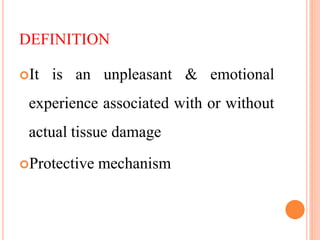
DEFINITION
It is an unpleasant & emotional
experience associated with or without
actual tissue damage
Protective mechanism
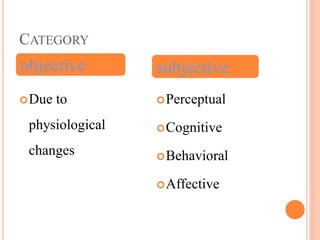
CATEGORY
Due to
physiological
changes
Perceptual
Cognitive
Behavioral
Affective
objective subjective
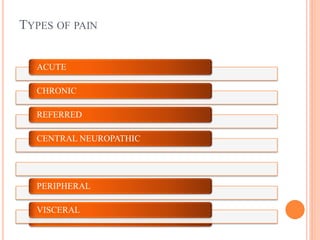
TYPES OF PAIN
ACUTE
CHRONIC
REFERRED
CENTRAL NEUROPATHIC
AUTONOMIC
PERIPHERAL
VISCERAL
ACUTE PAIN
 Normal predicted physiological response
 Serves as a warning
 Alert- tissues are exposed to damaging
 Localized pain
 Directly proportional to the intensity of stimuli
 It lasts as long as tissue damage exist
 Upto 3 months
CHRONIC PAIN
 Persists 3-6 months
 Pain continues after the stimulus has been removed
or tissue damage heals
 Results from hypersensitization of the pain receptors
& enlargement of the receptor field in response to
the localized inflammation that follows the tissue
damage
 Poorly localized
REFERRED PAIN
 Pain location other than its origin
 It follows specific pattern
 Results of a convergence of the primary afferent
neurons from deep structures & muscles to
secondary neurons that also have a cutaneous
receptive field
CENTRAL NEUROPATHIC PAIN
 Due to primary lesion or dysfunction of CNS
 Levels – nerve,
nerve root
central pain pathway in BRAIN/SC
 Onset may occur during the phase of recovery
from neurological deficit
 Eg., allodynia , dysesthesia
PERIPHERAL PAIN
Due to noxious irritation of the
nociceptors
It depends on the intensity of the stimulus
& types of the fibers carry the info into
dorsal gray matter i.e. A delta and C
AUTONOMIC PAIN
arises from the abnormal activity within
ANS
Eg. CRPS
VISCERAL PAIN
 It results from the activation of the thoracic,
pelvic or abdominal viscera
 Pain is diffuse, difficult to localize
 Eg. Appendicitis, gallstone, pelvic pain
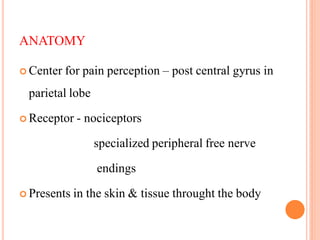
ANATOMY
 Center for pain perception – post central gyrus in
parietal lobe
 Receptor - nociceptors
specialized peripheral free nerve
endings
 Presents in the skin & tissue throught the body
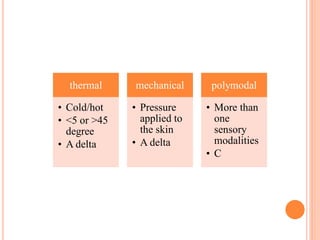
thermal
• Cold/hot
• <5 or >45
degree
• A delta
mechanical
• Pressure
applied to
the skin
• A delta
polymodal
• More than
one
sensory
modalities
• C
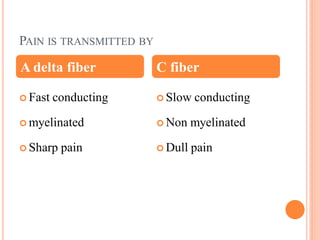
PAIN IS TRANSMITTED BY
 Fast conducting
 myelinated
 Sharp pain
 Slow conducting
 Non myelinated
 Dull pain
A delta fiber C fiber
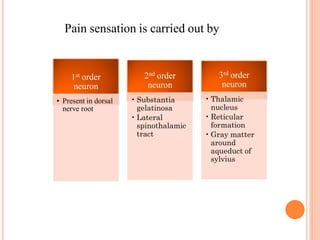
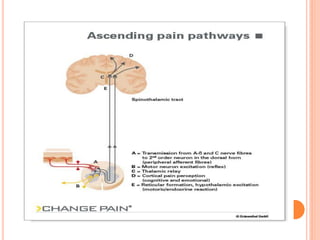
Pain sensation is carried out by
1st order
neuron
• Present in dorsal
nerve root
2nd order
neuron
• Substantia
gelatinosa
• Lateral
spinothalamic
tract
3rd order
neuron
• Thalamic
nucleus
• Reticular
formation
• Gray matter
around
aqueduct of
sylvius
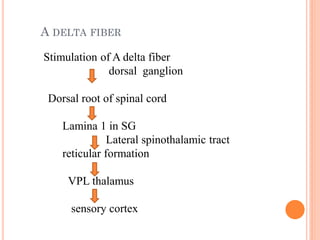
A DELTA FIBER
Stimulation of A delta fiber
dorsal ganglion
Dorsal root of spinal cord
Lamina 1 in SG
Lateral spinothalamic tract
reticular formation
VPL thalamus
sensory cortex
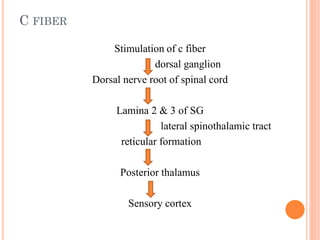
C FIBER
Stimulation of c fiber
dorsal ganglion
Dorsal nerve root of spinal cord
Lamina 2 & 3 of SG
lateral spinothalamic tract
reticular formation
Posterior thalamus
Sensory cortex
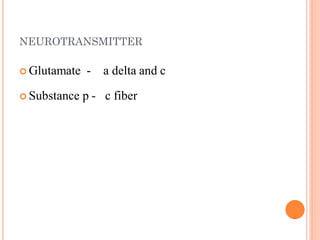
NEUROTRANSMITTER
 Glutamate - a delta and c
 Substance p - c fiber
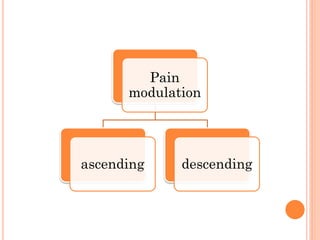
Pain
modulation
ascending descending
ASCENDING PATHWAY
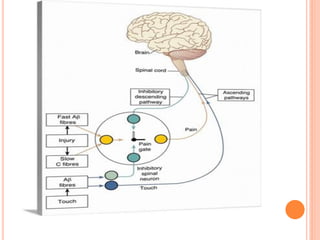
 Pain gate theory
 Melzack & wall 1965
 Process ocuur in SG
 T cells inhibited by Aβ by mechanoreceptors
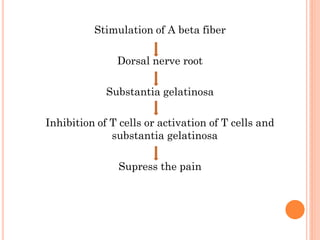
Stimulation of A beta fiber
Dorsal nerve root
Substantia gelatinosa
Inhibition of T cells or activation of T cells and
substantia gelatinosa
Supress the pain
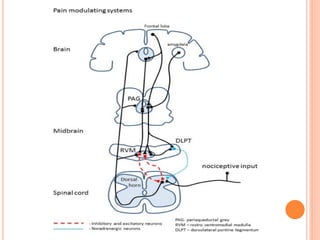
DESCENDING PATHWAY
 Supraspinal pain supression system
 It involves the action of neurotransmitter and
neuro modulator
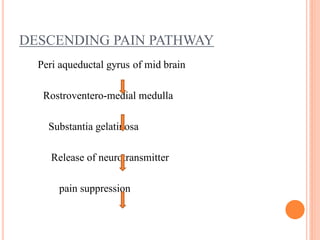
DESCENDING PAIN PATHWAY
Peri aqueductal gyrus of mid brain
Rostroventero-medial medulla
Substantia gelatinosa
Release of neurotransmitter
pain suppression
EXAMINATION OF PATIENT
OPQRST
OBSERVATION : entry to exit
gait
movement
ONSET : mechanism
how starts
date of onset
POSITION : location
PATTERN : constant /periodic
PAF/PRF
Improving/worsening
QUALITY : type of pain
QUANTITY : intensity
RADIATION :
SIGN & SYMPTOMS : Is pain affect ADL ?
how?
TREATMENT : any previous or present
medical or therapeutic treatment and its
effectiveness
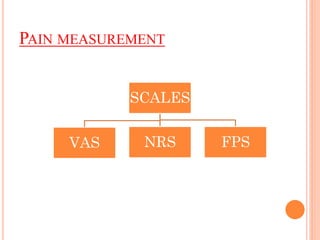
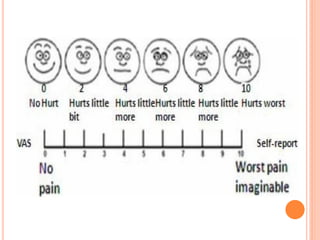
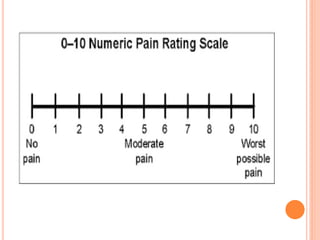
PAIN MEASUREMENT
SCALES
VAS NRS FPS
INTERPRETATION
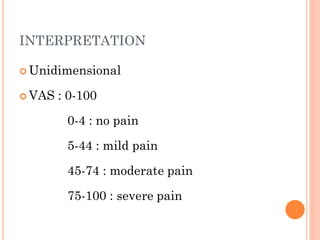
 Unidimensional
 VAS : 0-100
0-4 : no pain
5-44 : mild pain
45-74 : moderate pain
75-100 : severe pain
INTERPRETATION
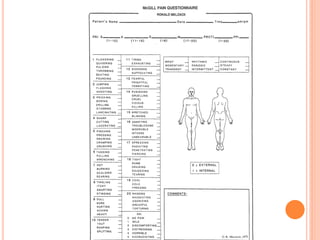
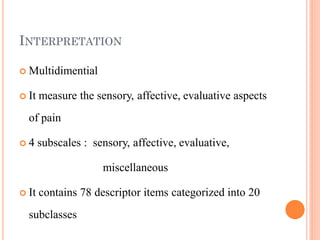
 Multidimential
 It measure the sensory, affective, evaluative aspects
of pain
 4 subscales : sensory, affective, evaluative,
miscellaneous
 It contains 78 descriptor items categorized into 20
subclasses
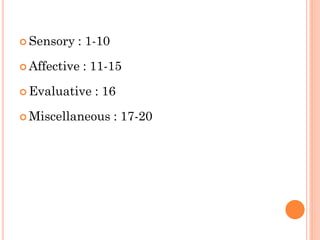
 Sensory : 1-10
 Affective : 11-15
 Evaluative : 16
 Miscellaneous : 17-20
.
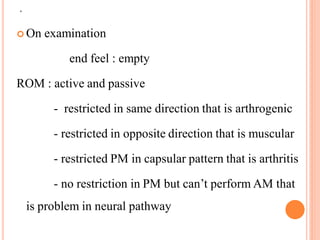
 On examination
end feel : empty
ROM : active and passive
- restricted in same direction that is arthrogenic
- restricted in opposite direction that is muscular
- restricted PM in capsular pattern that is arthritis
- no restriction in PM but can’t perform AM that
is problem in neural pathway
 Muscle strength
- movt is strong but painful : minor lesion in
muscle
- movt is weak & painful : major lesion
- movt is weak but doesn’t increase Pain
: complete tear or neurological
problem
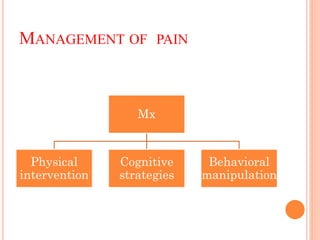
MANAGEMENT OF PAIN
Mx
Physical
intervention
Cognitive
strategies
Behavioral
manipulation
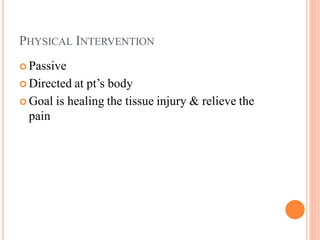
PHYSICAL INTERVENTION
 Passive
 Directed at pt’s body
 Goal is healing the tissue injury & relieve the
pain
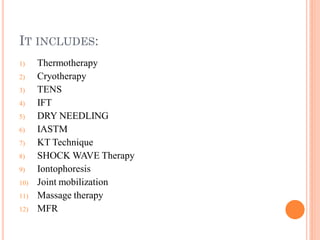
IT INCLUDES:
1) Thermotherapy
2) Cryotherapy
3) TENS
4) IFT
5) DRY NEEDLING
6) IASTM
7) KT Technique
8) SHOCK WAVE Therapy
9) Iontophoresis
10) Joint mobilization
11) Massage therapy
12) MFR
THERMOTHERAPY
 Physiological effects :
1. pain relieve
2. reduce spasm
3. promote healing
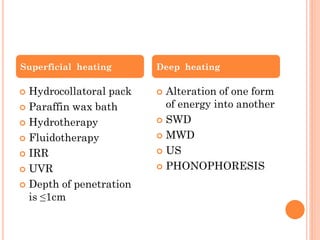
 Hydrocollatoral pack
 Paraffin wax bath
 Hydrotherapy
 Fluidotherapy
 IRR
 UVR
 Depth of penetration
is ≤1cm
 Alteration of one form
of energy into another
 SWD
 MWD
 US
 PHONOPHORESIS
Superficial heating Deep heating
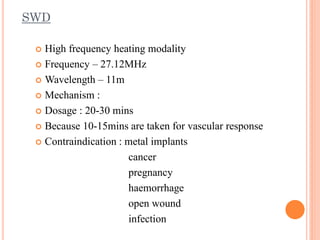
SWD
 High frequency heating modality
 Frequency – 27.12MHz
 Wavelength – 11m
 Mechanism :
 Dosage : 20-30 mins
 Because 10-15mins are taken for vascular response
 Contraindication : metal implants
cancer
pregnancy
haemorrhage
open wound
infection
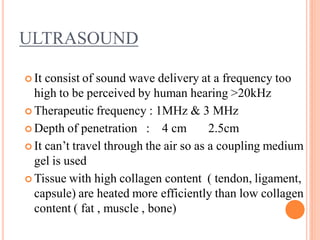
ULTRASOUND
 It consist of sound wave delivery at a frequency too
high to be perceived by human hearing >20kHz
 Therapeutic frequency : 1MHz & 3 MHz
 Depth of penetration : 4 cm 2.5cm
 It can’t travel through the air so as a coupling medium
gel is used
 Tissue with high collagen content ( tendon, ligament,
capsule) are heated more efficiently than low collagen
content ( fat , muscle , bone)
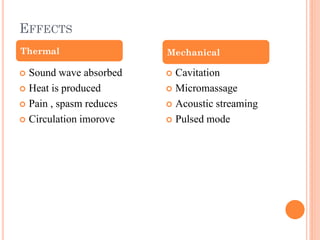
EFFECTS
 Sound wave absorbed
 Heat is produced
 Pain , spasm reduces
 Circulation imorove
 Cavitation
 Micromassage
 Acoustic streaming
 Pulsed mode
Thermal Mechanical
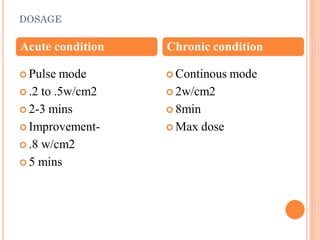
DOSAGE
 Pulse mode
 .2 to .5w/cm2
 2-3 mins
 Improvement-
 .8 w/cm2
 5 mins
 Continous mode
 2w/cm2
 8min
 Max dose
Acute condition Chronic condition
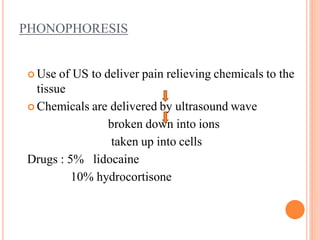
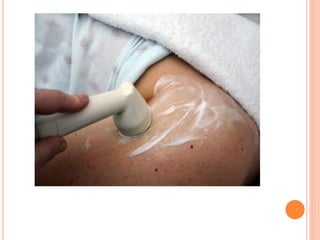
PHONOPHORESIS
 Use of US to deliver pain relieving chemicals to the
tissue
 Chemicals are delivered by ultrasound wave
broken down into ions
taken up into cells
Drugs : 5% lidocaine
10% hydrocortisone
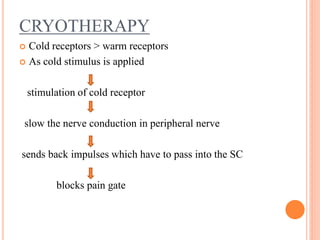
CRYOTHERAPY
 Cold receptors > warm receptors
 As cold stimulus is applied
stimulation of cold receptor
slow the nerve conduction in peripheral nerve
sends back impulses which have to pass into the SC
blocks pain gate
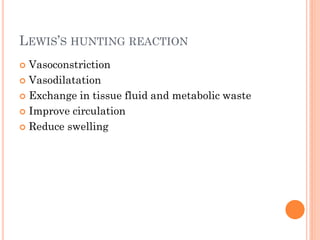
LEWIS’S HUNTING REACTION
 Vasoconstriction
 Vasodilatation
 Exchange in tissue fluid and metabolic waste
 Improve circulation
 Reduce swelling
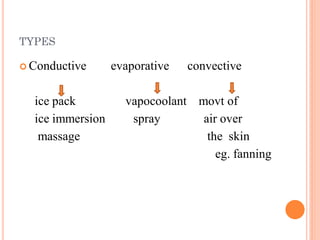
TYPES
 Conductive evaporative convective
ice pack vapocoolant movt of
ice immersion spray air over
massage the skin
eg. fanning
TENS
 Transcutaneous electrical nerve stimulation
 Used to control the pain perception
 3 types : high TENS
low TENS
burst TENS
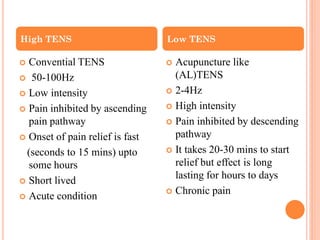
 Convential TENS
 50-100Hz
 Low intensity
 Pain inhibited by ascending
pain pathway
 Onset of pain relief is fast
(seconds to 15 mins) upto
some hours
 Short lived
 Acute condition
 Acupuncture like
(AL)TENS
 2-4Hz
 High intensity
 Pain inhibited by descending
pathway
 It takes 20-30 mins to start
relief but effect is long
lasting for hours to days
 Chronic pain
High TENS Low TENS
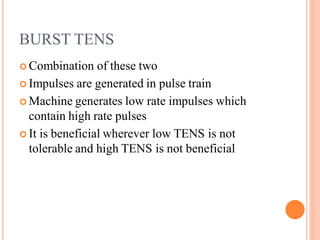
BURST TENS
 Combination of these two
 Impulses are generated in pulse train
 Machine generates low rate impulses which
contain high rate pulses
 It is beneficial wherever low TENS is not
tolerable and high TENS is not beneficial
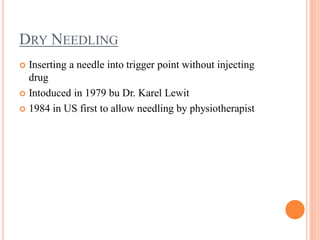
DRY NEEDLING
 Inserting a needle into trigger point without injecting
drug
 Intoduced in 1979 bu Dr. Karel Lewit
 1984 in US first to allow needling by physiotherapist
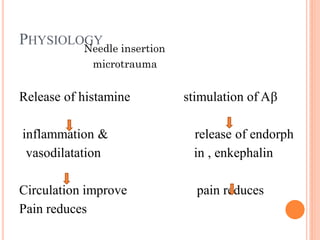
PHYSIOLOGY
Needle insertion
microtrauma
Release of histamine stimulation of Aβ
inflammation & release of endorph
vasodilatation in , enkephalin
Circulation improve pain reduces
Pain reduces
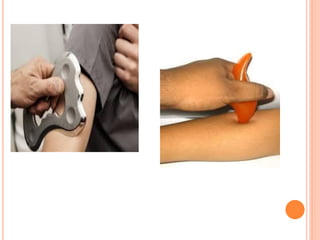
IASTM
 Instrument assisted soft tissue mobilization
 It is introduced by James Cyriax
 Concept of soft tissue mobilization, mechanical
loading & fibroblast production
 It is applied by using specially design instrument
 It helps in release soft tissur, adhesion, fascial
restriction
 Study shows , Duration : 2 session per week for 2-6
weeks
SHOCK WAVE THERAPY
 It is an acoustic wave which carries high energy to
painful spot and myoskeletal tissue
 Energy promotes regeneration & reparative process of
bone, soft tissue & tendon
 It acts by 3 mechanism:
- new blood vessel formation
- dispersion of substance p
- release trigger point
New blood vessels : microrupture of vessels
- expression of growth factor
- helps in arteriole remodeling
- increase blood and O2 supply
Dispersion of substance P :
- it lower the level of substance P
- reduces pain
Release trigger point:
acoustic energy break ca++ channel
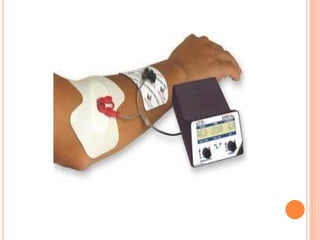
IONTOPHORESIS
 Process in which chemical ions are drive through the
skin by a small electrical current(direct current)
 Ions are placed on the skin under the electrode
 ions are charged and free to combine with
physiological ions
physiological effect starts
 Drugs are used:
1) 5% lidocaine ointment
-short lived immediate effect
- pain reduce
2) 1-10% hydrocortisone & dexamethasone
- relieve inflammatory pain
3) 2% magnesium
- relieve pain of muscle spasm
- by inhibit muscle contraction
4)Iodine ointment
-pain reduce from adhesion
5)salicylate
- reduces inflammatory pain
JOINT MOBILIZATION
 It is passive oscillation
 It works by improving blood supply to the joint
- altering activity in nervous system
- stretching the joint structure
 Maitland oscillatory mobilization
grade 1 and 2 is used for pain relief
G1-rhythmic oscillatory movt in initial range
G2- rhythmic oscillatory movt within available
range
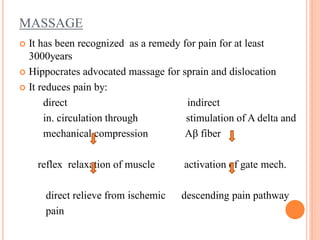
MASSAGE
 It has been recognized as a remedy for pain for at least
3000years
 Hippocrates advocated massage for sprain and dislocation
 It reduces pain by:
direct indirect
in. circulation through stimulation of A delta and
mechanical compression Aβ fiber
reflex relaxation of muscle activation of gate mech.
direct relieve from ischemic descending pain pathway
pain
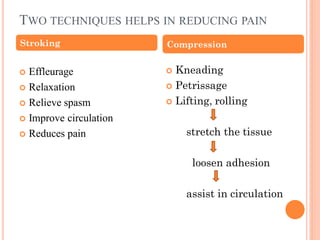
TWO TECHNIQUES HELPS IN REDUCING PAIN
 Effleurage
 Relaxation
 Relieve spasm
 Improve circulation
 Reduces pain
 Kneading
 Petrissage
 Lifting, rolling
stretch the tissue
loosen adhesion
assist in circulation
Stroking Compression
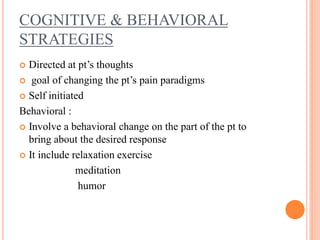
COGNITIVE & BEHAVIORAL
STRATEGIES
 Directed at pt’s thoughts
 goal of changing the pt’s pain paradigms
 Self initiated
Behavioral :
 Involve a behavioral change on the part of the pt to
bring about the desired response
 It include relaxation exercise
meditation
humor
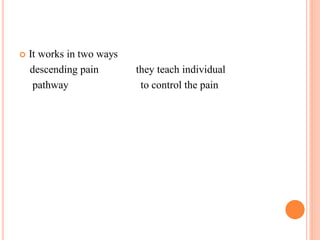
 It works in two ways
descending pain they teach individual
pathway to control the pain
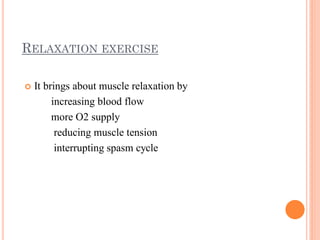
RELAXATION EXERCISE
 It brings about muscle relaxation by
increasing blood flow
more O2 supply
reducing muscle tension
interrupting spasm cycle
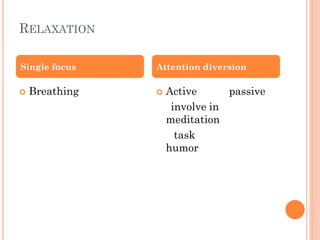
RELAXATION
 Breathing  Active passive
involve in
meditation
task
humor
Single focus Attention diversion
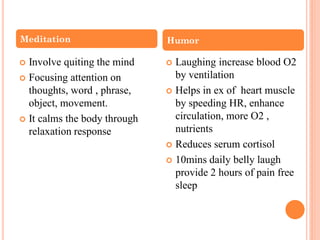
 Involve quiting the mind
 Focusing attention on
thoughts, word , phrase,
object, movement.
 It calms the body through
relaxation response
 Laughing increase blood O2
by ventilation
 Helps in ex of heart muscle
by speeding HR, enhance
circulation, more O2 ,
nutrients
 Reduces serum cortisol
 10mins daily belly laugh
provide 2 hours of pain free
sleep
Meditation Humor
REFERENCES
1. UMPHRED’S NEUROLOGICAL REHABILITATION, SIXTH
EDITION
2. ELECTROTHERAPY EXPLAINED
PRINCIPLES AND PRACTICE, FOURTH EDITION
3. CLAYTON’S ELECTROTHERAPY, EIGHTH EDITION
4. INTERNATIONAL JOURNAL OF SPORTS PHYSICAL
THERAPY
5. THE JOURNAL OF THE CANADIAN CHIROPRACTIC
ASSOCIATION
6. THE PHYSICIAN AND SPORTSMEDICINE 42(2) : 48-57
7. THE JOURNAL OF BONE AND JOINT SURGERY
8. ARTHRITIS CARE & RESEARCH / VOLUME 63, ISSUE S11
Pain and its  management

Pain and its management

  • 1.
  • 2.
     Definition  Types Pain pathway  Pain modulation  Assessment  Treatment
  • 3.
    DEFINITION It is anunpleasant & emotional experience associated with or without actual tissue damage Protective mechanism
  • 4.
  • 5.
    TYPES OF PAIN ACUTE CHRONIC REFERRED CENTRALNEUROPATHIC AUTONOMIC PERIPHERAL VISCERAL
  • 6.
    ACUTE PAIN  Normalpredicted physiological response  Serves as a warning  Alert- tissues are exposed to damaging  Localized pain  Directly proportional to the intensity of stimuli  It lasts as long as tissue damage exist  Upto 3 months
  • 7.
    CHRONIC PAIN  Persists3-6 months  Pain continues after the stimulus has been removed or tissue damage heals  Results from hypersensitization of the pain receptors & enlargement of the receptor field in response to the localized inflammation that follows the tissue damage  Poorly localized
  • 8.
    REFERRED PAIN  Painlocation other than its origin  It follows specific pattern  Results of a convergence of the primary afferent neurons from deep structures & muscles to secondary neurons that also have a cutaneous receptive field
  • 9.
    CENTRAL NEUROPATHIC PAIN Due to primary lesion or dysfunction of CNS  Levels – nerve, nerve root central pain pathway in BRAIN/SC  Onset may occur during the phase of recovery from neurological deficit  Eg., allodynia , dysesthesia
  • 10.
    PERIPHERAL PAIN Due tonoxious irritation of the nociceptors It depends on the intensity of the stimulus & types of the fibers carry the info into dorsal gray matter i.e. A delta and C
  • 11.
    AUTONOMIC PAIN arises fromthe abnormal activity within ANS Eg. CRPS
  • 12.
    VISCERAL PAIN  Itresults from the activation of the thoracic, pelvic or abdominal viscera  Pain is diffuse, difficult to localize  Eg. Appendicitis, gallstone, pelvic pain
  • 13.
    ANATOMY  Center forpain perception – post central gyrus in parietal lobe  Receptor - nociceptors specialized peripheral free nerve endings  Presents in the skin & tissue throught the body
  • 14.
    thermal • Cold/hot • <5or >45 degree • A delta mechanical • Pressure applied to the skin • A delta polymodal • More than one sensory modalities • C
  • 15.
    PAIN IS TRANSMITTEDBY  Fast conducting  myelinated  Sharp pain  Slow conducting  Non myelinated  Dull pain A delta fiber C fiber
  • 16.
    Pain sensation iscarried out by 1st order neuron • Present in dorsal nerve root 2nd order neuron • Substantia gelatinosa • Lateral spinothalamic tract 3rd order neuron • Thalamic nucleus • Reticular formation • Gray matter around aqueduct of sylvius
  • 18.
    A DELTA FIBER Stimulationof A delta fiber dorsal ganglion Dorsal root of spinal cord Lamina 1 in SG Lateral spinothalamic tract reticular formation VPL thalamus sensory cortex
  • 19.
    C FIBER Stimulation ofc fiber dorsal ganglion Dorsal nerve root of spinal cord Lamina 2 & 3 of SG lateral spinothalamic tract reticular formation Posterior thalamus Sensory cortex
  • 20.
    NEUROTRANSMITTER  Glutamate -a delta and c  Substance p - c fiber
  • 21.
  • 22.
    ASCENDING PATHWAY  Paingate theory  Melzack & wall 1965  Process ocuur in SG  T cells inhibited by Aβ by mechanoreceptors
  • 23.
    Stimulation of Abeta fiber Dorsal nerve root Substantia gelatinosa Inhibition of T cells or activation of T cells and substantia gelatinosa Supress the pain
  • 25.
    DESCENDING PATHWAY  Supraspinalpain supression system  It involves the action of neurotransmitter and neuro modulator
  • 26.
    DESCENDING PAIN PATHWAY Periaqueductal gyrus of mid brain Rostroventero-medial medulla Substantia gelatinosa Release of neurotransmitter pain suppression
  • 28.
    EXAMINATION OF PATIENT OPQRST OBSERVATION: entry to exit gait movement ONSET : mechanism how starts date of onset POSITION : location PATTERN : constant /periodic PAF/PRF Improving/worsening QUALITY : type of pain
  • 29.
    QUANTITY : intensity RADIATION: SIGN & SYMPTOMS : Is pain affect ADL ? how? TREATMENT : any previous or present medical or therapeutic treatment and its effectiveness
  • 30.
  • 33.
    INTERPRETATION  Unidimensional  VAS: 0-100 0-4 : no pain 5-44 : mild pain 45-74 : moderate pain 75-100 : severe pain
  • 35.
    INTERPRETATION  Multidimential  Itmeasure the sensory, affective, evaluative aspects of pain  4 subscales : sensory, affective, evaluative, miscellaneous  It contains 78 descriptor items categorized into 20 subclasses
  • 36.
     Sensory :1-10  Affective : 11-15  Evaluative : 16  Miscellaneous : 17-20
  • 37.
    .  On examination endfeel : empty ROM : active and passive - restricted in same direction that is arthrogenic - restricted in opposite direction that is muscular - restricted PM in capsular pattern that is arthritis - no restriction in PM but can’t perform AM that is problem in neural pathway
  • 38.
     Muscle strength -movt is strong but painful : minor lesion in muscle - movt is weak & painful : major lesion - movt is weak but doesn’t increase Pain : complete tear or neurological problem
  • 39.
  • 40.
    PHYSICAL INTERVENTION  Passive Directed at pt’s body  Goal is healing the tissue injury & relieve the pain
  • 41.
    IT INCLUDES: 1) Thermotherapy 2)Cryotherapy 3) TENS 4) IFT 5) DRY NEEDLING 6) IASTM 7) KT Technique 8) SHOCK WAVE Therapy 9) Iontophoresis 10) Joint mobilization 11) Massage therapy 12) MFR
  • 42.
    THERMOTHERAPY  Physiological effects: 1. pain relieve 2. reduce spasm 3. promote healing
  • 43.
     Hydrocollatoral pack Paraffin wax bath  Hydrotherapy  Fluidotherapy  IRR  UVR  Depth of penetration is ≤1cm  Alteration of one form of energy into another  SWD  MWD  US  PHONOPHORESIS Superficial heating Deep heating
  • 44.
    SWD  High frequencyheating modality  Frequency – 27.12MHz  Wavelength – 11m  Mechanism :  Dosage : 20-30 mins  Because 10-15mins are taken for vascular response  Contraindication : metal implants cancer pregnancy haemorrhage open wound infection
  • 45.
    ULTRASOUND  It consistof sound wave delivery at a frequency too high to be perceived by human hearing >20kHz  Therapeutic frequency : 1MHz & 3 MHz  Depth of penetration : 4 cm 2.5cm  It can’t travel through the air so as a coupling medium gel is used  Tissue with high collagen content ( tendon, ligament, capsule) are heated more efficiently than low collagen content ( fat , muscle , bone)
  • 46.
    EFFECTS  Sound waveabsorbed  Heat is produced  Pain , spasm reduces  Circulation imorove  Cavitation  Micromassage  Acoustic streaming  Pulsed mode Thermal Mechanical
  • 47.
    DOSAGE  Pulse mode .2 to .5w/cm2  2-3 mins  Improvement-  .8 w/cm2  5 mins  Continous mode  2w/cm2  8min  Max dose Acute condition Chronic condition
  • 48.
    PHONOPHORESIS  Use ofUS to deliver pain relieving chemicals to the tissue  Chemicals are delivered by ultrasound wave broken down into ions taken up into cells Drugs : 5% lidocaine 10% hydrocortisone
  • 50.
    CRYOTHERAPY  Cold receptors> warm receptors  As cold stimulus is applied stimulation of cold receptor slow the nerve conduction in peripheral nerve sends back impulses which have to pass into the SC blocks pain gate
  • 51.
    LEWIS’S HUNTING REACTION Vasoconstriction  Vasodilatation  Exchange in tissue fluid and metabolic waste  Improve circulation  Reduce swelling
  • 52.
    TYPES  Conductive evaporativeconvective ice pack vapocoolant movt of ice immersion spray air over massage the skin eg. fanning
  • 53.
    TENS  Transcutaneous electricalnerve stimulation  Used to control the pain perception  3 types : high TENS low TENS burst TENS
  • 54.
     Convential TENS 50-100Hz  Low intensity  Pain inhibited by ascending pain pathway  Onset of pain relief is fast (seconds to 15 mins) upto some hours  Short lived  Acute condition  Acupuncture like (AL)TENS  2-4Hz  High intensity  Pain inhibited by descending pathway  It takes 20-30 mins to start relief but effect is long lasting for hours to days  Chronic pain High TENS Low TENS
  • 55.
    BURST TENS  Combinationof these two  Impulses are generated in pulse train  Machine generates low rate impulses which contain high rate pulses  It is beneficial wherever low TENS is not tolerable and high TENS is not beneficial
  • 56.
    DRY NEEDLING  Insertinga needle into trigger point without injecting drug  Intoduced in 1979 bu Dr. Karel Lewit  1984 in US first to allow needling by physiotherapist
  • 57.
    PHYSIOLOGY Needle insertion microtrauma Release ofhistamine stimulation of Aβ inflammation & release of endorph vasodilatation in , enkephalin Circulation improve pain reduces Pain reduces
  • 58.
    IASTM  Instrument assistedsoft tissue mobilization  It is introduced by James Cyriax  Concept of soft tissue mobilization, mechanical loading & fibroblast production  It is applied by using specially design instrument  It helps in release soft tissur, adhesion, fascial restriction  Study shows , Duration : 2 session per week for 2-6 weeks
  • 60.
    SHOCK WAVE THERAPY It is an acoustic wave which carries high energy to painful spot and myoskeletal tissue  Energy promotes regeneration & reparative process of bone, soft tissue & tendon  It acts by 3 mechanism: - new blood vessel formation - dispersion of substance p - release trigger point
  • 62.
    New blood vessels: microrupture of vessels - expression of growth factor - helps in arteriole remodeling - increase blood and O2 supply Dispersion of substance P : - it lower the level of substance P - reduces pain Release trigger point: acoustic energy break ca++ channel
  • 63.
    IONTOPHORESIS  Process inwhich chemical ions are drive through the skin by a small electrical current(direct current)  Ions are placed on the skin under the electrode  ions are charged and free to combine with physiological ions physiological effect starts
  • 65.
     Drugs areused: 1) 5% lidocaine ointment -short lived immediate effect - pain reduce 2) 1-10% hydrocortisone & dexamethasone - relieve inflammatory pain 3) 2% magnesium - relieve pain of muscle spasm - by inhibit muscle contraction 4)Iodine ointment -pain reduce from adhesion 5)salicylate - reduces inflammatory pain
  • 66.
    JOINT MOBILIZATION  Itis passive oscillation  It works by improving blood supply to the joint - altering activity in nervous system - stretching the joint structure  Maitland oscillatory mobilization grade 1 and 2 is used for pain relief G1-rhythmic oscillatory movt in initial range G2- rhythmic oscillatory movt within available range
  • 67.
    MASSAGE  It hasbeen recognized as a remedy for pain for at least 3000years  Hippocrates advocated massage for sprain and dislocation  It reduces pain by: direct indirect in. circulation through stimulation of A delta and mechanical compression Aβ fiber reflex relaxation of muscle activation of gate mech. direct relieve from ischemic descending pain pathway pain
  • 68.
    TWO TECHNIQUES HELPSIN REDUCING PAIN  Effleurage  Relaxation  Relieve spasm  Improve circulation  Reduces pain  Kneading  Petrissage  Lifting, rolling stretch the tissue loosen adhesion assist in circulation Stroking Compression
  • 69.
    COGNITIVE & BEHAVIORAL STRATEGIES Directed at pt’s thoughts  goal of changing the pt’s pain paradigms  Self initiated Behavioral :  Involve a behavioral change on the part of the pt to bring about the desired response  It include relaxation exercise meditation humor
  • 70.
     It worksin two ways descending pain they teach individual pathway to control the pain
  • 71.
    RELAXATION EXERCISE  Itbrings about muscle relaxation by increasing blood flow more O2 supply reducing muscle tension interrupting spasm cycle
  • 72.
    RELAXATION  Breathing Active passive involve in meditation task humor Single focus Attention diversion
  • 73.
     Involve quitingthe mind  Focusing attention on thoughts, word , phrase, object, movement.  It calms the body through relaxation response  Laughing increase blood O2 by ventilation  Helps in ex of heart muscle by speeding HR, enhance circulation, more O2 , nutrients  Reduces serum cortisol  10mins daily belly laugh provide 2 hours of pain free sleep Meditation Humor
  • 74.
    REFERENCES 1. UMPHRED’S NEUROLOGICALREHABILITATION, SIXTH EDITION 2. ELECTROTHERAPY EXPLAINED PRINCIPLES AND PRACTICE, FOURTH EDITION 3. CLAYTON’S ELECTROTHERAPY, EIGHTH EDITION 4. INTERNATIONAL JOURNAL OF SPORTS PHYSICAL THERAPY 5. THE JOURNAL OF THE CANADIAN CHIROPRACTIC ASSOCIATION 6. THE PHYSICIAN AND SPORTSMEDICINE 42(2) : 48-57 7. THE JOURNAL OF BONE AND JOINT SURGERY 8. ARTHRITIS CARE & RESEARCH / VOLUME 63, ISSUE S11