1
Pathophysiology
Pain Unit:VI
Amjad Ali
Assistant Professor
02.10.2021
2
Outlines:
• Review the concept of somatosensory pathway.
• Describe the function of Nociceptors in response
to pain information.
• Describe the function of endogenous analgesic
mechanism as they relate to transmission of pain
information.
• Describe the proposed mechanism of pain relief
associated with the use of heat, cold and tense
i.e. transcutaneous electrical nerve impulses.
3
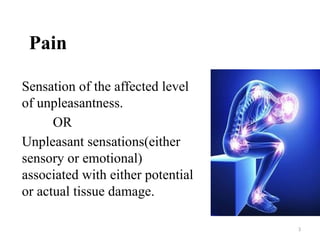
Pain
Sensation of the affected level
of unpleasantness.
OR
Unpleasant sensations(either
sensory or emotional)
associated with either potential
or actual tissue damage.
4
TYPES OF PAIN
• The most widely accepted
classifications of pain are according
to source or location, referral, and
duration (acute or chronic).
• Classification based on associated
medical diagnosis (e.g., surgery,
trauma, cancer, sickle cell disease,
fibromyalgia) is useful in planning
appropriate interventions.
5
Cont….
• Cutaneous pain is a sharp, burning pain that
has its origin in the skin or subcutaneous
tissues.
• Deep pain is a more diffuse and throbbing
pain that originates in structures such as the
muscles, bones, and tendons and radiates to
the surrounding tissues
6
Cont…
• Visceral pain is a diffuse and poorly defined
pain that results from stretching, distention, or
ischemia of tissues in a body organ.
• Acute pain is a self-limiting pain that lasts
less than 6 months.
7
Cont…
Chronic pain is persistent pain that lasts
longer than 6 months, lacks the autonomic and
somatic responses associated with acute pain,
and is accompanied by loss of appetite, sleep
disturbances, depression, and other debilitating
responses.
8
Cont…
• Referred pain is pain that originates at a
visceral site but is perceived as originating in
part of the body wall that is innervated by
neurons entering the same segment of the
nervous system.
9
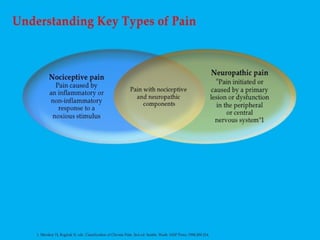
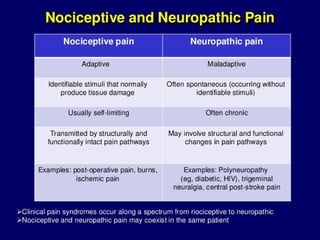
Types
• Nociceptive
• Neuropathic Pain
10
Pain categories
1. Somatogenic pain is pain with cause (usually known)
localised in the body tissue
a/ nociceptive pain
b/ neuropatic pain
2. Psychogenic pain is pain for which there is no known
physical cause but processing of sensitive information
in CNS is disturbed.
11
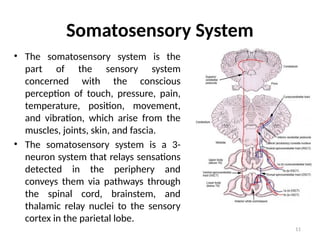
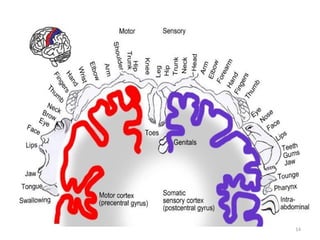
Somatosensory System
• The somatosensory system is the
part of the sensory system
concerned with the conscious
perception of touch, pressure, pain,
temperature, position, movement,
and vibration, which arise from the
muscles, joints, skin, and fascia.
• The somatosensory system is a 3-
neuron system that relays sensations
detected in the periphery and
conveys them via pathways through
the spinal cord, brainstem, and
thalamic relay nuclei to the sensory
cortex in the parietal lobe.
12
Cont..
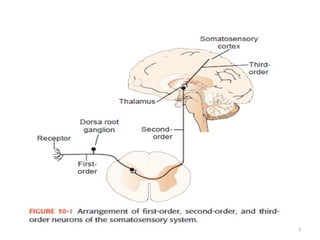
Somatosensory information is sequentially transmitted
over three types of neurons:
• First-order neurons, which transmit information from
sensory receptors to dorsal horn neurons;
• Second-order CNS association neurons, which
communicate with various reflex circuits and transmit
information to the thalamus;
• Third-order neurons, which forward the information
from the thalamus to the sensory cortex.
13
14
15
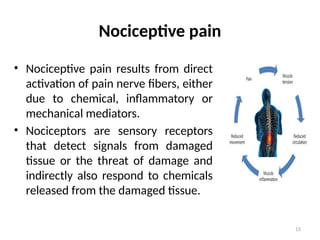
Nociceptive pain
• Nociceptive pain results from direct
activation of pain nerve fibers, either
due to chemical, inflammatory or
mechanical mediators.
• Nociceptors are sensory receptors
that detect signals from damaged
tissue or the threat of damage and
indirectly also respond to chemicals
released from the damaged tissue.
16
Cont.….
• Nociceptors are free nerve endings found in the skin,
muscle, joints, bone and viscera.
• Nerve endings contain transient receptor potential
(TRP) channels that sense and detect damage.
• They transduce a variety of noxious stimuli into
receptor potentials, which in turn initiate action
potential in the pain nerve fibers.
17
Cont.…..
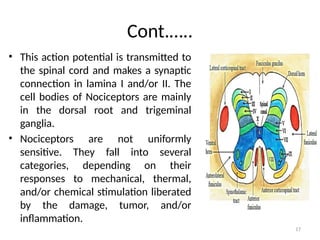
• This action potential is transmitted to
the spinal cord and makes a synaptic
connection in lamina I and/or II. The
cell bodies of Nociceptors are mainly
in the dorsal root and trigeminal
ganglia.
• Nociceptors are not uniformly
sensitive. They fall into several
categories, depending on their
responses to mechanical, thermal,
and/or chemical stimulation liberated
by the damage, tumor, and/or
inflammation.
18
19
20
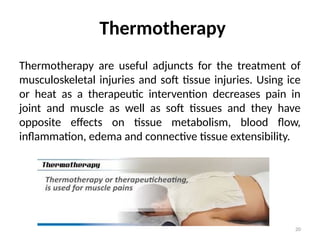
Thermotherapy
Thermotherapy are useful adjuncts for the treatment of
musculoskeletal injuries and soft tissue injuries. Using ice
or heat as a therapeutic intervention decreases pain in
joint and muscle as well as soft tissues and they have
opposite effects on tissue metabolism, blood flow,
inflammation, edema and connective tissue extensibility.
21
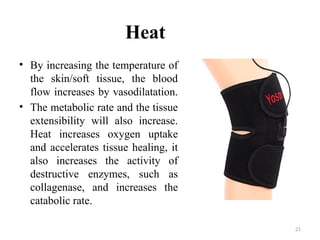
Heat
• By increasing the temperature of
the skin/soft tissue, the blood
flow increases by vasodilatation.
• The metabolic rate and the tissue
extensibility will also increase.
Heat increases oxygen uptake
and accelerates tissue healing, it
also increases the activity of
destructive enzymes, such as
collagenase, and increases the
catabolic rate.
22
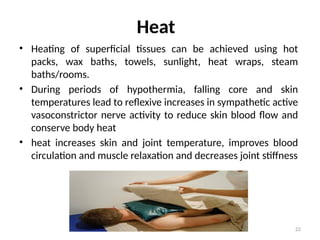
Heat
• Heating of superficial tissues can be achieved using hot
packs, wax baths, towels, sunlight, heat wraps, steam
baths/rooms.
• During periods of hypothermia, falling core and skin
temperatures lead to reflexive increases in sympathetic active
vasoconstrictor nerve activity to reduce skin blood flow and
conserve body heat
• heat increases skin and joint temperature, improves blood
circulation and muscle relaxation and decreases joint stiffness
23
Cold
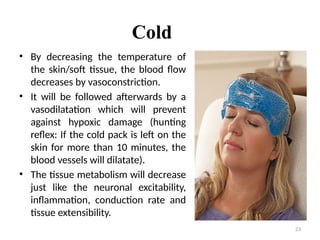
• By decreasing the temperature of
the skin/soft tissue, the blood flow
decreases by vasoconstriction.
• It will be followed afterwards by a
vasodilatation which will prevent
against hypoxic damage (hunting
reflex: If the cold pack is left on the
skin for more than 10 minutes, the
blood vessels will dilatate).
• The tissue metabolism will decrease
just like the neuronal excitability,
inflammation, conduction rate and
tissue extensibility.
24
Cold
• Cooling is achieved using ice packs, ice baths,
cooling gel packs, cold air and sprays.
• During periods of heat stress, increasing core
and skin temperatures lead to reflexive increases
in sympathetic active vasodilator nerve activity
to increase skin blood flow.
• Cold will numb the pain, decrease swelling,
constrict blood vessels and block nerve impulses
to the joint.
25
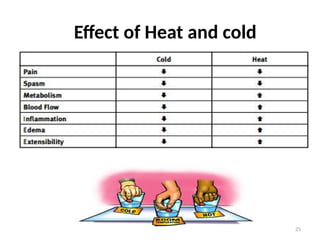
Effect of Heat and cold
26
Transcutaneous electrical nerve
stimulation (TENS):
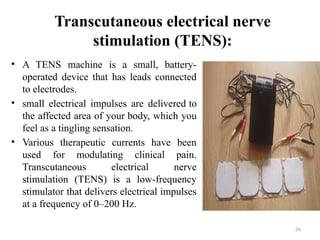
• A TENS machine is a small, battery-
operated device that has leads connected
to electrodes.
• small electrical impulses are delivered to
the affected area of your body, which you
feel as a tingling sensation.
• Various therapeutic currents have been
used for modulating clinical pain.
Transcutaneous electrical nerve
stimulation (TENS) is a low-frequency
stimulator that delivers electrical impulses
at a frequency of 0–200 Hz.
27
Transcutaneous electrical nerve stimulation
(TENS):
• The electrical impulses can block or reduce the
pain signals going to the spinal cord and brain,
which can help reduce or relieve pain or
muscle spasm.
• The electric currents can also stimulate the
production of endorphins, which are the body's
natural painkillers.
28
Cont.…
• It has been shown to be an effective treatment
modality for various types of musculoskeletal
pain, such as osteoarthritic knee, and chronic
low back pain.

29
30
References:
31

Pathophysiology Gen. Unit#03 (A) (1).pptx

  • 1.
  • 2.
    2 Outlines: • Review theconcept of somatosensory pathway. • Describe the function of Nociceptors in response to pain information. • Describe the function of endogenous analgesic mechanism as they relate to transmission of pain information. • Describe the proposed mechanism of pain relief associated with the use of heat, cold and tense i.e. transcutaneous electrical nerve impulses.
  • 3.
    3 Pain Sensation of theaffected level of unpleasantness. OR Unpleasant sensations(either sensory or emotional) associated with either potential or actual tissue damage.
  • 4.
    4 TYPES OF PAIN •The most widely accepted classifications of pain are according to source or location, referral, and duration (acute or chronic). • Classification based on associated medical diagnosis (e.g., surgery, trauma, cancer, sickle cell disease, fibromyalgia) is useful in planning appropriate interventions.
  • 5.
    5 Cont…. • Cutaneous painis a sharp, burning pain that has its origin in the skin or subcutaneous tissues. • Deep pain is a more diffuse and throbbing pain that originates in structures such as the muscles, bones, and tendons and radiates to the surrounding tissues
  • 6.
    6 Cont… • Visceral painis a diffuse and poorly defined pain that results from stretching, distention, or ischemia of tissues in a body organ. • Acute pain is a self-limiting pain that lasts less than 6 months.
  • 7.
    7 Cont… Chronic pain ispersistent pain that lasts longer than 6 months, lacks the autonomic and somatic responses associated with acute pain, and is accompanied by loss of appetite, sleep disturbances, depression, and other debilitating responses.
  • 8.
    8 Cont… • Referred painis pain that originates at a visceral site but is perceived as originating in part of the body wall that is innervated by neurons entering the same segment of the nervous system.
  • 9.
  • 10.
    10 Pain categories 1. Somatogenicpain is pain with cause (usually known) localised in the body tissue a/ nociceptive pain b/ neuropatic pain 2. Psychogenic pain is pain for which there is no known physical cause but processing of sensitive information in CNS is disturbed.
  • 11.
    11 Somatosensory System • Thesomatosensory system is the part of the sensory system concerned with the conscious perception of touch, pressure, pain, temperature, position, movement, and vibration, which arise from the muscles, joints, skin, and fascia. • The somatosensory system is a 3- neuron system that relays sensations detected in the periphery and conveys them via pathways through the spinal cord, brainstem, and thalamic relay nuclei to the sensory cortex in the parietal lobe.
  • 12.
    12 Cont.. Somatosensory information issequentially transmitted over three types of neurons: • First-order neurons, which transmit information from sensory receptors to dorsal horn neurons; • Second-order CNS association neurons, which communicate with various reflex circuits and transmit information to the thalamus; • Third-order neurons, which forward the information from the thalamus to the sensory cortex.
  • 13.
  • 14.
  • 15.
    15 Nociceptive pain • Nociceptivepain results from direct activation of pain nerve fibers, either due to chemical, inflammatory or mechanical mediators. • Nociceptors are sensory receptors that detect signals from damaged tissue or the threat of damage and indirectly also respond to chemicals released from the damaged tissue.
  • 16.
    16 Cont.…. • Nociceptors arefree nerve endings found in the skin, muscle, joints, bone and viscera. • Nerve endings contain transient receptor potential (TRP) channels that sense and detect damage. • They transduce a variety of noxious stimuli into receptor potentials, which in turn initiate action potential in the pain nerve fibers.
  • 17.
    17 Cont.….. • This actionpotential is transmitted to the spinal cord and makes a synaptic connection in lamina I and/or II. The cell bodies of Nociceptors are mainly in the dorsal root and trigeminal ganglia. • Nociceptors are not uniformly sensitive. They fall into several categories, depending on their responses to mechanical, thermal, and/or chemical stimulation liberated by the damage, tumor, and/or inflammation.
  • 18.
  • 19.
  • 20.
    20 Thermotherapy Thermotherapy are usefuladjuncts for the treatment of musculoskeletal injuries and soft tissue injuries. Using ice or heat as a therapeutic intervention decreases pain in joint and muscle as well as soft tissues and they have opposite effects on tissue metabolism, blood flow, inflammation, edema and connective tissue extensibility.
  • 21.
    21 Heat • By increasingthe temperature of the skin/soft tissue, the blood flow increases by vasodilatation. • The metabolic rate and the tissue extensibility will also increase. Heat increases oxygen uptake and accelerates tissue healing, it also increases the activity of destructive enzymes, such as collagenase, and increases the catabolic rate.
  • 22.
    22 Heat • Heating ofsuperficial tissues can be achieved using hot packs, wax baths, towels, sunlight, heat wraps, steam baths/rooms. • During periods of hypothermia, falling core and skin temperatures lead to reflexive increases in sympathetic active vasoconstrictor nerve activity to reduce skin blood flow and conserve body heat • heat increases skin and joint temperature, improves blood circulation and muscle relaxation and decreases joint stiffness
  • 23.
    23 Cold • By decreasingthe temperature of the skin/soft tissue, the blood flow decreases by vasoconstriction. • It will be followed afterwards by a vasodilatation which will prevent against hypoxic damage (hunting reflex: If the cold pack is left on the skin for more than 10 minutes, the blood vessels will dilatate). • The tissue metabolism will decrease just like the neuronal excitability, inflammation, conduction rate and tissue extensibility.
  • 24.
    24 Cold • Cooling isachieved using ice packs, ice baths, cooling gel packs, cold air and sprays. • During periods of heat stress, increasing core and skin temperatures lead to reflexive increases in sympathetic active vasodilator nerve activity to increase skin blood flow. • Cold will numb the pain, decrease swelling, constrict blood vessels and block nerve impulses to the joint.
  • 25.
  • 26.
    26 Transcutaneous electrical nerve stimulation(TENS): • A TENS machine is a small, battery- operated device that has leads connected to electrodes. • small electrical impulses are delivered to the affected area of your body, which you feel as a tingling sensation. • Various therapeutic currents have been used for modulating clinical pain. Transcutaneous electrical nerve stimulation (TENS) is a low-frequency stimulator that delivers electrical impulses at a frequency of 0–200 Hz.
  • 27.
    27 Transcutaneous electrical nervestimulation (TENS): • The electrical impulses can block or reduce the pain signals going to the spinal cord and brain, which can help reduce or relieve pain or muscle spasm. • The electric currents can also stimulate the production of endorphins, which are the body's natural painkillers.
  • 28.
    28 Cont.… • It hasbeen shown to be an effective treatment modality for various types of musculoskeletal pain, such as osteoarthritic knee, and chronic low back pain.
  • 29.
  • 30.
  • 31.