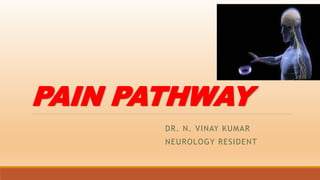
PAIN PATHWAY
DR. N. VINAY KUMAR
NEUROLOGY RESIDENT
Introduction
Pain is a vital function of the nervous system in providing the body with a warning of potential
or actual injury.
It is both a sensory and emotional experience, affected by psychological factors such as past
experiences, beliefs about pain, fear or anxiety.
The word pain is derived from Latin word Peone and the Greek word Poine meaning penalty or
punishment
History
ARISTOTLE considered pain a feeling and classified it as a passion of the soul, where the heart
was the source or processing centre of pain.
DESCRATES, GALEN, VESALIUS postulated that pain was the sensation in which brain played an
important role.
In the 19th century , MULLER, VAN FREY, GOLDSCHEIDER hypothesized the concepts of
neuroreceptors, nociceptors and sensory input.
Definitions
•Pain:
• According to the International Association for the Study of Pain (IASP), pain is “an
unpleasant sensory and emotional experience associated with actual or potential tissue damage, or
described in terms of such damage.”
•Nociception:
• Noxious stimulus or stimulus that can become noxious with prolonged exposure
• Process through which peripheral pain receptors transmit information about tissue damage
centrally as pain
•Nociceptor: receptor in end organ that detects biochemical changes associated with tissue
damage
•Hyperalgesia: exaggerated response to noxious stimuli
•Allodynia: sensation of pain in response to an innocuous stimulus
Embryology
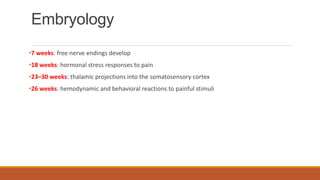
•7 weeks: free nerve endings develop
•18 weeks: hormonal stress responses to pain
•23–30 weeks: thalamic projections into the somatosensory cortex
•26 weeks: hemodynamic and behavioral reactions to painful stimuli
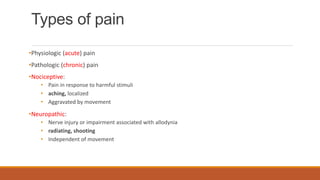
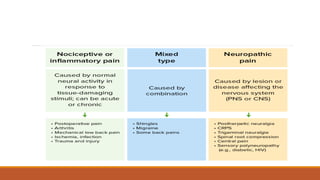
Types of pain
•Physiologic (acute) pain
•Pathologic (chronic) pain
•Nociceptive:
• Pain in response to harmful stimuli
• aching, localized
• Aggravated by movement
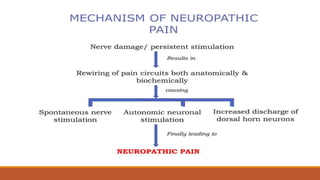
•Neuropathic:
• Nerve injury or impairment associated with allodynia
• radiating, shooting
• Independent of movement
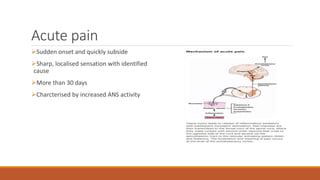
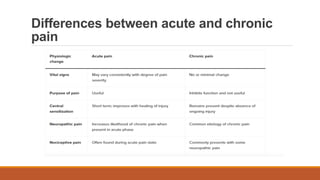
Acute pain
Sudden onset and quickly subside
Sharp, localised sensation with identified
cause
More than 30 days
Charcterised by increased ANS activity
Chronic pain
3-6 months longer
Begins when pain persists after initial injury has healed
Persistent or episodic pain of duration or intensity
May be nociceptive, inflammatory, neuropathic, or functional
Effects on physical functions, psychological changes, social and societal consequences.
Differences between acute and chronic
pain
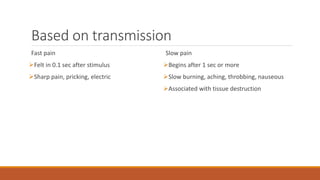
Based on transmission
Fast pain
Felt in 0.1 sec after stimulus
Sharp pain, pricking, electric
Slow pain
Begins after 1 sec or more
Slow burning, aching, throbbing, nauseous
Associated with tissue destruction
Function of pain
• As a adaptive measure to minimize further tissue damage
•Evoked responses:
• Withdrawal from noxious stimulus (e.g., spinal reflexes)
• Anticipatory movements
Components of pain pathway
1. Nociceptors
2. Primary afferent fibres
3. Dorsal horn of spinal cord
4. Ascending tracts and descending tracts
5. Pain processing centres
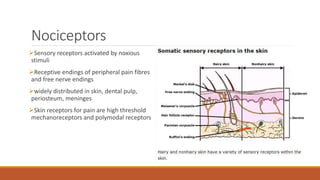
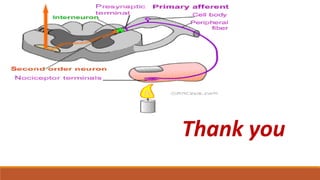
Nociceptors
Sensory receptors activated by noxious
stimuli
Receptive endings of peripheral pain fibres
and free nerve endings
widely distributed in skin, dental pulp,
periosteum, meninges
Skin receptors for pain are high threshold
mechanoreceptors and polymodal receptors
Anatomy and Physiology of Pain
Pathways
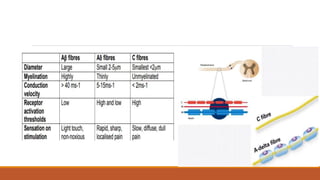
Types of afferent nerve fibers
Type A fibers: Large and myelinated → fast-conducting
•A-alpha: primary receptors of the muscle spindle and Golgi tendon organ
•A-beta:
• Afferent axon with the largest diameter
• Secondary receptors of the muscle spindle that contribute to cutaneous mechanoreceptors.
• Perceive light touch and/or moving stimuli
•A-delta:
• Free nerve endings that conduct stimuli related to pain, pressure and temperature.
• Conduction speed approximately 20 m/sec
•A-gamma: motor neurons that control the intrinsic activation of the muscle spindle.
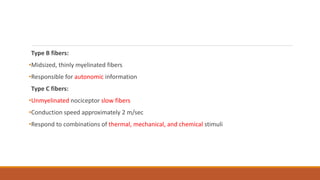
Type B fibers:
•Midsized, thinly myelinated fibers
•Responsible for autonomic information
Type C fibers:
•Unmyelinated nociceptor slow fibers
•Conduction speed approximately 2 m/sec
•Respond to combinations of thermal, mechanical, and chemical stimuli
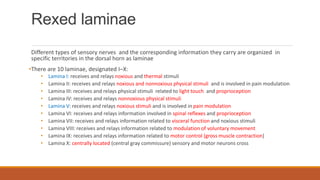
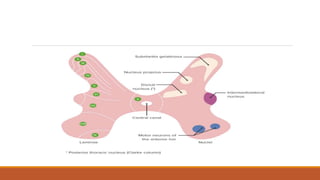
Rexed laminae
Different types of sensory nerves and the corresponding information they carry are organized in
specific territories in the dorsal horn as laminae
•There are 10 laminae, designated I–X:
• Lamina I: receives and relays noxious and thermal stimuli
• Lamina II: receives and relays noxious and nonnoxious physical stimuli and is involved in pain modulation
• Lamina III: receives and relays physical stimuli related to light touch and proprioception
• Lamina IV: receives and relays nonnoxious physical stimuli
• Lamina V: receives and relays noxious stimuli and is involved in pain modulation
• Lamina VI: receives and relays information involved in spinal reflexes and proprioception
• Lamina VII: receives and relays information related to visceral function and noxious stimuli
• Lamina VIII: receives and relays information related to modulation of voluntary movement
• Lamina IX: receives and relays information related to motor control (gross muscle contraction)
• Lamina X: centrally located (central gray commissure) sensory and motor neurons cross
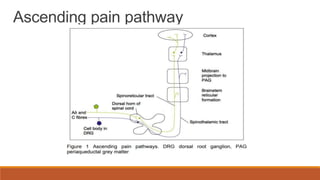
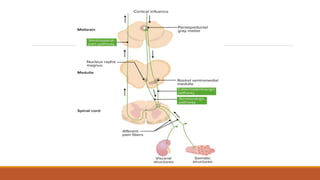
Ascending pain pathway
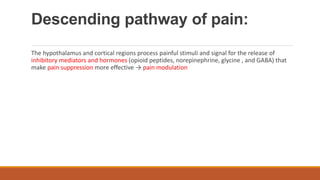
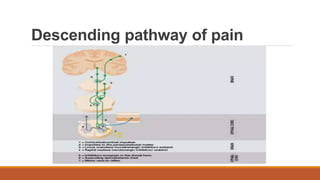
Descending pathway of pain:
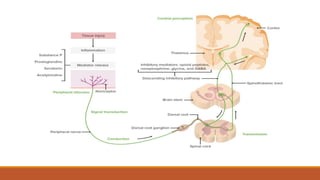
The hypothalamus and cortical regions process painful stimuli and signal for the release of
inhibitory mediators and hormones (opioid peptides, norepinephrine, glycine , and GABA) that
make pain suppression more effective → pain modulation
Descending pathway of pain
Physiology of Pain Pathways
Phases
1.Transduction
2.Transmission
3.Modulation
4.Central perception
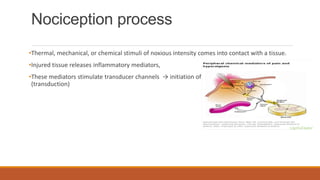
Nociception process
•Thermal, mechanical, or chemical stimuli of noxious intensity comes into contact with a tissue.
•Injured tissue releases inflammatory mediators,
•These mediators stimulate transducer channels → initiation of receptor potentials
(transduction)
•Receptor potentials evoke action potentials in sensory nerve fibers.
•Action potentials are carried as afferent signals via sensory nerve fibers to the dorsal root
ganglia and dorsal horn of the spinal cord (transmission).
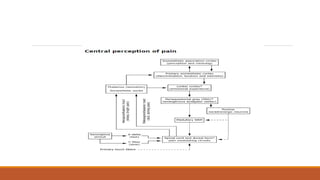
•From there, the signal is transmitted up the spinal cord to the brain stem and thalamus, where
significant processing (modulation) may occur.
•The signal finally reaches the somatosensory cortex(central perception).
•The biopsychosocial interpretation of the painful experience also involves:
• Amygdala : emotional and affective response to pain and pain modulation
• Hypothalamus: neuroendocrine corticotropin response to pain
• Periaqueductal gray matter: key center for pain modulation, involved in aversive and defensive pain
behaviors
• Basal ganglia: cognitive, affective, and discriminative (ability to localize sensory input) aspects of
pain perception
• Cerebral cortex: ultimate site of pain perception, potential for conscious activation of descending
pathways for pain modulation
Modulation of pain
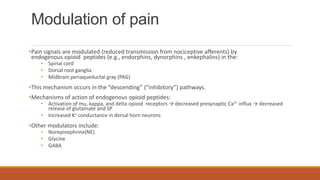
•Pain signals are modulated (reduced transmission from nociceptive afferents) by
endogenous opioid peptides (e.g., endorphins, dynorphins , enkephalins) in the:
• Spinal cord
• Dorsal root ganglia
• Midbrain periaqueductal gray (PAG)
•This mechanism occurs in the “descending” (“inhibitory”) pathways.
•Mechanisms of action of endogenous opioid peptides:
• Activation of mu, kappa, and delta opioid receptors → decreased presynaptic Ca2+ influx → decreased
release of glutamate and SP
• Increased K+ conductance in dorsal horn neurons
•Other modulators include:
• Norepinephrine(NE)
• Glycine
• GABA
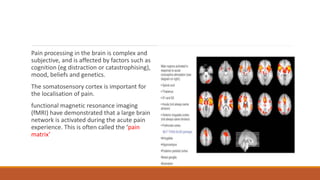
Pain processing in the brain is complex and
subjective, and is affected by factors such as
cognition (eg distraction or catastrophising),
mood, beliefs and genetics.
The somatosensory cortex is important for
the localisation of pain.
functional magnetic resonance imaging
(fMRI) have demonstrated that a large brain
network is activated during the acute pain
experience. This is often called the ‘pain
matrix’
Visceral Pain
Characteristics
•Poorly localized
•Unpleasant
•Associated with nausea and autonomic symptoms
Nociception process
•Nociceptors in the walls of the viscera are sensitive to distention and inflammation of the organ
→ receptor and action potentials are evoked
•The action potentials are carried by afferent fibers via sympathetic and parasympathetic nerves
of the myenteric plexus.
•The signal is transmitted to the neural bodies in the dorsal (and cranial) nerve ganglia → signal
continues to the dorsal horn of the spinal cord.
•Convergence-projection theory: visceral afferent fibers converge with somatic afferent fibers on
the same neural bodies in the dorsal horn→ the signal is sent through the spinal cord to
the thalamus and the somatosensory cortex.
•Pain is perceived to come from the somatic structure corresponding to the somatic fibers that
converged with the visceral fibers (referred pain).
Peripheral versus Central
Sensitization
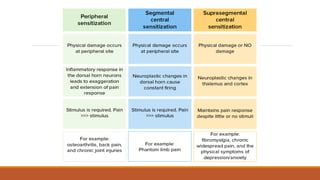
Peripheral sensitization
•Results from persistent or repetitive peripheral nociception or nerve injury
•Hyperstimulation or damage to the 1st-order neuron alters the electrical traits and elaboration
of neurotransmitters ( SP, CGRP, NGF).
•The inflammation and the initial injury combine to create an enhanced pain sensation and
perpetuates the pain response:
• Neuropathic pain may develop in an area devoid of nerve injury.
• May manifest with hypersensitivity, hyperalgesia, allodynia.
Central sensitization
•occur centrally, perhaps at the level of the rexed laminae
•Generally a progression from peripheral sensitization but may also be produced without any
known peripheral stimulus or a CNS insult.
•Often occurs in the setting of CNS insults (e.g., stroke, spinal cord injury)
•Often associated with psychiatric conditions
•May occur as a primary disorder (e.g., fibromyalgia)
Pain theories
Specificity theory
Pattern theory
Neuromatrix theory
Gate control theory
SPECIFICITY THEORY
This theory states pain as separate modality
evoked by specific receptors that transmit
information to pain centres or regions in fore
brain where pain is experienced.
PATTERN THEORY
Pain receptors share endings or pathways with
other sensory modalities but different
patterns of activity of the same neurors can be
used to signal painful and nonpainful stimuli.
Neuromatrix theory
 MELZACK
Explains role of brain in pain as well as the multiple dimensions and determinants of pain.
Brain contains neural network called body self neuromatrix
Contains somatosensory, limbic, thalamocortical components.
The Gate Control Theory of Pain
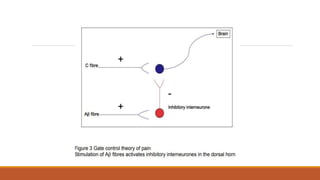
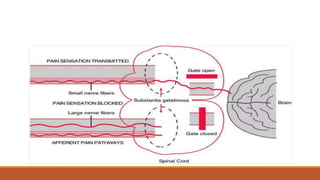
•A physiologic sensory “gate” exists at the level of the dorsal horn in any given spinal segment.
• Only so much sensory information can get through the gate at any given time.
• Preferential passage through the gate is granted to incoming sensory signals conducted by larger,
more heavily myelinated, faster-conducting nerve fibers.
• An open gate is a dorsal horn receiving isolated noxious (painful) stimulus.
• A closed gate is a dorsal horn receiving simultaneous physical (nonnoxious) physical stimuli.
Incoming pain signals are largely conducted by A-delta and type C fibers, while A-beta fibers
carry nonnoxious physical stimuli(e.g., movement, vibration, pressure, temperature, electrical
stimulation).
Take home message
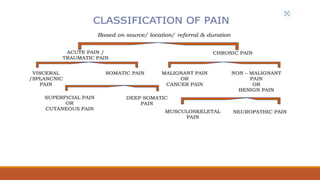
I. Pain is classified based on duration, location, transmission speed and source
II. A-delta (relatively slow-conducting) and type C (slow-conducting) fibers are involved in pain
pathway
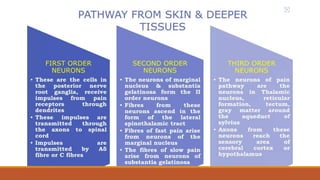
III. First order, second order and third order neurons
IV. Ascending and descending pain pathway
V. Four phases of pain pathway transduction, transmission, modulation and central perception.
VI. Various theories of pain mechanism out of which gate control theory is well accepted.
Thank you

PAIN PATHWAY.pptx

  • 1.
    PAIN PATHWAY DR. N.VINAY KUMAR NEUROLOGY RESIDENT
  • 2.
    Introduction Pain is avital function of the nervous system in providing the body with a warning of potential or actual injury. It is both a sensory and emotional experience, affected by psychological factors such as past experiences, beliefs about pain, fear or anxiety. The word pain is derived from Latin word Peone and the Greek word Poine meaning penalty or punishment
  • 3.
    History ARISTOTLE considered paina feeling and classified it as a passion of the soul, where the heart was the source or processing centre of pain. DESCRATES, GALEN, VESALIUS postulated that pain was the sensation in which brain played an important role. In the 19th century , MULLER, VAN FREY, GOLDSCHEIDER hypothesized the concepts of neuroreceptors, nociceptors and sensory input.
  • 4.
    Definitions •Pain: • According tothe International Association for the Study of Pain (IASP), pain is “an unpleasant sensory and emotional experience associated with actual or potential tissue damage, or described in terms of such damage.” •Nociception: • Noxious stimulus or stimulus that can become noxious with prolonged exposure • Process through which peripheral pain receptors transmit information about tissue damage centrally as pain •Nociceptor: receptor in end organ that detects biochemical changes associated with tissue damage •Hyperalgesia: exaggerated response to noxious stimuli •Allodynia: sensation of pain in response to an innocuous stimulus
  • 5.
    Embryology •7 weeks: freenerve endings develop •18 weeks: hormonal stress responses to pain •23–30 weeks: thalamic projections into the somatosensory cortex •26 weeks: hemodynamic and behavioral reactions to painful stimuli
  • 7.
    Types of pain •Physiologic(acute) pain •Pathologic (chronic) pain •Nociceptive: • Pain in response to harmful stimuli • aching, localized • Aggravated by movement •Neuropathic: • Nerve injury or impairment associated with allodynia • radiating, shooting • Independent of movement
  • 8.
    Acute pain Sudden onsetand quickly subside Sharp, localised sensation with identified cause More than 30 days Charcterised by increased ANS activity
  • 9.
    Chronic pain 3-6 monthslonger Begins when pain persists after initial injury has healed Persistent or episodic pain of duration or intensity May be nociceptive, inflammatory, neuropathic, or functional Effects on physical functions, psychological changes, social and societal consequences.
  • 10.
    Differences between acuteand chronic pain
  • 13.
    Based on transmission Fastpain Felt in 0.1 sec after stimulus Sharp pain, pricking, electric Slow pain Begins after 1 sec or more Slow burning, aching, throbbing, nauseous Associated with tissue destruction
  • 14.
    Function of pain •As a adaptive measure to minimize further tissue damage •Evoked responses: • Withdrawal from noxious stimulus (e.g., spinal reflexes) • Anticipatory movements
  • 15.
    Components of painpathway 1. Nociceptors 2. Primary afferent fibres 3. Dorsal horn of spinal cord 4. Ascending tracts and descending tracts 5. Pain processing centres
  • 16.
    Nociceptors Sensory receptors activatedby noxious stimuli Receptive endings of peripheral pain fibres and free nerve endings widely distributed in skin, dental pulp, periosteum, meninges Skin receptors for pain are high threshold mechanoreceptors and polymodal receptors
  • 17.
    Anatomy and Physiologyof Pain Pathways Types of afferent nerve fibers Type A fibers: Large and myelinated → fast-conducting •A-alpha: primary receptors of the muscle spindle and Golgi tendon organ •A-beta: • Afferent axon with the largest diameter • Secondary receptors of the muscle spindle that contribute to cutaneous mechanoreceptors. • Perceive light touch and/or moving stimuli •A-delta: • Free nerve endings that conduct stimuli related to pain, pressure and temperature. • Conduction speed approximately 20 m/sec •A-gamma: motor neurons that control the intrinsic activation of the muscle spindle.
  • 18.
    Type B fibers: •Midsized,thinly myelinated fibers •Responsible for autonomic information Type C fibers: •Unmyelinated nociceptor slow fibers •Conduction speed approximately 2 m/sec •Respond to combinations of thermal, mechanical, and chemical stimuli
  • 20.
    Rexed laminae Different typesof sensory nerves and the corresponding information they carry are organized in specific territories in the dorsal horn as laminae •There are 10 laminae, designated I–X: • Lamina I: receives and relays noxious and thermal stimuli • Lamina II: receives and relays noxious and nonnoxious physical stimuli and is involved in pain modulation • Lamina III: receives and relays physical stimuli related to light touch and proprioception • Lamina IV: receives and relays nonnoxious physical stimuli • Lamina V: receives and relays noxious stimuli and is involved in pain modulation • Lamina VI: receives and relays information involved in spinal reflexes and proprioception • Lamina VII: receives and relays information related to visceral function and noxious stimuli • Lamina VIII: receives and relays information related to modulation of voluntary movement • Lamina IX: receives and relays information related to motor control (gross muscle contraction) • Lamina X: centrally located (central gray commissure) sensory and motor neurons cross
  • 23.
  • 24.
    Descending pathway ofpain: The hypothalamus and cortical regions process painful stimuli and signal for the release of inhibitory mediators and hormones (opioid peptides, norepinephrine, glycine , and GABA) that make pain suppression more effective → pain modulation
  • 25.
  • 26.
    Physiology of PainPathways Phases 1.Transduction 2.Transmission 3.Modulation 4.Central perception
  • 27.
    Nociception process •Thermal, mechanical,or chemical stimuli of noxious intensity comes into contact with a tissue. •Injured tissue releases inflammatory mediators, •These mediators stimulate transducer channels → initiation of receptor potentials (transduction)
  • 28.
    •Receptor potentials evokeaction potentials in sensory nerve fibers. •Action potentials are carried as afferent signals via sensory nerve fibers to the dorsal root ganglia and dorsal horn of the spinal cord (transmission). •From there, the signal is transmitted up the spinal cord to the brain stem and thalamus, where significant processing (modulation) may occur. •The signal finally reaches the somatosensory cortex(central perception).
  • 29.
    •The biopsychosocial interpretationof the painful experience also involves: • Amygdala : emotional and affective response to pain and pain modulation • Hypothalamus: neuroendocrine corticotropin response to pain • Periaqueductal gray matter: key center for pain modulation, involved in aversive and defensive pain behaviors • Basal ganglia: cognitive, affective, and discriminative (ability to localize sensory input) aspects of pain perception • Cerebral cortex: ultimate site of pain perception, potential for conscious activation of descending pathways for pain modulation
  • 30.
    Modulation of pain •Painsignals are modulated (reduced transmission from nociceptive afferents) by endogenous opioid peptides (e.g., endorphins, dynorphins , enkephalins) in the: • Spinal cord • Dorsal root ganglia • Midbrain periaqueductal gray (PAG) •This mechanism occurs in the “descending” (“inhibitory”) pathways. •Mechanisms of action of endogenous opioid peptides: • Activation of mu, kappa, and delta opioid receptors → decreased presynaptic Ca2+ influx → decreased release of glutamate and SP • Increased K+ conductance in dorsal horn neurons •Other modulators include: • Norepinephrine(NE) • Glycine • GABA
  • 33.
    Pain processing inthe brain is complex and subjective, and is affected by factors such as cognition (eg distraction or catastrophising), mood, beliefs and genetics. The somatosensory cortex is important for the localisation of pain. functional magnetic resonance imaging (fMRI) have demonstrated that a large brain network is activated during the acute pain experience. This is often called the ‘pain matrix’
  • 34.
  • 35.
    Nociception process •Nociceptors inthe walls of the viscera are sensitive to distention and inflammation of the organ → receptor and action potentials are evoked •The action potentials are carried by afferent fibers via sympathetic and parasympathetic nerves of the myenteric plexus. •The signal is transmitted to the neural bodies in the dorsal (and cranial) nerve ganglia → signal continues to the dorsal horn of the spinal cord.
  • 36.
    •Convergence-projection theory: visceralafferent fibers converge with somatic afferent fibers on the same neural bodies in the dorsal horn→ the signal is sent through the spinal cord to the thalamus and the somatosensory cortex. •Pain is perceived to come from the somatic structure corresponding to the somatic fibers that converged with the visceral fibers (referred pain).
  • 38.
    Peripheral versus Central Sensitization Peripheralsensitization •Results from persistent or repetitive peripheral nociception or nerve injury •Hyperstimulation or damage to the 1st-order neuron alters the electrical traits and elaboration of neurotransmitters ( SP, CGRP, NGF). •The inflammation and the initial injury combine to create an enhanced pain sensation and perpetuates the pain response: • Neuropathic pain may develop in an area devoid of nerve injury. • May manifest with hypersensitivity, hyperalgesia, allodynia.
  • 39.
    Central sensitization •occur centrally,perhaps at the level of the rexed laminae •Generally a progression from peripheral sensitization but may also be produced without any known peripheral stimulus or a CNS insult. •Often occurs in the setting of CNS insults (e.g., stroke, spinal cord injury) •Often associated with psychiatric conditions •May occur as a primary disorder (e.g., fibromyalgia)
  • 41.
    Pain theories Specificity theory Patterntheory Neuromatrix theory Gate control theory
  • 42.
    SPECIFICITY THEORY This theorystates pain as separate modality evoked by specific receptors that transmit information to pain centres or regions in fore brain where pain is experienced. PATTERN THEORY Pain receptors share endings or pathways with other sensory modalities but different patterns of activity of the same neurors can be used to signal painful and nonpainful stimuli.
  • 43.
    Neuromatrix theory  MELZACK Explainsrole of brain in pain as well as the multiple dimensions and determinants of pain. Brain contains neural network called body self neuromatrix Contains somatosensory, limbic, thalamocortical components.
  • 44.
    The Gate ControlTheory of Pain •A physiologic sensory “gate” exists at the level of the dorsal horn in any given spinal segment. • Only so much sensory information can get through the gate at any given time. • Preferential passage through the gate is granted to incoming sensory signals conducted by larger, more heavily myelinated, faster-conducting nerve fibers. • An open gate is a dorsal horn receiving isolated noxious (painful) stimulus. • A closed gate is a dorsal horn receiving simultaneous physical (nonnoxious) physical stimuli. Incoming pain signals are largely conducted by A-delta and type C fibers, while A-beta fibers carry nonnoxious physical stimuli(e.g., movement, vibration, pressure, temperature, electrical stimulation).
  • 47.
    Take home message I.Pain is classified based on duration, location, transmission speed and source II. A-delta (relatively slow-conducting) and type C (slow-conducting) fibers are involved in pain pathway III. First order, second order and third order neurons IV. Ascending and descending pain pathway V. Four phases of pain pathway transduction, transmission, modulation and central perception. VI. Various theories of pain mechanism out of which gate control theory is well accepted.
  • 48.