Pain Physiology
R.Srihari
Topics for discussion
• Definitions
• Physiology of pain
• Pain pathway
• Important terminologies
Definition
• Pain:
– An unpleasant sensory or emotional experience
associated with actual or potential tissue damage
or described in terms of such damage
• Nociception:
– neural response related to potentially tissue
damaging stimuli
Terminologies for pain
• dysthesia – experience of abnormal noxious
sensation
– paraesthesia - abnormal nonpainful sensation;
– hyperpathia- exaggerated pain response to
noxious or nonoxious stimuli)
• allodynia - perception of nonoxious stimuli as
painful
• Hyperalgesia: increased pain response to
painful stimuli
• Hypoalgesia: decreased sensitivity to noxious
stimuli
• Hyperesthesia and Hypoesthesia :increase or
decrease, respectively, in sensitivity to
nonnoxious stimuli
Physiology of Pain
• Pain transmission:
– A good way to understand physiology of pain is to
follow nociceptive signal pathways from the
periphery to the brain,
– with emphasis on integration and modulation of
nociceptive signal at different steps in the CNS
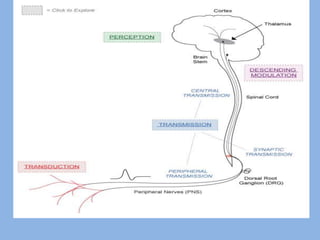
• Transmission of pain occurs by :
– Transduction
– Transmission
– Perception
– Modulation
• For understanding, it can be divided into
peripheral transmission and central
transmission
• Peripheral Transmission:
– Peripheral transmission of pain consists
production of electrical signals at the pain nerve
endings (Transduction) followed by propagation of
those signals through the peripheral nervous
system (Transmission)
• Central Transmission:
– Includes transmission and perception whereby
signals are transmitted from spinal cord to the
brain
• Transduction:
– Primary sensory structure that accomplishes
transduction –nociceptor (free nerve endings sensing
heat, mechanical and chemical tissue damage)
– Several types are described:
• Mechanoceptors – sense pinch and pin prick
• Silent nociceptors- sense pain only during inflammation
• Polymodal mechanothermal receptors- most prevalent and
respond to excess pressure, temperature and algogens
• Transmission:
– Pain impulses transmitted by 2 fibre systems
– The presence of 2 pain pathways-explains
existence of 2 components of pain: Fast pain(Ad)
and Slow pain (C )
– Ultimately synapse in spinal cord with second
order neurons which send impulse to CNS
• Perception:
– From thalamus to somatosensory areas of
cerebral cortex( in the post central gyrus) and
superior wall of the sylvian fissure
– Fibres are also projected to limbic system- anterior
cingulate gyrus and insula
• Modulation:
– Occurs at different sites:
• Nociceptor
• Spinal cord
• Supraspinal structures
– This modulation can either inhibit or facilitate pain
• Peripheral Modulation:
– Nociceptors and their neurons display sensitization
following repeated stimulation
– Sensitization of nociceptors result in
• decrease in threshold
• Increase in frequency response
• Decrease in response latency
• Spontaneous firing even after cessation of stimulus
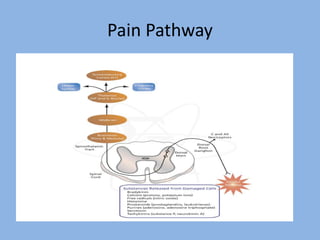
– Primary hyperalgesia mediated by algogens like
histamine, bradykinin, PGE2 and leukotrienes from
damaged tissues
• Secondary hyperalgesia or neurogenic inflammation-
longterm tissue hypersensitivity beyond area of
original injury  within the CNS
– Repeated recruitment of C-fibres following an injury will cause change
in response properties of membranes of secondary neurons
– Over a period – can cause increase in perceived pain even if intensity
of stimulation remains constant
– This spinal sensitization can persist for minutes, but can also present
for hours or even days
– The prolonged activation of NMDA receptors will induce transcription
of rapidly expressed genes (c-fos, c-jun), resulting in sensitization of
nociceptors
– This neuronal plasticity of the secondary neuron will result in reduced
recruitment threshold of secondary neurons in the spinal cord
hyperalgesia and allodynia that persist even after healing of injury
• Central Sensitization: refers to phenomenon where
second neuron membrane permeability changes and
responds at higher frequency when recruited by nociceptive
and non-nociceptive primary input
– This can facilitate or inhibit pain. The mechanisms of
facilitation are as follows:
• Windup and sensitization of second order neurons
• Receptive field expansion
• Hyper excitability of flexion responses
– Neurochemical mediators of central sensitization
• sP , CGRP, VIP, Cholecystokinin, angiotensin, galantin, L-
aspartate and L-glutamate
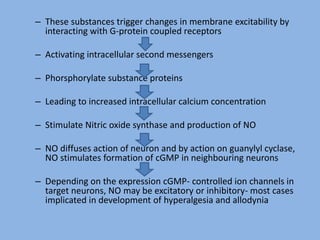
– These substances trigger changes in membrane excitability by
interacting with G-protein coupled receptors
– Activating intracellular second messengers
– Phorsphorylate substance proteins
– Leading to increased intracellular calcium concentration
– Stimulate Nitric oxide synthase and production of NO
– NO diffuses action of neuron and by action on guanylyl cyclase,
NO stimulates formation of cGMP in neighbouring neurons
– Depending on the expression cGMP- controlled ion channels in
target neurons, NO may be excitatory or inhibitory- most cases
implicated in development of hyperalgesia and allodynia
• Inhibitory mechanisms can be either Spinal or
Supraspinal
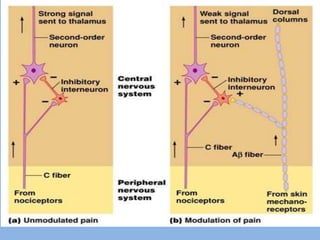
– Segmental inhibition –consists of activation of large
afferent fibres of inhibitory WDR neurons and
spinothalamic activity
– Glycine and GABA –inhibitory neurotransmitters
– Segmental inhibtion mediated by GABA receptor
activity increases K+ conductance across cell
membrane
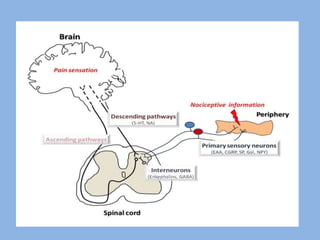
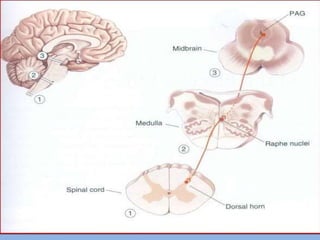
– Supraspinal inhibition – occurs whereby several
supraspinal structures send fibres down the spinal cord to
inhibit pain at the level of the dorsal horn
• Includes –Periaqueductal Gray, Nucleus Raphe Magnus and
Reticular formation
– Axons from these structures act pre-synaptically on the
primary afferent neurons and post synaptically on the
second order neurons(interneurones)
– These axons utilise monoamines (NA and Serotonin) as
neurotransmitters and terminate on nociceptive neurons
in spinal cord + spinal inhibitory interneurones (store and
release opioids)
– Noradrenaline mediates action via alpha 2 receptors
– Endogeneous opioids via enkephalins and B-endorphins–
mainly act presynaptically whereas opiates act
postsynaptically
– Cognitive Modulation:
• Involves patient’s ability to relate a painful experience
to another event
Pain Pathway
Important terminologies
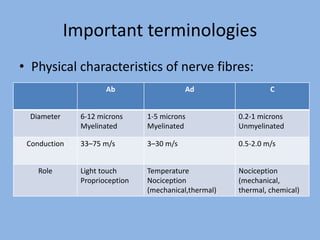
• Physical characteristics of nerve fibres:
Ab Ad C
Diameter 6-12 microns
Myelinated
1-5 microns
Myelinated
0.2-1 microns
Unmyelinated
Conduction 33–75 m/s 3–30 m/s 0.5-2.0 m/s
Role Light touch
Proprioception
Temperature
Nociception
(mechanical,thermal)
Nociception
(mechanical,
thermal, chemical)
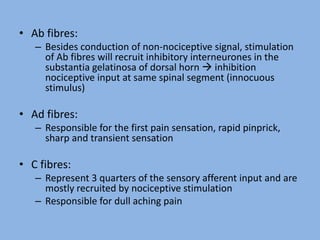
• Ab fibres:
– Besides conduction of non-nociceptive signal, stimulation
of Ab fibres will recruit inhibitory interneurones in the
substantia gelatinosa of dorsal horn  inhibition
nociceptive input at same spinal segment (innocuous
stimulus)
• Ad fibres:
– Responsible for the first pain sensation, rapid pinprick,
sharp and transient sensation
• C fibres:
– Represent 3 quarters of the sensory afferent input and are
mostly recruited by nociceptive stimulation
– Responsible for dull aching pain
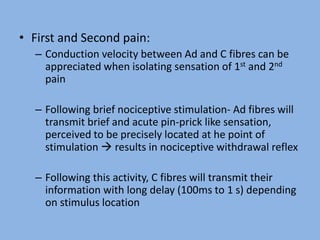
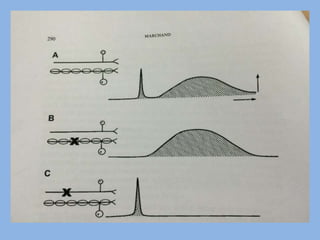
• First and Second pain:
– Conduction velocity between Ad and C fibres can be
appreciated when isolating sensation of 1st and 2nd
pain
– Following brief nociceptive stimulation- Ad fibres will
transmit brief and acute pin-prick like sensation,
perceived to be precisely located at he point of
stimulation  results in nociceptive withdrawal reflex
– Following this activity, C fibres will transmit their
information with long delay (100ms to 1 s) depending
on stimulus location
• Secondary neurons : can be classified as
– Nociceptive specific neurons:
• Respond only to nociceptive stimulation
• Can be divided into 2 subclasses depending on their recruitment
by Ad alone or combination of Ad and C fibres
– Wide dynamic range neurons:
• Respond gradually to stimuli from innocuous to nociceptive
• Their capacity to respond to both nociceptive and innocous stimuli
is related to the fact that they have received input from Ad, C and
Ab fibres
• Receptive field is dynamic
• Changes in receptive field, membrane permeability to ion
exchange and discharge frequency of these neurons all suggest
substantial role in chronicity of pain
• Temporal Summation:
– Good illustration of importance of signal conduction in Ad
and C fibres
– Here, pain perception is compared with repeated
stimulations at same intensity but different rates
– High frequency of stimulation will produce temporal
summation of C-fibre activity as a result of relatively slow
conductance of these fibres
– Resulting in increased perceived intensity of second pain
• Spatial Summation:
– Stimulation of a large territory will recruit more
nociceptors than when a small area is stimulated
– Results in more intense pain perception
– However increasing surface area that is stimulated
recruits both excitatory and inhibitory
mechanisms
Thank You

Pain physiology

  • 1.
  • 2.
    Topics for discussion •Definitions • Physiology of pain • Pain pathway • Important terminologies
  • 3.
    Definition • Pain: – Anunpleasant sensory or emotional experience associated with actual or potential tissue damage or described in terms of such damage • Nociception: – neural response related to potentially tissue damaging stimuli
  • 4.
    Terminologies for pain •dysthesia – experience of abnormal noxious sensation – paraesthesia - abnormal nonpainful sensation; – hyperpathia- exaggerated pain response to noxious or nonoxious stimuli) • allodynia - perception of nonoxious stimuli as painful
  • 5.
    • Hyperalgesia: increasedpain response to painful stimuli • Hypoalgesia: decreased sensitivity to noxious stimuli • Hyperesthesia and Hypoesthesia :increase or decrease, respectively, in sensitivity to nonnoxious stimuli
  • 6.
    Physiology of Pain •Pain transmission: – A good way to understand physiology of pain is to follow nociceptive signal pathways from the periphery to the brain, – with emphasis on integration and modulation of nociceptive signal at different steps in the CNS
  • 7.
    • Transmission ofpain occurs by : – Transduction – Transmission – Perception – Modulation • For understanding, it can be divided into peripheral transmission and central transmission
  • 9.
    • Peripheral Transmission: –Peripheral transmission of pain consists production of electrical signals at the pain nerve endings (Transduction) followed by propagation of those signals through the peripheral nervous system (Transmission) • Central Transmission: – Includes transmission and perception whereby signals are transmitted from spinal cord to the brain
  • 10.
    • Transduction: – Primarysensory structure that accomplishes transduction –nociceptor (free nerve endings sensing heat, mechanical and chemical tissue damage) – Several types are described: • Mechanoceptors – sense pinch and pin prick • Silent nociceptors- sense pain only during inflammation • Polymodal mechanothermal receptors- most prevalent and respond to excess pressure, temperature and algogens
  • 11.
    • Transmission: – Painimpulses transmitted by 2 fibre systems – The presence of 2 pain pathways-explains existence of 2 components of pain: Fast pain(Ad) and Slow pain (C ) – Ultimately synapse in spinal cord with second order neurons which send impulse to CNS
  • 12.
    • Perception: – Fromthalamus to somatosensory areas of cerebral cortex( in the post central gyrus) and superior wall of the sylvian fissure – Fibres are also projected to limbic system- anterior cingulate gyrus and insula
  • 13.
    • Modulation: – Occursat different sites: • Nociceptor • Spinal cord • Supraspinal structures – This modulation can either inhibit or facilitate pain
  • 14.
    • Peripheral Modulation: –Nociceptors and their neurons display sensitization following repeated stimulation – Sensitization of nociceptors result in • decrease in threshold • Increase in frequency response • Decrease in response latency • Spontaneous firing even after cessation of stimulus – Primary hyperalgesia mediated by algogens like histamine, bradykinin, PGE2 and leukotrienes from damaged tissues
  • 15.
    • Secondary hyperalgesiaor neurogenic inflammation- longterm tissue hypersensitivity beyond area of original injury  within the CNS – Repeated recruitment of C-fibres following an injury will cause change in response properties of membranes of secondary neurons – Over a period – can cause increase in perceived pain even if intensity of stimulation remains constant – This spinal sensitization can persist for minutes, but can also present for hours or even days – The prolonged activation of NMDA receptors will induce transcription of rapidly expressed genes (c-fos, c-jun), resulting in sensitization of nociceptors – This neuronal plasticity of the secondary neuron will result in reduced recruitment threshold of secondary neurons in the spinal cord hyperalgesia and allodynia that persist even after healing of injury
  • 16.
    • Central Sensitization:refers to phenomenon where second neuron membrane permeability changes and responds at higher frequency when recruited by nociceptive and non-nociceptive primary input – This can facilitate or inhibit pain. The mechanisms of facilitation are as follows: • Windup and sensitization of second order neurons • Receptive field expansion • Hyper excitability of flexion responses – Neurochemical mediators of central sensitization • sP , CGRP, VIP, Cholecystokinin, angiotensin, galantin, L- aspartate and L-glutamate
  • 17.
    – These substancestrigger changes in membrane excitability by interacting with G-protein coupled receptors – Activating intracellular second messengers – Phorsphorylate substance proteins – Leading to increased intracellular calcium concentration – Stimulate Nitric oxide synthase and production of NO – NO diffuses action of neuron and by action on guanylyl cyclase, NO stimulates formation of cGMP in neighbouring neurons – Depending on the expression cGMP- controlled ion channels in target neurons, NO may be excitatory or inhibitory- most cases implicated in development of hyperalgesia and allodynia
  • 18.
    • Inhibitory mechanismscan be either Spinal or Supraspinal – Segmental inhibition –consists of activation of large afferent fibres of inhibitory WDR neurons and spinothalamic activity – Glycine and GABA –inhibitory neurotransmitters – Segmental inhibtion mediated by GABA receptor activity increases K+ conductance across cell membrane
  • 19.
    – Supraspinal inhibition– occurs whereby several supraspinal structures send fibres down the spinal cord to inhibit pain at the level of the dorsal horn • Includes –Periaqueductal Gray, Nucleus Raphe Magnus and Reticular formation – Axons from these structures act pre-synaptically on the primary afferent neurons and post synaptically on the second order neurons(interneurones) – These axons utilise monoamines (NA and Serotonin) as neurotransmitters and terminate on nociceptive neurons in spinal cord + spinal inhibitory interneurones (store and release opioids) – Noradrenaline mediates action via alpha 2 receptors – Endogeneous opioids via enkephalins and B-endorphins– mainly act presynaptically whereas opiates act postsynaptically
  • 20.
    – Cognitive Modulation: •Involves patient’s ability to relate a painful experience to another event
  • 21.
  • 25.
    Important terminologies • Physicalcharacteristics of nerve fibres: Ab Ad C Diameter 6-12 microns Myelinated 1-5 microns Myelinated 0.2-1 microns Unmyelinated Conduction 33–75 m/s 3–30 m/s 0.5-2.0 m/s Role Light touch Proprioception Temperature Nociception (mechanical,thermal) Nociception (mechanical, thermal, chemical)
  • 26.
    • Ab fibres: –Besides conduction of non-nociceptive signal, stimulation of Ab fibres will recruit inhibitory interneurones in the substantia gelatinosa of dorsal horn  inhibition nociceptive input at same spinal segment (innocuous stimulus) • Ad fibres: – Responsible for the first pain sensation, rapid pinprick, sharp and transient sensation • C fibres: – Represent 3 quarters of the sensory afferent input and are mostly recruited by nociceptive stimulation – Responsible for dull aching pain
  • 27.
    • First andSecond pain: – Conduction velocity between Ad and C fibres can be appreciated when isolating sensation of 1st and 2nd pain – Following brief nociceptive stimulation- Ad fibres will transmit brief and acute pin-prick like sensation, perceived to be precisely located at he point of stimulation  results in nociceptive withdrawal reflex – Following this activity, C fibres will transmit their information with long delay (100ms to 1 s) depending on stimulus location
  • 29.
    • Secondary neurons: can be classified as – Nociceptive specific neurons: • Respond only to nociceptive stimulation • Can be divided into 2 subclasses depending on their recruitment by Ad alone or combination of Ad and C fibres – Wide dynamic range neurons: • Respond gradually to stimuli from innocuous to nociceptive • Their capacity to respond to both nociceptive and innocous stimuli is related to the fact that they have received input from Ad, C and Ab fibres • Receptive field is dynamic • Changes in receptive field, membrane permeability to ion exchange and discharge frequency of these neurons all suggest substantial role in chronicity of pain
  • 30.
    • Temporal Summation: –Good illustration of importance of signal conduction in Ad and C fibres – Here, pain perception is compared with repeated stimulations at same intensity but different rates – High frequency of stimulation will produce temporal summation of C-fibre activity as a result of relatively slow conductance of these fibres – Resulting in increased perceived intensity of second pain
  • 31.
    • Spatial Summation: –Stimulation of a large territory will recruit more nociceptors than when a small area is stimulated – Results in more intense pain perception – However increasing surface area that is stimulated recruits both excitatory and inhibitory mechanisms
  • 32.