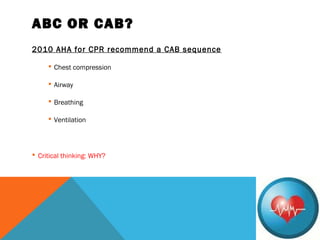
PEDIATRIC BASIC LIFE SUPPORT
PRESENTED BY : LOUIS VAN RENSBURG (ALS PARAMEDIC)
ABC OR CAB?
2010 AHA for CPR recommend a CAB sequence
 Chest compression
 Airway
 Breathing
 Ventilation
 Critical thinking: WHY?
CAB GUIDELINES
How do we classify age groups according to PALS ?
• Infant BSL guidelines apply to infants < approximately one year of age.
• Child BSL guidelines apply to children > 1 year until puberty (breast development in
girls and axillary hair in males)
• Adult BSL for puberty and above.
CHEST COMPRESSION
Compression Ventilation Ratio:
 15:2
 30:2
When would you use which ratio?
Rate of 100 compression per minute
Push hard: sufficient force to depress at least one third the anterior-
posterior diameter of the chest.
 1 ½ inches in infants (4 cm)
 2 inches in children (5 cm)
Allow chest recoil after each compression to allow the heart to refill with
blood
(NB Hands off time)
CHEST COMPRESSION
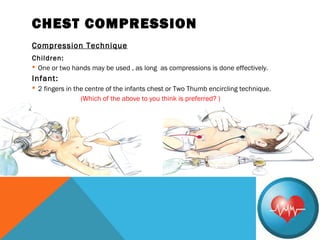
Compression Technique
Children:
 One or two hands may be used , as long as compressions is done effectively.
Infant:
 2 fingers in the centre of the infants chest or Two Thumb encircling technique.
(Which of the above to you think is preferred? )
VENTILATION / COMPRESSION
One rescuer: 30 :2
Two rescuer: 15:2
After initial 30 compression, open airway using a head tilt-chin lift and
give 2 breaths.
Note: if you use mouth to mouth, pinch off the nose.
Continue for approximately 2 minutes (about 5 cycles) before calling for
ERS and AED.
(Do you agree with the above statement)
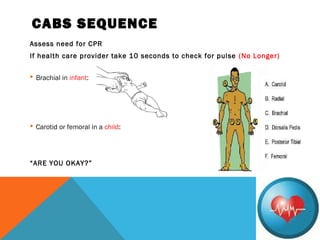
CABS SEQUENCE
Assess need for CPR
If health care provider take 10 seconds to check for pulse (No Longer)
 Brachial in infant:
 Carotid or femoral in a child:
“ARE YOU OKAY?”
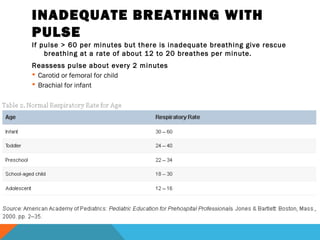
INADEQUATE BREATHING WITH
PULSE
If pulse > 60 per minutes but there is inadequate breathing give rescue
breathing at a rate of about 12 to 20 breathes per minute.
Reassess pulse about every 2 minutes
 Carotid or femoral for child
 Brachial for infant
UNRESPONSIVE AND NOT
BREATHING
If the child is unresponsive and not breathing (or only gasping) begin
CPR.
Start with high-quality chest compression. (30 chest compressions or
15 chest Compressions)
After one cycle 2 minutes check for pulses/re-asses
SEE PBLS ALGORITHM ON NEXT SLIDE
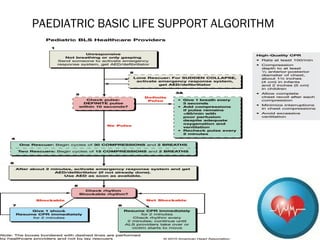
PAEDIATRIC BASIC LIFE SUPPORT ALGORITHM
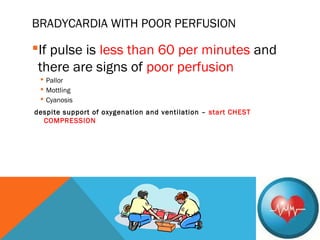
BRADYCARDIA WITH POOR PERFUSION
If pulse is less than 60 per minutes and
there are signs of poor perfusion
 Pallor
 Mottling
 Cyanosis
despite support of oxygenation and ventilation – start CHEST
COMPRESSION
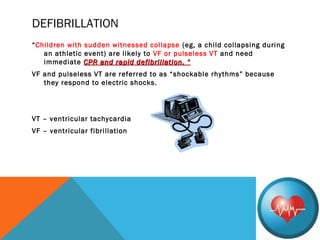
DEFIBRILLATION
“Children with sudden witnessed collapse (eg, a child collapsing during
an athletic event) are likely to VF or pulseless VT and need
immediate CPR and rapid defibrillation. “CPR and rapid defibrillation. “
VF and pulseless VT are referred to as “shockable rhythms” because
they respond to electric shocks.
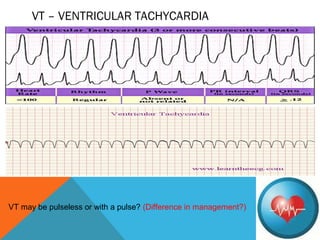
VT – ventricular tachycardia
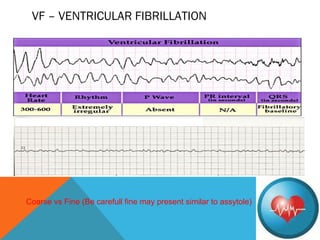
VF – ventricular fibrillation
VT – VENTRICULAR TACHYCARDIA
VT may be pulseless or with a pulse? (Difference in management?)
VF – VENTRICULAR FIBRILLATION
Coarse vs Fine (Be carefull fine may present similar to assytole)
DEFIBRILLATION DOSING
The recommended first energy dose for defibrillation is 2 J/kg.
If second dose is required, it should be doubled to 4 J/kg.
AED with pediatric attenuator is preferred for children < 8 years of age.
WEIGHT = (AGE * 2 ) + 8
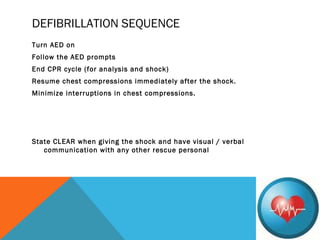
DEFIBRILLATION SEQUENCE
Turn AED on
Follow the AED prompts
End CPR cycle (for analysis and shock)
Resume chest compressions immediately after the shock.
Minimize interruptions in chest compressions.
State CLEAR when giving the shock and have visual / verbal
communication with any other rescue personal
ASPHYXIAL CARDIAC ARREST
Cardiac arrest caused by asphyxiation (lack of oxygen in blood)
• Carbon dioxide accumulates in the lungs while oxygen in the lungs is depleted
resulting in cardiac arrest.
• Causes: drowning, choking, airway obstruction, sepsis, shock. (Anything else.)
ASPHYXIAL CARDIAC ARREST
Ventilations over Compressions:
“One large pediatric study demonstrated that CPR with chest
compression and mouth-to-mouth rescue breathing is more effective
than compression alone when the arrest was from a noncardiac
etiology.”
“Ventilations are more important during resuscitation from asphysia-
induced arrest, than during resuscitation from VF or pulseless VT.”
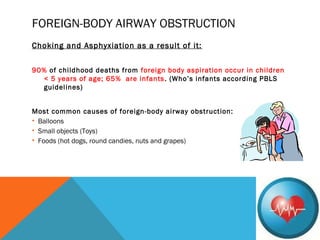
FOREIGN-BODY AIRWAY OBSTRUCTION
Choking and Asphyxiation as a result of it:
90% of childhood deaths from foreign body aspiration occur in children
< 5 years of age; 65% are infants. (Who’s infants according PBLS
guidelines)
Most common causes of foreign-body airway obstruction:
• Balloons
• Small objects (Toys)
• Foods (hot dogs, round candies, nuts and grapes)
FBAO WHAT TO DO NEXT?
If FBAO is mild, do not interfere.
 Allow the victim to clear the airway by coughing.
If the FBAO is severe (victim unable to make a sound) you must act the
relieve the obstruction.
FBAO
If FBAO is mild, do not interfere.
 Allow the victim to clear the airway by coughing.
If the FBAO is severe (victim unable to make a sound) you must act the
relieve the obstruction.
• Responsive Pt:
• Ask to cough, and don’t interfere with their own actions to remove object (unless
pt becomes unconscious. )
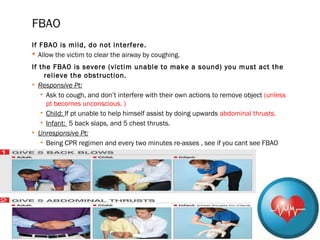
• Child: If pt unable to help himself assist by doing upwards abdominal thrusts.
• Infant: 5 back slaps, and 5 chest thrusts.
• Unresponsive Pt:
• Being CPR regimen and every two minutes re-asses , see if you cant see FBAO
FBAO – UNRESPONSIVE
• Start Chest Compression
• After 30 chest compressions open airway (NB look for object = FBAO)
• If you see a foreign body remove it
• DO NOT perform a blind finger sweep
• Give 2 breaths
• Followed by 30 chest compressions
Paediatric bls and choking algorithm

Paediatric bls and choking algorithm

  • 1.
    PEDIATRIC BASIC LIFESUPPORT PRESENTED BY : LOUIS VAN RENSBURG (ALS PARAMEDIC)
  • 2.
    ABC OR CAB? 2010AHA for CPR recommend a CAB sequence  Chest compression  Airway  Breathing  Ventilation  Critical thinking: WHY?
  • 3.
    CAB GUIDELINES How dowe classify age groups according to PALS ? • Infant BSL guidelines apply to infants < approximately one year of age. • Child BSL guidelines apply to children > 1 year until puberty (breast development in girls and axillary hair in males) • Adult BSL for puberty and above.
  • 4.
    CHEST COMPRESSION Compression VentilationRatio:  15:2  30:2 When would you use which ratio? Rate of 100 compression per minute Push hard: sufficient force to depress at least one third the anterior- posterior diameter of the chest.  1 ½ inches in infants (4 cm)  2 inches in children (5 cm) Allow chest recoil after each compression to allow the heart to refill with blood (NB Hands off time)
  • 5.
    CHEST COMPRESSION Compression Technique Children: One or two hands may be used , as long as compressions is done effectively. Infant:  2 fingers in the centre of the infants chest or Two Thumb encircling technique. (Which of the above to you think is preferred? )
  • 6.
    VENTILATION / COMPRESSION Onerescuer: 30 :2 Two rescuer: 15:2 After initial 30 compression, open airway using a head tilt-chin lift and give 2 breaths. Note: if you use mouth to mouth, pinch off the nose. Continue for approximately 2 minutes (about 5 cycles) before calling for ERS and AED. (Do you agree with the above statement)
  • 7.
    CABS SEQUENCE Assess needfor CPR If health care provider take 10 seconds to check for pulse (No Longer)  Brachial in infant:  Carotid or femoral in a child: “ARE YOU OKAY?”
  • 8.
    INADEQUATE BREATHING WITH PULSE Ifpulse > 60 per minutes but there is inadequate breathing give rescue breathing at a rate of about 12 to 20 breathes per minute. Reassess pulse about every 2 minutes  Carotid or femoral for child  Brachial for infant
  • 9.
    UNRESPONSIVE AND NOT BREATHING Ifthe child is unresponsive and not breathing (or only gasping) begin CPR. Start with high-quality chest compression. (30 chest compressions or 15 chest Compressions) After one cycle 2 minutes check for pulses/re-asses SEE PBLS ALGORITHM ON NEXT SLIDE
  • 10.
    PAEDIATRIC BASIC LIFESUPPORT ALGORITHM
  • 11.
    BRADYCARDIA WITH POORPERFUSION If pulse is less than 60 per minutes and there are signs of poor perfusion  Pallor  Mottling  Cyanosis despite support of oxygenation and ventilation – start CHEST COMPRESSION
  • 12.
    DEFIBRILLATION “Children with suddenwitnessed collapse (eg, a child collapsing during an athletic event) are likely to VF or pulseless VT and need immediate CPR and rapid defibrillation. “CPR and rapid defibrillation. “ VF and pulseless VT are referred to as “shockable rhythms” because they respond to electric shocks. VT – ventricular tachycardia VF – ventricular fibrillation
  • 13.
    VT – VENTRICULARTACHYCARDIA VT may be pulseless or with a pulse? (Difference in management?)
  • 14.
    VF – VENTRICULARFIBRILLATION Coarse vs Fine (Be carefull fine may present similar to assytole)
  • 15.
    DEFIBRILLATION DOSING The recommendedfirst energy dose for defibrillation is 2 J/kg. If second dose is required, it should be doubled to 4 J/kg. AED with pediatric attenuator is preferred for children < 8 years of age. WEIGHT = (AGE * 2 ) + 8
  • 16.
    DEFIBRILLATION SEQUENCE Turn AEDon Follow the AED prompts End CPR cycle (for analysis and shock) Resume chest compressions immediately after the shock. Minimize interruptions in chest compressions. State CLEAR when giving the shock and have visual / verbal communication with any other rescue personal
  • 17.
    ASPHYXIAL CARDIAC ARREST Cardiacarrest caused by asphyxiation (lack of oxygen in blood) • Carbon dioxide accumulates in the lungs while oxygen in the lungs is depleted resulting in cardiac arrest. • Causes: drowning, choking, airway obstruction, sepsis, shock. (Anything else.)
  • 18.
    ASPHYXIAL CARDIAC ARREST Ventilationsover Compressions: “One large pediatric study demonstrated that CPR with chest compression and mouth-to-mouth rescue breathing is more effective than compression alone when the arrest was from a noncardiac etiology.” “Ventilations are more important during resuscitation from asphysia- induced arrest, than during resuscitation from VF or pulseless VT.”
  • 19.
    FOREIGN-BODY AIRWAY OBSTRUCTION Chokingand Asphyxiation as a result of it: 90% of childhood deaths from foreign body aspiration occur in children < 5 years of age; 65% are infants. (Who’s infants according PBLS guidelines) Most common causes of foreign-body airway obstruction: • Balloons • Small objects (Toys) • Foods (hot dogs, round candies, nuts and grapes)
  • 20.
    FBAO WHAT TODO NEXT? If FBAO is mild, do not interfere.  Allow the victim to clear the airway by coughing. If the FBAO is severe (victim unable to make a sound) you must act the relieve the obstruction.
  • 21.
    FBAO If FBAO ismild, do not interfere.  Allow the victim to clear the airway by coughing. If the FBAO is severe (victim unable to make a sound) you must act the relieve the obstruction. • Responsive Pt: • Ask to cough, and don’t interfere with their own actions to remove object (unless pt becomes unconscious. ) • Child: If pt unable to help himself assist by doing upwards abdominal thrusts. • Infant: 5 back slaps, and 5 chest thrusts. • Unresponsive Pt: • Being CPR regimen and every two minutes re-asses , see if you cant see FBAO
  • 22.
    FBAO – UNRESPONSIVE •Start Chest Compression • After 30 chest compressions open airway (NB look for object = FBAO) • If you see a foreign body remove it • DO NOT perform a blind finger sweep • Give 2 breaths • Followed by 30 chest compressions