BLS
BASIC LIFE SUPPORT
General Concepts
• 350000 cardiac arrests per year in US
• Survival to hospital 5-10%
• Early resuscitation and prompt defibrillation (within 1-2 minutes) can result in >60%
survival
• Bystander CPR- vital intervention before arrival of emergency services
Chain Of Survival
• Adult Chain Of Survival
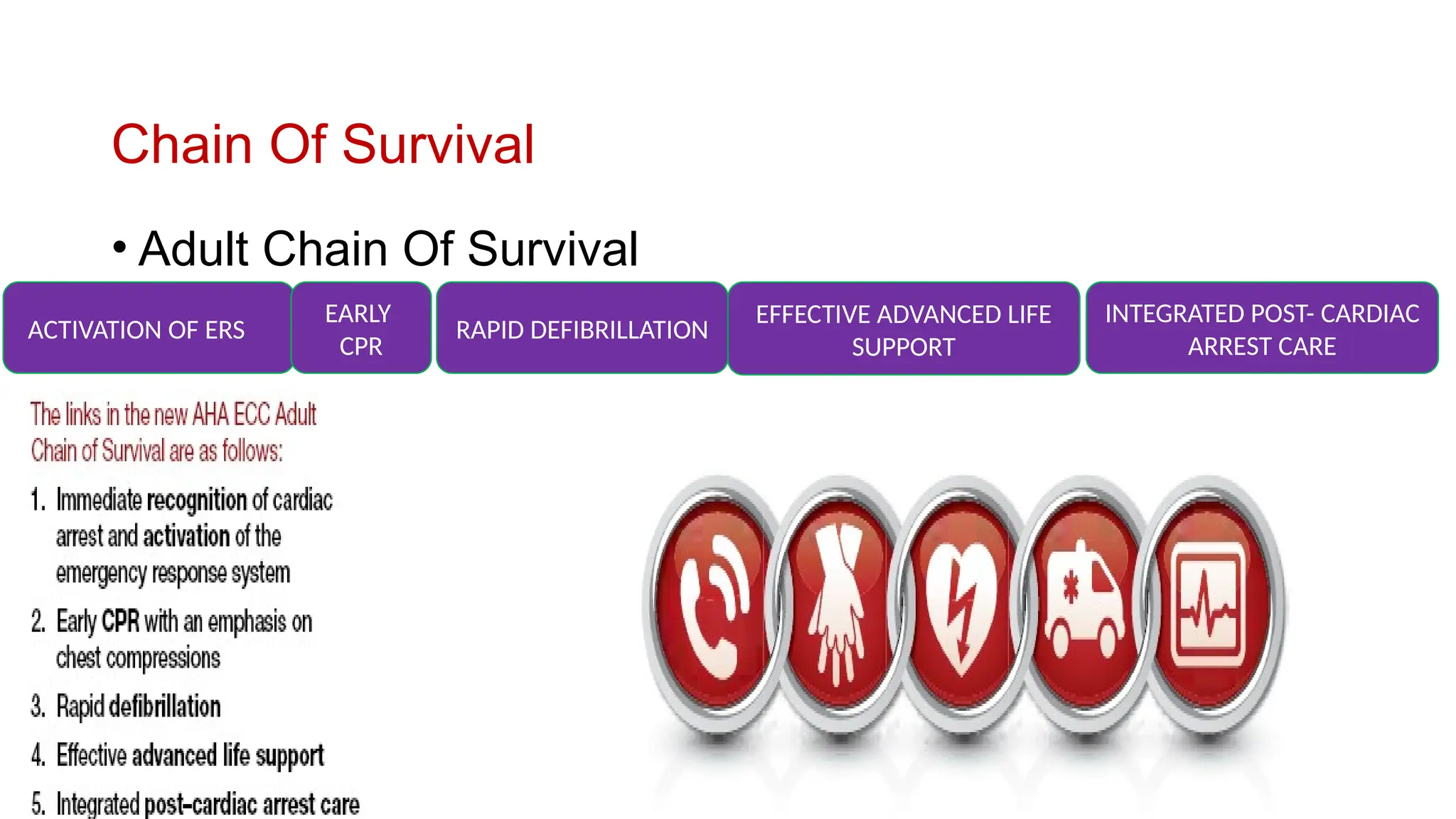
ACTIVATION OF ERS
EARLY
CPR
RAPID DEFIBRILLATION
EFFECTIVE ADVANCED LIFE
SUPPORT
INTEGRATED POST- CARDIAC
ARREST CARE
Chain Of Survival
• Paediatric Chain of Survival
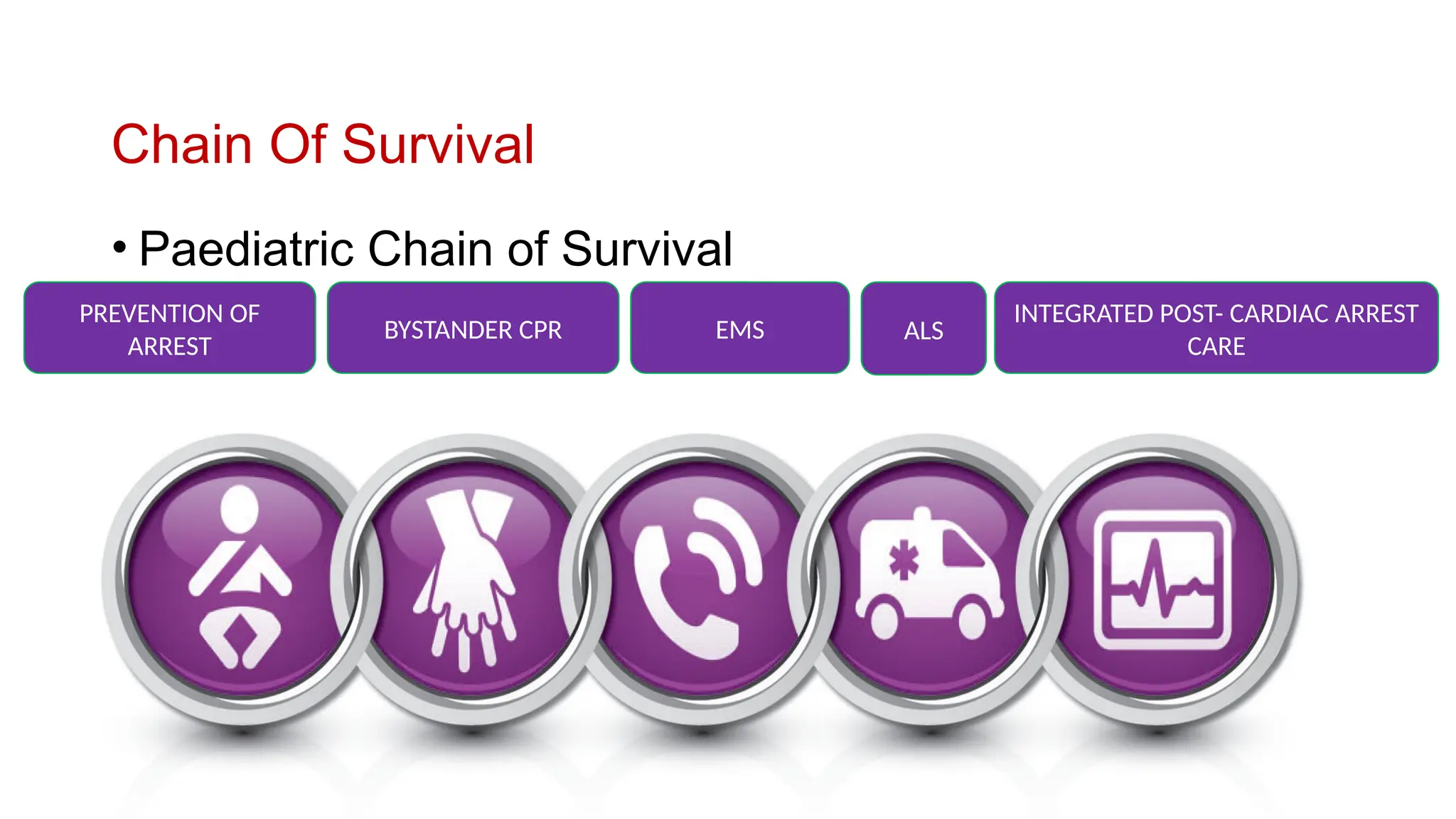
PREVENTION OF
ARREST
BYSTANDER CPR EMS ALS
INTEGRATED POST- CARDIAC ARREST
CARE
Adult Basic Life Support
Activation of Emergency response system
• Activate emergency response system
after checking for responsiveness
• Retrieve AED if available (or send someone to do so)
• Begin CPR if pulse not felt within 10 seconds
2010 AHA Guidelines: Change of Sequence
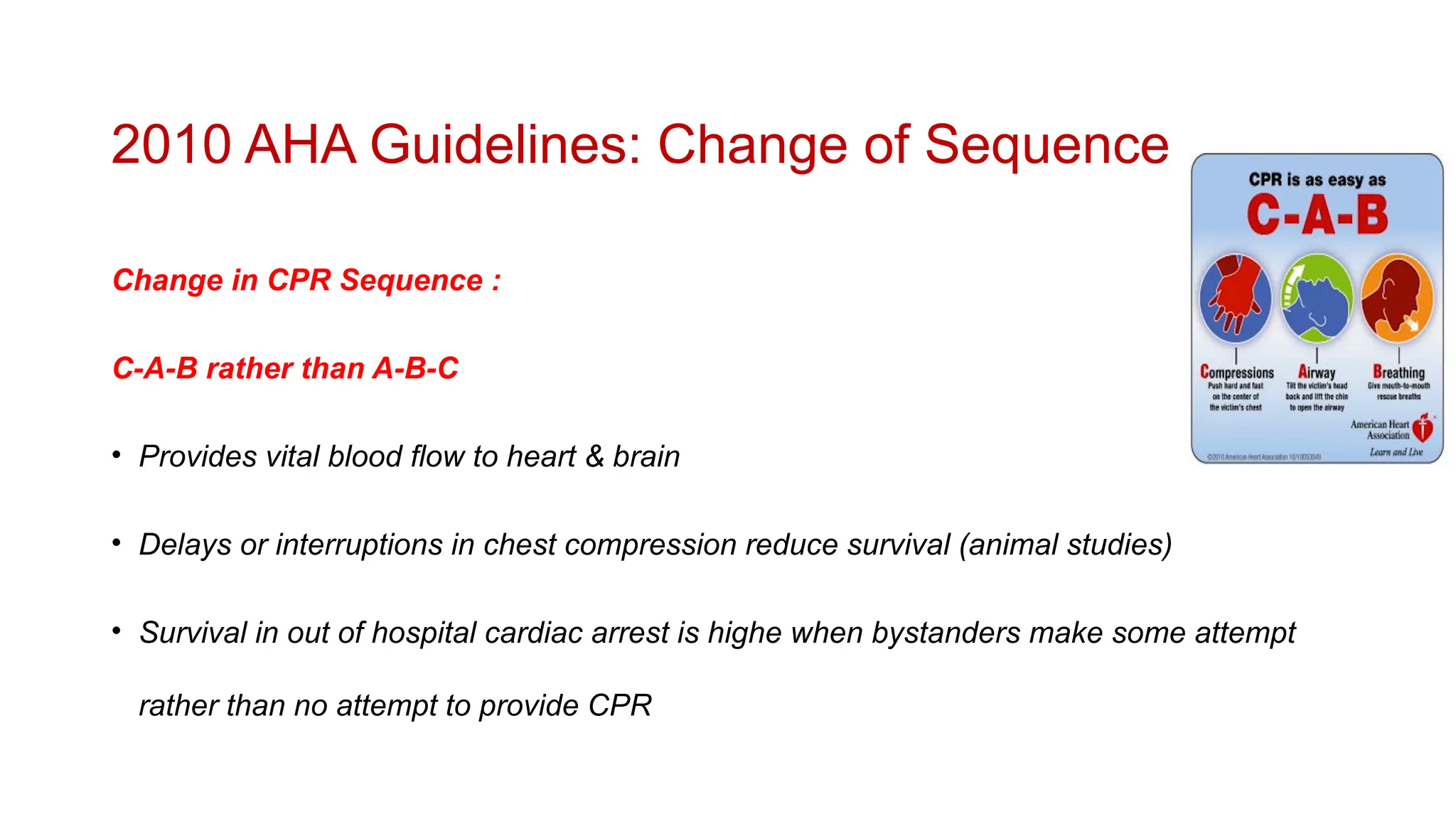
C
A
B
2010 AHA Guidelines: Change of Sequence
Change in CPR Sequence :
C-A-B rather than A-B-C
• Provides vital blood flow to heart & brain
• Delays or interruptions in chest compression reduce survival (animal studies)
• Survival in out of hospital cardiac arrest is highe when bystanders make some attempt
rather than no attempt to provide CPR
High Quality CPR
Chest compression rate : at least 100 per minute
• Number of chest compressions per minute is important determinant of ROSC
• More compressions are associated with high survival rate
• Minimum interruptions in chest compressions
Chest compression depth : atleast 2 inches
• Compressions create blood flow by ↑ intrathoracic pressure & directly compressing the heart
• Compression of at least 2 inches more effective than 11
/2 inches
PUSH HARD , PUSH FAST AND ALLOW COMPLETE CHEST RECOIL WITH MINIMAL
INTERRUPTIONS
Look Listen Feel- No
Elimination of “Look , Listen, & Feel for breathing”
• CPR is performed if the adult is unresponsive & not breathing or not breathing normally
• Breathing is briefly checked as a part of check for cardiac arrest
Adult BLS
Adult BLS
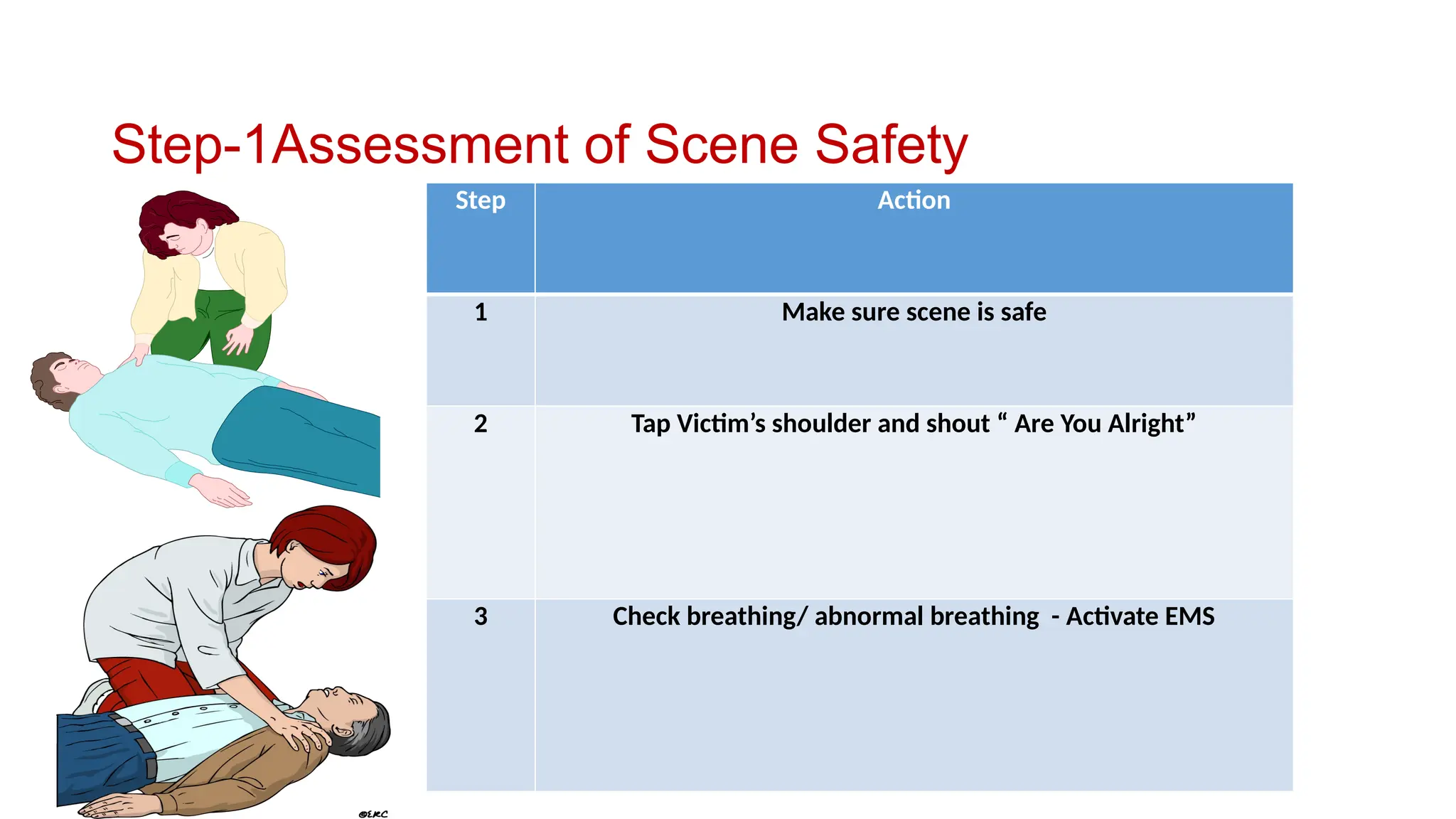
Step-1Assessment of Scene Safety
Step Action
1 Make sure scene is safe
2 Tap Victim’s shoulder and shout “ Are You Alright”
3 Check breathing/ abnormal breathing - Activate EMS
Step 2- Activate ERS, Get AED
Step-3 Pulse Check
Step Action
1 Locate the trachea, using 2 or 3 fingers
2 Slide these 2 or 3 fingers into the groove between the trachea and the muscles at the side of the neck, where you can
feel the carotid pulse
3 Feel for a pulse for at least 5 but no more than 10 seconds. If you do not definitely feel a pulse, begin CPR, starting with
chest compressions (C-A-B sequence).
Step-4 Begin 30:2
• Lone rescuer 30 compressions/ 2 breaths- Any age
• At least 100 compressions per minute
Chest Compression Techniques
Alternate Technique: Chest Compressions
• if you have difficulty pushing deeply during compressions,
• Put one hand on the breastbone to push on the chest. Grasp the wrist of that hand with
your other hand to support the first hand as it pushes the chest .
Move Victim When Necessary
• Do not move the victim while CPR is in progress unless the victim is in a dangerous
environment (such as a burning building)
• Or if you believe you cannot perform CPR effectively in the victim’s present position or
location.
• CPR is better and has fewer interruptions when rescuers perform the resuscitation where
they find the victim.
Opening The Airway: Head Tilt Chin Lift
Ste
p
Action
1 Place hand on victim’s forehead and push with your
palm to tilt the head back
2 Place the fingers of the other hand under the bony part
of the lower jaw near the chin
3 Lift the jaw to bring the chin forward
Mouth to Mouth Barrier Devices
• Masks
• Shields
Breathing: Mouth To Nose (when to use)
• Can’t open mouth
• Can’t make a good seal
• Severely injured mouth
• Stomach distension
• Mouth to stoma (tracheotomy)
2 Rescuer Adult Sequence
Rescuer Location Duties
Rescuer1 At the victim’s side • Perform chest compressions.
— Compress the chest at least 2 inches (5 cm).
— Compress at a rate of at least 100/mm.
— Allow the chest to recoil completely after each compression.
— Minimize interruptions in compressions (try to limit any interruptions in chest
compressions to <10 seconds).
— Use a compressions-to-breaths ratio of 30:2.
— Count compressions aloud.
• Switch duties with the second rescuer every 5 cycles or about 2 minutes, taking <5
seconds to switch.
2 Rescuer Adult Sequence
Rescuer Location Duties
Rescuer2 At the victim’s head Maintain an open airway using either
— Head tilt—chin lift
— Jaw thrust
• Give breaths, watching for chest rise and avoiding excessive ventilation.
• Encourage the first rescuer to perform compressions that are deep enough and fast
enough and to allow complete chest recoil between compressions.
• Switch duties with the first rescuer every 5 cycles or about 2 minutes, taking <5 seconds
to switch.
Jaw Thrust
AED – Adults & Children Above 8 Yrs
• The interval from collapse to defibrillation is one of the most important determinants of survival
from sudden cardiac arrest with ventricular fibrillation or pulseless ventricular tachycardia.
• Automated external defibrillators (AEDs) are computerized devices that can identify cardiac
rhythms that need a shock.
• They can then deliver the shock.
• AEDs are simple to operate, allowing laypersons and healthcare providers to attempt
defibrillation safely.
AED – Adults & Children Above 8 Yrs
• Keeping the time between the last compression and shock delivery to 10 seconds or less,
the shock is much more likely to be effective (ie, to eliminate ventricular fibrillation and
result in return of spontaneous circulation).
• Effectiveness of shock delivery decreases significantly for every additional 10 seconds
that elapses between last compression and shock delivery.
2 Rescuer BLS Sequence With An AED
Second rescuer
places AED
beside victim
Operator turns
AED on
Attach electrode pads to
the victim and then attach
the electrodes to the AED.
The operator clears the
victim before delivering
a shock. B. When
everyone is clear of the
victim, the operator
presses the SHOCK
button.
Start CPR beginning
with chest
compressions
BLS/CPR – Children 1 Yr To Puberty
• Compression-ventilation ratio for 2-rescuer CPR: 15:2 ratio for 2-rescuer child CPR
• Compression depth: For children, compress at least one third the depth of the chest,
approximately 2 inches (5 cm)
• Compression technique: May use 1- or 2-handed chest compressions for very small children
• When to activate the emergency response system:
• If you did not witness the arrest and are alone, provide 2 minutes of CPR before leaving
the child to activate the emergency response system and get the AED (or defibrillator).
• If the arrest is sudden and witnessed, leave the child to activate the emergency response
system and get the AED (or defibrillator), and then return to the child.
2 Rescuer Child BLS Sequence
Step Action
1 Check the child for a response and check breathing. If there is no response and no breathing or only gasping, the
second rescuer activates the emergency response system
2 Check the child’s pulse (take at least 5 but no more than 10 seconds). You may try to feel the child’s carotid or femoral
pulse.
3 If within 10 seconds you don’t definitely feel a pulse or if, despite adequate oxygenation and ventilation, the heart
rate is <60/mm with signs of poor perfusion, perform cycles of compressions and breaths (30:2 ratio). When
the second rescuer arrives, use a compressions-to-breaths ratio of 15:2.
Importance of Breaths In Children And Infants
• Typical cardiac arrest in an adult, the oxygen content of the blood is typically normal, so
compressions alone may maintain adequate oxygen delivery to the heart and brain for the first few
minutes after arrest.
• In contrast, infants and children who develop cardiac arrest often have respiratory failure or shock
that reduces the oxygen content in the blood even before the onset of arrest.
• Chest compressions alone are not as effective for delivering oxygen to the heart and brain as the
combination of compressions plus breaths.
• Extremely important to give both compressions and breaths for infants and children during CPR.
BLS/CPR – Infants
• The key differences for infant BLS are
• The location of pulse check: brachial artery in infants
• Technique of delivering compressions: 2 fingers for single rescuer and 2 thumb—encircling
hands technique for 2 rescuers
• Compression depth: at least one third the chest depth, approximately 11/2 inches (4 cm)
• Compression-ventilation rate and ratio for 2 rescuers: same as for child—15:2 ratio for 2
rescuers
BLS/CPR – Infants
Rescue Breathing
Relief of Choking : Responsive Adult/Children
Relief of Choking : Unresponsive Adult/Children
Relief of choking responsive infants
Relief of choking unresponsive infants
Injuries Related to CPR
• Fractures
• Rib
• The sternal tip
• Lacerations
• Liver,
• lung,
• spleen
POST CARDIAC ARREST CARE
The initial objectives of post– cardiac arrest care are to
● Optimize cardiopulmonary function and vital organ perfusion.
● Transport patient for comprehensive post–cardiac arrest treatment system of care that
includes acute coronary interventions, neurological care, goal-directed critical care, and
hypothermia.
● Transport the in-hospital post– cardiac arrest patient to an appropriate critical-care unit
capable of providing comprehensive post– cardiac arrest care.
● Try to identify and treat the precipitating causes of the arrest and prevent recurrent arrest.
Conclusion:Critical Concepts
• Compression- Within 10 Secs Of Recognition Of Cardiac Arrest
• Push Hard Push Fast:
• Compression @ 100/Min
• Depth- 2 Inches/ 1.5 Inch(inf)
• Allow Complete Chest Recoil
• Interruptions – Minimum
• Effective Breaths- Chest Rise
• Avoid Excessive Ventilation
THANK YOU

Basic life support steps as per AHA FINAL.pptx

  • 1.
  • 2.
    General Concepts • 350000cardiac arrests per year in US • Survival to hospital 5-10% • Early resuscitation and prompt defibrillation (within 1-2 minutes) can result in >60% survival • Bystander CPR- vital intervention before arrival of emergency services
  • 3.
    Chain Of Survival •Adult Chain Of Survival ACTIVATION OF ERS EARLY CPR RAPID DEFIBRILLATION EFFECTIVE ADVANCED LIFE SUPPORT INTEGRATED POST- CARDIAC ARREST CARE
  • 4.
    Chain Of Survival •Paediatric Chain of Survival PREVENTION OF ARREST BYSTANDER CPR EMS ALS INTEGRATED POST- CARDIAC ARREST CARE
  • 5.
    Adult Basic LifeSupport Activation of Emergency response system • Activate emergency response system after checking for responsiveness • Retrieve AED if available (or send someone to do so) • Begin CPR if pulse not felt within 10 seconds
  • 6.
    2010 AHA Guidelines:Change of Sequence C A B
  • 7.
    2010 AHA Guidelines:Change of Sequence Change in CPR Sequence : C-A-B rather than A-B-C • Provides vital blood flow to heart & brain • Delays or interruptions in chest compression reduce survival (animal studies) • Survival in out of hospital cardiac arrest is highe when bystanders make some attempt rather than no attempt to provide CPR
  • 8.
    High Quality CPR Chestcompression rate : at least 100 per minute • Number of chest compressions per minute is important determinant of ROSC • More compressions are associated with high survival rate • Minimum interruptions in chest compressions
  • 9.
    Chest compression depth: atleast 2 inches • Compressions create blood flow by ↑ intrathoracic pressure & directly compressing the heart • Compression of at least 2 inches more effective than 11 /2 inches PUSH HARD , PUSH FAST AND ALLOW COMPLETE CHEST RECOIL WITH MINIMAL INTERRUPTIONS
  • 10.
    Look Listen Feel-No Elimination of “Look , Listen, & Feel for breathing” • CPR is performed if the adult is unresponsive & not breathing or not breathing normally • Breathing is briefly checked as a part of check for cardiac arrest
  • 11.
  • 12.
  • 13.
    Step-1Assessment of SceneSafety Step Action 1 Make sure scene is safe 2 Tap Victim’s shoulder and shout “ Are You Alright” 3 Check breathing/ abnormal breathing - Activate EMS
  • 14.
    Step 2- ActivateERS, Get AED
  • 15.
    Step-3 Pulse Check StepAction 1 Locate the trachea, using 2 or 3 fingers 2 Slide these 2 or 3 fingers into the groove between the trachea and the muscles at the side of the neck, where you can feel the carotid pulse 3 Feel for a pulse for at least 5 but no more than 10 seconds. If you do not definitely feel a pulse, begin CPR, starting with chest compressions (C-A-B sequence).
  • 16.
    Step-4 Begin 30:2 •Lone rescuer 30 compressions/ 2 breaths- Any age • At least 100 compressions per minute
  • 17.
  • 18.
    Alternate Technique: ChestCompressions • if you have difficulty pushing deeply during compressions, • Put one hand on the breastbone to push on the chest. Grasp the wrist of that hand with your other hand to support the first hand as it pushes the chest .
  • 19.
    Move Victim WhenNecessary • Do not move the victim while CPR is in progress unless the victim is in a dangerous environment (such as a burning building) • Or if you believe you cannot perform CPR effectively in the victim’s present position or location. • CPR is better and has fewer interruptions when rescuers perform the resuscitation where they find the victim.
  • 20.
    Opening The Airway:Head Tilt Chin Lift Ste p Action 1 Place hand on victim’s forehead and push with your palm to tilt the head back 2 Place the fingers of the other hand under the bony part of the lower jaw near the chin 3 Lift the jaw to bring the chin forward
  • 21.
    Mouth to MouthBarrier Devices • Masks • Shields
  • 22.
    Breathing: Mouth ToNose (when to use) • Can’t open mouth • Can’t make a good seal • Severely injured mouth • Stomach distension • Mouth to stoma (tracheotomy)
  • 23.
    2 Rescuer AdultSequence Rescuer Location Duties Rescuer1 At the victim’s side • Perform chest compressions. — Compress the chest at least 2 inches (5 cm). — Compress at a rate of at least 100/mm. — Allow the chest to recoil completely after each compression. — Minimize interruptions in compressions (try to limit any interruptions in chest compressions to <10 seconds). — Use a compressions-to-breaths ratio of 30:2. — Count compressions aloud. • Switch duties with the second rescuer every 5 cycles or about 2 minutes, taking <5 seconds to switch.
  • 24.
    2 Rescuer AdultSequence Rescuer Location Duties Rescuer2 At the victim’s head Maintain an open airway using either — Head tilt—chin lift — Jaw thrust • Give breaths, watching for chest rise and avoiding excessive ventilation. • Encourage the first rescuer to perform compressions that are deep enough and fast enough and to allow complete chest recoil between compressions. • Switch duties with the first rescuer every 5 cycles or about 2 minutes, taking <5 seconds to switch.
  • 25.
  • 26.
    AED – Adults& Children Above 8 Yrs • The interval from collapse to defibrillation is one of the most important determinants of survival from sudden cardiac arrest with ventricular fibrillation or pulseless ventricular tachycardia. • Automated external defibrillators (AEDs) are computerized devices that can identify cardiac rhythms that need a shock. • They can then deliver the shock. • AEDs are simple to operate, allowing laypersons and healthcare providers to attempt defibrillation safely.
  • 27.
    AED – Adults& Children Above 8 Yrs • Keeping the time between the last compression and shock delivery to 10 seconds or less, the shock is much more likely to be effective (ie, to eliminate ventricular fibrillation and result in return of spontaneous circulation). • Effectiveness of shock delivery decreases significantly for every additional 10 seconds that elapses between last compression and shock delivery.
  • 28.
    2 Rescuer BLSSequence With An AED Second rescuer places AED beside victim Operator turns AED on Attach electrode pads to the victim and then attach the electrodes to the AED. The operator clears the victim before delivering a shock. B. When everyone is clear of the victim, the operator presses the SHOCK button. Start CPR beginning with chest compressions
  • 29.
    BLS/CPR – Children1 Yr To Puberty • Compression-ventilation ratio for 2-rescuer CPR: 15:2 ratio for 2-rescuer child CPR • Compression depth: For children, compress at least one third the depth of the chest, approximately 2 inches (5 cm) • Compression technique: May use 1- or 2-handed chest compressions for very small children • When to activate the emergency response system: • If you did not witness the arrest and are alone, provide 2 minutes of CPR before leaving the child to activate the emergency response system and get the AED (or defibrillator). • If the arrest is sudden and witnessed, leave the child to activate the emergency response system and get the AED (or defibrillator), and then return to the child.
  • 30.
    2 Rescuer ChildBLS Sequence Step Action 1 Check the child for a response and check breathing. If there is no response and no breathing or only gasping, the second rescuer activates the emergency response system 2 Check the child’s pulse (take at least 5 but no more than 10 seconds). You may try to feel the child’s carotid or femoral pulse. 3 If within 10 seconds you don’t definitely feel a pulse or if, despite adequate oxygenation and ventilation, the heart rate is <60/mm with signs of poor perfusion, perform cycles of compressions and breaths (30:2 ratio). When the second rescuer arrives, use a compressions-to-breaths ratio of 15:2.
  • 31.
    Importance of BreathsIn Children And Infants • Typical cardiac arrest in an adult, the oxygen content of the blood is typically normal, so compressions alone may maintain adequate oxygen delivery to the heart and brain for the first few minutes after arrest. • In contrast, infants and children who develop cardiac arrest often have respiratory failure or shock that reduces the oxygen content in the blood even before the onset of arrest. • Chest compressions alone are not as effective for delivering oxygen to the heart and brain as the combination of compressions plus breaths. • Extremely important to give both compressions and breaths for infants and children during CPR.
  • 32.
    BLS/CPR – Infants •The key differences for infant BLS are • The location of pulse check: brachial artery in infants • Technique of delivering compressions: 2 fingers for single rescuer and 2 thumb—encircling hands technique for 2 rescuers • Compression depth: at least one third the chest depth, approximately 11/2 inches (4 cm) • Compression-ventilation rate and ratio for 2 rescuers: same as for child—15:2 ratio for 2 rescuers
  • 33.
  • 34.
  • 35.
    Relief of Choking: Responsive Adult/Children
  • 36.
    Relief of Choking: Unresponsive Adult/Children
  • 37.
    Relief of chokingresponsive infants
  • 38.
    Relief of chokingunresponsive infants
  • 39.
    Injuries Related toCPR • Fractures • Rib • The sternal tip • Lacerations • Liver, • lung, • spleen
  • 40.
    POST CARDIAC ARRESTCARE The initial objectives of post– cardiac arrest care are to ● Optimize cardiopulmonary function and vital organ perfusion. ● Transport patient for comprehensive post–cardiac arrest treatment system of care that includes acute coronary interventions, neurological care, goal-directed critical care, and hypothermia. ● Transport the in-hospital post– cardiac arrest patient to an appropriate critical-care unit capable of providing comprehensive post– cardiac arrest care. ● Try to identify and treat the precipitating causes of the arrest and prevent recurrent arrest.
  • 43.
    Conclusion:Critical Concepts • Compression-Within 10 Secs Of Recognition Of Cardiac Arrest • Push Hard Push Fast: • Compression @ 100/Min • Depth- 2 Inches/ 1.5 Inch(inf) • Allow Complete Chest Recoil • Interruptions – Minimum • Effective Breaths- Chest Rise • Avoid Excessive Ventilation
  • 46.

Editor's Notes

  • #23 If you are alone and find an unresponsive victim not breathing, shout for help. If no one responds, activate the emergency response system, get an AED (or defibrillator) if avail able, and then return to the victim to check a pulse and begin CPR (C-A-B sequence).
  • #24 To perform a pulse check in the adult, palpate a carotid pulse If you do not definitely feel a pulse within 10 seconds, start chest compressions.
  • #31 The risk of infection from CPR is extremely low and limited to a few case reports, but the US Occupational Safety and Health Administration (OSHA) requires that healthcare workers use standard precautions in the workplace, including during CPR.
  • #58 In infants, the recommended compression depth is at least one third of the anterior-posterior depth of the infant’s chest, or approximately 1½ inches (4 cm). This is different from compression depth for both adults (at least 2 inches) and children (at least one third the depth of the chest, approximately 2 inches [5 cm]).