
SUBMITED TO:
DR. Dalip Kumar
SUBMITED BY:
ASHISH (2015A14BVI)
Marketing
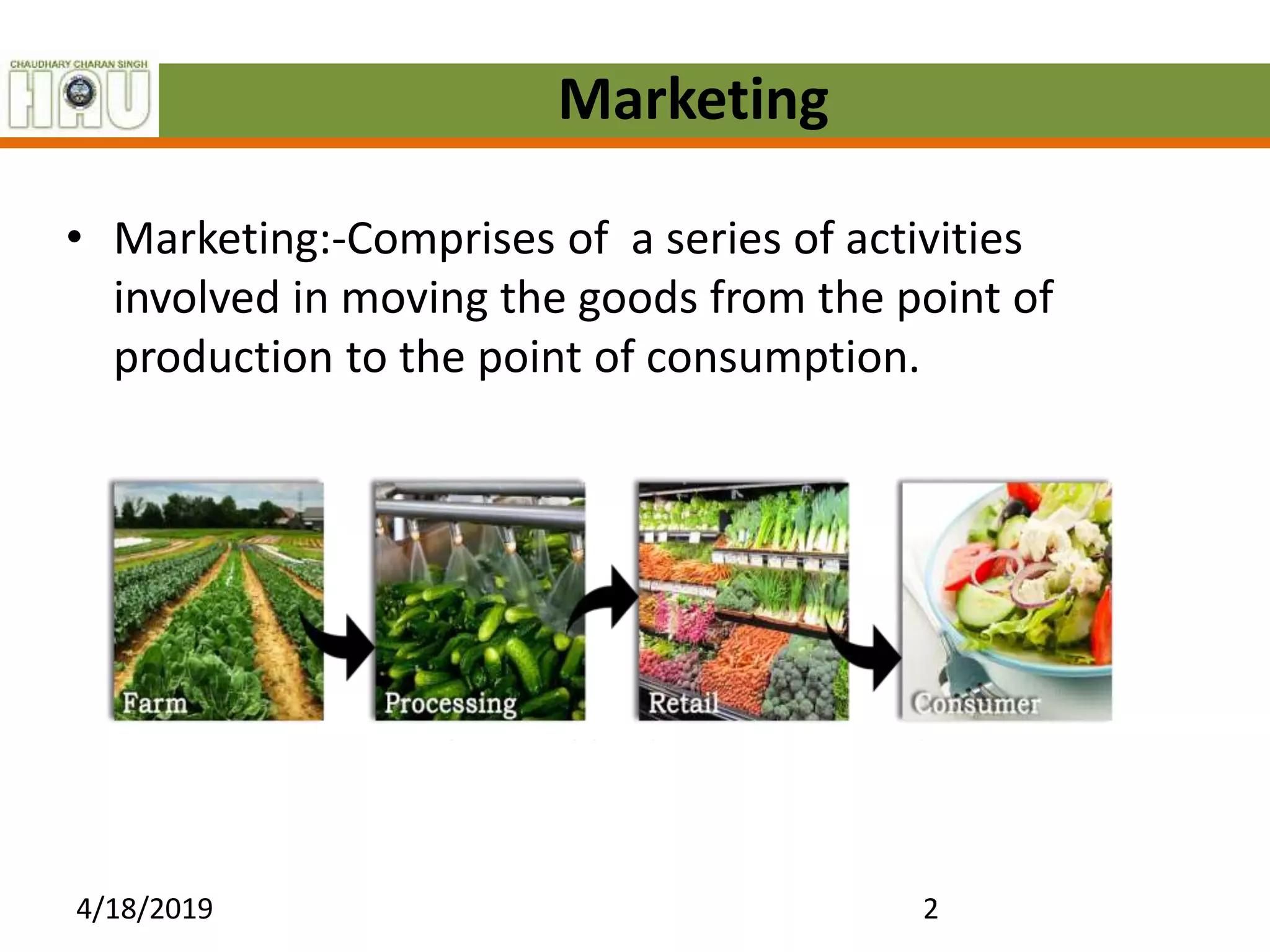
• Marketing:-Comprises of a series of activities
involved in moving the goods from the point of
production to the point of consumption.
4/18/2019 2
Marketing
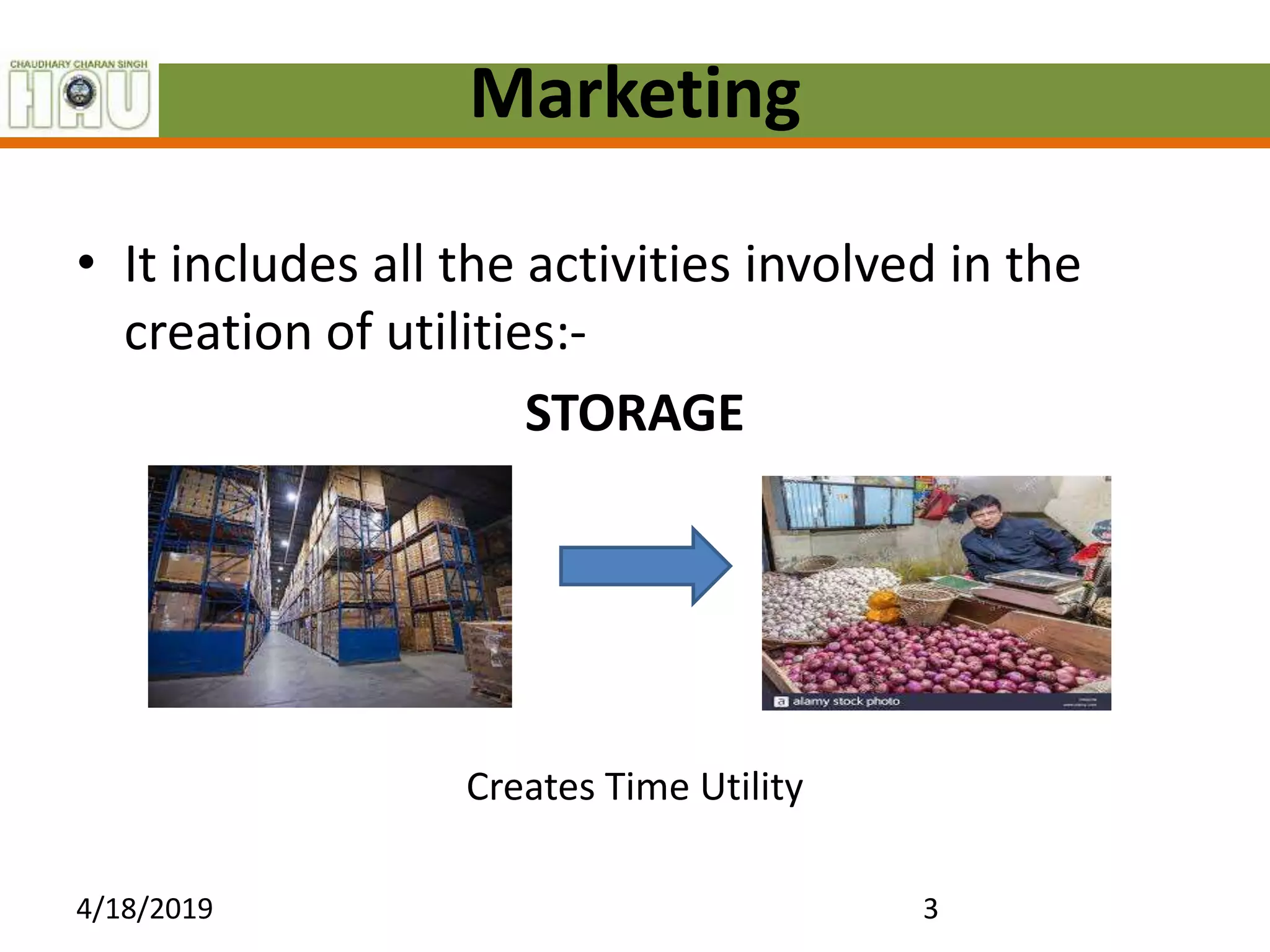
• It includes all the activities involved in the
creation of utilities:-
STORAGE
Creates Time Utility
4/18/2019 3
Marketing
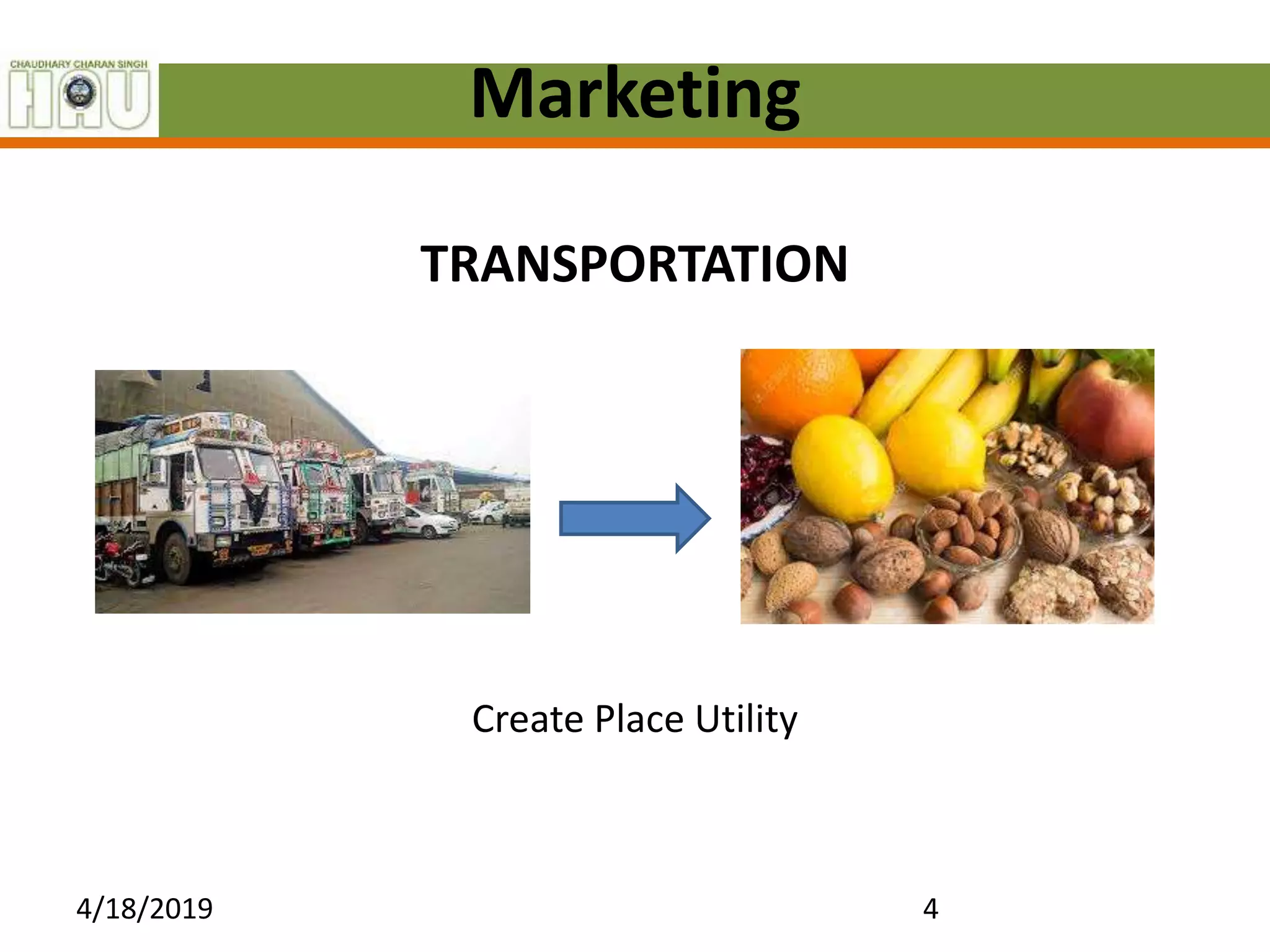
TRANSPORTATION
Create Place Utility
4/18/2019 4
Marketing
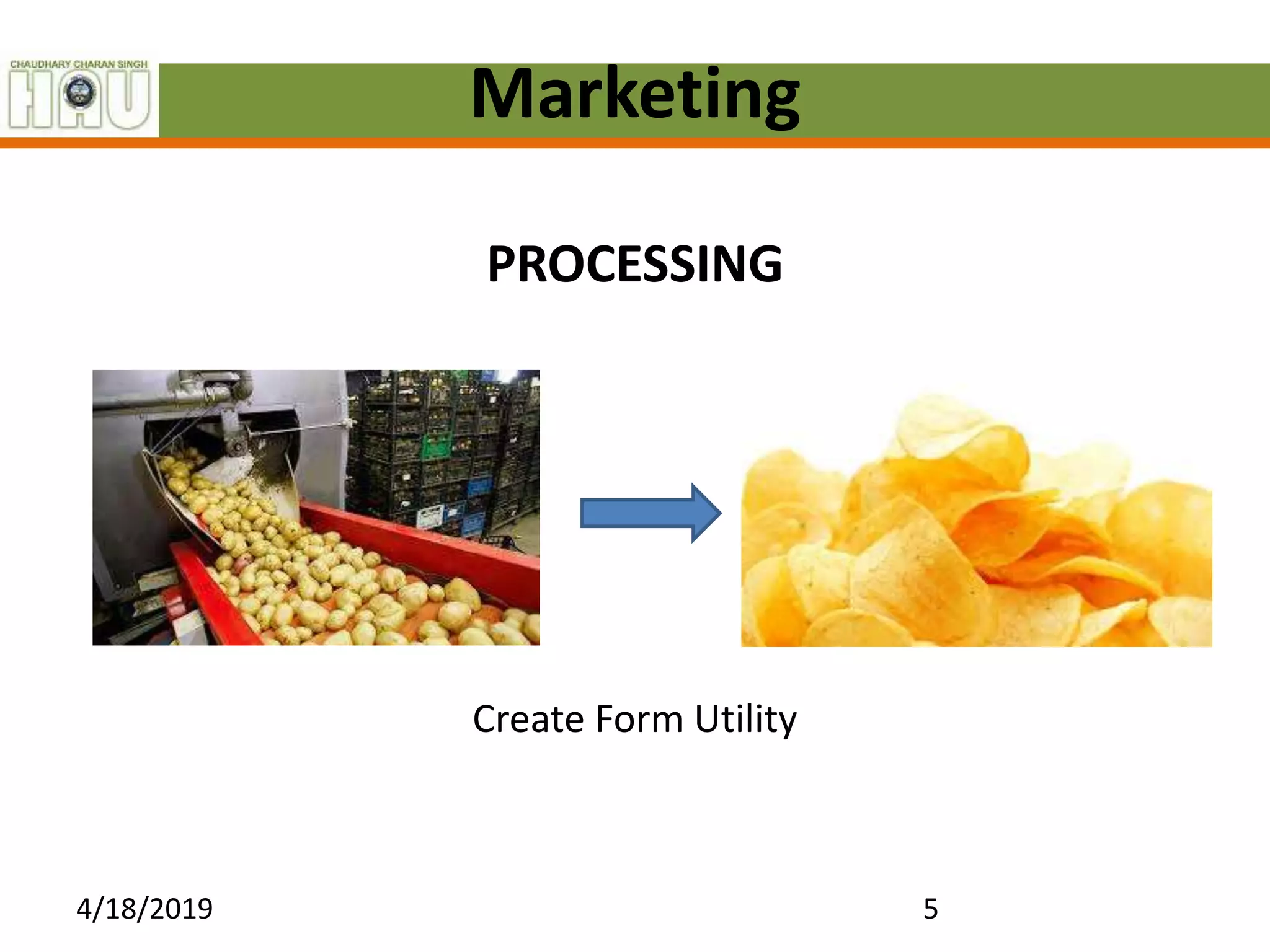
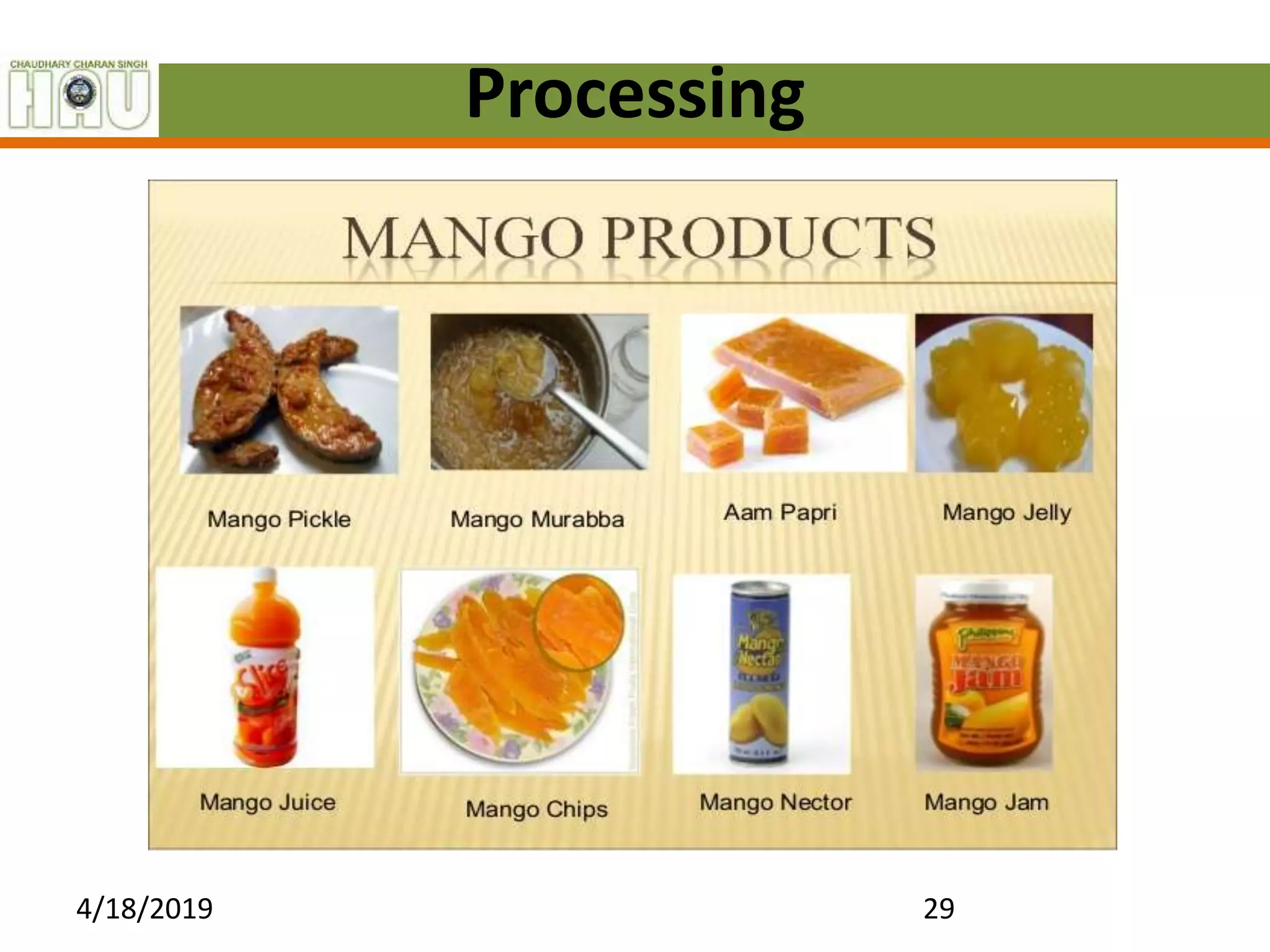
PROCESSING
Create Form Utility
4/18/2019 5
Marketing
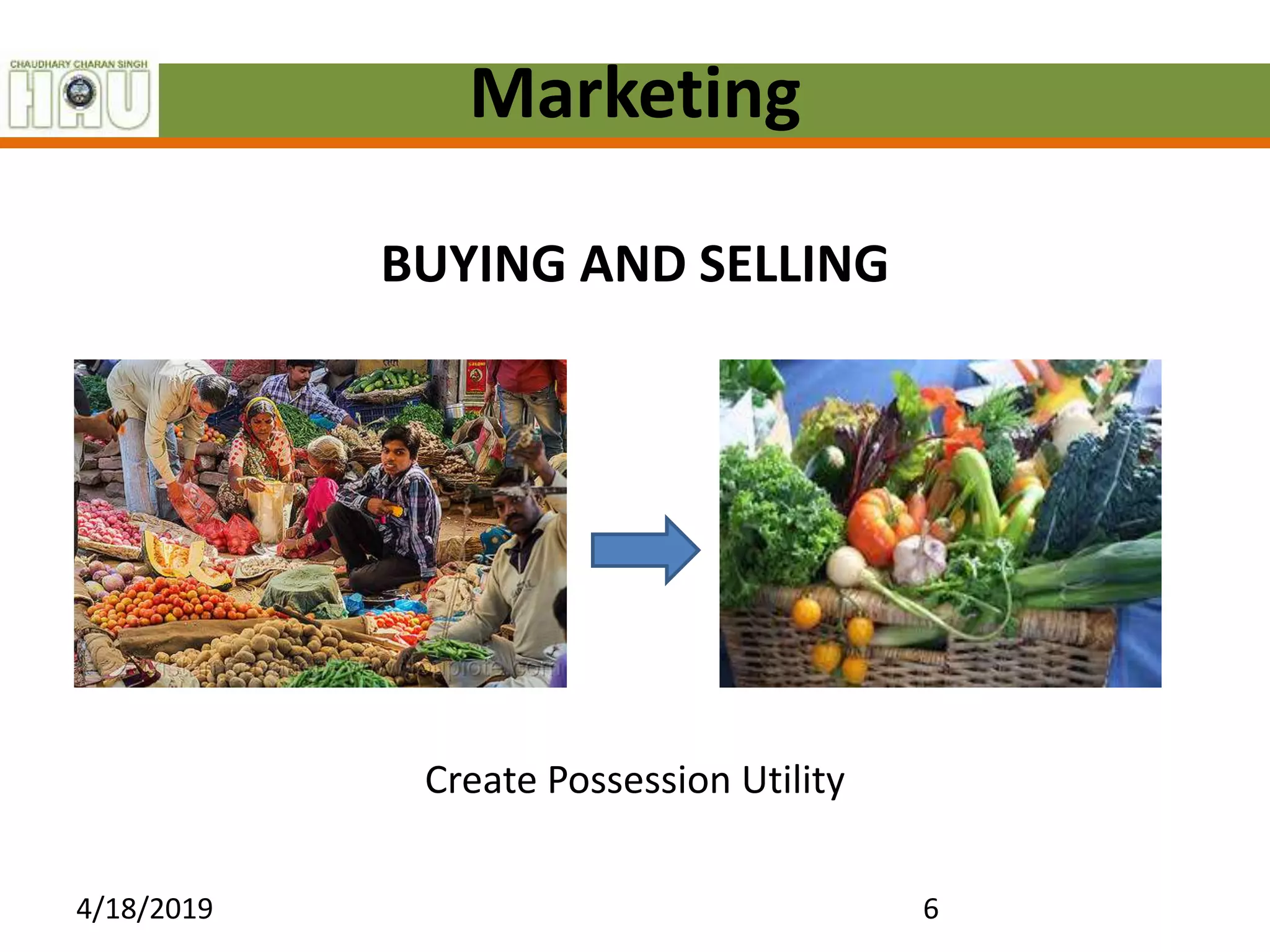
BUYING AND SELLING
Create Possession Utility
4/18/2019 6
Marketing Functions
Marketing Functions:- Any single activity performed in
carrying a product from the point of its production to
the ultimate consumer may be termed as a marketing
function e.g.,
• Packing or Packaging
• Transportation
• Grading, Standardization
• Storage
• Financing
• Buying and Selling
4/18/2019 7
Classification of Marketing Functions
By Thomsen:-
1. Primary Functions :
• Assembling or procurement
• Processing
• Dispersion or Distribution
2. Secondary Functions :
• Packing or Packaging
• Transportation
• Grading, Standardization and Quality Control
• Storage and Warehousing
• Price Determination or Discovery
4/18/2019 8
Classification of Marketing Functions
• Risk Taking
• Financing
• Buying and Selling
• Demand Creation
• Dissemination of Market Information
3. Tertiary Functions :
• Banking
• Insurance
• Communications – posts &
• Telegraphs
• Supply of Energy – Electricity
4/18/2019 9
Classification of Marketing Functions
By Kohls and Uhl:-
1. Physical Functions :
• Storage and Warehousing
• Grading
• Processing
• Transportation
2. Exchange Functions :
• Buying
• Selling
4/18/2019 10
Classification of Marketing Functions
3. Facilitative Functions :
• Standardization of grades
• Financing
• Risk Taking
• Dissemination of Market
• Information
4/18/2019 11
Marketing Functions
Packing and Packaging
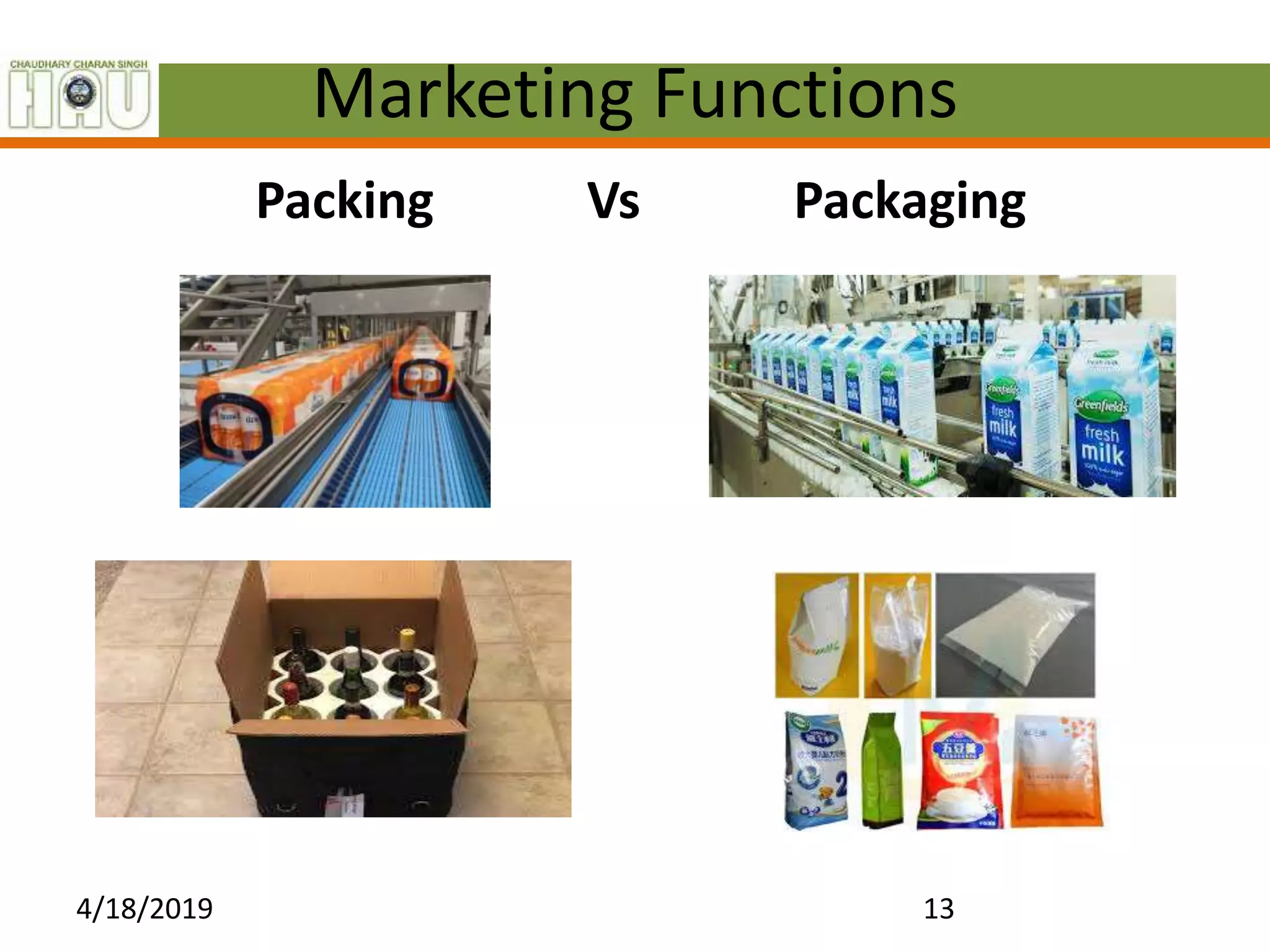
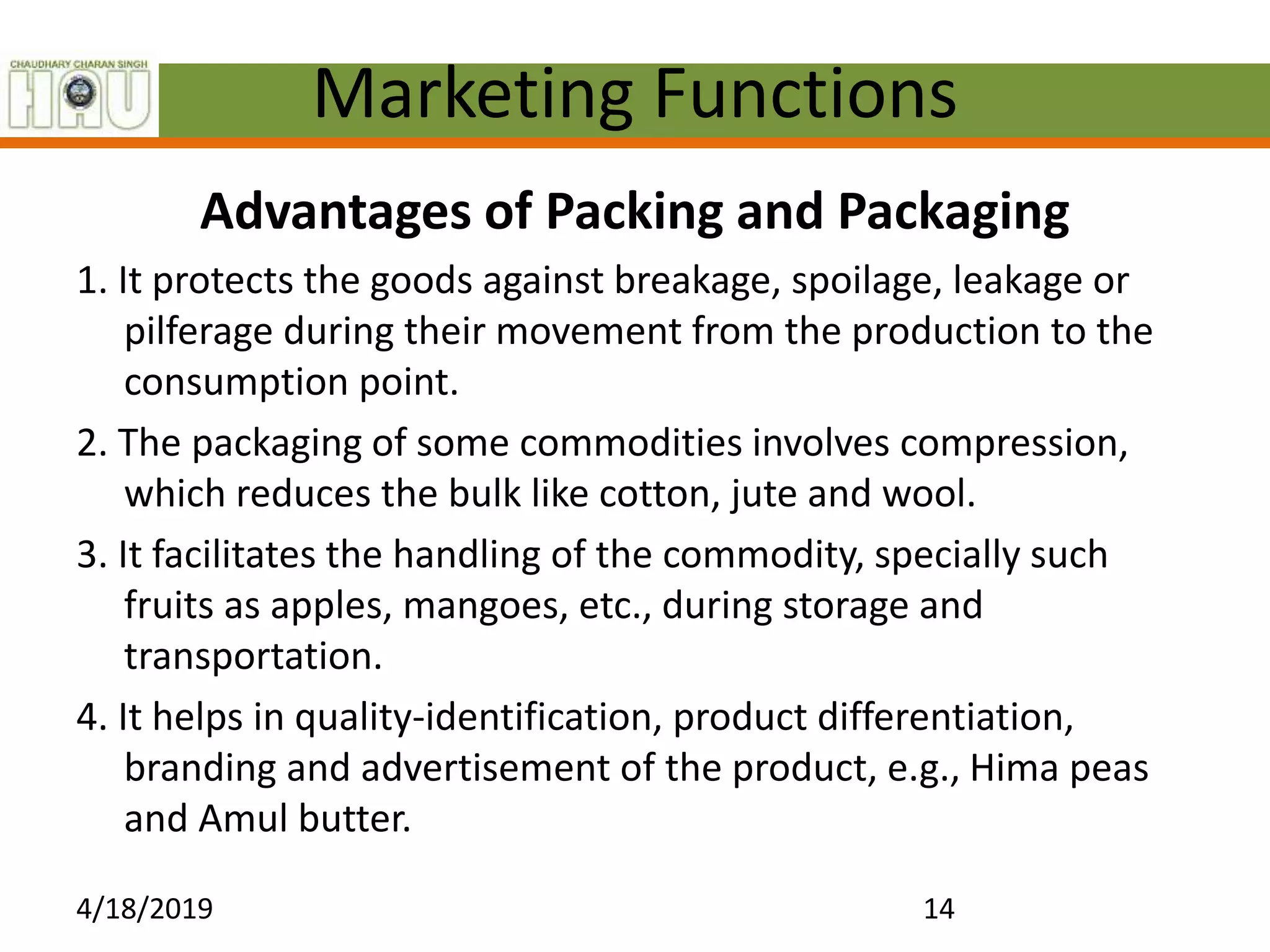
• Packing means, the wrapping and crating of
goods before they are transported.
• Packaging is a part of packing, which means
placing the goods in small packages like bags,
boxes, bottles or parcels for sale to the
ultimate consumers..
4/18/2019 12
Marketing Functions
Packing Vs Packaging
4/18/2019 13
Marketing Functions
Advantages of Packing and Packaging
1. It protects the goods against breakage, spoilage, leakage or
pilferage during their movement from the production to the
consumption point.
2. The packaging of some commodities involves compression,
which reduces the bulk like cotton, jute and wool.
3. It facilitates the handling of the commodity, specially such
fruits as apples, mangoes, etc., during storage and
transportation.
4. It helps in quality-identification, product differentiation,
branding and advertisement of the product, e.g., Hima peas
and Amul butter.
4/18/2019 14
Marketing Functions
5. Packaging helps in reducing marketing costs by
reducing handling and retailing costs.
6. It helps in checking adulteration.
7. Packaging ensures cleanliness of the product
8. Packaging with labeling facilitates the conveying of
instructions to the buyers as to how to use or
preserve the commodity. The label shows the
composition of the product.
4/18/2019 15
Marketing Functions
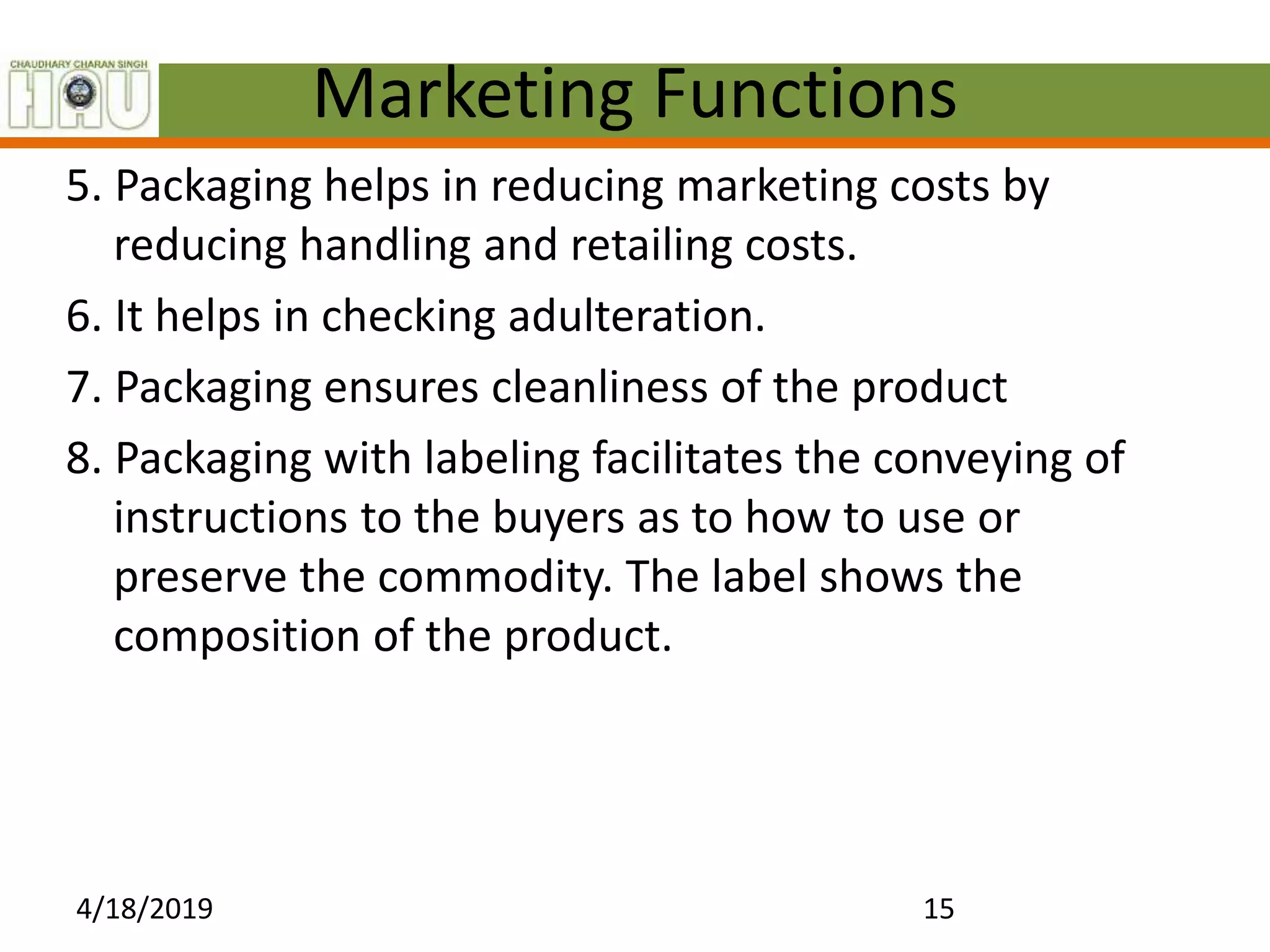
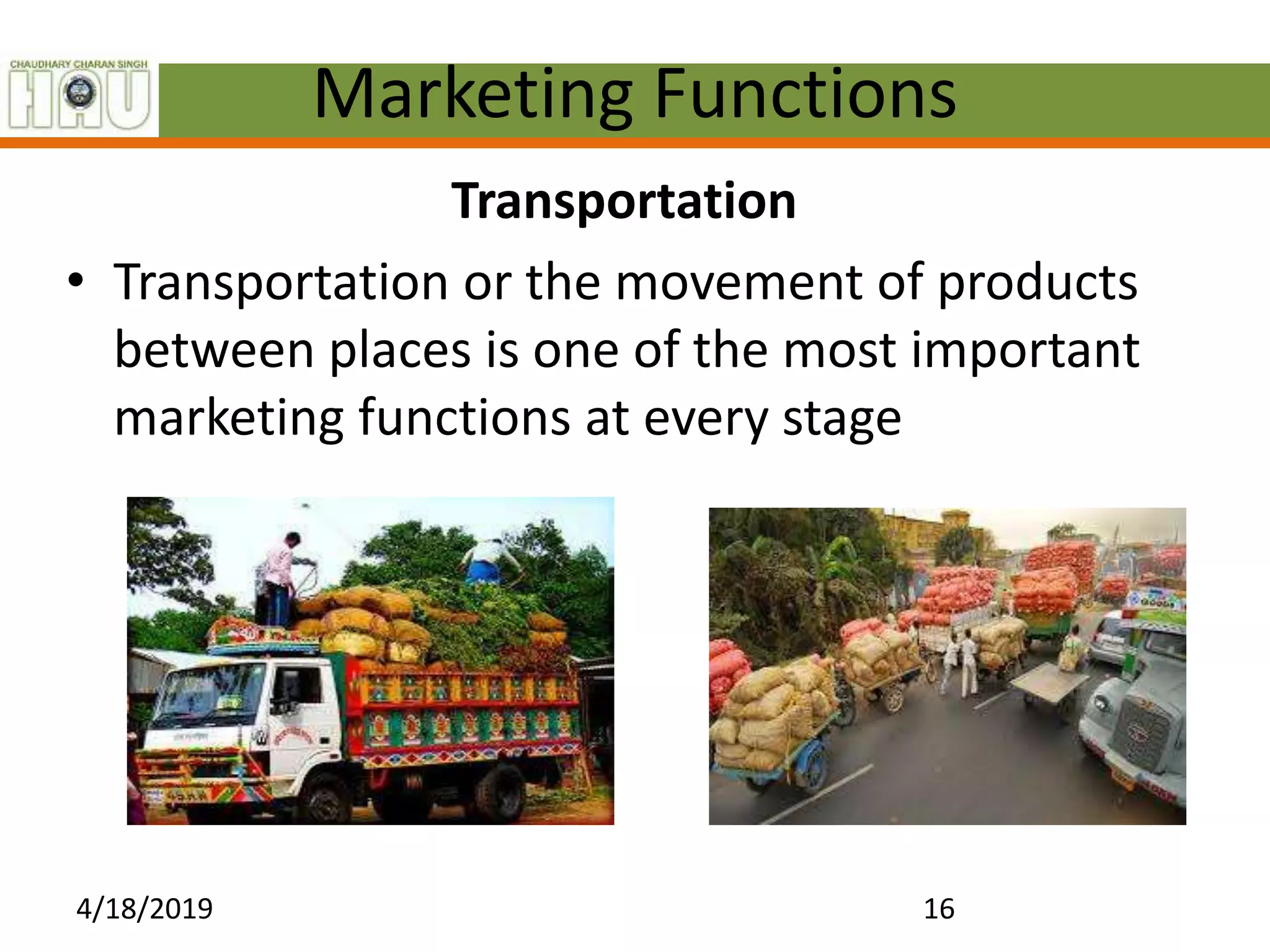
Transportation
• Transportation or the movement of products
between places is one of the most important
marketing functions at every stage
4/18/2019 16
Marketing Functions
Advantages of the Transport Function
1. Widening of the Market
2. Narrowing Price Difference Over Space
3. Creation of Employment
4. Facilitation of Specialized Farming
5. Transformation of the Economy
6. Mobility of the Factors of Production
4/18/2019 17
Marketing Functions
Factors affecting the cost of transportation
1. Distance
2. Quantity of the Product
3. Mode of Transportation
4. Condition of Road
5. Availability of Return Journey consignment
6. Risk Associated: Problems in Transportation of
Agricultural Commodities
4/18/2019 18
Factors affecting the cost of transportation
7. Nature of Products:
a) Perishability (e.g., Vegetables);
b) Bulkinesss (e.g., straw);
c) Fragility (e.g. tomatoes);
d) Inflammability (e.g., Petrol);
e) Requirement of a special type of facility (i.e,
for livestock and milk).
4/18/2019 19
Marketing Functions
Grading and standardization
• Standardization means the determination of
the standards to be established for different
commodities.
• Standards are established on the basis of
certain characteristics-such as weight, size,
colour, appearance, texture, moisture content,
staple length, amount of foreign matter,
ripeness, sweetness, taste, chemical content,
etc.
4/18/2019 20
Marketing Functions
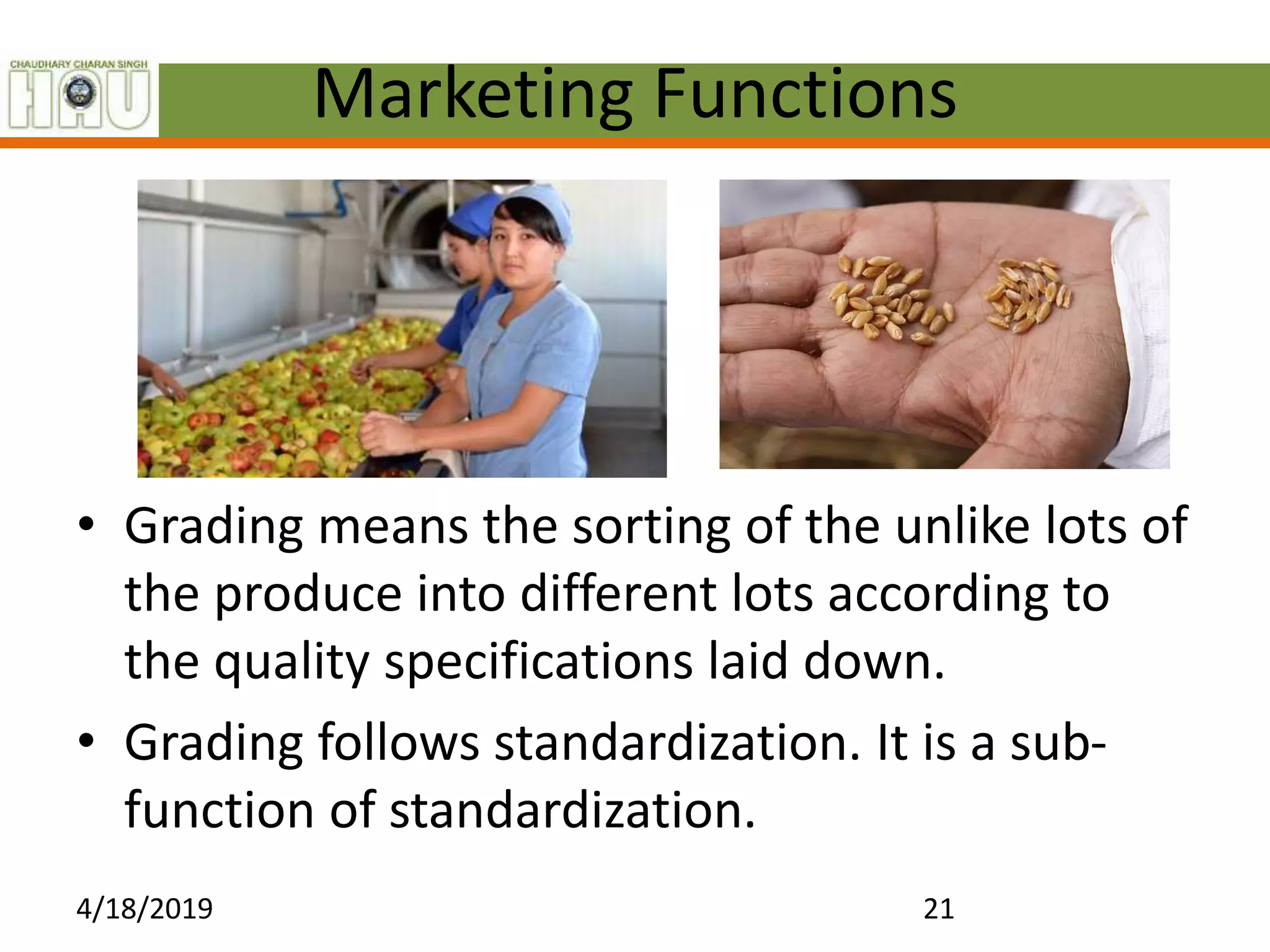
• Grading means the sorting of the unlike lots of
the produce into different lots according to
the quality specifications laid down.
• Grading follows standardization. It is a sub-
function of standardization.
4/18/2019 21
Types of Grading
1. Fixed Grading / Mandatory Grading:
This means sorting out of goods according to the size, quality
and other characteristics which are of fixed standards. These
do not vary over time and space.
2. Permissive / Variable Grading:
The goods are graded under this method according to
standards, which vary over time. In India, grading by this
method is not permissible.
4/18/2019 22
Types of Grading
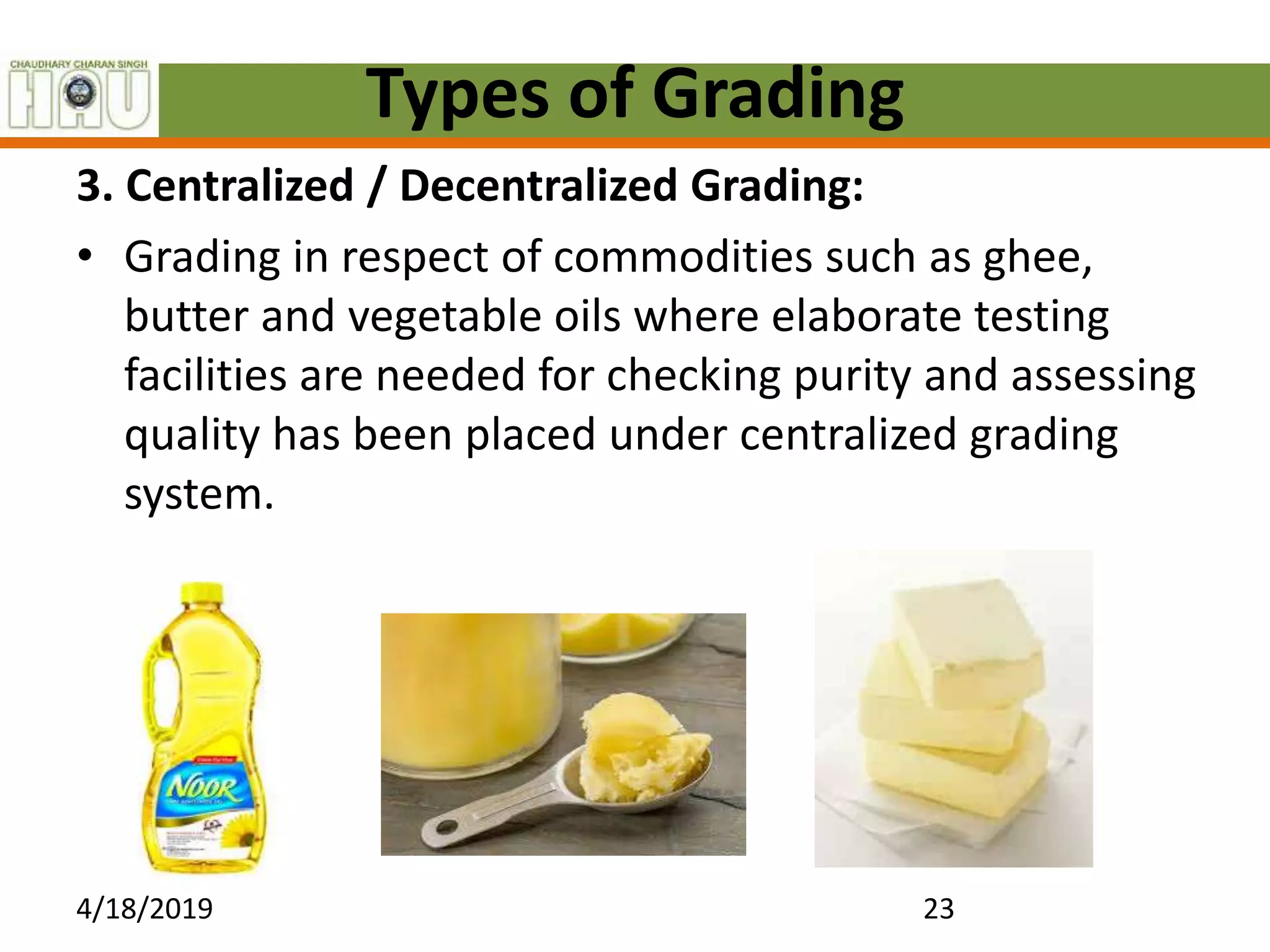
3. Centralized / Decentralized Grading:
• Grading in respect of commodities such as ghee,
butter and vegetable oils where elaborate testing
facilities are needed for checking purity and assessing
quality has been placed under centralized grading
system.
4/18/2019 23
Types of Grading
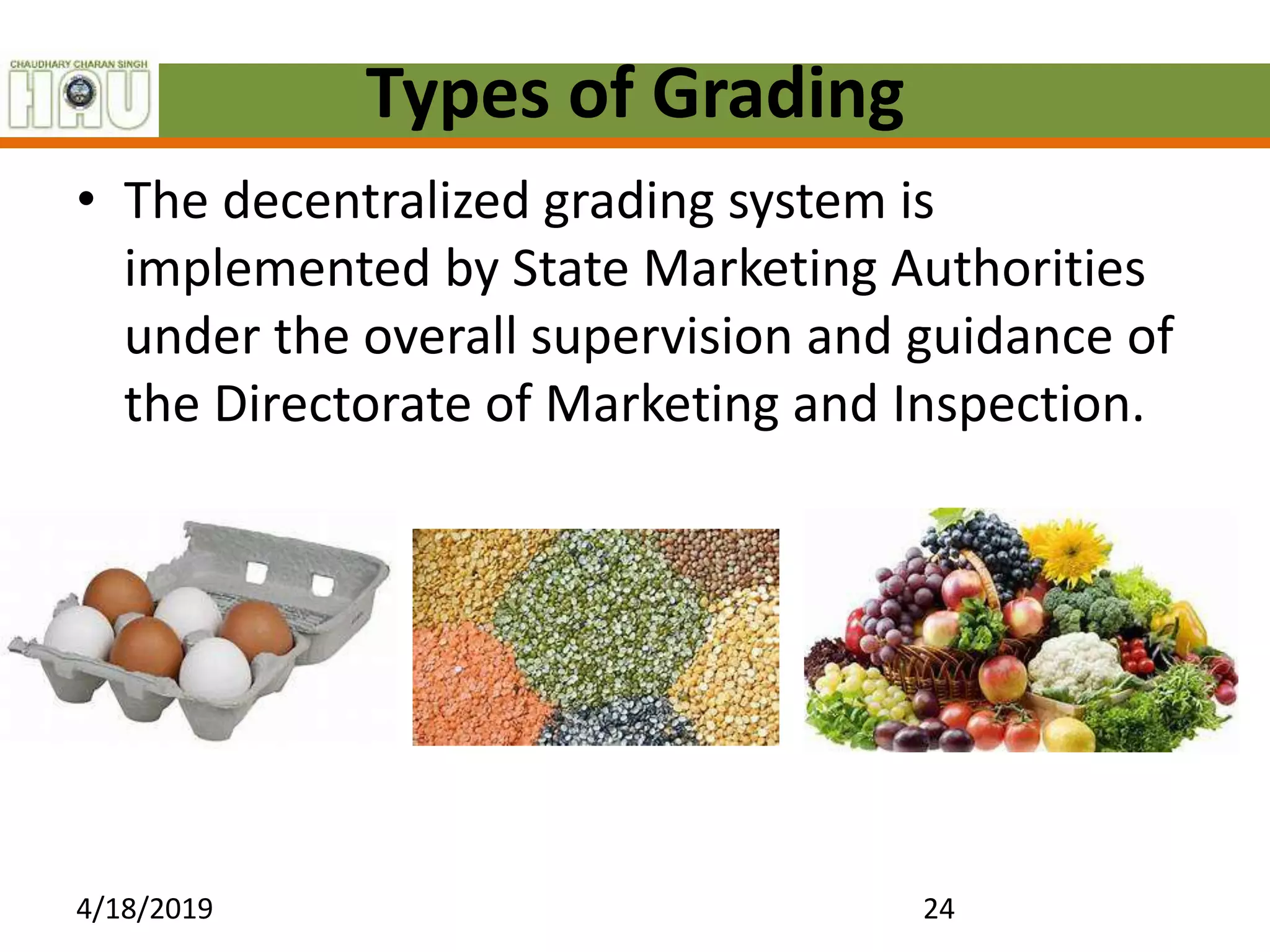
• The decentralized grading system is
implemented by State Marketing Authorities
under the overall supervision and guidance of
the Directorate of Marketing and Inspection.
4/18/2019 24
Marketing Functions
Advantages of Grading
1. Grading before sale enables farmers to get a higher
price for their produce.
2. widens the market for the product.
3. reduces the cost of marketing.
4. eliminating the cost of handling and weighing at ever
stage.
5. Grading helps consumers to get standard quality
products at fair prices.
6.Grading contributes to market competition and
pricing efficiency
4/18/2019 25
Marketing Functions
STORAGE
Holding and preserving goods from the time they are produced untill
they are needed for consumption.
Advantages:-
• ensures a continuous flow of goods in the market;
• protects the quality of perishable and semi – perishable products
from deterioration;
• stabilization of prices by adjusting demand and supply
• Storage provides employment and income through price
advantages
• necessary either for their ripening (e.g., banana, mango, etc.)
4/18/2019 26
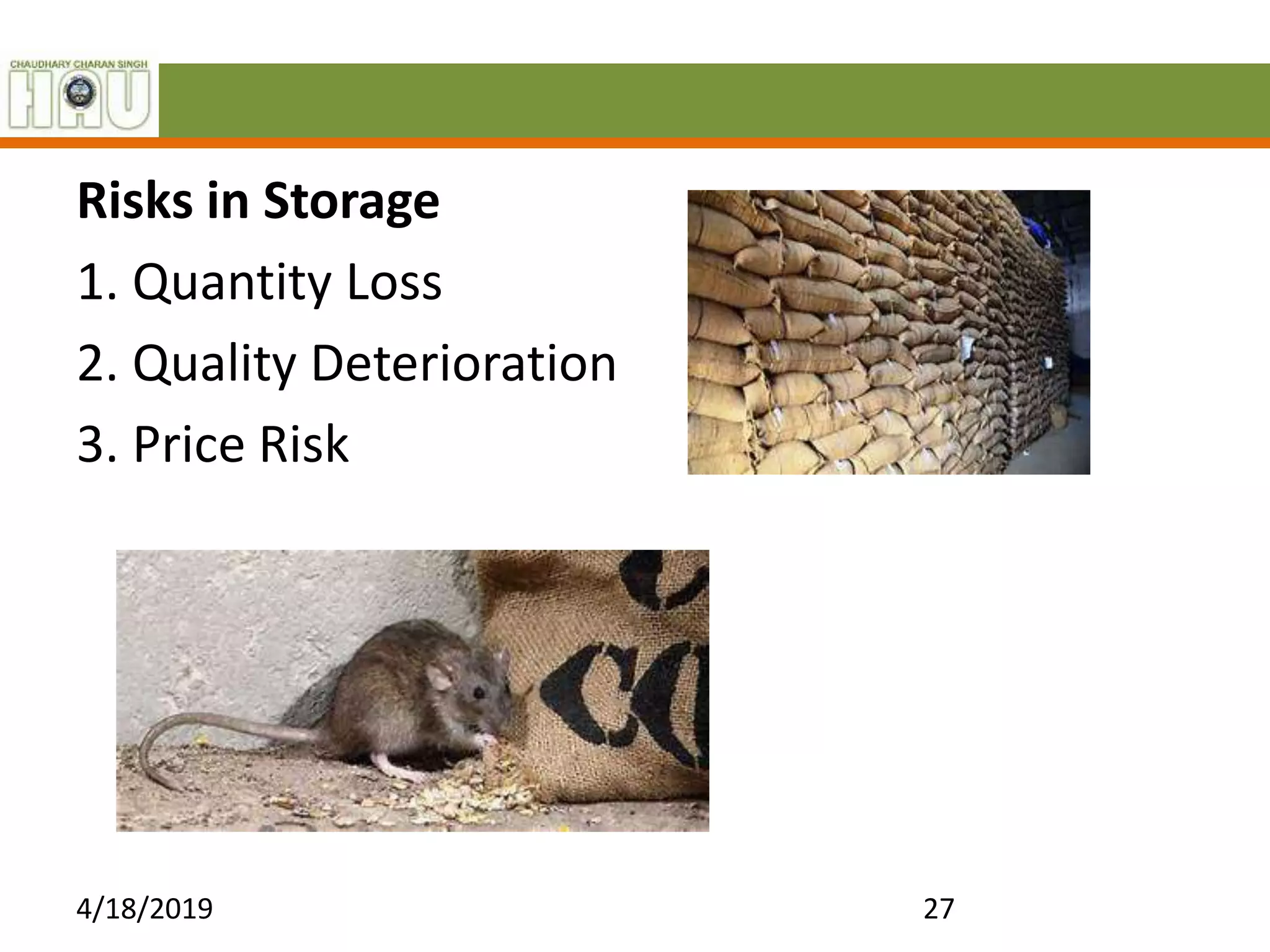
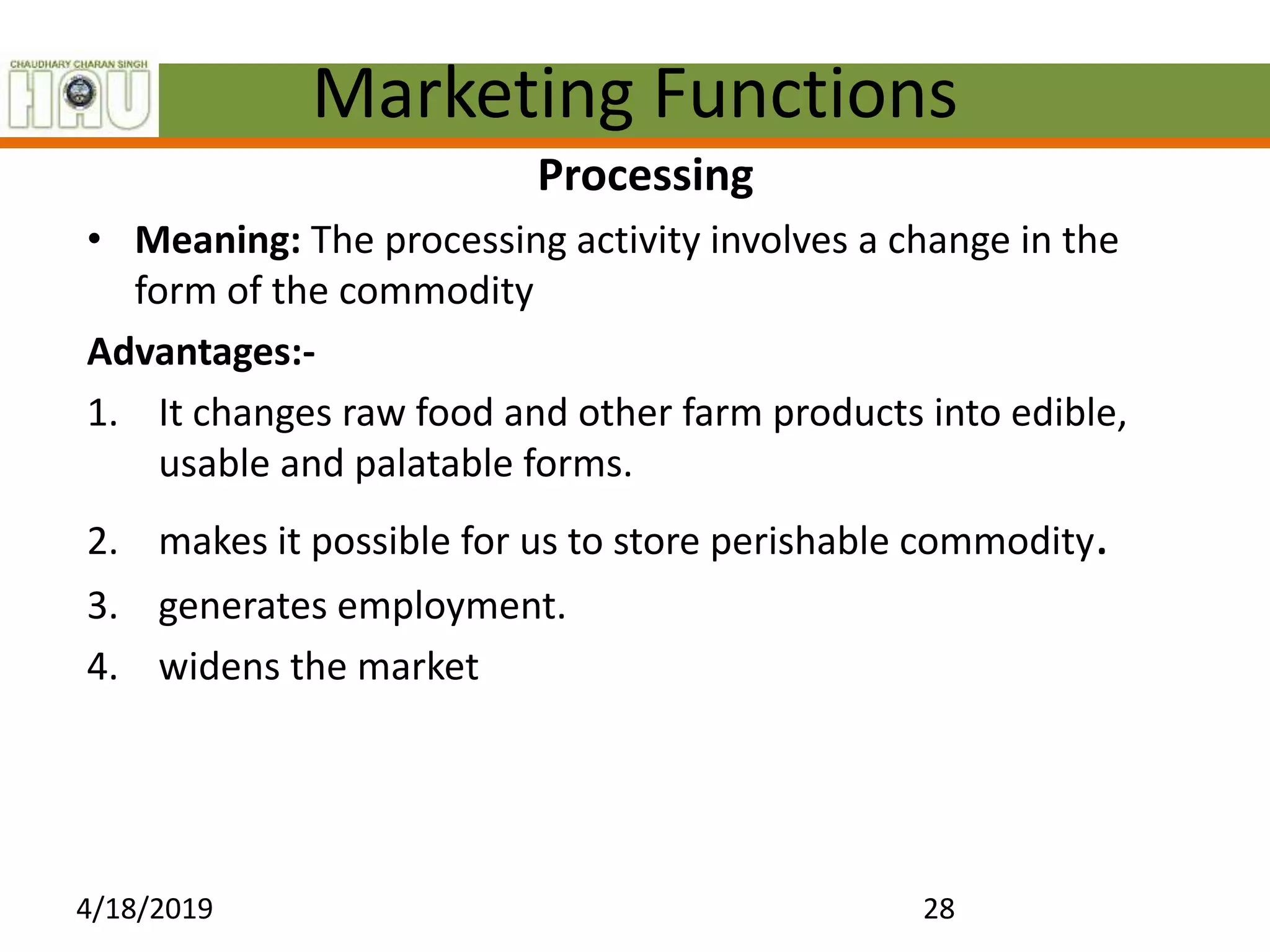
Risks in Storage
1. Quantity Loss
2. Quality Deterioration
3. Price Risk
4/18/2019 27
Marketing Functions
Processing
• Meaning: The processing activity involves a change in the
form of the commodity
Advantages:-
1. It changes raw food and other farm products into edible,
usable and palatable forms.
2. makes it possible for us to store perishable commodity.
3. generates employment.
4. widens the market
4/18/2019 28
Processing
4/18/2019 29
Marketing Functions
Buying and Selling
Meaning: buyers and sellers come together, goods are transferred
from seller to buyer, and the possession utility is added to the
commodities.
Methods:-
(i) Under Cover of a Cloth (Hatha System)
(ii) Private Negotiations
(iii) Quotations on Samples taken by Commission Agent
(iv) Dara Sale Method
(v) Moghum Sale Method
(vi) Open Auction Method
(vii)Close Tender System
4/18/2019 30
Marketing Functions
Market information
• Meaning : reception of knowledge or intelligence
Types of Market Information:-
• a) Market Intelligence:-information relating to such
facts that prevailed in the past
• b) Market News:-refers to current information about
prices, arrivals and changes in market conditions
Criteria for Good Market Information:-
a) Comprehensive b) Accuracy c) Relevance d)
b) Confidentiality e) Trustworthiness f) Equal and Easy
c) Accessibility g) Timeliness
4/18/2019 31
Marketing Functions
Financing
• The financing function of marketing involves the use of capital to
meet the financial requirements of the agencies engaged in
various marketing activities
Factors affecting Capital Requirements of an Agricultural Marketing
Firm:-
• Nature and Volume of Business
• Continuity of Business during Various Seasons
• Terms of Payment for Purchase and Sale
• Fluctuations in Prices
• Risk-taking Capacity
• General Conditions in the Economy
4/18/2019 32
SYMBOL OF TRUST

Marketing Functions

  • 1.
    SUBMITED TO: DR. DalipKumar SUBMITED BY: ASHISH (2015A14BVI)
  • 2.
    Marketing • Marketing:-Comprises ofa series of activities involved in moving the goods from the point of production to the point of consumption. 4/18/2019 2
  • 3.
    Marketing • It includesall the activities involved in the creation of utilities:- STORAGE Creates Time Utility 4/18/2019 3
  • 4.
  • 5.
  • 6.
    Marketing BUYING AND SELLING CreatePossession Utility 4/18/2019 6
  • 7.
    Marketing Functions Marketing Functions:-Any single activity performed in carrying a product from the point of its production to the ultimate consumer may be termed as a marketing function e.g., • Packing or Packaging • Transportation • Grading, Standardization • Storage • Financing • Buying and Selling 4/18/2019 7
  • 8.
    Classification of MarketingFunctions By Thomsen:- 1. Primary Functions : • Assembling or procurement • Processing • Dispersion or Distribution 2. Secondary Functions : • Packing or Packaging • Transportation • Grading, Standardization and Quality Control • Storage and Warehousing • Price Determination or Discovery 4/18/2019 8
  • 9.
    Classification of MarketingFunctions • Risk Taking • Financing • Buying and Selling • Demand Creation • Dissemination of Market Information 3. Tertiary Functions : • Banking • Insurance • Communications – posts & • Telegraphs • Supply of Energy – Electricity 4/18/2019 9
  • 10.
    Classification of MarketingFunctions By Kohls and Uhl:- 1. Physical Functions : • Storage and Warehousing • Grading • Processing • Transportation 2. Exchange Functions : • Buying • Selling 4/18/2019 10
  • 11.
    Classification of MarketingFunctions 3. Facilitative Functions : • Standardization of grades • Financing • Risk Taking • Dissemination of Market • Information 4/18/2019 11
  • 12.
    Marketing Functions Packing andPackaging • Packing means, the wrapping and crating of goods before they are transported. • Packaging is a part of packing, which means placing the goods in small packages like bags, boxes, bottles or parcels for sale to the ultimate consumers.. 4/18/2019 12
  • 13.
    Marketing Functions Packing VsPackaging 4/18/2019 13
  • 14.
    Marketing Functions Advantages ofPacking and Packaging 1. It protects the goods against breakage, spoilage, leakage or pilferage during their movement from the production to the consumption point. 2. The packaging of some commodities involves compression, which reduces the bulk like cotton, jute and wool. 3. It facilitates the handling of the commodity, specially such fruits as apples, mangoes, etc., during storage and transportation. 4. It helps in quality-identification, product differentiation, branding and advertisement of the product, e.g., Hima peas and Amul butter. 4/18/2019 14
  • 15.
    Marketing Functions 5. Packaginghelps in reducing marketing costs by reducing handling and retailing costs. 6. It helps in checking adulteration. 7. Packaging ensures cleanliness of the product 8. Packaging with labeling facilitates the conveying of instructions to the buyers as to how to use or preserve the commodity. The label shows the composition of the product. 4/18/2019 15
  • 16.
    Marketing Functions Transportation • Transportationor the movement of products between places is one of the most important marketing functions at every stage 4/18/2019 16
  • 17.
    Marketing Functions Advantages ofthe Transport Function 1. Widening of the Market 2. Narrowing Price Difference Over Space 3. Creation of Employment 4. Facilitation of Specialized Farming 5. Transformation of the Economy 6. Mobility of the Factors of Production 4/18/2019 17
  • 18.
    Marketing Functions Factors affectingthe cost of transportation 1. Distance 2. Quantity of the Product 3. Mode of Transportation 4. Condition of Road 5. Availability of Return Journey consignment 6. Risk Associated: Problems in Transportation of Agricultural Commodities 4/18/2019 18
  • 19.
    Factors affecting thecost of transportation 7. Nature of Products: a) Perishability (e.g., Vegetables); b) Bulkinesss (e.g., straw); c) Fragility (e.g. tomatoes); d) Inflammability (e.g., Petrol); e) Requirement of a special type of facility (i.e, for livestock and milk). 4/18/2019 19
  • 20.
    Marketing Functions Grading andstandardization • Standardization means the determination of the standards to be established for different commodities. • Standards are established on the basis of certain characteristics-such as weight, size, colour, appearance, texture, moisture content, staple length, amount of foreign matter, ripeness, sweetness, taste, chemical content, etc. 4/18/2019 20
  • 21.
    Marketing Functions • Gradingmeans the sorting of the unlike lots of the produce into different lots according to the quality specifications laid down. • Grading follows standardization. It is a sub- function of standardization. 4/18/2019 21
  • 22.
    Types of Grading 1.Fixed Grading / Mandatory Grading: This means sorting out of goods according to the size, quality and other characteristics which are of fixed standards. These do not vary over time and space. 2. Permissive / Variable Grading: The goods are graded under this method according to standards, which vary over time. In India, grading by this method is not permissible. 4/18/2019 22
  • 23.
    Types of Grading 3.Centralized / Decentralized Grading: • Grading in respect of commodities such as ghee, butter and vegetable oils where elaborate testing facilities are needed for checking purity and assessing quality has been placed under centralized grading system. 4/18/2019 23
  • 24.
    Types of Grading •The decentralized grading system is implemented by State Marketing Authorities under the overall supervision and guidance of the Directorate of Marketing and Inspection. 4/18/2019 24
  • 25.
    Marketing Functions Advantages ofGrading 1. Grading before sale enables farmers to get a higher price for their produce. 2. widens the market for the product. 3. reduces the cost of marketing. 4. eliminating the cost of handling and weighing at ever stage. 5. Grading helps consumers to get standard quality products at fair prices. 6.Grading contributes to market competition and pricing efficiency 4/18/2019 25
  • 26.
    Marketing Functions STORAGE Holding andpreserving goods from the time they are produced untill they are needed for consumption. Advantages:- • ensures a continuous flow of goods in the market; • protects the quality of perishable and semi – perishable products from deterioration; • stabilization of prices by adjusting demand and supply • Storage provides employment and income through price advantages • necessary either for their ripening (e.g., banana, mango, etc.) 4/18/2019 26
  • 27.
    Risks in Storage 1.Quantity Loss 2. Quality Deterioration 3. Price Risk 4/18/2019 27
  • 28.
    Marketing Functions Processing • Meaning:The processing activity involves a change in the form of the commodity Advantages:- 1. It changes raw food and other farm products into edible, usable and palatable forms. 2. makes it possible for us to store perishable commodity. 3. generates employment. 4. widens the market 4/18/2019 28
  • 29.
  • 30.
    Marketing Functions Buying andSelling Meaning: buyers and sellers come together, goods are transferred from seller to buyer, and the possession utility is added to the commodities. Methods:- (i) Under Cover of a Cloth (Hatha System) (ii) Private Negotiations (iii) Quotations on Samples taken by Commission Agent (iv) Dara Sale Method (v) Moghum Sale Method (vi) Open Auction Method (vii)Close Tender System 4/18/2019 30
  • 31.
    Marketing Functions Market information •Meaning : reception of knowledge or intelligence Types of Market Information:- • a) Market Intelligence:-information relating to such facts that prevailed in the past • b) Market News:-refers to current information about prices, arrivals and changes in market conditions Criteria for Good Market Information:- a) Comprehensive b) Accuracy c) Relevance d) b) Confidentiality e) Trustworthiness f) Equal and Easy c) Accessibility g) Timeliness 4/18/2019 31
  • 32.
    Marketing Functions Financing • Thefinancing function of marketing involves the use of capital to meet the financial requirements of the agencies engaged in various marketing activities Factors affecting Capital Requirements of an Agricultural Marketing Firm:- • Nature and Volume of Business • Continuity of Business during Various Seasons • Terms of Payment for Purchase and Sale • Fluctuations in Prices • Risk-taking Capacity • General Conditions in the Economy 4/18/2019 32
  • 33.