Marketing
Management
Thursday, October 1, 2020 1
B
M
2
0
5
Thursday, October 1, 2020 2
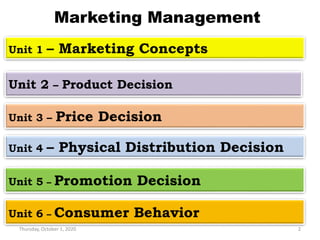
Marketing Management
Unit 1 – Marketing Concepts
Unit 4 – Physical Distribution Decision
Unit 2 – Product Decision
Unit 3 – Price Decision
Unit 5 – Promotion Decision
Unit 6 – Consumer Behavior
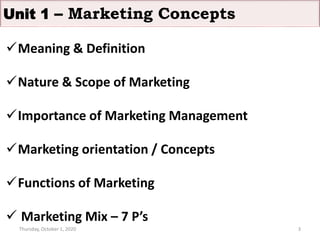
Meaning & Definition
Nature & Scope of Marketing
Importance of Marketing Management
Marketing orientation / Concepts
Functions of Marketing
 Marketing Mix – 7 P’s
Thursday, October 1, 2020 3
Unit 1 – Marketing Concepts
Thursday, October 1, 2020 4
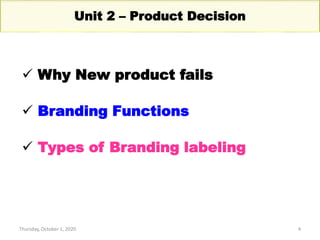
Unit 2 – Product Decision
 Why New product fails
 Branding Functions
 Types of Branding labeling
Thursday, October 1, 2020 5
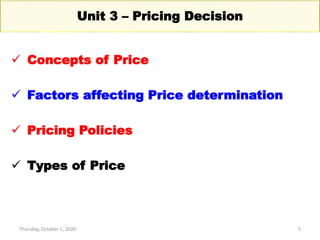
Unit 3 – Pricing Decision
 Concepts of Price
 Factors affecting Price determination
 Pricing Policies
 Types of Price
Thursday, October 1, 2020 6
Unit 4 – Physical Distribution Decision
 Meaning
 Functions & Types of Channels of
Distribution
 Channel Intermediaries
 Channel Management Decisions
 Retailing & Wholesaling
Thursday, October 1, 2020 7
Unit 5 – Promotion Decision
 Concepts of Promotion
 Promotion Mix
1. Advertising
2. Types of Advertising
3. Personal Selling
4. Sales Promotion & its types
5. Publicity
6. Public relations
Thursday, October 1, 2020 8
Unit 6 – Consumer Behavior
 Concepts
 Factors influencing in Consumer Buying Behavior
AIDAS formula in consumer adoption process
In this era of competition,
understanding the consumer is
a necessity for marketers.
9
Consumer Market
Consists of all the individuals
and households who buy or
acquire goods & services for
personal consumption.
10
Thursday, October 1, 2020 11
1.Consumer behavior or Buyer behavior is
The study of consumers &
how they make decisions, &
it includes factors that influence the
purchase and use of products.
– Understand consumers and their buying
behaviors is very important for the marketers.
– Implement the marketing concept.
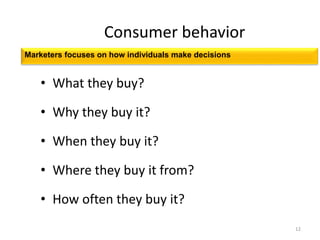
Consumer behavior
• What they buy?
• Why they buy it?
• When they buy it?
• Where they buy it from?
• How often they buy it?
Marketers focuses on how individuals make decisions
12
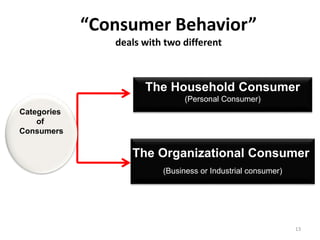
“Consumer Behavior”
deals with two different
The Household Consumer
(Personal Consumer)
The Organizational Consumer
(Business or Industrial consumer)
Categories
of
Consumers
13
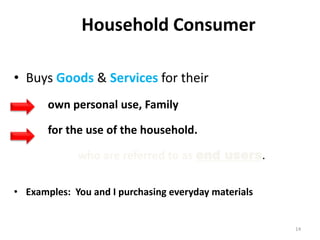
Household Consumer
• Buys Goods & Services for their
own personal use, Family
for the use of the household.
who are referred to as end users.
• Examples: You and I purchasing everyday materials
14
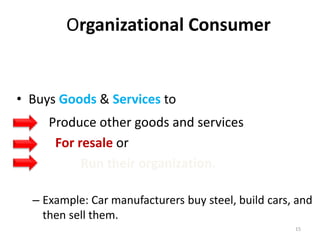
Organizational Consumer
• Buys Goods & Services to
Produce other goods and services
For resale or
Run their organization.
– Example: Car manufacturers buy steel, build cars, and
then sell them.
15
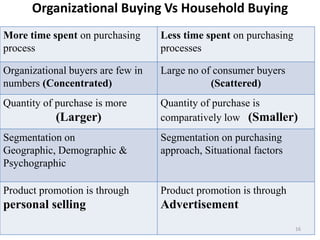
Organizational Buying Vs Household Buying
More time spent on purchasing
process
Less time spent on purchasing
processes
Organizational buyers are few in
numbers (Concentrated)
Large no of consumer buyers
(Scattered)
Quantity of purchase is more
(Larger)
Quantity of purchase is
comparatively low (Smaller)
Segmentation on
Geographic, Demographic &
Psychographic
Segmentation on purchasing
approach, Situational factors
Product promotion is through
personal selling
Product promotion is through
Advertisement
16
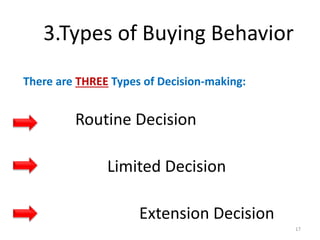
3.Types of Buying Behavior
There are THREE Types of Decision-making:
Routine Decision
Limited Decision
Extension Decision
17
Types of Buying Behavior
• Routine Decision:
Purchases are made frequently and do not
require much thought.
– Examples? chewing gum, newspaper
– In business companies usually use the same supplier for
all routine purchases
(ex. office supplies).18
Types of Buying Behavior
• Limited Decision:
Limited decision-making takes more time than routine decision-making.
This usually involves more expensive purchases or less
frequent purchases.
– More expensive, less frequent purchases
• Pair of jeans
– Businesses can use this for purchases of office
equipment or furniture etc…
19
Types of Buying Behavior
• Extension Decision:
• Happens when the consumer methodically goes
through the decision-making process.
– Usually for Expensive purchases (Car, Home)
– Consumers take time to come to the correct
conclusion.
– In business this could take place when purchasing a
company vehicle. 20
4. Factors Influencing
Consumer Behavior
1. Cultural Factor
2. Social Factor
3. Personal Factor
4. Psychological Factor
21
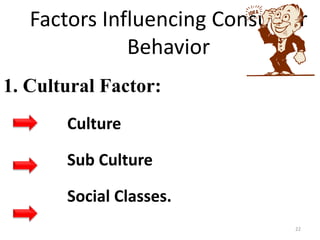
Factors Influencing Consumer
Behavior
1. Cultural Factor:
Culture
Sub Culture
Social Classes.
22
Factors Influencing Consumer Behavior
Culture
Person grows up in society, he learns a basic set
of values, preferences & behavior by a
Member of society,
Family & Institutions.
23
Factors Influencing Consumer
Behavior
• Sub Culture
Nationality groups,
Religious groups,
Tribal groups,
Geographical areas
24
Distinct
characteristics
of life style
Factors Influencing Consumer Behavior
Social Classes.
Like Upper class,
Middle class,
Lower class.
Occupation,
Income,
Education etc
25
Factors Influencing Consumer
Behavior
2. Social Factor
i) Groups
ii) Family
iii) Roles and status
26
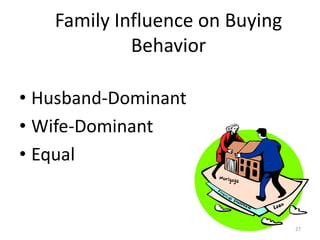
Family Influence on Buying
Behavior
• Husband-Dominant
• Wife-Dominant
• Equal
27
Factors Influencing Consumer
Behavior
3. Personal Factor
i) Age and life cycle stage
ii) Occupation
iii) Economic situation
IV) Life Style Activities (Work, hobbies, shopping, etc)
Interest (Food, fashion, family recreation) and
Opinions (about themselves, Business, Products)
V) Personality. Extroversion – Introversion
Self-confidence, Dominance, sociability, Aggressiveness 28
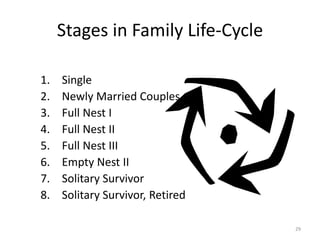
Stages in Family Life-Cycle
1. Single
2. Newly Married Couples
3. Full Nest I
4. Full Nest II
5. Full Nest III
6. Empty Nest II
7. Solitary Survivor
8. Solitary Survivor, Retired
29
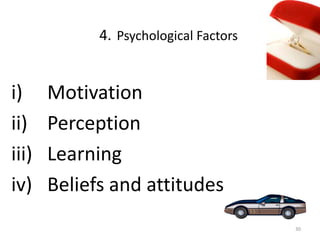
4. Psychological Factors
i) Motivation
ii) Perception
iii) Learning
iv) Beliefs and attitudes
30
Psychological Factors
Motivation:
–Maslow
• Hierarchy of Needs
31
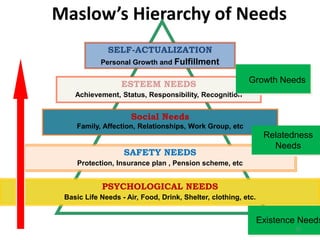
Maslow’s Hierarchy of Needs
PSYCHOLOGICAL NEEDS
Basic Life Needs - Air, Food, Drink, Shelter, clothing, etc.
SAFETY NEEDS
Protection, Insurance plan , Pension scheme, etc
ESTEEM NEEDS
Achievement, Status, Responsibility, Recognition
SELF-ACTUALIZATION
Personal Growth and Fulfillment
Social Needs
Family, Affection, Relationships, Work Group, etc
Existence Needs
Relatedness
Needs
Growth Needs
32
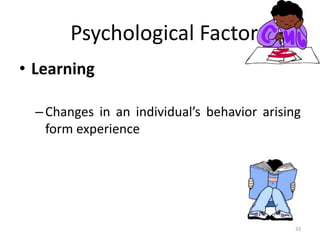
Psychological Factors
• Learning
–Changes in an individual’s behavior arising
form experience
33
Psychological Factors
• Learning
–Changes in an individual’s behavior arising
form experience
34
Psychological Factors
• Beliefs
– Descriptive thoughts that a person holds about
something
35
Psychological Factors
• Attitudes
– Enduring favorable or unfavorable cognitive
evaluations emotional feelings and action tendencies
36
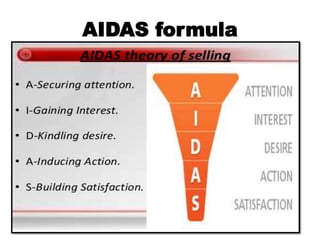
AIDAS formula
Thursday, October 1, 2020 37
AIDAS formula
Thursday, October 1, 2020 38
A – Attention (awareness):
Attract the attention of the customer towards the
message in the content. The first
step towards any piece of content is to capture
attention. Content Creators start with a concept
deeply relevant and timely to the audience. The
content solves a problem, explains a solution or
simply generates expectation.
I – Interest:
Interest of the customer with a relevant copy.
Once the attention is grabbed, the content should
provide the consumer with Value, in a way that
the user can understand and empathize.
AIDAS formula
Thursday, October 1, 2020 39
D – Desire:
Convince customers, with the content,
that they want and desire the product or
service in discussion to satisfy their
needs. In this step, the customer knows
what he needs, and probably is evaluating
different options.
A – Action:
Lead customers towards taking action.
Once the content generated desire, it
must provide means to quickly convert the
consumer.
Thursday, October 1, 2020 40

Unit 6 consumer behavior

  • 1.
  • 2.
    Thursday, October 1,2020 2 Marketing Management Unit 1 – Marketing Concepts Unit 4 – Physical Distribution Decision Unit 2 – Product Decision Unit 3 – Price Decision Unit 5 – Promotion Decision Unit 6 – Consumer Behavior
  • 3.
    Meaning & Definition Nature& Scope of Marketing Importance of Marketing Management Marketing orientation / Concepts Functions of Marketing  Marketing Mix – 7 P’s Thursday, October 1, 2020 3 Unit 1 – Marketing Concepts
  • 4.
    Thursday, October 1,2020 4 Unit 2 – Product Decision  Why New product fails  Branding Functions  Types of Branding labeling
  • 5.
    Thursday, October 1,2020 5 Unit 3 – Pricing Decision  Concepts of Price  Factors affecting Price determination  Pricing Policies  Types of Price
  • 6.
    Thursday, October 1,2020 6 Unit 4 – Physical Distribution Decision  Meaning  Functions & Types of Channels of Distribution  Channel Intermediaries  Channel Management Decisions  Retailing & Wholesaling
  • 7.
    Thursday, October 1,2020 7 Unit 5 – Promotion Decision  Concepts of Promotion  Promotion Mix 1. Advertising 2. Types of Advertising 3. Personal Selling 4. Sales Promotion & its types 5. Publicity 6. Public relations
  • 8.
    Thursday, October 1,2020 8 Unit 6 – Consumer Behavior  Concepts  Factors influencing in Consumer Buying Behavior AIDAS formula in consumer adoption process
  • 9.
    In this eraof competition, understanding the consumer is a necessity for marketers. 9
  • 10.
    Consumer Market Consists ofall the individuals and households who buy or acquire goods & services for personal consumption. 10
  • 11.
    Thursday, October 1,2020 11 1.Consumer behavior or Buyer behavior is The study of consumers & how they make decisions, & it includes factors that influence the purchase and use of products. – Understand consumers and their buying behaviors is very important for the marketers. – Implement the marketing concept.
  • 12.
    Consumer behavior • Whatthey buy? • Why they buy it? • When they buy it? • Where they buy it from? • How often they buy it? Marketers focuses on how individuals make decisions 12
  • 13.
    “Consumer Behavior” deals withtwo different The Household Consumer (Personal Consumer) The Organizational Consumer (Business or Industrial consumer) Categories of Consumers 13
  • 14.
    Household Consumer • BuysGoods & Services for their own personal use, Family for the use of the household. who are referred to as end users. • Examples: You and I purchasing everyday materials 14
  • 15.
    Organizational Consumer • BuysGoods & Services to Produce other goods and services For resale or Run their organization. – Example: Car manufacturers buy steel, build cars, and then sell them. 15
  • 16.
    Organizational Buying VsHousehold Buying More time spent on purchasing process Less time spent on purchasing processes Organizational buyers are few in numbers (Concentrated) Large no of consumer buyers (Scattered) Quantity of purchase is more (Larger) Quantity of purchase is comparatively low (Smaller) Segmentation on Geographic, Demographic & Psychographic Segmentation on purchasing approach, Situational factors Product promotion is through personal selling Product promotion is through Advertisement 16
  • 17.
    3.Types of BuyingBehavior There are THREE Types of Decision-making: Routine Decision Limited Decision Extension Decision 17
  • 18.
    Types of BuyingBehavior • Routine Decision: Purchases are made frequently and do not require much thought. – Examples? chewing gum, newspaper – In business companies usually use the same supplier for all routine purchases (ex. office supplies).18
  • 19.
    Types of BuyingBehavior • Limited Decision: Limited decision-making takes more time than routine decision-making. This usually involves more expensive purchases or less frequent purchases. – More expensive, less frequent purchases • Pair of jeans – Businesses can use this for purchases of office equipment or furniture etc… 19
  • 20.
    Types of BuyingBehavior • Extension Decision: • Happens when the consumer methodically goes through the decision-making process. – Usually for Expensive purchases (Car, Home) – Consumers take time to come to the correct conclusion. – In business this could take place when purchasing a company vehicle. 20
  • 21.
    4. Factors Influencing ConsumerBehavior 1. Cultural Factor 2. Social Factor 3. Personal Factor 4. Psychological Factor 21
  • 22.
    Factors Influencing Consumer Behavior 1.Cultural Factor: Culture Sub Culture Social Classes. 22
  • 23.
    Factors Influencing ConsumerBehavior Culture Person grows up in society, he learns a basic set of values, preferences & behavior by a Member of society, Family & Institutions. 23
  • 24.
    Factors Influencing Consumer Behavior •Sub Culture Nationality groups, Religious groups, Tribal groups, Geographical areas 24 Distinct characteristics of life style
  • 25.
    Factors Influencing ConsumerBehavior Social Classes. Like Upper class, Middle class, Lower class. Occupation, Income, Education etc 25
  • 26.
    Factors Influencing Consumer Behavior 2.Social Factor i) Groups ii) Family iii) Roles and status 26
  • 27.
    Family Influence onBuying Behavior • Husband-Dominant • Wife-Dominant • Equal 27
  • 28.
    Factors Influencing Consumer Behavior 3.Personal Factor i) Age and life cycle stage ii) Occupation iii) Economic situation IV) Life Style Activities (Work, hobbies, shopping, etc) Interest (Food, fashion, family recreation) and Opinions (about themselves, Business, Products) V) Personality. Extroversion – Introversion Self-confidence, Dominance, sociability, Aggressiveness 28
  • 29.
    Stages in FamilyLife-Cycle 1. Single 2. Newly Married Couples 3. Full Nest I 4. Full Nest II 5. Full Nest III 6. Empty Nest II 7. Solitary Survivor 8. Solitary Survivor, Retired 29
  • 30.
    4. Psychological Factors i)Motivation ii) Perception iii) Learning iv) Beliefs and attitudes 30
  • 31.
  • 32.
    Maslow’s Hierarchy ofNeeds PSYCHOLOGICAL NEEDS Basic Life Needs - Air, Food, Drink, Shelter, clothing, etc. SAFETY NEEDS Protection, Insurance plan , Pension scheme, etc ESTEEM NEEDS Achievement, Status, Responsibility, Recognition SELF-ACTUALIZATION Personal Growth and Fulfillment Social Needs Family, Affection, Relationships, Work Group, etc Existence Needs Relatedness Needs Growth Needs 32
  • 33.
    Psychological Factors • Learning –Changesin an individual’s behavior arising form experience 33
  • 34.
    Psychological Factors • Learning –Changesin an individual’s behavior arising form experience 34
  • 35.
    Psychological Factors • Beliefs –Descriptive thoughts that a person holds about something 35
  • 36.
    Psychological Factors • Attitudes –Enduring favorable or unfavorable cognitive evaluations emotional feelings and action tendencies 36
  • 37.
  • 38.
    AIDAS formula Thursday, October1, 2020 38 A – Attention (awareness): Attract the attention of the customer towards the message in the content. The first step towards any piece of content is to capture attention. Content Creators start with a concept deeply relevant and timely to the audience. The content solves a problem, explains a solution or simply generates expectation. I – Interest: Interest of the customer with a relevant copy. Once the attention is grabbed, the content should provide the consumer with Value, in a way that the user can understand and empathize.
  • 39.
    AIDAS formula Thursday, October1, 2020 39 D – Desire: Convince customers, with the content, that they want and desire the product or service in discussion to satisfy their needs. In this step, the customer knows what he needs, and probably is evaluating different options. A – Action: Lead customers towards taking action. Once the content generated desire, it must provide means to quickly convert the consumer.
  • 40.